BBC Pop Up’s Report On Tripoli Is Shallow, Garbage, Full Of Generalizations, Horrible, and Horrifyingly Silly

I’m sick of Western journalist coming into the country with their preconceptions in place and then going out of their way to find the right people for them to make sure they propagate those exact beliefs back onto their core audience.

I haven’t been discussing BBC Pop Up’s reports much, mostly because I’ve found them to be just another regurgitation of a lot of previous reporting on the issues they’re tackling. But then the crew of BBC Pop Up decided to visit the capital of North Lebanon, Tripoli, against all advice – or so they’d make you believe after all the Beirutis they know told them it was dangerous and unvisitable.

But our brave, courageous crew decided to risk their lives – hilarious – and visit Tripoli. They probably didn’t know that the most dangerous thing that could happen to them in the city is an overdose on sugar and an increased risk of diabetes at Hallab, but you wouldn’t have known that based on that 16 minute report.

Instead, what you got was an “in-depth” – which is also basically the same vomit that we’ve been exposed to as Lebanese from the extremists that still plague the neighborhoods of Bab el Tebbaneh and Jabal Mohsen. The cause of the fighting was never discussed – because labeling as sectarian and having it remain at that is enough. The gut-wrenching poverty in those neighborhoods wasn’t even tackled, even when a man from Jabal Mohsen said – and I quote: “When I don’t have any money and then someone gives me $3000-4000, and asks me to fight. This is how they attract people.”

You’d think that statement, coupled with a previous one about how Ali – the man in question – was being paid 50,000LL to throw a grenade during the fighting between Bab el Tebbaneh and Jabal Mohsen, which has been over for about 3 years now, would prompt them to change direction of their reporting and delve deeper into the root of the city’s fighting.

Spoiler alert: it did not.

Not even when Ali agreed with the Sunni protestors who were the centerpiece of the report, with a protest calling on the government to free the jailed Islamists, a recurrent but ultimately fringe topic in the Lebanese political spectrum but one which made it onto a 16 minute report about an entire city, labeling it Islamist anyway, did the nature of the report change.

Even when Ali mentioned that a lot of those jailed people had nothing to do with the fighting and those who did were being manipulated by leaders higher up the echelons who are still free today, the report still did not veer from the goal it had set for itself the moment that random Beiruti told the British crew that Tripoli was unsafe: we are here to show that this place is different from Beirut, and that it is dangerous and that people here are extremists.

Extremism? Nice. Going to the poor areas of a city and labeling it all based on them? Amazing.

Delving into the cause of that “extremism” and poverty? Meh, who has time for that.

The magnum opus comes when they interview one man who’s asked about Shariah Law, before he says that everyone in the city wants that, somehow making his statement a valid proposition in the eye of the reporter. His rhetoric was not challenged, neither on the spot nor in a voice over that shows that not to be in the case in the other side of Tripoli, the majority, that BBC Pop Up did not try to cover because it doesn’t fit into what they’re trying to advance in the documentary.

The twist though is that that wasn’t what the man said, according to eye-witnesses who were there at that moment. What he said was: as a Muslim, I agree with the Shariah but this can never be applied in Lebanon where we have such diversity. This didn’t fit with what BBC wanted to portray so they cut his words and edited them the way they wanted.

The only saving grace is the brief mention of March, and the tremendous work that the organization is doing in Tripoli, with it bringing together both sides of the conflict and trying to change their perspective on how it is to live together. March has brought young people from both sides into a play that has toured Lebanon. They’ve also built a coffee shop that’s run by the people of the area, and they’ve renovated and fixed up the fighting-ravaged markets of the area into “Bab El Dahab,” without the help of any local politician, some of whom tried to take credit for the initiative.

For BBC Pop Up, Tripoli is Syria Street and the two factions that live on either side of it. The city of over half a million people is represented, in their eyes, by the tens of thousands who live in stinking poverty in those two neighborhoods, effectively making it okay for them to title a piece that would be broadcast to the world: Tripoli: Extremist City?

The title is horrible. The report is shallow as hell. The reporting is horrifyingly silly. The generalizations are ridiculous. The overall result is garbage. You’d think that an organization with their resources would actually have the decency to delve deeper into the conflict, but no luck. Instead, what we got was the same kind of report that Lebanese media used to do back when the fighting was still ongoing: no substance, no style, barely scraping the surface. Except this time the report is international, and not on a narrow Lebanese level for the parents of those who live in Beirut to forbid their children from going up North because “it’s dangerous.”

The fact of the matter is Tripoli is not dangerous. Not even those parts that the BBC reporter visited are dangerous: they’re just people who’ve been dealt a very bad hand at life trying to make the best of what was given to them and who are trying to find a new normal after their war. But that’s too mundane to be reported on I guess.

The fact of the matter is that beyond the narrow Syria Street is a city that’s trying to reclaim its position on the Lebanese level: with festivals, events trying to bring in people from other parts of the country, attempts at revamping its image, among other things. Of course, that’s not cool enough to be reported on because who needs another city trying to paint itself cosmopolitan in Lebanon when you can have a new Qandahar instead?

Lebanese Ministry of Culture Is Transferring The Roman Columns That Were Thrown Away To A Safe Location


Around 2 days after I wrote a very widely circulated post about the matter, which referenced a L’Orient Le Jour article on the issue, Lebanon’s Ministry of Culture decided to take notice of the 500 or so Roman Columns entrusted to its care, and it has begun transferring them to warehouses for safe keeping.

The actions of the Ministry of Culture were brought to my attention by SkyNews Arabia reporter Larissa Aoun who tweeted the above referenced picture from the site where the Roman Columns were thrown away when their warehouse was dismantled earlier this year.

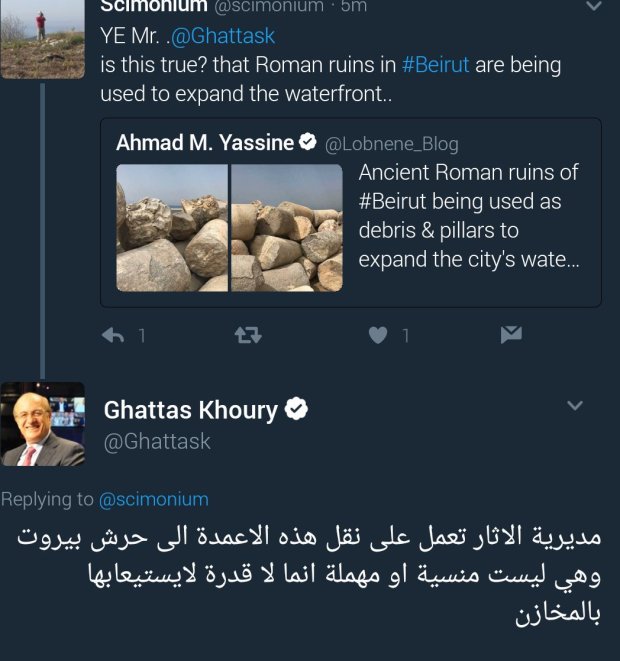
Minister of Culture Ghattas Khoury, on the other hand, is not happy that the issue got this much attention, especially with MP and head of Kataeb Samy Gemayel discussed the issue in a Facebook live video, which you can view here:

In a statement from the site where the Ministry of Culture was doing its job, Minister Khoury issued the following statement:

The statement’s essence translates to: “we’re here to assert that the columns here are under the care of the Ministry of Culture. I had said on Twitter that we were monitoring the columns and would transfer them to Horsh Beirut soon.”

Of course, the definition of “soon” in Lebanese politics and governance would’ve been months if not longer, hadn’t the issue gained the traction that it did, forcing the Ministry to save face by acting on the issue as promptly as it did, and transferring the columns – especially those with inscriptions and other decorations – for safe keeping.

As I mentioned previously, the columns were supposed to be transported to different locations across Beirut to make Jbeil-esque entrances or streets in the city, but such plans were changed for reasons that have not been detailed.

The columns, according to Minister Ghattas Khoury, are now set to be transferred to Horsh Beirut, which is the last green space available in Beirut – if they keep it of course. What will happen to them in Horsh Beirut is probably uncertain as sections of it are going to be transformed to a hospital, because that’s exactly what Beirut needs: less green spaces, more buildings.

It’s a shame that our history and heritage needs viral blog posts for our system to governance to act on protecting it. It’s not just about these columns. It’s also about the many ancient houses around Beirut, the many sites uncovered at various construction plots around the city, among others. How many more times are we supposed to cry out for such landmarks and historical sites to be studied and preserved when it should be a reflex for concerned ministries to do so?

It doesn’t make sense that in a country with as much history, a lot of it is wiped to ease the way for businessmen, without Lebanese people even becoming aware of it in the first place, and to have that history’s last frontier be social media, not authorities who should be the main defender of the heritage of the country they’re serving.

Until the next archeological crisis, I hope these columns beautify Beirut. We all know it needs it.

500 Roman Columns In Beirut Have Been Thrown Away By The Sea Next To Biel, Because Who Needs History Anyway

Make sure you download this blog’s iOS app to stay up to date! (Link). 

The saga of the sure and constant destruction of any historical remnants of Beirut continue. The city, which is constantly listed among the world’s oldest continuously inhabited locales, is having progressively less things to show for its history as the Lebanese government and everyone involved in governance seems not to care the least about that particular aspect of the city, treating it with as much carelessness as you could imagine… and then some.

Picture this: if you go near Biel, in the recently built Beirut Waterfront area, you will stumble on an archeological discovery that most countries around the world can’t even boast about having: between 400 to 500 roman columns are found there, thrown away by the sea, waiting for kingdom come to do its job.

Of course, it’s not a discovery per se. Rather, those columns are there because the place that’s been storing them for the past 20 years was recently demolished to make way for new construction in the area. I wonder what string of logic led them to believe that the best mode of action towards those columns was just to throw them away near the sea and wait?

First reported a few days ago by L’Orient Le Jour, these columns were obtained during the many archeological digs that took place around Beirut between 1993 and 1997, soon after the end of the Lebanese civil war. The plan for the columns in questions, all of which were well-preserved, was to be dispersed around the city in various historical public spaces, similar to the one you’d see entering Jbeil.

Except that did not happen: the columns were never properly sorted, they were never categorized according which site they were extracted from in order to plant them in their natural location, and here they are today lying by the sea.

The person overseeing those columns was Hans Curvers, the archeologist appointed by Solidere. Needless to say, we all know the story of Solidere with any archeological finding in the Downtown Beirut area: complete media blackout, banning anyone and everything from approaching the site where those ruins were found and then – suddenly – those ruins vanishing or getting destroyed beyond recognition.

The General Directory of Antiquities in Lebanon (DGA) admitted that there were some shortcomings in the way the columns have been dealt with, which is an understatement given the fact they’re lying by a polluted sea because their warehouse was demolished without a backup plan.

The Ministry of Culture, through its head Mr. Ghattas Khoury (whose track record is of taking out the protections of cultural houses around the city), noted that the columns were “not forgotten” but awaiting transfer to Horsh Beirut, and that they were lying there because they didn’t have warehouses to store them. How is that even an excuse?

Why weren’t those columns transferred to Horsh Beirut months ago when the park opened instead of waiting until media notices the fact they’ve been thrown away? Why weren’t transient alternative warehouses built for these columns until such transfer could be accomplished? Are the ministry of culture and the DGA so incompetent that they don’t know (or probably don’t care) about the damage that such columns might be exposed to in such conditions?

The fact of the matter is, Beirut – one of the world’s most archeologically rich places – is becoming progressively poorer in anything that represents its history and heritage by the day. From old houses and breweries and buildings, to ruins and roman columns, nothing is safe. But I guess it all doesn’t matter as long as some shady international publication decides that it should be placed on a “best of” list which makes everything a-okay.