Thoughts on Beirut’s Social Media Awards

Before the award ceremony is held next week and this gets considered as a post by one of those bad sports who didn’t like not winning, I figured I’d pitch in on the current “it” thing on Lebanon’s social media scene.

First things first, I believe I have to commend the organizers for their work. They’ve been withstanding the barrage of not-constructive negativity well and devoting their time for this – free of charge.

Now, since I cannot, for the life of me, be absolutely gushing about anything, I feel like I have to give a few remarks which I hope are taken into consideration for the awards’ next iteration:

The nominations:

The nomination process was all over the place. I personally didn’t nominate myself nor anyone else for that matter. But I believe that, since databases in all of the awards’ major categories are present, perhaps it would have been better if the judging panel relied on those and narrowed down the nominees instead. Moreover, does the fact that someone randomly nominated a blog or an institution to a category mean the nominee is particularly representative of said-category?

As an example: is the most engaging tweep category truly representative of Lebanon’s most engaging tweeps? Doesn’t it lack some names such as @TawaNicolas, @MarkInHd, @TKHaddad or @Shadonium?

The categories:

Some of the categories are either too broad or too ambiguous. For instance, my blog is nominated for “best news blog” along with several others, one being Naharnet which later pulled out of the competition to allow bloggers to compete among themselves. I personally think Naharnet should be the only one in this category because they are the only one really providing news. But they’re not a blog. And I don’t think we are really providing “news.” So which is it?

Another example that comes to mind is the best NGO/community category which has Lebanese Memes campaigning against several NGOs such as Donner Sang Compter and Foodblessed. Is it really fair for NGOs who are actively trying to save lives or change the way people think to compete with one of Lebanon’s most popular Facebook pages?

In a recent interview, Aline Chirinian – a member of the Online Collaborative running the awards – said that the NGO/Community category is the most voted on particularly because of Lebanese Memes. I personally find it nonsensical for them to win just because the category was made to include them. And Lebanese Memes are obviously winning.

The Formula:

The 50% judges/50% voting formula is fair. But it would have been better if we didn’t know how nominees stood among the judges. When the voting began, SMABeirut’s twitter account tweeted that nominees were listed in the descending order of judges’ points. If those that are not listed first were to have any “decent” shot at winning, they’d have to get a huge number of votes and I’m not sure how feasible that is with the judges re-voting on the categories later on. Revealing how the judges voted very early in the competition takes away from the competitive spirit.

I’ll take my case as an example. I’m fifth in the blog of the year category and last in the best news category. I’m not optimistic to the point of foolishness about my prospects and it’s more than okay. I’m having fun with the campaign more than anything else. After all, how many times does the Pope endorse someone? However, it would have been more interesting for me if I didn’t know that the judges prefer four other blogs over mine as the year’s best blogs.

Potential Winner Bias:

When members of the jury were announced, it was also made public that those members won’t be in for the running for any potential award. This affected Lebanese politician Nicolas Sehanoui who is, without a doubt, Lebanon’s most active politician on Twitter. However, as I was voting, I couldn’t help but notice that other categories also had some bias to some candidates which are involved in the organization of the Social Media Awards. As an example: Phoenicia Hotel is hosting the award ceremony and they are up for an award – conveniently first in their category as well. Another example: Alfa is both a sponsor and up for several categories.

Judging Panel Bias:

A question that can’t but be asked about the judging panel is the following: can they leave their own personal preference aside and judge a medium in which they are personally interacting with most of the nominated candidates and are on better terms with some than others?

Final Thoughts:

I applaud you if you’re still reading till this point. Many have been telling me how these awards may not be very useful and that their purpose is misguided, spamming timelines in the process. Well, I think this whole thing is just for fun and better have our timelines spammed with this than with posts about the weather, no?

And in case you still haven’t voted for this blog (what are you waiting for, seriously?), please do.

Middle Eastern Talent Show Overdose: Star Academy Is Back

Star Academy Arabia

Just when you thought saturation was reached with Arabs Got Talent, The Voice, X Factor Arabia and Arab Idol, Star Academy decides to return to the singing show scene after a two year hiatus, fully-rebranded as Star Academy Arabia.

Casting for the show has started in Jordan and will continue across countries of the region. Lebanon will have its share next week at Monroe Hotel. And to re-assert itself as the most popular of the bunch, its Facebook page – started less than a month ago – already has north of 50,000 likes (link).

A source has told me the show will start this coming October on a yet-to-be-chosen TV station although I think we can assume it won’t be MBC who should have its hands (and schedule) full with both The Voice and Arab Idol. Dutch company Endemol is currently at the helm.

Toni Qahwaji has been tipped off to direct the show. He was a regular when the show aired on LBC in 2011 and earlier.

So in case the other twenty three talent shows weren’t enough to satisfy this apparently incessant need among the public, another one will be launching yet another “winner” to forget about.

I, for one, had thought Star Academy decided to call it off – similar to what happened to the French version – after its last lackluster season. I figured people may have gotten tired of it. It seems I was extrapolating based on what I felt towards these shows now that I’m not thirteen anymore.

I bet these shows have lost track of the participants they can’t wait to make millions off then forget about the moment the season wraps.  I don’t know about you but I’ve lost track after Joseph Attieh.

Remembering The Little Children Terrorists of Qana

Because not remembering the woes and wounds of this nation is part of why we are where are today, I present to you a guest post by my good friend Hala Hassan.

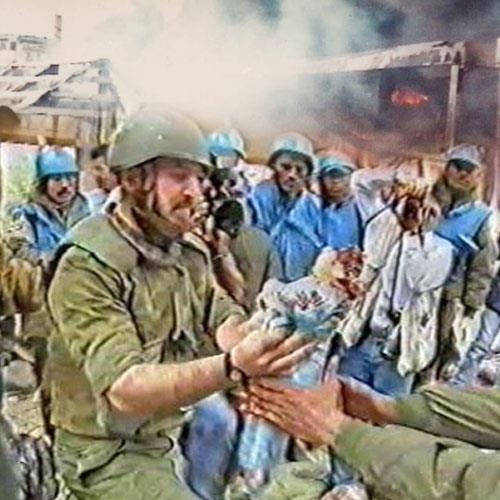
Qana Lebanon Massacre 1996

It was April of 1996. I was a 6 year old girl, growing increasingly scared of a month where I’d wake up to rockets getting fired every single day from the neighboring tanks over the hill and warplanes constantly raping the sky above my house.

Operation Grapes of Wrath was getting scarier, deadlier, more ominous by the minute. Just another regular day of a Southerner back then.

Random memory #1: Zaven, who currently runs a TV show on Future TV, was a news anchor then who, along with his co-anchor short haired Zahira Harb (I don’t know where she is now or what she does), were distinctive figures in my 6 year old memory.

Random memory #2: a man sitting on a plastic chair, head dangling to one side, blood and broken glass everywhere.

My memory of that spring is as vivid as if it were happening now. I can still remember all details of Thursday April 18th and the crystal clear images showing death and horror at every turn.

I remember the faces of UNIFIL soldiers crying and shouting, overwhelmed with the shock, ramble and fire.

The news was shocking. An Israeli raid targeted without any hesitation whatsoever a compound of UNIFIL forces in the Sourthern village of Qana where families had sought refuge, most of which were elderly, kids and women.

Yes it was a massacre, a crime against humanity: flesh and blood melting into the steel, splashed body tissues and fluids on the walls, dismantled and disfigured corpses, beheaded babies, pools of flesh merging into impossibly differentiated individuals.

The Cruelty was caught on tape and registered in minds, reinforced by the sorrow of those who survived and shock.

The whole country was in shock. No excuse could have been given, no excuse would have been accepted and will ever be.

I haven’t seen bigger funerals than the one carrying the victims of Qana to their final resting place. A sea of black, of arms swaying in sorrow under coffins each of which held entire families, their bodies burned together. More than a hundred souls were taken in fraction of seconds. Dreams were blown into little pieces lying together in common graves.

It took me 9 years to make peace with newspapers. My older sister used the idea of Qana newspaper pictures as a way to scare me for years. That’s how childhood in South Lebanon went. I envy the kids who grew up scared of boogeyman.

I know that massacres take place every day around the world, today more than ever, neighboring countries more than distant ones. Civil wars or terrorist attacks, respect goes to every innocent soul in this world that is lost intentionally or as collateral damage in conflicts they may not want to be part of.

Everything feels more intense and more important when it’s personal, which Qana – to me – undoubtedly is, but the point behind all of this is that terrorism has no nationality, no color and no ethnicity.

Recognize the terrorists. It is never too late to be fair.

Mobile Phone Purchases in Lebanon To Be Regulated Starting June 1st, 2013

The day we have all been dreading is upon us.

Are you one of those people who ridiculed that $1500 price tag for the iPhone 5 when it was released as you should, bought one on your own from abroad and had a friend bring it over with them and bypass our ridiculous custom fees? Well, you lucked out.

As of June 1st, 2013 that option may not be available to you anymore as part of a new decree to fight phone counterfeits on the Lebanese market which do not possess a true IMEI number (link). Your phone number will have to be registered to your phone’s IMEI number in order for you to get service.

So unless you’re a tourist coming into the country and roaming, you’ll have to pay custom fees on your phone in order to have its IMEI registered and use it on Lebanon’s dismal phone networks: alfa and touch.

What will become even more complicated is you selling your used phone to someone when you want to buy a newer one. If you want to do so, you’ll have to have that phone’s IMEI unregistered to your phone number first, a process they say will happen through texts with your mobile operator or online.

When you buy your new phone, you’ll have a period of 3 months to register it with your carrier. In order to do so, you are asked to keep your purchase receipt.

You can only change 3 phones in 6 months. I can already hear millionaires weeping in sadness.

These new regulations, if applied, are absolutely absurd. A few questions at the top of my head are the following:

  1. Is the best possible way to fight counterfeits across the Lebanese market making it a nightmare for every Lebanese out there to buy and sell mobile phones, a process that should be very straightforward?
  2. Does it make sense to enforce regulations on phones across the board this way when some major smartphone companies, as an example Apple, have yet to officially release their phone in the country and customers have to purchase them at near-black market prices?
  3. What if someone bought their phone abroad as a personal purchase and want to use it here? Do they seriously want us to worry about something other than have the LTE frequencies match and the phone be unlocked? Are we supposed to pay custom fees on every single electronic purchase we make just because it’s the best way to fight those knock-off iPhones and Galaxy S?
  4. How reasonable is it to ask for the nearly 2-million Lebanese who are in possession of phones that don’t even need to be smart to go register them based on a number most of those Lebanese don’t know exist? What happens to those who fail to have their phones registered on September 1st, 2013 – 3 months after the regulations go into effect?
  5. Did anyone  go over the intricate details of this and ask themselves if it’s remotely plausible? How many countries across the world apply this? A google search pointed to India only.

This feels oddly extensive of another decree that took place a few months ago (link) that required Lebanese to go register their phone numbers. Big brother seems to want to watch you even further.

How about we look up to countries where the telecom sector is flourishing and see the steps they’re making in fighting those fake phones and sustain their networks first?

Even so, does a decree on this magnitude even sound reasonable in a country that can’t even manage to apply a simple smoking ban?

Kill All The Muslims

My sympathy goes to all the victims of yesterday’s Boston Marathon bombing and to all the people who died cross the world in various other bombings in Iraq, Syria, etc… yesterday as well.

I could go on and on about how such acts are those of cowardice but what good would my words do to a country struck by tragedy and to the grieving parents of the people that died yesterday?

However, is it acceptable for the mantra “innocent until proven guilty” to become “an Arab Muslim until proven otherwise” when it comes to any terrorist act taking place anywhere in the world?

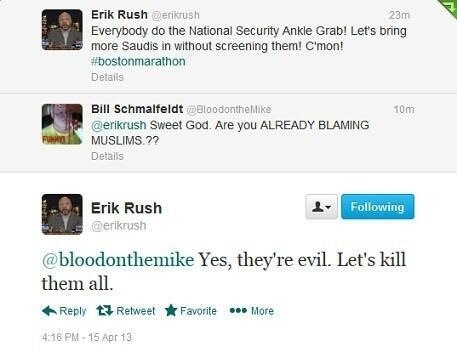
Case in point: the following tweets from an American pundit. Do you want to kill all the Muslims too?

20130416-113303.jpg

Is this even allowed in the case when the bomber turns out to be, in fact, an Arab Muslim?

He later on said that this was “sarcasm.” Though I think his “sarcasm” got lost with bashing the “Islam apologetics.”