One Day – Movie Review

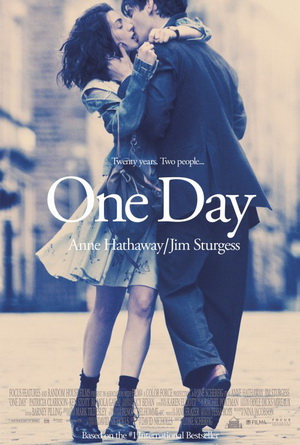
In One Day, Anne Hathaway is Emma, a British college graduate, who has a crush on Dexter (Jim Sturgess). On the day of their graduation on July 15th, 1988, Emma and Dex spend the night together and make a promise to catch up each year on that day to see where they both are in their lives and careers. One Day is a snapshot of 23 years in their relationship. Each scene in One Day is one particular year in the relationship of Emma and Dexter. Sometimes they spend the day together, other times they don’t. But they’re always on each other’s mind on that day.

Some might say that there’s simply too much gaps to be filled by such a premise. But the movie flows smoothly and doesn’t feel dragged out, mostly due to it being directed by the same man that brought the world An Education in 2009: Lone Scherfig. Instead of filling in the dull details and making this a three hour movie, Scherfig alludes to what happened in the year that past with each subsequent scene. Say Emma got an advance to write a book, you find the book already published in the next frame of the movie and so on and so forth.

One Day can be divided into three parts with each part representing a phase of the relationship between Dex and Emma. The first two thirds are closer in structure to each other than they are to the third even though the movie ends up wrapping up perfectly, with a little nice bow to top it all off.

Anne Hathaway as Emma tries her best to be British in the movie and for the entire length of it, she somehow pulls it off. Sure, there are moments where the role escapes her but in the grand picture, this is not the case. Hathaway is, really, a great actress. And for her role in Emma, although it feels a little restrained at times, possibly due to the nature of the character, her performance is still nuanced and emotive. You can see her showcase the struggles and the life of Emma and at times she manages to do so brilliantly. It’s definitely not her best work, however, but one cannot but see the true potential Hathaway brings to any movie she is part of. She is one of those rare actresses that have managed to escape the frame set for them by their debut Disney movie and transcended into giving the world great cinematic features. The best is yet to come from her.

Jim Sturgess, with Dexter to play with, is confident and charming as his character should be. But the moments he truly shines in delivering are those where, despite the strong exterior of Dexter, you can feel the sadness build inside him: the sadness of not reaching his desired goals in life, the sadness of losing his mother, the sadness of seeing Emma slip away, etc…

Sturgess and Hathaway nail their parts in One Day. Perhaps it would have been easier to bring British actors and actresses to do this movie. But what fun would that be? One Day is a quirky movie about a life. To have it be as authentic as possible, somehow perfect dialect would have rendered the movie less effective.

One Day is a realistic movie of a friendship. If you seek escapism in your movies, this is not the movie for you. The characters don’t always get to their goals in life and in their relationships. They don’t get to see each other whenever they want. There’s disappointment. But there’s also fulfillment. There are moments of sadness. But there are also moments of sheer happiness. Ultimately, the movie is similar to all our lives: we are but a collection of memories, some that fade away and others that are worth holding on to.

8/10

A Dangerous Method – Movie Review

Psychology and cinema have a long history together with the former often shaping the latter into delivering movies of great caliber. Last year’s “Black Swan” was a manifestation of that: a psychological thriller examining the darkness of human nature. In A Dangerous Method, psychology is literally in center-stage as this is a movie about how two of psychology’s most influential scholars came to their theories: Carl Jung and Sigmund Freud.

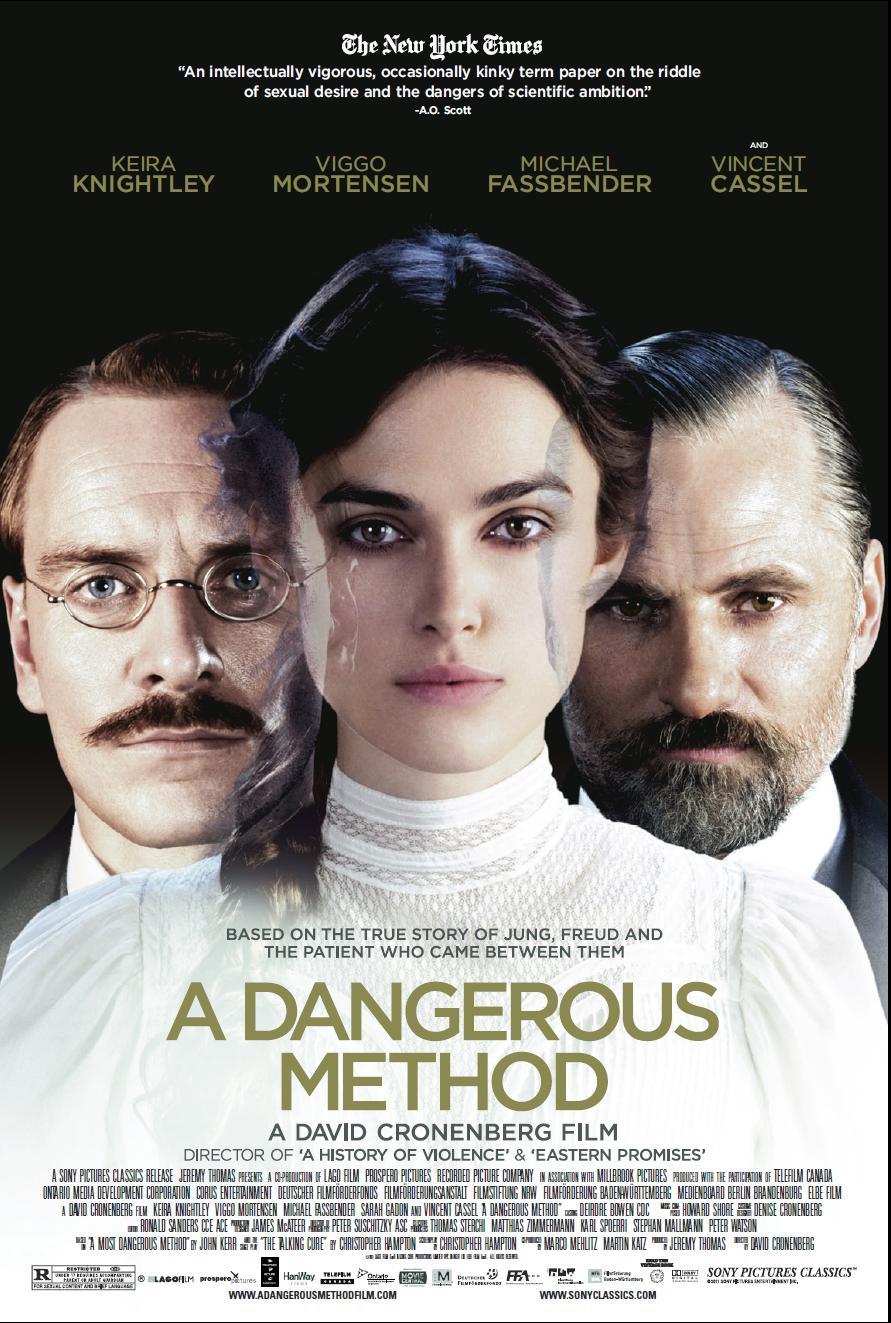
David Cronenberg’s new cinematic feature opens with an exquisitely chilling scene. Sabina Spielrein (Keira Knightley) is in the back of car shouting her lungs out as two men barely restrain her as they take her to a mental institution to be examined by Dr. Carl Jung (Michael Fassbender), who’s attempting Sigmund Freud’s (Viggo Mortensen) new method of treatment, called psychoanalysis. Spielrein is an unhinged Russian aristocrat who wants to become a doctor while Jung is eager to prove himself to his colleagues and the community and would, therefore, make Spielrein his main case. To his patients, Jung is superior. To his colleagues, he is always inferior. And it’s from there that his need to prove himself arises. Soon enough, Spielrein is “cured” but instead of letting her have a clean break with her sexual fantasies, Jung immerses himself in them, whipping her before having sex with her, putting a strain in his marriage where the sex is “tender” to which Spielrein offers that she “can be ferocious.” Meanwhile, Jung debates with Freud in numerous correspondances on how to improve psychoanalysis, featuring the dissolution of the relationship between them.

A Dangerous Method boasts what I believe is a brilliant and highly interesting trailer. But simply put, don’t let the trailer fool you into thinking this is more than a historical and biographical movie. It’s a history book on screen, which makes it boring, redundant and, eventually, pointless. The production feels disconnected. The movie’s pace is slow and when it picks up it’s only for a few minutes.

For a movie about emotions and feelings, the movie also doesn’t offer much in that department. Apart from a great performance by Keira Knightley who outshines both male leads, the movie is stark, grim and too safe. For a movie about psychoanalysis and the repressed sexual urges of Man, there’s simply too little of that… there’s too little visceral emotions in there for it to have any credibility outside the historical realms it’s featuring.

Let’s talk about Knightley. I mentioned the opening scene for a reason. The second half of that scene features Knightley blowing you away with her twitching, writhing, screaming, laughing…. She’s hysterical in front of your eyes and she does such a good job at it that it’s hard to think A Dangerous Method won’t be a great movie, even with her extending her jaw to cringe-inducing measures as if trying to pull that coveted golden Oscar statue towards her. But then as Jung begins his movie-long analytical character, coupled with an even more analytical approach from Freud, whatever emotion brought to table by Knightley is diluted beyond recognition to form an emotionally disembodied movie about emotions. Through the rest of the movie, even as she’s cured, Knightley retains an element of craziness to her character that keeps you on guard whenever she’s on screen. You get to certain points where you wish the Jung-Freud sequences had been rewritten to feature her: less historical accuracy, more in-depth approach, more emotions, more crazy.

As mentioned earlier, Fassbender and Mortensen’s characters are simply a psychology book in reading. Some of their script can be found in a psychology book somewhere even verbatim, perhaps.  But both actors do their best with the characters they were given. Taken in absolute value, the performances are good enough to pull this movie as it is. But when you expect much more from a movie dealing with Freud, Jung and psychoanalysis, you want the script itself to be more out of the box and their performances to be crazier.

It might be that I had too high expectations but A Dangerous Method seriously underwhelmed and disappointed me. Not only does this movie have no award-season chances (or limited chances at that) but it poses the question of how many times could the Freud-theme be handled in cinema before finally getting it right? You’d think a director like David Cronenberg would be good enough to bring the crazy of his previous movies to a movie about crazy. But it looks like it’s not the case. And ultimately, there’s nothing dangerous about A Dangerous Method except the one word in its title.

Ellen Degeneres’ Role in Twilight: Breaking Dawn, Part 1 – Hilarious

It looks like Ellen Degeneres has a small role in a very crucial moment in the new Twilight movie: Breaking Dawn – Part 1.

You don’t believe me? Well, check it out:

Well, I wasn’t entirely truthful. She doesn’t quite have a role. But it’s still hilarious (and probably the only nonexistent highlight from the movie I still haven’t seen.)


In Time – Movie Review

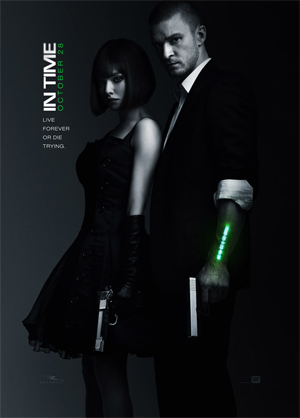
Set in a futuristic alternative universe, In Time is a sci-fi drama about a world where currency is time. People are born with thirteen yellow digits imprinted on their forearms. Once they turn a certain age, these digits give them a year to live. It is then that their strive for more life starts. Bargaining, buying more time, playing poker for more time, etc… become common activities.

And as it is with our world, that world is also divided into a downtown called “New Greenwich” and the ghettos. People living in New Greenwich have too much time whilst those in the ghettos don’t have enough. They live in fear of their seconds ticking away and that is the world Will Salas (Justin Timberlake) lives in, at least until he randomly stumbles on a man in a bar with over a century on his watch, getting him to go on a journey that leads him to Sylvia Weis (Amanda Seyfried), daughter of a time-company tycoon.

The premise of the movie is fascinating to say the least. It’s very easy to get engrossed in the whole idea of the movie – at least for the first half, after which it becomes dreary. The problem with the story of In Time is that it goes nowhere. While the foundation of the idea is great, the execution is less than stellar and sometimes cringe-worthy, especially when you couple it with Justin Timberlake’s acting.

Imagine a man whose mother dies in his arms… his reaction would be weeping. Justin Timberlake does that but it’s so unconvincing that it becomes borderline comical. And this spotty performance persists throughout the movie, leading to one unconvincing scene after another – scenes that could have been much more had they brought some better actor.

Compared to Timberlake, Amanda Seyfried looks good in the movie – and I do not mean her natural looks, although those eyes are a sight to behold. Her character starts by telling Salas that people in new Greenwich don’t live; everything there is slow and redundant. But she wants to live. And that is precisely the transition she acts out well enough: from a robotic rich girl to a feisty woman.

I can only begin to think what some brilliant director like Christopher Nolan could have done to a movie with the premise of In Time. He would have delivered a cinematic masterpiece, à la Inception or The Dark Knight. But sadly, a masterpiece is far from being achieved here. Couple horrible acting at times with a weak storyline and you have a movie that is spotty at best – although it does have some scenes that will get your heart pounding. But at the end of the day, it’s nothing more than a waste of time. Don’t watch it if you have something better to do. My problem was I did not.

The Ides of March – Movie Review

If you’re like me and had no idea what “Ides of March” meant until after the movie, it’s interesting to note it’s Roman for the 15th of March.

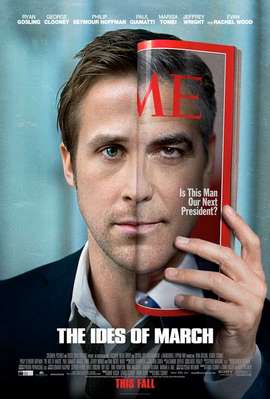
The Ides of March is the story of the days leading up to that day, on which a heavily-contested Ohio Democrat primary is supposed to take place between governor Mike Morris (George Clooney) and senator Pullman. Morris is the frontrunner but not by much. He is easily able to inspire many by his rousing speeches and his ability to draw empathy out of his audience. He is seen by his campaign managers as the best candidate to ever grace the US political scene up to the point where they’ve come to believe they cannot be disappointed by him.

Stephen Meyers (Ryan Gosling) is one of the top managers in Morris’ campaign and he’s also one of those people. After an attempt by the opposing Pullman camp to court Meyers and have him join their side, Meyers will start discovering an aspect to the political life he loves so much that is much darker than he thought. And as his closest friend in the field, journalist Ida Horowicz (Marisa Tomei), had told him without him believing: “[Morris] is a politician. He will let you down — sooner or later.”

The movie itself is highly engaging. It has a dark, somber mood to it that doesn’t let down from the get go, making it highly enriching for you to sink your senses. The movie sets itself as a political drama from the first minute and stays as such for the course of its ninety minute run.

Scene after scene, the movie builds the tale of how Americans elect their leaders. It forms a plot of corruption that goes on behind scenes we can never see and it illustrates the brutality of people towards each other – how in politics, playing everyone is key to survival. This teaches the main character, Stephen Meyers, an invaluable lesson, one that he wished he’d never learn: to reach places in the political world, you have to give up your basic principles in life. And seeing Meyers transform from the utopia boy at the beginning of the movie to the pragmatic man at the end is a very engaging journey.

The acting in the movie is top notch, as is expected from Ryan Gosling, Philip Seymour Hoffman and George Clooney. As mentioned previously, Gosling provides the movie’s crux when it comes to the acting with the other actors and actresses coming in as accessory to his story. You can sense his anger when he is so, you can feel his sadness when he’s devastated. He slightly reminded me in The Ides of March of his outstanding performance in Blue Valentine, although this still doesn’t come close to that.

George Clooney starts off by portraying a leader you all want to follow: one that shouts integrity and honor and respect. His speeches captivate you, his ideas engage you… and sooner or later, with the twists in the story coming to surface, the leader loses that gleam of pride in his eyes and he becomes someone you can’t but run away from. The transition is performed very subtly by Clooney.

Philip Seymour Hoffman is the angry campaign manager whose goal in life is to get Morris to the White House. And as is expected from Hoffman, his performance is top notch.

The script, co-written by Clooney, is very sharp and that is overly obvious by the way it flows and by the realism it exudes. It’s so realistic, in fact, that it could have easily been a conversation between a bunch of people prior to any elections. The movie has many of the issues people discuss and these issues have been weaved into a highly interesting political movie canvas that doesn’t come off as preachy or trying to convince you of one point or another.

Clooney, as a director, provides good subtle nuances. One particular scene that comes to mind is one where Morris is delivering a speech on one side of the American flag, while Gosling and Hoffman are panicking about the campaign on the other side. Such scenes, although mostly go unnoticed, reveal a high attention to detail, one that you cannot but credit.

The Ides of March, however, is far from being perfect. Sure, it’s highly engaging. But the twist in the movie is highly predictable, which ultimately makes the plot more on the deja-vu side, but it’s the kind of deja-vu that remains interesting. And even though you feel connecting to the characters on screen, towards the end of the movie you get disconnected from everyone as they change to characters you don’t want to relate to. The movie leaves you with an ending that feels lacking. You want more mostly because you want to feel that this man you cheered for is better than what he turned out to be.

At the end of the day, The Ides of March remains a highly realistic movie that is sure to please anyone with an interest in politics in general and political movies in particular. It’s a very tightly-produced drama that doesn’t ask much of you except to concentrate and watch, ultimately inherently asking fundamental questions about the values of democracy we all consider a given.