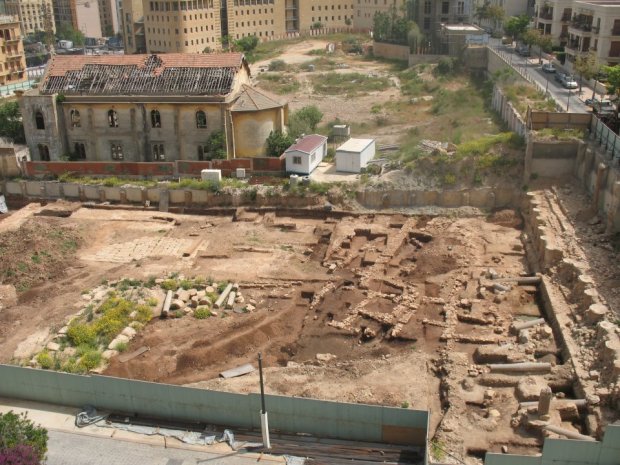
Discovered in 1988, the Roman Hippodrome in Beirut is situated in Wadi Abou Jmil, next to the newly renovated Jewish Synagogue in Downtown Beirut. This monument, dating back for thousands of years, now risks to be destroyed.
The hippodrome is considered, along with the Roman Road and Baths, as one of the most important remaining relics of the Byzantine and Roman era. It spreads over a total area of 3500 m2.
Requests for construction projects in the hippodrome’s location have been ongoing since the monument’s discovery but were constantly refused by former ministers of culture of which we name Tarek Metri, Tamam Salam and Salim Warde. In fact, Tamam Salam had even issued a decree banning any work on the hippodrome’s site, effectively protecting it by law. Salim Warde did not contest the decree. Current minister of culture Gabriel Layoun authorized constructions to commence.
When it comes to ancient sites in cities that have lots of them, such as Beirut, the current adopted approach towards these sites is called a “mitigation approach” which requires that the incorporation of the monuments in modern plans does not affect those monuments in any way whatsoever. The current approval by minister Layoun does not demand such an approach to be adopted. The monument will have one of its main walls dismantled and taken out of location. Why? to build a fancy new high-rise instead. Minister Layoun sees nothing wrong with this. In fact, displacing ruins is never done unless due to some extreme circumstances. I highly believe whatever Solidere has in store for the land is considered an “extreme circumstance.”
The Roman Hippodrome in downtown Beirut is considered as one of the best preserved not only in Lebanon, but in the world. It is also the fifth to be discovered in the Middle East. In fact, a report (Arabic) by the General Director of Ruins in Lebanon, Frederick Al Husseini, spoke about the importance of the monument as one that has been talked about in various ancient books. It has also been correlated with Beirut’s infamous ancient Law School. He speaks about the various structures that are still preserved and only needing some restoration to be fully exposed. He called the monument as a highly important site for Lebanon and the world and is one of Beirut’s main facilities from the Byzantine and Roman eras, suggesting to work on preserving and making this site one of Beirut’s important cultural and touristic locations. His report dates back from 2008.
MP Michel Aoun, the head of the party of which Gabriel Layoun is part, defended his minsiter’s position by saying that: “there are a lot of discrepancies between Solidere and us. Therefore, a minister from our party cannot be subjected to Solidere. Minister Layoun found a way, which is adopted internationally, to incorporate ancient sites with newer ones… So I hope that media outlets do not discuss this issue in a way that would raise suspicion.”
With all due respect to Mr. Aoun and his minister but endangering Beirut’s culture to strip away even more of the identity that makes it Beirut is not something that should concern him or Solidere. What’s happening is a cultural crime to the entirety of the Lebanese population, one where the interests of meaningless politicians becomes irrelevant. Besides, for a party that has been anti-Solidere for years, I find it highly hypocritical that they are allowing Solidere to dismantle the Roman Hippodrome.
The conclusion is: never has a hippodrome been dismantled and displaced in any parts of the world. Beirut’s hippodrome will effectively become part of the parking of the high-rise to be built in its place. No mitigation approach will be adopted here. It is only but a diversion until people forget and plans go well underway in secrecy. But the time for us to be silent about this blatant persecution of our history cannot continue.
If there’s anything that we can do is let the issue propagate as much as we can. There shouldn’t be a Lebanese person in the 10452 km2 that remains clueless about any endangered monument for that matter. Sadly enough, this goes beyond the hippodrome. We have become so accustomed to the reality of it that we’ve become very submissive: the ancient Phoenician port is well behind us, there are constructions around the ancient Phoenician port of Tyre and the city itself risks of being removed off UNESCO’s list for Cultural Heritage Sites.
The land on which ancient monuments are built doesn’t belong to Solidere, to the Ministry of Culture or to any other contractor – no matter how much they’ve paid to buy it. It belongs to the Lebanese people in their entirety. When you realize that of the 200 sites uncovered at Solidere, those that have remained intact can be counted with the fingers of one hand, the reality becomes haunting. It’s about time we rise to our rights. Beirut’s hippodrome will not be destroyed.





 A Separate State of Mind | A Blog by Elie Fares