On The Maronite Patriarch, Samir Geagea & Michel Aoun

Left: Michel Aoun, center: Patriarch Raï, right: Samir Geagea

When it comes to the Maronite Patriarch, Bechara Al Raï, I feel I have to be extra careful. The line between criticizing the individual and his stances is very thin and it is one I do not want to cross because he is, first and foremost, the head of a Church I feel proud to be part of for various reasons.

The leading Maronite politicians in Lebanon have found themselves at opposite sides of the aforementioned line. Being very kind-hearted, I’ll assume the line is very blurry for proper discrimination. But don’t be fooled, there’s a very important distinction between the stances Samir Geagea took regarding the current Patriarch and those adopted by Michel Aoun towards the former one.

The year is 2005.

Michel Aoun is preparing a parliamentary bid with an almost exclusively Christian coalition of political forces. At the end of May 2005, Aoun has gotten a sizable portion of the Christian votes – 70% in some areas. The patriarch at the time, Nasrallah Sfeir, had openly endorsed Aoun for trying to bring Christians together under a political idea that was, at the time, opposite to the alliance that included Hezbollah.

The year is 2006.

Michel Aoun signed an agreement with Hezbollah as the latter slowly drifted away from the electoral alliance it had forged a few months earlier. The agreement served to create a “Christian cover” for Hezbollah’s arms. It backfired. Aoun’s popularity began to slip, whether his followers like to admit it or not. The patriarch, following the political doctrine Bkerke has always been known for, began to criticize Aoun’s drastic shift in political positions. Subsequently, Aoun began to attack the patriarch both on personal and political levels. The attacks ended in 2011 when Sfeir resigned and Bechara Al Raï took over.

The year is 2012.

Samir Geagea is being interviewed on a political talk show, Bi Mawdou3iye, on MTV. He declares that the recent pro-Syrian stances of the Maronite Patriarch do not represent the historical path Bkerke had drawn for itself. He also asserted that the position of Bkerke as a leader in Lebanese society has dramatically decreased as a result of the erroneous stances taken by the patriarch.

Moreover, commenting on recent declarations by a mufti in KSA that the Arabian peninsula should not have any church standing in the near future, he replied that the stances coming out from the Azhar are the ones to be considered as legitimate and that the xenophobic declarations of Saudi Arabia’s mufti are very similar in crude nature to what the Patriarch had said about him being afraid for the Christians of the East because of the Islamists rising around us.

The time is now.

I am faced with a torrent of people sharing certain articles about how Samir Geagea is a hypocrite in criticizing the patriarch. And it is here that I bring back the initial point I mentioned in this post: there’s a thin line between criticizing a person, which Michel Aoun flagrantly did for years, and criticizing a person’s stances, which Samir Geagea has been doing for the past year.

It is a very thin line but it exists. And you cannot compare both men with regards to how they behaved towards the Maronite Patriarch without taking that into consideration. The fact of the matter remains that when Samir Geagea’s pardon went through and he was released out of prison in July 2005, the months when Patriarch Sfeir and his party had been at odds were not marred by discordance.

The fact of the matter remains that even when Samir Geagea is in grave disagreement with the current patriarch, his critiques cannot but be considered respectful. Or need I remind people of “the patriarch must have gotten horny” comment by one of Michel Aoun’s allies, a statement which was not condemned by Aoun’s party, or when the patriarch was called senile by Michel Aoun’s close entourage, a statement that the General did not, also, condemn.

The fact of the matter remains that the patriarch, with his current stances, is not helping to elevate the position of the Church he was appointed in charge of. Many bishops have even expressed discomfort in the way he is handling things. Patriarch Raï might be taking the power his congregation vested in him for granted. You cannot simply support the regime of a man who has been killing your people for years and years and expect then not to react negatively. You cannot expect your congregation to fathom supporting one of the main reasons their role in Lebanese society has degraded this substantially and pretend as if the years of Syrian occupation had never happened.

The difference between Michel Aoun and Samir Geagea goes back to principles. One has principles, the other simply lacks them. One expected Bkerke to change the way he saw fit and was disappointed when it didn’t. The other was disappointed as Bkerke strayed from the principles it built for hundreds of years and used to cement itself as a champion for the rights of Maronites in particular and Lebanese in general.

After all, how can we forget when Aoun’s supporters stormed Bkerke in a riot years ago? And they have the audacity to criticize Geagea for speaking up.

Yet again, people tend to jump the boat of hype without looking at the underlying current. But every now and then, a slight nudge of their memories is in order.

Can we move on now?

Kataeb and Ahrar “History Book” Protest Turns Bloody – Reminiscent of Syrian Occupation Days

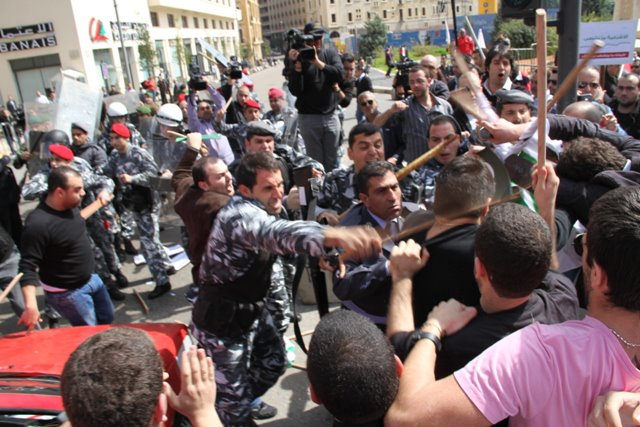
No, the above picture is not from the long gone anti-Syrian protests. No, the above picture is not out of a history book, which might never be written.

The above is a picture from a few hours ago, in Downtown Beirut, of Kataeb and Ahrar supporters getting beaten up by Lebanese armed forces, during a protest against the proposed history book, drafted by Lebanon’s unicolor government.

The differences between then and now are striking. The ultimate scene, however, is quite the same: Lebanese protesting flagrant violations of their rights and armed personnel beating them up for speaking up. The difference? The order to beat up the protesters was Syrian back then. This time, however, it’s Lebanese – or as “Lebanese” as it can get.

The Lebanese army was present. It did not interfere. After all, what’s the Lebanese army doing these days except sitting on the sidelines setting up checkpoints in irrelevant places, doing nothing to protect the people it should be working hard to keep safe?

The students were stopped by the armed forces on their way to the Grand Serail. As a result, 14 of the students were injured and transferred to nearby hospitals.

In a country with no victors, how could the current government expect people to forget about their history, their struggles, their own revolutions and be subdued to its version of a history which glorifies events that shouldn’t be glorified and forgets about other incidents that should never be forgotten?

In a country with no victors, how could the Lebanese armed forces take a side against the protesters in such a way, when if the other “team” protested, the only thing they’d be doing is cower away in their barracks eating tawouk? For our armed forces, a bunch of university students protesting a book is far more dangerous than hundreds of men dressed in black shirts roaming the streets of Beirut in obvious display of tactical power. Where were the armed forces then? Or do they only know to stand against those that are “weak” in Lebanese society?

In a country with no victors, what warrants a select group of unqualified people to write a book where they highlight the struggles of people from “down under,” while neglecting the struggles of every single other portion of Lebanese society?

I am sick and tired of being treated as subclass citizen by the state of Lebanon because:

1) I did not live under Israeli occupation.

2) I do not support a political party which flaunts its weapons.

3) I am not of a certain sect, which is protected by some “un”holy parties.

I am sick and tired of not being able to trust any of Lebanon’s armed forces and them not doing anything in any way whatsoever to bridge the gap of bias they have created across Lebanon.

I am sick and tired of loving a country so much when with each passing moment they make me feel like I have no place here – even when it comes to talking about a history book.

But I’m sorry to break it to them – students and real activists who were not deterred by the brutality of the Syrian regime will not fear a government whose only reason of existing is the “un”holy backbone it has. And a history book, which is as biased as the one currently written, will never pass.

After all, if a history book was irrelevant, why were those students beaten up?

Kony 2012: Hype? Activism? Scam? – An Opinion

I took my time to watch the Kony 2012 video that went viral, partly because I didn’t want to jump on the bandwagon of the movement’s supporters immediately without an educated decision, partly because of the polarizing views I had read of the video. And lastly because of the bandwidth, which I don’t have, that I’ll be investing in watching the movie.

Now, a few hours after watching the 30 minutes long video, I think I am in a position to judge it. And for that purpose, I will categorize my response to four main parts.

1 – The Non-Supporters:

Those who didn’t support the movement portrayed by the movie used arguments such as “what now?” and “what’s the point?” or “we don’t see a credible plan of movement.” And they have every right to their questioning. But allow me to ask the following. A few days ago, how many of you had heard of Joseph Kony (or Uganda for that matter)? How many of you had known on Monday what the Lord’s Resistance Army (LRA) was doing and how many children it had abducted for its plans?

So for all matters and purposes, the Kony 2012 video’s main purpose is education. It is to let as many people know about the injustice going on in that part of the world. It definitely comes off as preachy. It’s very difficult to come off as neutral in such circumstances. Sure there are worse “bad guys” out there that need to be highlighted. But having worse bad rulers or military men out there does not render what this video has done irrelevant. You can complain about the rulers of other countries. It doesn’t mean you need to bash this movie to do so. Sure this is definitely helped by the celebrity momentum it’s been getting. But when the frenzy subsides, you’re still left with millions of people who know what Joseph Kony has done and is doing. And that’s the plan: get as many people involved in order to get somewhere. In the age of the internet, that’s a credible plan.

2 – The Supporters:

On the other hand, you have the absolute majority of people who basically threw their support behind the Kony 2012 movement by sharing the video, buying the advertised kit and helping in spreading the word. Over 60 million people have watched the video, a testament to how strong the momentum behind the movie has become. However, when it comes to these supporters, many believe the movement stops at that: sharing the video and posting a Facebook status. How many of those 60 million people will actually rush to the streets of their cities on April 20th to hang the Kony 2012 posters? How many of those 60 million people consider themselves now “activists” in a cause they may not really fully understand?

The internet has made it way easier for many people to be involved in such movements. But on the other hand, the internet has also made the supporters of such movements sedentary in their support: merely a form of passive spoon-feeding of information, which is passively passed on with near minimal understanding or tangible involvement of the cause at hand.

What the supporters also need to know is that the compassion they are feeling for the children of Uganda needs to be passed on as well to places where even worse injustice is taking place. If more people are aware of the killings in Syria, Myanmar or any other country in the world, then Kony 2012 has achieved yet another milestone: to increase the scope of awareness of people.

I thought this was supposed to be an international campaign.

3 – The Conspiracy Theorists:

Many people are widely skeptical about Kony 2012 not because of its meaning and message but because of what it’s advocating: an American military involvement in Uganda. Why so? Because Uganda recently became an oil producer. However, what the movie is advocating is not really direct US military involvement in Uganda – it’s asking for more US political awareness for the children in that country and, possibly, more involvement in the political processes taking place there in hope for the capture of Joseph Kony.

The Obama administration has also not authorized direct military involvement of the personnel it sent to Uganda. And at this point of the presidential campaign, I highly doubt Obama would ruin the economical improvements he has been working for more than three years on just to please a movement that will, eventually, tone down to regular non-frenzy levels.

4 – The Reality:

When it comes to Kony 2012, you cannot but care about the matter at hand. If you don’t, then you simply lack compassion. However, the whole affair is not exactly very peachy. The organization responsible for the movie, Invisible Children, doesn’t allow its finances to be audited. Therefore, you cannot know where your donations are actually going. However, approximations have it that only 31% of the donations Invisible Children receives actually go into helping out the children of Uganda. The rest goes into movie making, the travel expenses of its personnel and whatnot.

Moreover, when it comes to Uganda, the LRA has been rendered inactive since 2006 and the Ugandan army has been slowly taking over in parts of the country where the LRA was in control. However, that doesn’t mean the Ugandan army is much better. In fact, reports have shown that the army has been using rape as a weapon in its fights. Besides, Yoweri Museveni, the current Ugandan president, has abolished limits on presidential terms. He has been serving as Ugandan president since 1986. He’s accused of democracy oppression. Invisible Children supports his regime.

Finally, one interesting thing to note is that the LRA is to Christianity as Al Qaeda is to Islam – both are extremist religious groups, led by men who have no understanding of the scripture they follow. The difference between LRA and Al Qaeda is that the latter is seen as international terrorism and the former is seen as a Ugandan affair. What they have in common, on the other hand, is that the killing of Joseph Kony will do as much harm to the LRA as the death of Osama Bin Laden did to Al Qaeda.

But regardless, oppressors need to be stopped on the hope that maybe tomorrow the world for the visible children of Uganda and the world becomes safer.

Watch the Kony 2012 video here:

The Hurdles Facing Lebanese Women Today – Happy International Women’s Day?

This is a guest post by Agnès Semaan, a current law student at the Université SaintEsprit de Kaslik (USEK). You can follow her on twitter here.

– – – – – – – – – – – – – – – – – – – – – – – – – – – – – – – – – – – – – – – – – – – – – – – – – – – – – – – – – – – – – – – – – – – – – – – – –

I’ll start this article by sharing with you some of what I learned at law school:

1) If you want to cheat on your wife, do it with many girls not just one long-term extra marital affair or simply don’t bring your mistress home because only then can a man be trialed for adultery.

2) I learned that if my rapist married me, his crime would be nullified.

3) I learned that I cannot sue my husband if he raped me.

4) I learned that if I want my children to be Lebanese, I better marry a Lebanese because that’s the only way for my children to get my nationality.

I’m not a Feminazi. I’m just someone who noticed how this day lost its political flavor. The International Women’s Day is not about forwarding some cheesy Whatsapp message to all your girlfriends wishing them a nice day, It’s a day that honors the work of the Suffragettes that campaigned for women’s right to vote and most of all to remind us that inequities still need to be redressed.

And it is here that I address the following:


1 – Nationality

Why nationality is needed is quite simple: if you don’t have the Lebanese nationality you must continuously secure residency and work permits that enable you to live and work legally in Lebanon and you are not granted access to public education and other services at the same low fees that Lebanese citizens do.

Here’s a fun fact: an Ottoman law allowed women to naturalize their children, as in grant full citizenship rights, when born on Ottoman soil regardless of the spouse’s nationality.

I can go on and on about how not being able, as a woman, to pass your nationality to your children weakens the woman’s status and role because she’s not treated as an equal citizen; thus contradicting the Lebanese constitution, the Convention on the Elimination of All Forms of Discrimination against Women (CEDAW), the International Covenant on Civil and Political Rights (ICCPR) and the Convention on the Rights of the Child (CRC). But let’s face it, it comes down to the Palestinians and the right of return. Some lawmakers are against this in order to protect Palestinians’ right to return to Palestine (UN General Assembly resolution 194). So since that’s the case, why are we not worried about Palestinian women who get married to Lebanese men?!

2 – Penal code

Lebanon must amend discriminatory laws to ensure conformity with CEDAW and international standards like the international Beijing Declaration and Platform for Action of 1995. The sanctity of the private home, guaranteed in our constitution, should not be a getaway in affairs of sexual domestic violence because marital rape is still rape and it definitely needs legal recognition (art. 503 and 504). However, this law needs to have a safety net for the husbands because they will be abused if the law is overprotective and over cautious because otherwise one will be able to blackmail their spouse using the prerogative bestowed by this law upon them. Many reforms must be made to the criminal law for the simple reason that it’s not acceptable that a rapist not be prosecuted and his conviction be nullified if he marries the victim (art.522) and that a man will only be tried for adultery if he has extra-marital sex in the conjugal home or if he has a long-term extra-marital relationship along with a much softer sentence than a woman would get in such circumstances (articles 478, 488 and 489)?

3 – Inheritance

Current status: an absolute failure.

It’s 2012 and a Muslim girl still gets half of what her brother inherits. I can’t even begin to describe how dreadful this law is. Every single word in the formulation of that law is insulting and to go into every detail would make this post extremely long and repulsive. The Christian personal status law, although better, still fails in different areas mainly with all the “smartassery” there, such as the implied notion that Muslims cannot inherit from Christians. What we need is an optional civil law, point à la ligne.

4 – Elections and the quota

Yes. Women should not be limited in a certain number of candidates. Why can’t all the 128 deputies in parliament be females? It’s a viable question and absolutely rightful to be asked. But let’s not get carried away in our wishful, foolishly optimistic thinking: Half a loaf of bread is better than no bread at all, and this is an effective way to encourage women to run for elections. So that’s why we should at least start by ratifying a women’s quota bill before 2013.

5 – The women?

Why do we find time to complain about traffic, politicians, watch a soccer game going on in some European country and get carried away, change our display picture on blackberry 20 times per day, tweet about Christian Louboutin’s new collection, comment “hayete kom t belle!”on EVERY.SINGLE.PICTURE. but we can’t find time to address the previously mentioned issues? Rights are not given, they are taken and that’s why we need to raise our voices to make ourselves heard in a sea of male politicians who quench our voices simply by them outnumbering us in every way possible. It is here that I find that women are the main hurdle facing women. We tend to be cynical with regards to each other, pessimistic about each other assuming power, that we believe the best options out there are not really women. And the cycle repeats itself, leading to more and more marginalization of this half of the Lebanese society.

I’ll finish by saying this: it’s not hard to change laws. Get a bunch of influential women into parliament and you’re well underway. Our greatest challenge here is not changing the laws but changing Lebanese mentalities. Ratifying new laws might be the first step in that direction. Until next year, here’s hoping my fellow Lebanese women that we’ll see some change.


NY Times Fail: Mistake Hillary Clinton’s Name – Call Her Hillary Putin Instead

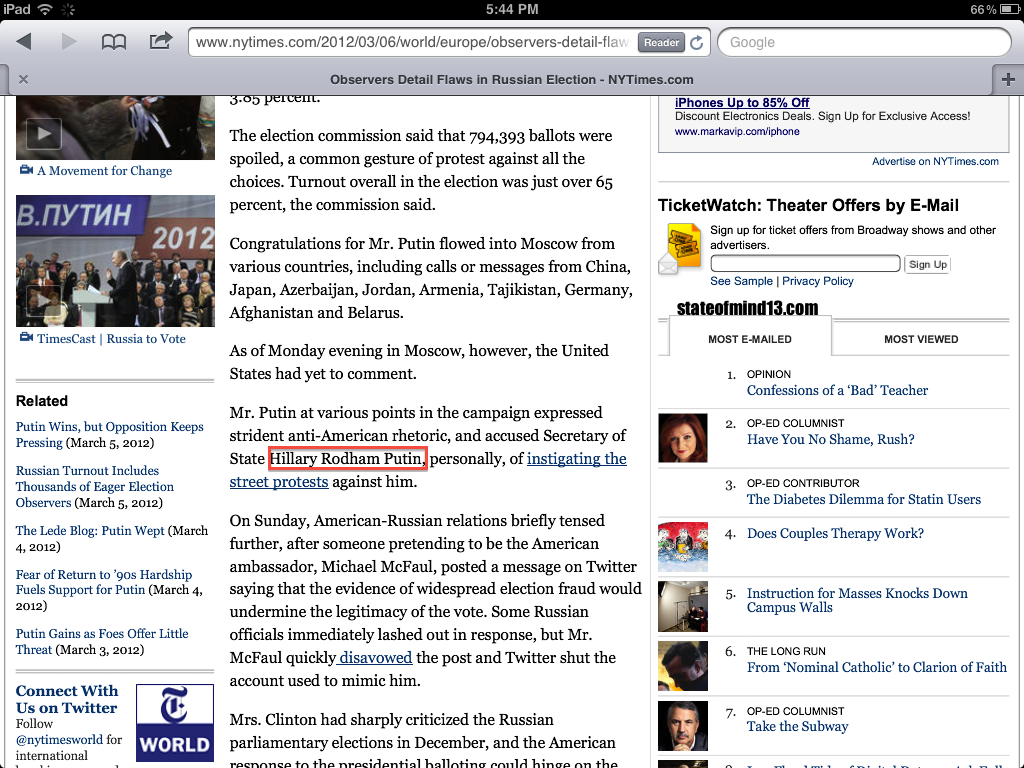
As I was reading an article in the NY Times about the Russian elections, I was confused for a moment when I saw them mention someone by the name of Hillary Rodham Putin and referring to her as Secretary of State.

Clinton, Putin, same thing for the NY Times apparently….