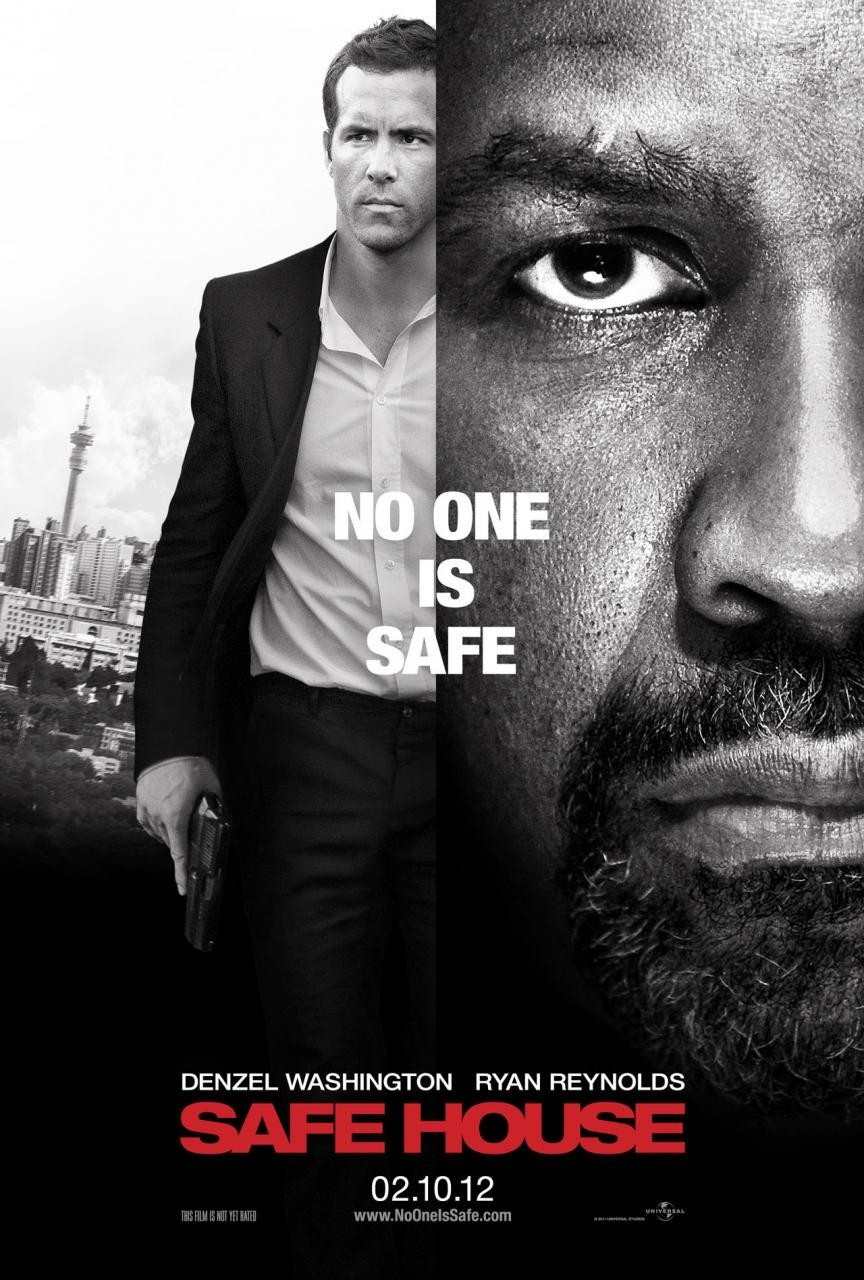
Safe House – Movie Review

In Safe House, Denzel Washington stars as Tobin Frost, a former CIA agent who has gone rogue after all his work with the agency. Upon procuring valuable information from an MI6 agent, Frost is chased down by armed men in Johannesburg and seeks shelter in the American embassy, after which he is taken to a safe house, pending investigation.

The safe house is run by Matt Weston (Ryan Reynolds), a CIA spy who’s really not more than a housekeeper. Soon enough, however, the house turns out to be anything but safe when the location is compromised, the CIA squad protecting Weston and Frost is killed by armed men who start chasing both Frost and Weston seeking out the information that Frost possesses. As both men run for their lives, Weston is confronted by Frost’s questions as to how the safe house was compromised? is there a traitor amidst the CIA top officials? And what’s in the information that Frost possesses that could get someone that important worked up?

Safe House can be summarized in an idiom: same old, same old. While Denzel Washington and Ryan Reynolds work really well with the material they are given, the movie remains: less about story, more about action sequences. And at some points the action sequences are top notch. However, due to the redundancy and familiarity of the story at hand, the movie gets dull at certain times and drags on, especially when there are no action sequences to leave you transfixed. Those times, however, are minimal.

Ryan Reynolds is likeable as Matt. Denzel Washington is fierce as Frost. Vera Farmiga, who  also stars in Safe House as Catherine Linklater, a CIA official trying to get Frost and Weston to safety, is also an interesting addition to the movie. In a way, Safe House boasts an all-star cast that helps it level up its somewhat mediocre déjà vu storyline and turn in into something that will entertain you.

At the end of the day, Safe House is an energetic movie. It might have its slow moments but those are too little to get you deterred from the rampant path the movie is on. The movie also boasts some very beautiful African scenery and despite some lack of character development, as is expected in such movies, Safe House doesn’t slack off. While the plot’s ultimate lesson goes along the lines of “been there, done that,” with it being: trust no one, it doesn’t come off as saccharine or even forced. It’s a natural progression of the plot at hand. So simply put, Safe House is a movie that will entertain you during its run. My only problem with it is that its two hour run could have been comfortably shortened by at least fifteen minutes, without damaging the progression, as well as it not taking a risk with going new places with its plot. Apart from that, not a bad movie to watch on a Friday night.

7/10


The Wall Street Journal Showcases Hiking in Lebanon’s Mountain Trail

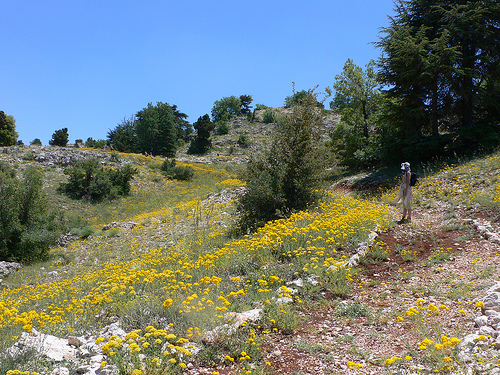
The trail in Tannourine

(source)

It seems someone, somehow, has paid attention to the rambling of many Lebanese bloggers about the coverage Beirut gets by renowned international publications. The Wall Street Journal has decided to showcase something that many Lebanese are not familiar with: a 440 km hiking trail going from Lebanon’s North to its South: the Lebanon Mountain Trail (LMT).

After the Telegraph article about Beirut and the New York Times article about Beirut’s Zaitunay Bay, this is definitely a welcome change in a direction that I believe Lebanon can be a pioneer in especially in the region: scenic tourism.

Brooke Anderson, the article’s author, says of the trail as seemingly a world away from Beirut, even though it’s only one hour away.

She describes the trail as showing different sceneries depending on the season: “colorful foliage in the autumn, snowy summits in the winter, waterfalls in the spring and a respite from the hot summers on the coast. It is home to Roman ruins, temples, mosques and churches dating back over a thousand years.”

And even though many Lebanese have not heard of it, foreigners haven’t been as clueless. She speaks of the experience of Adrain Cazalet, an Englishman, who has hiked the trail twice in different seasons and is planning a third trip this coming May and a Dutch contractor, Wim Balvert, who has hiked the trail twice as well, one of those being with his family. They were impressed the most by the Qadisha Valley. Who wouldn’t be fascinated by it, really?

The project was conceived by Lebanese expat Joseph Karam who modeled it after the Appalachian Trail in the U.S., which spans from Maine to Georgia, with donations from USAID and other private donors. The most famous part of the trail is probably the Baskinta Literary Trail, a 24 km walk across the infamous Metn town, which celebrates many famous Lebanese authors such as Baskinta’s own Mikhael Naimy.

I think this is a fascinating side of Lebanon that few get to see, especially Lebanese. Perhaps if more of us get exposed to this side of our country, some of which hasn’t been touched by concrete blocks yet, we’d be less keen about nagging all the time and perhaps relish the beauty of our nation – at least for the duration of our hike.

Thank you for the Wall Street Journal for taking a chance on non-Beirut Lebanon. Here’s hoping some contractor doesn’t wind up in some region of the Trail and lets his greed get into the way of keeping whatever remains of Lebanon’s beauty intact. And people still ask me why I’m harsh on Beirut-related international publications. Simply put, we have such jewels that few know about and you’re still talking to me about how fascinating Le Grey is?

Iran To Execute Youcef Nadarkhani, a Pastor, For Converting to Christianity

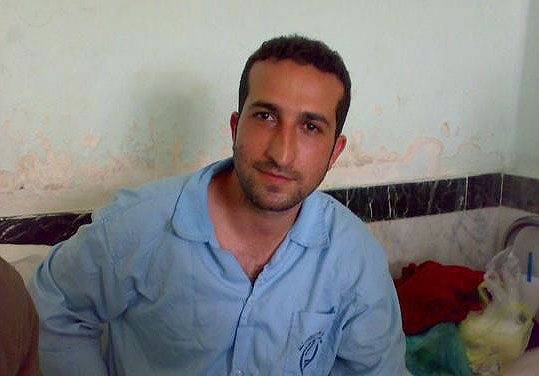
This is Youcef Nadarkhani

Youcef Nadarkhani is a 34 year old man who converted to Christianity at age 19. He came under the Iranian government’s radar in 2006 when he applied for his church to be recognized by the Iranian government.

Three years later, he went to local officials to complain about the indoctrination of Islam at his children’s local school, saying that his children should not be forced to learn about Islam. He was subsequently faced with a court order to renounce his Christian faith, which he refused to do. He is now facing the death penalty, being put on death row.

The Christian pastor faced charges of “apostasy” and “evangelizing muslims.” The widespread condemnation has led  the Iranian court to accuse the pastor of committing rape and other crimes as well. As of today, he is still alive.

For reference, Iran is one of the signatories of the Human Rights charter, as well as various United Nations agreements, which guarantee religious freedom. The US congress has also unanimously approved of a resolution to condem the sentencing.

The Iranian government is known to carry on execution sentences at random times. Nadarkhani’s sentencing can be carried out immediately or dragged on for years. His supporters fear his case might be used by the Iranian government as leverage against the sanctions imposed on the country.

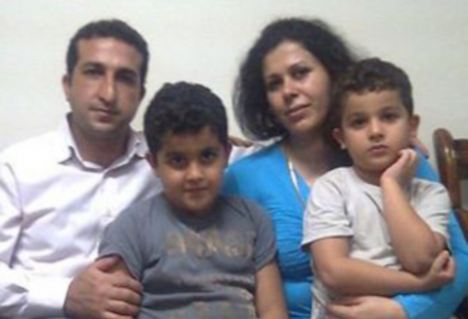
Youcef Nadarkhani with his family

I honestly cannot fathom how some governments can rationalize decisions like this in the 21st century. Not only is the Iranian government violating every single human rights agreement it has signed, it’s also doing so flagrantly. How can a government sign an agreement to ensure religious freedom and then kill those who do not follow the religion enforced by the state?  How can the judges of said Iranian court remain sane with them fabricating charges for a man whose only “fault” was to change religions?

Even Nadarkhani’s wife was arrested and found guilty before she appealed the decision and got released two weeks later. Her arrest was seen by many as a pressure on her husband to renounce his faith.

Religious minorities in Iran, such as Christians, Jews, Bahais, etc… face social marginalization, persecution and political isolation. The Iranian government, however, saves its hardest punishment to those who “abandon” Islam. It even has fatwas that demand the death of apostates.

Iran’s secretive judicial system leaves the international community questioning Nadarkhani’s fate. But the international pressure being put on Iran by various governments and organizations is paying off. Pastor Nadrakhani would have been executed already if his case hadn’t caused outrage.

It looks like world is still concerned with religious freedom, as is evident by people from various political fields (conservatives and liberals), countries and religious views (Atheism, Judaism, Islam and Christianity) coming together to help Youcef Nadarkhani. So what can we do? We can help by spreading the word. The more people know about Nadrakhani’s case, the harder it will be for such oppressive governments to let it slide. It is high time we stand up for our basic liberties, such as our freedom to choose whatever religion we want to follow. When it comes to one’s relationship with God (or any other entity), the government should have no say – let alone punishing a person for not having the relationship it deems appropriate.


PS: For the Lebanese reading this who will accuse me of being one-sided, the same applies to the Saudi government’s oppressive view towards religions (and other basic liberties) too.


Lebanese Governmental Websites Hacked

It looks like “Anonymous” has opened up a Lebanese branch. The websites for the municipality of Beirut, the Ministry of Economy, General Security and the Ministry of Immigration have just been hacked to show a picture of a poor man feeding the government.

It looks like the hype of football has gone down a notch and people have begun to notice fuel prices are on their way to an all-time high. This time, however, we don’t have bickering ministers to cut down the prices.

Power to the people? If only such things were actually relevant.