After Georges Nasser’s films “Ila Ayn” 1957, “Le Petit Étranger” 1962, and Maroun Baghdadi’s “Hors La Vie” 1991, Nadine Labaki’s latest “Capharnaüm” is chosen to be in the official competition at the 2018 Cannes Festival.
While the movie does not have a trailer yet, and neither do we have an official synopsis of what it is about, this is such an honor to bestow on this phenomenal Lebanese director whose previous two films were also critically acclaimed, with Where Do We Go Now winning the top prize at the Toronto Film Festival and being nominated for a Critics Choice Award in 2009.
Being part of the Official Selection at Cannes means that Capharnaüm is in the running for the show’s top prize – the Palme D’Or – for best movie. Nadine’s previous movies were selected for a different, less prestigious subset, the “Un Certain Regard” selection.
Other movies that were selected along with Capharnaüm are:
Le Livre D’Image, dir: Jean-Luc Godard
Blackkklansman, dir: Spike Lee
Three Faces, dir: Jafar Panahi
Cold War, dir: Pawel Pawlikowski
Leto, dir: Kirill Serebrennikov
Lazzaro Felice, dir: Alice Rohrwacher
Under The Silver Lake, dir: David Robert Mitchell
Capernaum, dir: Nadine Labaki
At War, dir: Stephane Brizé
Asako I&II, dir: Ryusuke Hamaguchi
Sorry Angel, dir: Christophe Honoré
Dogman, dir: Matteo Garrone
Girls Of The Sun, dir: Eva Husson
Yomeddine, dir: A.B Shawky
Burning, dir: Lee-Chang Dong
Shoplifters, dir: Kore-Eda Hirokazu
Ash Is Purest White, dir: Jia Zhang-Ke
The fact that Nadine Labaki is in the running against a legend such as Jean-Luc Goddard is an honor in itself.
I personally can’t wait to see Capernaum, and hope it’s as phenomenal as the honors it’s being bestowed indicate.
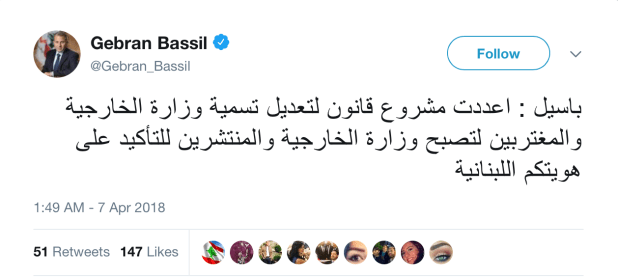
Gebran Bassil – our esteemed minister of Foreign Affairs and Immigrants – wants to change the name of the ministry he is heading from that dealing with Immigrant affairs, to – what I would assume translates as: Ministry of Foreign Affairs and the Diaspora. In Arabic, the change goes from Meghterbin to Mountashirin.
The change, it seems, is Bassil’s attempt – in his ever lasting effort to gain a parliament seat in my home district (which he will get with this freak of an electoral law they’ve come up with) – to indicate to us, Lebanon’s immigrants at large, that our identity is Lebanese.
As if we have forgotten.
We may have left the country, dear sir, but the attempt to wash away the very hard decision of us deciding to pack up everything and leave will not be accepted. The mere fact that you think I need to be reminded of my Lebanese identity is insulting.
I have not forgotten that I have not seen my parents in months. I have not forgotten that I couldn’t be next to my grandfather as he drew his dying breath. I have not forgotten that I am missing out on Celine and Yasmina growing up. I have not forgotten that I have not seen my best friends and have not been in their lives for almost a year.
I have not forgotten that I will be missing out on Celine and Simon’s baptisms. I have not forgotten that I haven’t hugged my grandmothers in what feels like an eternity. I have not forgotten that I haven’t seen my brothers in months either.
And yet, here we are.
What makes me Lebanese is them. It’s what I’ve left behind and I remember every single day of being ten thousand miles away, as I get glimpses of what I’ve left behind over WhatsApp voice messages.
No, you do not get to sugar coat me being away from home.
I have also not forgotten the country you and your friends made me leave. In the time I’ve been here, America has offered me more – and I’m not even their citizen – than what my own government has in over twenty seven years of being its citizen.
America has offered me well-paved roads. You haven’t.
America has offered me a well-paying job. You haven’t.
America has offered me fast internet, water that doesn’t die off on me, electricity that I can rely on, gas that doesn’t break the bank to buy, accessibility that cannot be replaced, and prosperity that cannot be priced.
America has offered me a place in which I can build my own home, without worrying about tomorrow might bring. You haven’t.
What have you offered?
You’ve offered a country where everyone has a militia, where you don’t succeed based on your qualifications but based on who you know, where half of people my age are struggling to find a job, where corruption is our modus operandi, where the most basic of human requirements are not provided to me.
But please, do remind me that I’m Lebanese. Remind me of how I can’t go on vacation anywhere without needing two hundred and fifty different pieces of paper to have them consider me for a visa. Remind me of how you and your friends have turned the country’s reputation into a shithole. Remind me of all that baggage that I’ve willingly left behind – just because you need my vote, I suppose.
You think we wanted to leave. No one wants to leave their home, and everything that they’ve known their whole life. But you’ve made me do so.
I have not forgotten why I left. I thank the heavens each day that I took that decision. And it won’t really matter what you name your little useless ministry, at least for me.
Come April 29th, Lebanon’s voting immigrants – please choose wisely. And on May 6th, I hope the Lebanese populace back home remembers that their sons and daughters are immigrating for a reason.
As Lebanon’s 2018 elections go on in full swing, a total of 976 candidates have presented to the Ministry of Interior affairs as of the deadline at midnight on March 6th. Of those, 111 candidates are women.
There are two ways to look at this. 111 candidates being women is essentially only 11.37% of the total number of candidates. Yes, the percentage may be dreary, but back in 2009 – the last time we actually had parliamentary elections – only 15 women had run, from a field of over 702 candidates. That’s nearly 2%, an abomination by all measures.
So instead of saying that 111 candidates being women is not good enough, I choose to celebrate the milestone of having that many women run. It’s the highest number since El-Taef agreement, and will only be just a stepping stone for future elections to come.
This year’s elections has the highest number of candidates ever recorded. The previous record was 702, in 2009. There were 484 candidates in 2005, 545 in 2000, 599 in 1996 and 408 in 1992, the first election after the Taef agreement. Prior to the Lebanese civil war, with less seats in parliament, the most candidates that had run was 366 in 1972.
The reason these elections have had a higher influx of candidates in general is the new election law at hand: it allows more representation to entities of the electorate that had been diluted away previously. Even Lebanon’s political parties are fielding candidates in districts that they had not been competitive in. For instance, the Lebanese Forces and FPM have candidates in the deep south and the Beqaa-Hermel districts. More importantly, however, a good chunk of those candidates are people from Lebanon’s civil society who had fought tooth and nail over the past few years against the limitless corruption of those in power.
Interestingly enough, a quarter of Lebanon’s current parliament members are not running for re-election. The most notable of those is probably former prime minister Fouad Sanioura, who held the Sunni seat in Saida since 2009. Many simply didn’t stand a chance at defeating a challenge in the shuffling of proportional representation.
While 111 women running for parliament is an achievement in itself, it shows – yet again – that Lebanon’s political parties have failed in further strengthening the political might of this core demographic in the Lebanese population. Remember the days when they were talking about women quotas? Even their most conservative of quotas is higher than the number of women candidates that are running, and definitely higher than the ones they will have on their list.
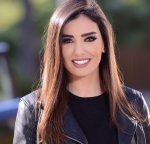
It’s up to us, therefore, to make sure we have as many new and fresh faces in parliament as possible. As an expat in the United States, I will vote on April 29th. My district – Batroun – has the least number of candidates running in the entire country: only 10 candidates are running for 2 Maronite seats. Of those 10 candidates, a phenomenal journalist, lawyer, and friend named Layal Bou Moussa is hoping to make a dent in the Lebanese political sphere.
It is without hesitation, therefore, that I say my preferential vote will be going to her this year. She has proven over and over again to be a loud voice for all the oppressed. As a reporter for New TV, she’s exposed corruption of those in power. It’s time we give her a chance, every one else in my district has been in power in one way or the other since at least 2005. Enough is enough. On April 29th, I’m with her.
There’s a lot to say about the chance that people from Lebanon’s civil society have to get to parliament. But if we all belittle their chances and either not vote or vote for political parties instead, then we’ll be falling into the same rabbit hole we’re never going to get out of. It’s worse when there are accomplished candidates running in our districts that need our votes.
Other notable female candidates running are:
Paula Yaacoubian for the Armenian seat in Beirut’s 1st district,
Joumana Haddad for the Minorities seat in Beirut’s 1st district,
Jessica Azar – MTV journalist – for the Greek Orthodox seat in Metn,
Sethrida Geagea for the Maronite seat in Becharre,
Gilberte Zouein running for the Maronite seat in Keserwan,
Maya Terro running for the Sunni seat in Chouf,
Sandrella Merhej running for the Maronite seat in Baalbek,
Lina Mokhayber running for the Greek Orthodox seat in Metn,
Raghida Dargham running for the Druze seat in Beirut’s second district,
Michelle Tuein running for the Greek Orthodox seat in Beirut’s first district, among others.
Layal Bou Moussa
Sethrida Geagea
Jessica Azar
Paula Yaacoubian
Joumana Salloum
Maya Terro
Gilberte Zouein
Sandrella Merhej
Raghida Dargham
Michelle Tueini
How many of those candidates will end up in parliament is yet to be determined, but the mere fact that since the last time we’ve held parliamentary elections, the number of Lebanese women willing to throw in their hat into the figurative political scene has grown by more than 700% is telling. Maybe this time, we can actually get more than 4 women out of 128 members of parliament.
The next deadline in the election process is to submit lists. Candidates cannot run on their own anymore, and as such they need to be part of bigger lists that are running candidates to their district. This is because the new electoral law adopts proportional representation, which will make voting not as simple. The following is a neat video by the Lebanese Forces about how the law work. Yes, it’s a political party’s video, but no it’s not partisan in its information:
In your daily dose of the increasing censorship being enforced by an unchecked government in this country, comedian Hisham Haddad is now on their chopping block as the Lebanese government is filing a lawsuit against him for making fun of the Saudi Crown Prince Mohammad Ben Salman.
In case anyone forgot, Mohammad Ben Salman is the same guy who, not even three months ago, had our own prime minister imprisoned and forced to resign from office. He’s also the same guy who has a bunch of his cousins still held at the Ritz-Carlton hotel in his crackdown on “corruption” as he buys mansions and paintings for hundreds of millions of dollars.
Haddad’s “fault” it seems is that he made fun of Michel Hayek’s yearly NYE predictions in which he “advised” the crown prince to cut down on his intake of fast food. The joke in question is the following:
There’s literally nothing in it that is remotely offensive, not that an offensive joke is grounds for a lawsuit in the first place. And yet here we are. Since when are we a country where criticism of any political leader is a red line? Or is it just because its *this* particular leader, whose ass we really want to keep kissing?
I’m not sure if there’s a toxic level of confusion at play here, but Lebanon not a country where citizens can be silenced left and right for making a joke about leaders – and at the very least leaders of other countries – and no repercussions about it. We are not a country where a joke can get you beheaded, imprisoned. In other words, Lebanon is not Saudi Arabia. Our leaders are not supreme rulers. They are elected officials who answer to us, and whose powers end when they try to walk all over our constitutionally given freedoms just to appease foreign leaders by going extra miles just for their appeasement.
This same government was upset a few weeks ago that Marcel Ghanem’s TV show allowed Saudi pundits to be on air and insult the Lebanese government and its president. By the looks of it, MBS seems to be a role model for the way our leaders want to govern, but they won’t be having any of it.
Regardless of the girth of Mohammad Ben Salman’s abdomen, or the amount of daily fat he likes to eat, this country will never become what our leaders want it to become: a place where we have to think 300 times about criticizing a politician, the policies of another country, a religious leader, or agree in any form or fashion to their heinous attempts at oppression by filing baseless lawsuits just because they’re bored.
If Saudi Citizens are used to having their basic human rights and freedoms walked all over, then we – as lebanese citizens – are not. And what Hisham Haddad is going through now, and Marcel Ghanem before him, are horrendous transgressions against their basic constitutional rights as Lebanese citizens, just to please a Saudi prince.
Lebanon is not a district of the Kingdom of Saudi Arabia. Our president is not a crown prince. And Mohammad Ben Salman is open season for any joke in my country. Now let’s have Lebanon’s government be up to speed with this.
Ziad Doueiry’s latest movie, “The Insult,” was just announced as one of the five nominees in the Best Foreign Film category for the 2018 Oscars. This marks the first time ever that a Lebanese movie has scored such a nomination – the closest we’d gotten before was when Nadine Labaki’s “Where Do We Go Now” won the big prize at the Toronto Film Festival, and scored a nomination for best movie at the Critics Choice Award, losing to “A Separation.”
Released in September in Lebanon, “The Insult” quickly became one of the year’s biggest hits at the Lebanese box office, and a true testament to what Lebanese cinema can do when given proper material. In a time when we are inundated with one mind-numbing stupidity after the next, and chastised for being critical because the only thing you’re allowed to be in Lebanon is supportive, The Insult was a breath of fresh air, and hopefully a new standard by which other Lebanese filmmakers go about their craft.
“The Insult” is about the Palestinian Yasser (Kamel El Basha), a respected foreman in Beirut charged with fixing building-code violations, who encounters car mechanic Toni (Adel Karam) whose building has an illegal drainpipe. After Yasser suggests fixing the drainpipe, Toni slams the door in his face, which prompts Yasser to fix the drainpipe anyway, leading to an insult from Yasser’s side.
This single slur then becomes the hallmark for a court case that divides the nation, pitting Palestinian refugee and construction worker, against a Lebanese Christian. The court case evolves into more than just insults, but into the long standing sectarian grievances that plague our daily lives back home.
The political backdrop of “The Insult” are historical speeches of Bachir Gemayel, with all the political pulsations that such speeches entail on the relationship between Lebanese – mostly Christians – and Palestinians refugees; it’s essentially a cross examination of an aspect of Lebanese society that many of us do not routinely address.
I recently had the honor to watch this movie in New York City. The experience of “The Insult”was humbling. It was a movie so about home, that I was watching from so far away. For the duration of its runtime, I was transported back to the streets of Achrafieh that I knew, to those encounters and discussions that we know all too well. It was so engrossing that I was disoriented, exiting that New York City theatre, as to where I was. It’s a work of art that renders you speechless, worthy of an Oscar nomination.
The entire cast did such a phenomenal job, with career defining performances. I was a proud Lebanese watching those actors soar on screen, in front of Americans who were as engrossed as I was, despite them not being aware of the historical backdrop to which the scenes unfold. It doesn’t matter – the struggles illustrated in “The Insult” are universal, transcending politics, and attaining human nature.
With that movie, Ziad Doueiry has proven once again that Lebanon has enough reservoir of stories to make proper cinema, as our brains are rendered numb with the barrage of worthless junk that fills theaters. Congrats to the makers of the movie and all of the cast, you’ve made us tremendously proud. Best of luck to you, and I hope you bring home that trophy.











 A Separate State of Mind | A Blog by Elie Fares