Thoughts on Beirut’s Social Media Awards

Before the award ceremony is held next week and this gets considered as a post by one of those bad sports who didn’t like not winning, I figured I’d pitch in on the current “it” thing on Lebanon’s social media scene.

First things first, I believe I have to commend the organizers for their work. They’ve been withstanding the barrage of not-constructive negativity well and devoting their time for this – free of charge.

Now, since I cannot, for the life of me, be absolutely gushing about anything, I feel like I have to give a few remarks which I hope are taken into consideration for the awards’ next iteration:

The nominations:

The nomination process was all over the place. I personally didn’t nominate myself nor anyone else for that matter. But I believe that, since databases in all of the awards’ major categories are present, perhaps it would have been better if the judging panel relied on those and narrowed down the nominees instead. Moreover, does the fact that someone randomly nominated a blog or an institution to a category mean the nominee is particularly representative of said-category?

As an example: is the most engaging tweep category truly representative of Lebanon’s most engaging tweeps? Doesn’t it lack some names such as @TawaNicolas, @MarkInHd, @TKHaddad or @Shadonium?

The categories:

Some of the categories are either too broad or too ambiguous. For instance, my blog is nominated for “best news blog” along with several others, one being Naharnet which later pulled out of the competition to allow bloggers to compete among themselves. I personally think Naharnet should be the only one in this category because they are the only one really providing news. But they’re not a blog. And I don’t think we are really providing “news.” So which is it?

Another example that comes to mind is the best NGO/community category which has Lebanese Memes campaigning against several NGOs such as Donner Sang Compter and Foodblessed. Is it really fair for NGOs who are actively trying to save lives or change the way people think to compete with one of Lebanon’s most popular Facebook pages?

In a recent interview, Aline Chirinian – a member of the Online Collaborative running the awards – said that the NGO/Community category is the most voted on particularly because of Lebanese Memes. I personally find it nonsensical for them to win just because the category was made to include them. And Lebanese Memes are obviously winning.

The Formula:

The 50% judges/50% voting formula is fair. But it would have been better if we didn’t know how nominees stood among the judges. When the voting began, SMABeirut’s twitter account tweeted that nominees were listed in the descending order of judges’ points. If those that are not listed first were to have any “decent” shot at winning, they’d have to get a huge number of votes and I’m not sure how feasible that is with the judges re-voting on the categories later on. Revealing how the judges voted very early in the competition takes away from the competitive spirit.

I’ll take my case as an example. I’m fifth in the blog of the year category and last in the best news category. I’m not optimistic to the point of foolishness about my prospects and it’s more than okay. I’m having fun with the campaign more than anything else. After all, how many times does the Pope endorse someone? However, it would have been more interesting for me if I didn’t know that the judges prefer four other blogs over mine as the year’s best blogs.

Potential Winner Bias:

When members of the jury were announced, it was also made public that those members won’t be in for the running for any potential award. This affected Lebanese politician Nicolas Sehanoui who is, without a doubt, Lebanon’s most active politician on Twitter. However, as I was voting, I couldn’t help but notice that other categories also had some bias to some candidates which are involved in the organization of the Social Media Awards. As an example: Phoenicia Hotel is hosting the award ceremony and they are up for an award – conveniently first in their category as well. Another example: Alfa is both a sponsor and up for several categories.

Judging Panel Bias:

A question that can’t but be asked about the judging panel is the following: can they leave their own personal preference aside and judge a medium in which they are personally interacting with most of the nominated candidates and are on better terms with some than others?

Final Thoughts:

I applaud you if you’re still reading till this point. Many have been telling me how these awards may not be very useful and that their purpose is misguided, spamming timelines in the process. Well, I think this whole thing is just for fun and better have our timelines spammed with this than with posts about the weather, no?

And in case you still haven’t voted for this blog (what are you waiting for, seriously?), please do.

Accidental Sectarian

Answering “we’re in West Beirut” to a question of location was my mistake. I hadn’t really meant the war-sense of the word but when you grow up hearing about areas being in West Beirut and other areas being in East Beirut, the terminology sticks. 

For the person who heard me, however, I was another one of those – the people whose heads are transfixed with their own region, their own bubble, dismissing everything else in the process. I tried to explain that I didn’t mean it that way. No amount of speech could change things.

Today, a few months after that incidence, I sat reflecting on it and only one conclusion presented itself to me.

It’s not the cliche line about how the war hasn’t really ended yet. It’s not the even more-cliche line about remembering and not repeating: “tenzeker w ma ten3ad.”

I am a person who, like many people from my demographic criteria, is in a dilemma of pride and blame. I cannot not be proud of where I’m from or the houses, families and regions that built me. But there’s also a tinge of blame for those houses and regions and people that I cannot shake off. I am caught between Christian pride and Christian blame. And I think others are caught between Muslim pride and Muslim blame as well – in the sociological aspect of the notion, of course.

But the truth of the matter is that I have no idea what actually happened during those 15 years. I keep hearing about how some politicians were vicious warlords back then who killed people mercilessly or about MPs standing on checkpoints as military men. I keep hearing about those battles whose names keep getting thrown around, as I nod without having a clue what’s being discussed.

Does anyone really know what happened during the civil war, even those who actually lived it? Of course, they would never admit the answer is no. Everyone I know considers their side of the story as scripture. I’m sure the other side of the country has a different story which they take as scripture as well. And both sides get offended if you insinuate they may not know the whole story.

When the current ruling class of the country, most of which was the class leading the civil war, throws around war-era jabs at each other when the going gets tough, what can you expect from all the regular folk who considered those politicians their reference during Lebanon’s civil war?

How could we actually be called to learn from the civil war when those who ran the battles and the politics of the war haven’t sat down and discussed what happened between 1975 or earlier and 1990 to agree on what  needs to be learned in the first place?

We cannot rewrite the history that hasn’t even been written yet.

Until a time when the notion of west and east Beirut becomes purely geographical, I am, like the majority of Lebanese today, an accidental sectarian of the conditions in which I was brought up, of those hidden green lines that exist between regions and people and of the rubble we’re still sifting through 23 years later.

Carrefour Lebanon’s Tough Path To Success?

Carrefour was one of the simple pleasures of my life in France. It was close to my apartment – a two minute walk. I would find everything that I needed among its not so numerous shelves: the place was as small as a mini-market in Lebanese standards.

Carrefour also represented an entire shift in my thinking paradigm when it comes to grocery shopping. For starters, they didn’t offer plastic bags for your purchases for free. I no longer needed hypermarkets to find mundane things I had come to believe only existed there. But most importantly, it made me deviate from buying the brands I had grown used to in favor of its own offering: the brand Carrefour.

Let’s take a simple example: fruit yoghurt. 12 Carrefour little packets of the substance cost €1.23 whereas half that amount of other brands such as Danone or Nestlé cost at least 3 times that much.
This quickly perpetuated to my purchases of my entire grocery: from cheese to bread to toilet paper. The amount of money I was saving up because of that kept me from thinking about any potential difference in quality which I frankly didn’t even encounter: the brand Carrefour offered stuff which were equal if not sometimes better than the more expensive alternatives.

Today, Carrefour is opening in Lebanon in Beirut’s City Center – a new mall in Hazmieh, because places outside of Beirut and its suburbs are not supposed to get malls. It has ads spreading all the way to Tripoli announcing the place. This is proof if you don’t believe me:

20130403-180841.jpg

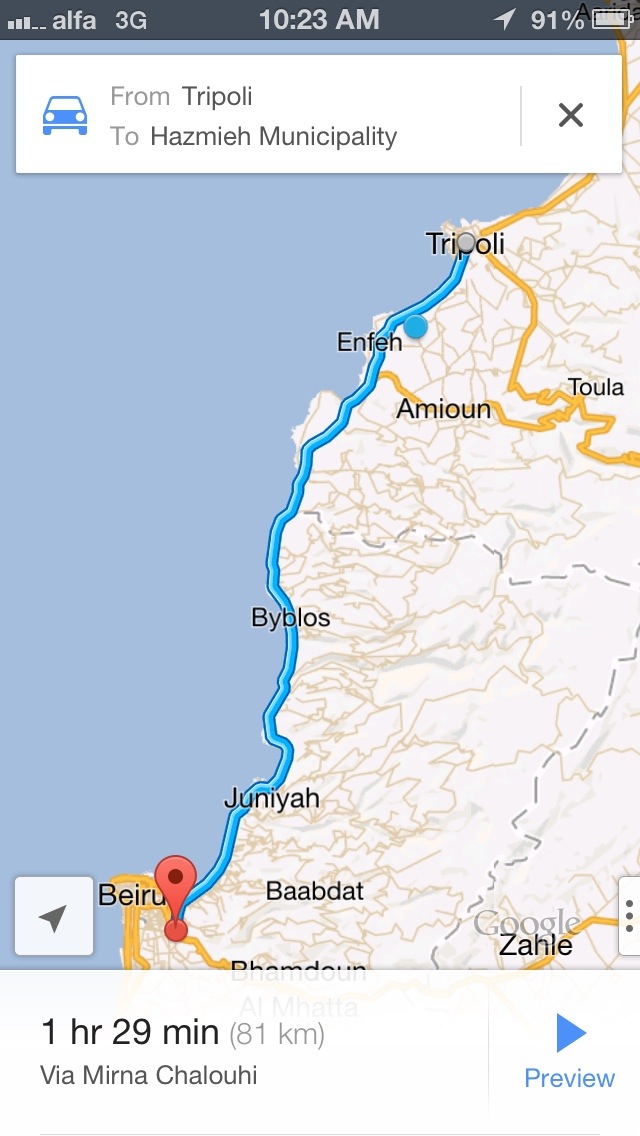
Is Carrefour overdoing the marketing blitz? Definitely. How so? Well, ask yourself this simple question: regardless of how much money you’d be saving, would you be willing to drive 81km in Lebanon in order to buy grocery?

20130403-180940.jpg

But that’s not the major hurdle Carrefour will be facing in Lebanon: it’s getting an entire country to have the paradigm shift I had when I stayed in France, something that other brands tried to do and failed.

Spinneys, for instance, does the same thing Carrefour will be doing in a few days: it offers its own tissues, its own grains, soda, chips, etc…. But people rarely buy them because we, as Lebanese, have somehow associated the cheapness of the brand and the fact that it isn’t as trustworthy compared to others with it not being good enough.
Carrefour, which is sending text messages to almost everyone in Lebanon, will not be cheaper than any of their other already present alternatives if people refuse to buy its brand which begets the question: will it be any different and do we really need another chain in the country?

20130403-181027.jpg

Besides, will the Carrefour brand be cheaper than what the market currently offers? For instance, will Carrefour yoghurt be cheaper than the one Taanayel offers? Or will it feature a price hike because it’s “signé” and imported from “Paghis” à la Paul and Fauchon and other French outlets in Lebanon?

Moreover, the success of Carrefour in Europe stems from it being accessible to everyone through small shops like the one I described previously. Few are the Carrefour hypermarkets across France but many are the mini markets, which makes any customer’s shopping experience more personal and less hectic.
In fact, the entire city of Lille, France’s 4th in size, has only one major Carrefour store in the city’s main mall Euralille. However, it has dozens of smaller Carrefours spread around the city and its suburbs offering almost the same thing.

Will Carrefour adopt the same approach in Lebanon? Or will it be the same thing all over again: spreading across the country in huge chains that won’t offer anything different from what’s already present?
If Carrefour wants to spread in Lebanon and offer a true alternative to the Lebanese, shouldn’t it start differently from what others did and not follow up with the current trend of you finding everything you need in malls only?

If Carrefour moves to Tripoli for instance, it will have a very hard time battling it out for market share with the wildly popular Spinneys. But if it offered smaller shops around the city, then people might end up making it their go-to place.

Perhaps market research showed some room for an alternative. But I don’t think the alternative is necessarily another grocery chain but a whole new approach to what’s already here: to get people to buy cheaper and equally good products, make things more accessible and make them need driving from Achrafieh and nearby Spinneys or TSC to said alternative.

I don’t think Carrefour will do that in its present form.

Vote For “A Separate State of Mind!”


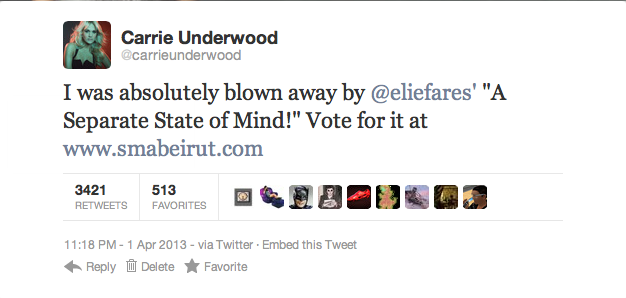
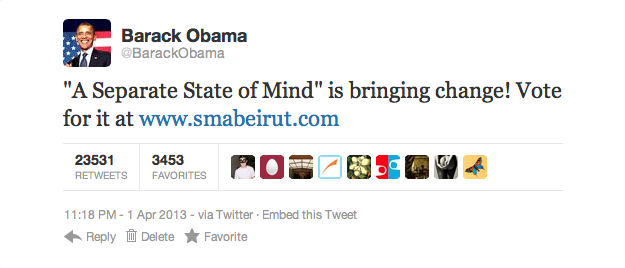
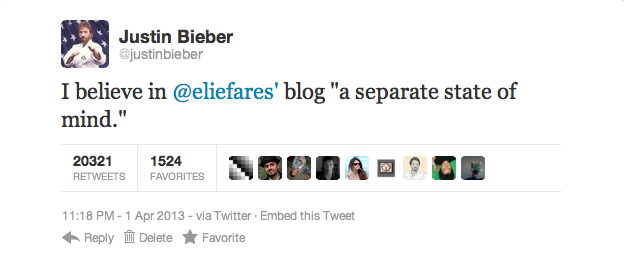
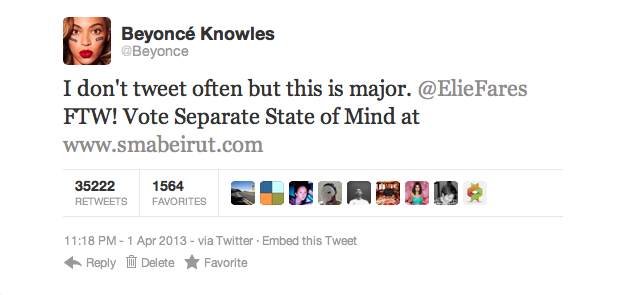
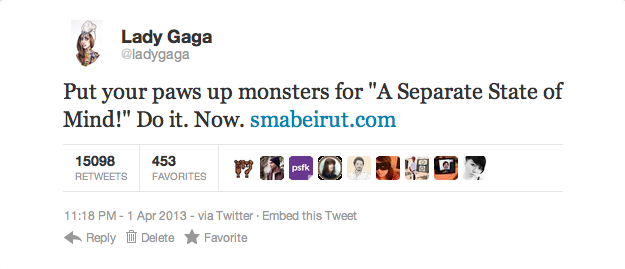
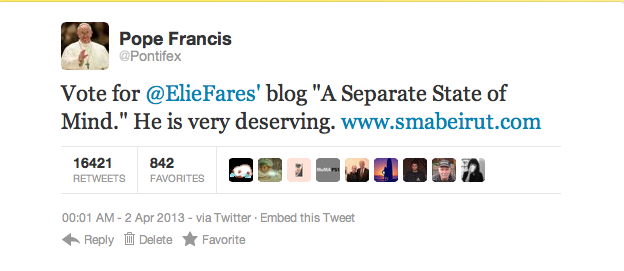
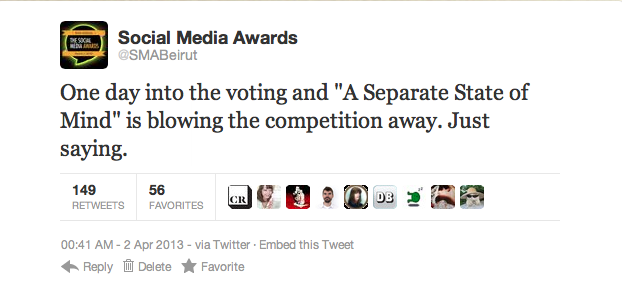
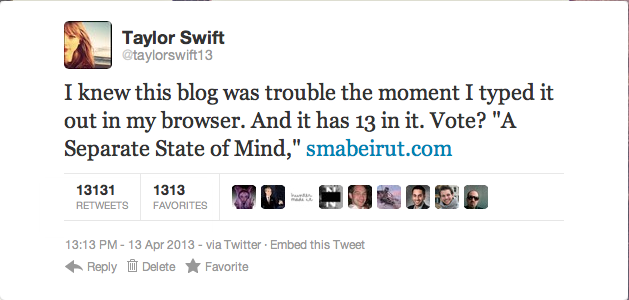
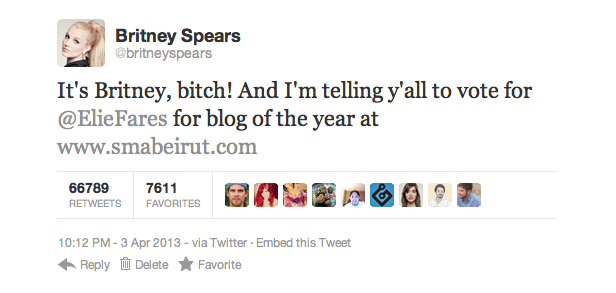
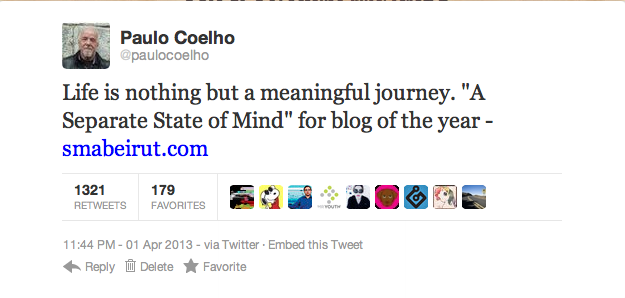
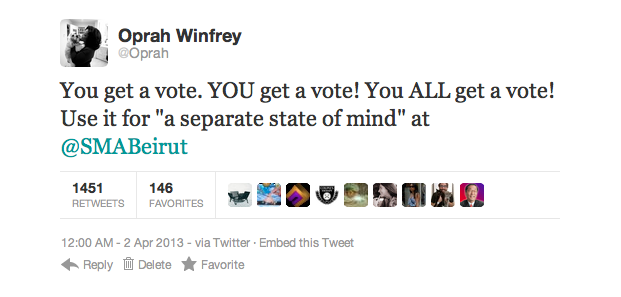
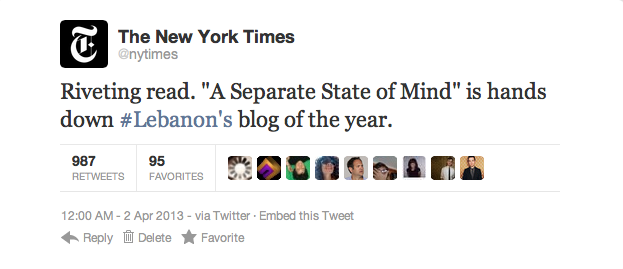
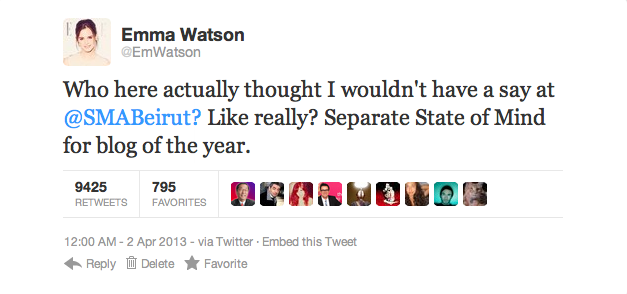
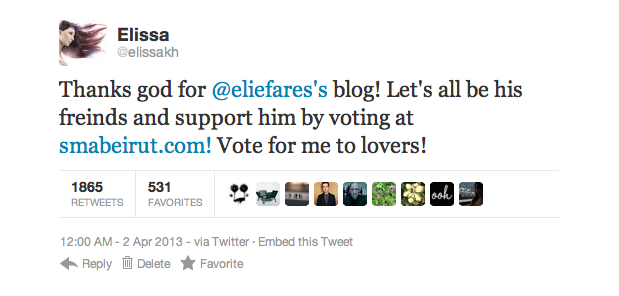
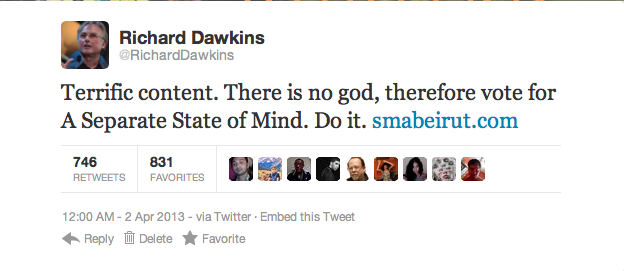
Overwhelming success! Celebrity endorsements! Awesome blog! You don’t believe me? Well, check these out:

Screen Shot 2013-04-01 at 11.20.32 PM Screen Shot 2013-04-01 at 11.21.14 PM Screen Shot 2013-04-01 at 11.22.21 PM Screen Shot 2013-04-01 at 11.23.25 PM Screen Shot 2013-04-01 at 11.24.36 PM Screen Shot 2013-04-01 at 11.26.53 PM Screen Shot 2013-04-01 at 11.27.40 PM Screen Shot 2013-04-01 at 11.44.07 PM

Screen Shot 2013-04-03 at 10.13.37 PM

Screen Shot 2013-04-01 at 11.45.10 PM Screen Shot 2013-04-02 at 12.02.54 AM Screen Shot 2013-04-02 at 12.04.09 AM Screen Shot 2013-04-02 at 12.06.32 AM Screen Shot 2013-04-02 at 12.08.47 AM Screen Shot 2013-04-02 at 12.11.08 AM

Well, not quite. The above tweets are not real. But they could have been. Am I right?

Ok, I’ll take my antipsychotic pill now.

Anyway, this blog is nominated for “Blog of the Year” and “Best News Blog” – I know, I know – at Beirut’s Social Media Awards. I’d appreciate your support.

  1. Go to www.smabeirut.com
  2. Log in with either your Facebook or Twitter account
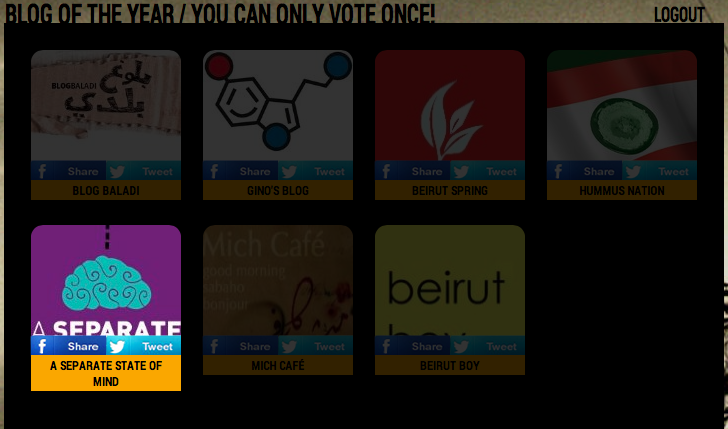
  3. Vote for “Separate State of Mind” in the first two categories. You can only vote once so be careful to choose right! Voting happens by clicking on the “vote” button next to my blog’s picture (that of a brain).
  4. Tell your friends.
  5. Come back here to receive your cyber hug.

This is how your screen turns once you’re successful:

Screen Shot 2013-04-02 at 7.54.44 PM

Thank you awesome readers!


Beirut Bel Aswad Wel Abiad (Beirut in Black & White) – A Lebanese Short Movie

This Woody Allen-inspired short movie is one of the best ones I’ve seen lately. It’s directed by Alba student Marie-Louise Elia and produced by Marie-Noel Bou Haila (A lot of Maries in one sentence). You can find the former on Twitter here.

It’s a candid, honest, funny, sarcastic and extremely witty portrayal of Beirut – characteristics you rarely find this authentically in Lebanese productions. Many aspire to incorporate such elements in their movies but end up coming off as over-pretentious instead. Not this one.

The director, Marie-Louise Elia, is currently searching for actors for her upcoming movie. So if you’re interested, talk to her on Twitter. If her upcoming work is anything as good as this, it’ll look good on your resumé.