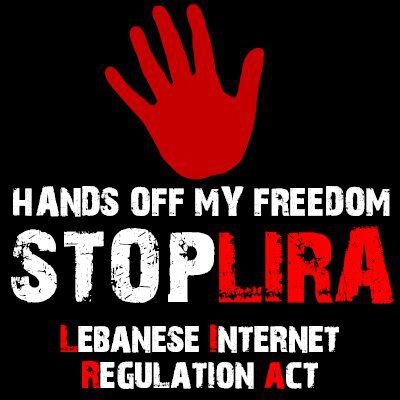
LIRA: The Lebanese Internet Regulatory Act – What You Need To Know

The news about an internet regulatory act, targeting Lebanese bloggers mainly, surfaced a few months ago and then died down. No one had taken the whole affair seriously. After all, in the country of freedom of the Middle East, such a thing could never be viable – or so we thought.

Efforts by minister Walid Daouk to pass the law have exponentially increased recently, including him bypassing parliament and taking the law immediately to his cabinet, an obvious breach of hierarchy, but what could you expect from a minister in a cabinet that has done next to nothing in the year it has been ruling except create hurdles for itself, protest on itself, quit within itself and preach about “shortcomings” of previous governments?

Al-Nahar has published the law in its current form. Blogger Joseph Choufani has translated it to English as well, for those of you who cannot read Arabic.

The law has been dubbed LIRA – the Lebanese Internet Regulatory Act, an interesting name if you ask me. It is the Lebanese version of SOPA and PIPA, which took the internet by storm back in Janurary.

What does the average Lebanese user need to know about LIRA?

Simply put, for a blogger like me, I’ll have to register my blog with the ministry of Information. For me to be able to run this blog, I shouldn’t have committed any crimes or misdemeanors. So if your judicial record is not “clean,” you cannot express yourself online (or even in voting but that’s a different matter) – so your voice is quenched. I also cannot run more than one blog at a time. So you’re stuck with “A Separate State of Mind” by yours truly.

For people using electronic media, the same rules regarding journalism will apply to you. Never mind the fact that most of us use electronic media as a carefree medium to express ourselves, the minister expects us now to behave on our blogs, online accounts and any other social network we are present on as if we are journalists in some fancy Lebanese newspaper – with punishments applicable.

On top of that, the law is actually very vague. It states that every Lebanese website needs to go through the proposed regulations. But what’s the definition of a “Lebanese” website? Is it one hosted in Lebanon? Is it one whose domain has been purchased by a Lebanese?

In simple and concise terms, your whole online presence will have to go through in a way that is approved and clear to the Ministry of Information, conforming with the rules it has set for you.

As BeirutSpring points out, the motivation behind such a law is not to “protect” Lebanese internet users but rather to have a 21st century big brother presence over them, punishing those who stray away from the pack set forth by the law at hand. In a time when neighboring countries are moving towards more freedom (regardless of what you think of the process taking them there), Lebanon, the country which has the most freedom out of the bunch, is taking steps backwards.

This is not only detrimental to us as individuals, it is also detrimental to us a society at a time where online presence has become a make it or break it deal for businesses, people and everything in between. If Lebanon’s online presence, however dismal that may be with our horrible internet, is threatened by regulations on top of our pitiful bandwidth, then we might as well kiss our position in the 21st century bye bye.

Minister Daouk must heard Somalia’s information darkness is very nice all year round. If you care to join him, be my guest. If you don’t, Lebanon’s online community has decided to fight the bill using the medium the act is trying to regulate. The hashtag #StopLIRA will be used on Twitter. Sharing articles with your friends (such as this one) to raise awareness about the issue is a must. Get going, everyone.


 

Lebanese Memes: You Know It’s True

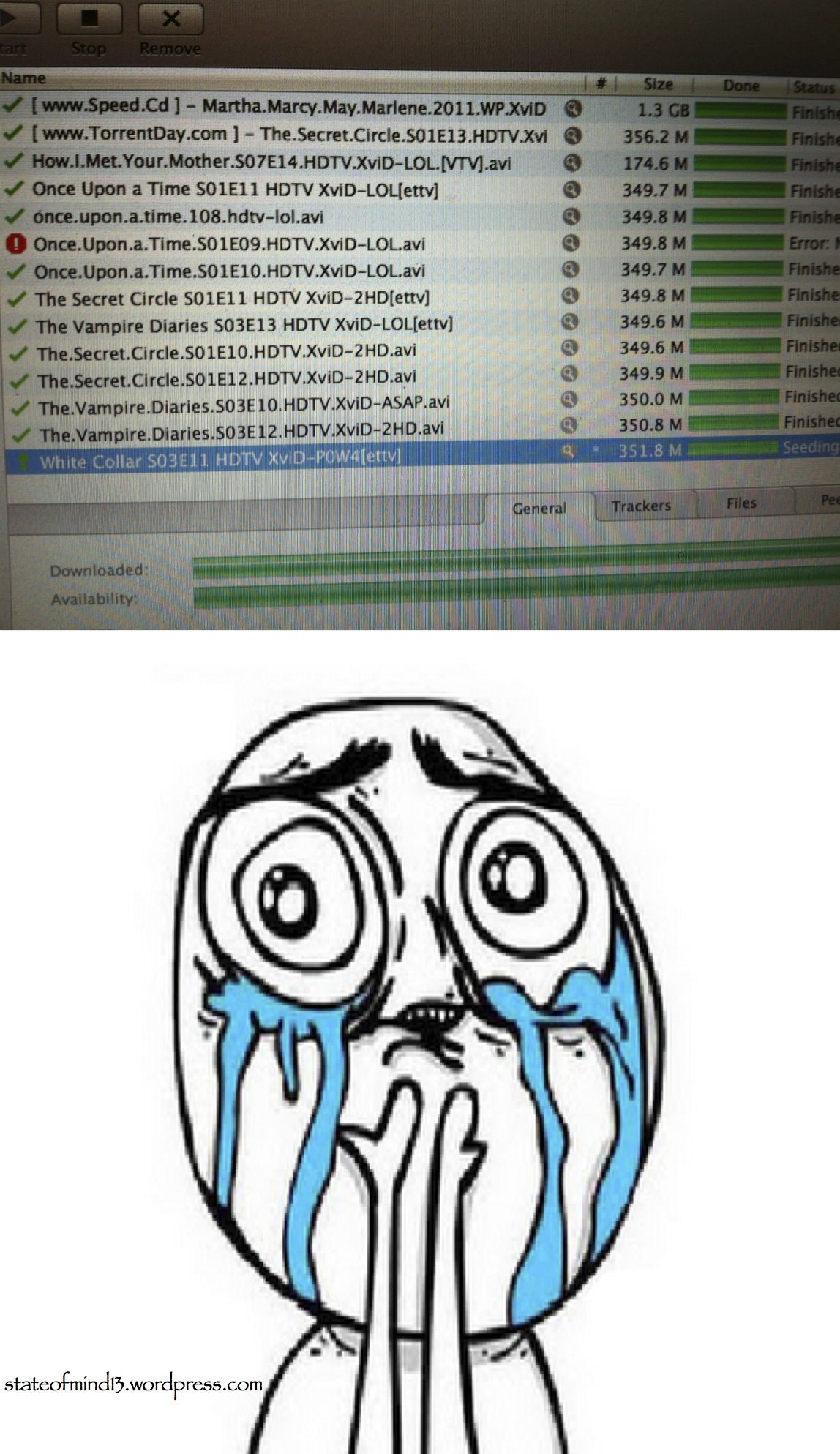
This meme was submitted by my friend Maguy after recently traveling to Abu Dhabi.

For reference, this is what she downloaded in 30 minutes:

On an unrelated note, if you don’t watch The Vampire Diaries, start putting it in your downloads queue.


Lebanon’s Alfa Telecom Announces 3G Packages

Alfa Telecom, one of Lebanon’s two mobile carriers, has announced its 3G packages, ahead of the service launch on November 1st.

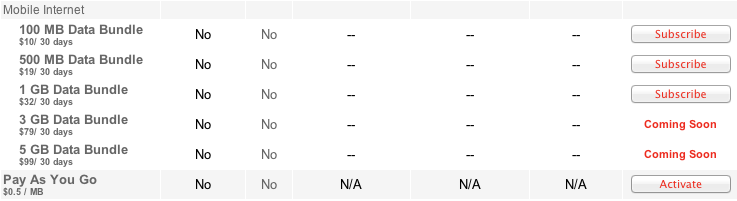
5 packages are being offered ranging from 100MB to 5 GB in quota and from $10 to $99 in prices, as well as a pay as you go plan, which is tariffed per MB.

Alfa will also be offering data sim cards for users for dongles that connect to laptops, as well as 3G-equipped tablets such as the iPad 3G.

It is important to note, however, that you will not be able to accumulate any MBs that remain and add them up to your upcoming month’s quota. You can also continue using these plans, beyond their allocated quotas, and be charged per extra MB.

These plans are available for both prepaid and postpaid subscribers.

As for 3G coverage, starting November 1st, Alfa will have Beirut city covered, as well as most of Mount Lebanon and Tripoli, with coverage to increase in the coming months.

MTC, on the other hand, has announced it will be covering Beirut, Tripoli and Saida in its first phase starting November 1st and its packages will most probably be the same – although they have only confirmed the $10 and $19 packages.

For more info on 3G in Lebanon, you can check this post. 

3G in Lebanon: Prices, Launch Date and Testing Experience

For those who don’t know, minister of telecommunications Nicolas Sahnaoui unveiled the 3G packages we’ve all been waiting for today.

The main package will be 500MB for a $19 monthly fee.

A smaller 100 MB package for $10 exists as well for those who don’t need extensive data.

Nothing has been mentioned about more data extensive package or if there will be a package suitable for those who need a laptop 3G connection via a dongle only.

Each extra MB of consumption will be charged at 4 cents/MB.

The service will launch on November 1st in Beirut and Mount Lebanon on both carriers Alfa and MTC and will be available for both prepaid and postpaid lines.

Sahnaoui also announced that 4G will be available in Lebanon starting Summer 2012, allowing speeds up to 100 Mb/s, after the initial phase of the fiber optics infrastructure upheaval ends.

What do I personally think of the proposed plans? The $10 one (if true) doesn’t make sense. I’d rather pay double to get five times the allowed quota. But is 500MB enough with 3G? I hardly think so. It’s very easy to burn through them without knowing due to the great speed the service provides. On the bright side, the cost of an extra MB isn’t that much so it might help a little.

However, does the claim that Lebanon’s 3G is the cheapest in the region hold up? Let’s look at 3G prices in KSA:

1GB for 50 Riyals (20,000L.L. or about $13.5), 5GB for1 100 Riyals (40,000L.L. or $36), Unlimited for 350 Riyals(140,000L.L. or $93)
So we definitely do not have the cheapest 3G in the region.

However how is 3G? I can answer that question.

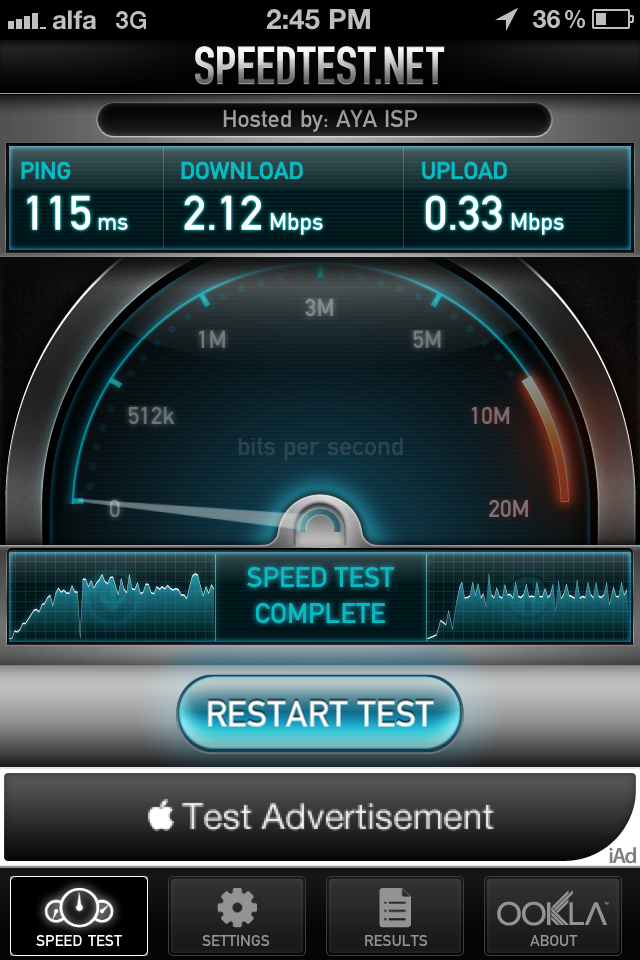
After testing the service for four weeks, I can attest to its reliability – especially in Beirut – on alfa. I was getting speeds no less than 2 Mbps in Achrafieh and faced next to no data interruptions using my iPhone’s hotspot feature to connect to my laptop. I’ve gotten download speeds nearing 300 KB/s, which is more than what I got using 3G in Spain. For reference, a 350 MB episode of the Vampire Diaries took me about 20 minutes to download, which is almost unheard of in Lebanon.

Cynics have been saying that the 3G speeds the 4000 testers were getting are good just because you only have 4000 testers. However, after speaking to an alfa representative, he confirmed that they were not deploying the whole bandwidth they had for those 4000 testers so it could be that when 3G becomes available for the public, speed degradations will be rare.

3G coverage in Jbeil, however, has been very spotty. I didn’t manage to get 3G almost anywhere I went in the city and the moments I did get 3G, download speed was horrible, knowing that Jbeil was one of the covered cities during the testing period.

Tripoli, which wasn’t on the map my carrier alfa provided me with, had great 3G coverage, with speeds averaging 1.7 Mbps as well.

It is interesting to note, however, that I managed to get up to 5Mbps on 3G in Sodeco area in Achrafieh:


3G in Lebanon To Be Delayed and Not Launch in October?

4000 lucky people are already using the service – of which I am one – but for the rest of Lebanon, the tantalizing dream of faster internet will possibly just stay a dream.

Personally, I found the area of coverage in the test pilot to be sort of absurd. Why is it that only Mount Lebanon and Beirut are the covered areas? Shouldn’t at least Lebanon’s major cities (Batroun, Amioun, Tripoli, Saida, etc…) be covered as well to get a broader picture of how the service acts in those locations?

However, while using it in Beirut, I’ve found the service to be seamless. I burned through 30 MB of data within minutes and without knowing. And no, I wasn’t streaming on YouTube. The only drawback was something I had also experienced while backpacking across Spain and France: battery life is murdered.

I was getting speeds of about 2 Mbps, which is very comparable – and even better – to the speeds I was using on Spain’s Orange and France’s SFR. Coverage, however, even in Beirut, was still quite spotty and I found my iPhone switching back and forth between edge and 3G frequently.

But basically everyone was waiting for October to roll around so we can put the smart in our smartphones and actually have data plans that would hopefully bring the country and us forward. But it looks like it won’t happen.

Just today, Lebanon’s Shawra council, responsible to uphold whatever little law is applied in this country, has ordered the rolling of 3G services to stop. The degree itself says the delay should happen for a month. But we all know how things in happen tend to be delayed. Why? They cited “illegal” actions taken place by the Ministry of Telecommunication at the hand of both former minister Charbel Nahhas and current one Nicolas Sahnaoui.”

Change and reform, indeed.