Just a Bachir Gemayel Speech from 1979

This is Bachir Gemayel

I recently started reading a book by Rani Geha, which has the speeches late Lebanese president Bashir Gemayel between 1979 and 1982, titled: “Words from Bashir.”

With the little time I have with Med School and all, my advancement with the book has been rather slow. But it’s still an eye-opening experience to see such speeches on paper and how true they reflect on Lebanese society and politics today.

In February 1979 and in a speech in front of a crowd in Jal El Dib, the main points Bachir Gemayel made are as follows:

1) There is a need for a radical change to move the Lebanese state from one that is subservient to Syria and Palestine to one that only answers to its own people.

2) We need a Lebanon where the foreign ministry is the foreign ministry of Lebanon, not a spokesperson for Syria or Palestine or any other nation.

3) The institutions in Lebanon need to be the property of the Lebanese citizen.

4) Lebanon is too small to be divided: one part for the Syrians, one part for the Palestinians and one tiny part for the Lebanese.

5) Those who want to grant the Palestinians a country, let them grant that country from their own share not from Lebanon’s share.

6) Let the West appease the Arabs as long as the Arabs produce oil. The West is losing its values and, as such, we cannot rely on it for support anymore.

7) Syrian entities in Lebanese uniforms, using Lebanese weapons, are not to be accepted as part of the country we want to live in.

8) In 1958, the Arabs had Abdel Nasser. Today (1979) they have Hafez Al Assad. The school of thought shared by these two men can bring nothing but a catastrophe.

9) From 1943 to 1975, we were ruled by a school of thought that never believed Lebanon to have a cause or anything to fight for. We were governed by a school of thought that supposed we should unconditionally align ourselves with whichever Arab nation proved to be the strongest, in a way to keep our heads, while internally we were ruled by apparatuses and typewriters. We were ruled my moral submission.

10) Many Lebanese do not have the faith and self-confidence that they have can change things on the ground, creating a de-facto situation that many nations around the globe take use of.

The fact that these 10 points are still as true today as they were in 1979 is not a reflection on our society but it’s a reflection on our region. The school of thought shared by Abdel Nassar and Assad is still alive and kicking today, actively patroned by their descendants. We even have a statue for one of them on Beirut’s sea promenade. There is constant talk about nationalizing the Palestinians in Lebanon, giving them a piece of a country they are not entitled to. There is constant talk about taking out Syrian intelligence and arms from inside Lebanon.

And it all stays as such… talks. Why? Because at the end of the day, there’s simply so much that a Lebanese can do in going against the current of what the big nations want. But you know what, for what it’s worth, and looking at the circumstances we’re living in, we’re not doing very bad for ourselves. 

Until then, long live the memory of a president whose words resonate true 33 years later.

Lebanon’s Electricity Crisis: The Gebran Bassil Paradigm

As I’m writing this, I’m looking at the light bulb we have installed in our house to let us know if the electricity we’re having is provided by our “moteur” subscriber or by Electricite du Liban. It is lit. So much for EDL.

What’s troubling is that this lightbulb has been lit a lot these past few days. Hold on, I stand corrected. This light bulb has been lit a lot these past two months. I know this firsthand because my father is one of those moteur providers you like to hate so much for overcharging you. But when you don’t get electricity for 330 hours in a given month, the moteur provider will have to charge you.

What I don’t get, however, is why Lebanon’s electricity has suddenly gone into dying mode, especially in the last two months. I understand having to go through a weekend of total blackout in Beirut due to a protest in a power plant. But to go on for two months without getting half a day of coverage is way exaggerated if you ask me.

Has Lebanon’s need for power suddenly exponentially increased beyond what it was a couple of months ago? I hardly think so. Did the dismal capacity of our power plants exponentially decline in the past two months? I hardly think so as well. What has changed in the last two months is the way the Minister of Energy’s brain neurons are firing.

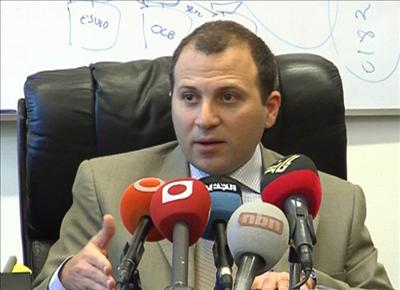
This is Gebran Bassil – Batroun’s “pride and joy”

I’ll just come out and say it. I do not like Gebran Bassil. Never have and I’m guessing never will. Perhaps that’s why we voted against him and got him to lose twice. But how good is that when he’s always finding his way to power?

Gebran Bassil reminds me of kindergarten days. That short, plumped bully kid you all hate and have no idea how he can actually bully everyone. Then you remember. Someone has his back. The fact that he lost two successive parliamentary elections and still made his way to three successive cabinets, even becoming a major hurdle to the instillment of the second, is only indicative of how spoiled he is and how used he is to getting his way, never hearing no as an answer to anything he requests.

The latest? He’s actually threatening the current government of taking it to the streets to get his way when it comes to the proposed electricity bill. I’m not sure he knows this but wouldn’t he be protesting against his own allies? And wouldn’t taking it to the streets to fight for a proposed law be a hurdle towards the advancement of a state the way Michel Aoun & co want it – “change and reform”?

As far as I’m concerned, when it comes to the electricity situation in Lebanon nowadays, Gebran Bassil is not reforming. He is deforming. There’s nothing working about it. And as long as he keeps acting like an insolent brat and not a minister, it will not head in the right direction anytime soon.

Perhaps when a politician’s allies are not responsive to the “plans” he or she is introducing would be an obvious enough hint that they’re doing something wrong. But I guess that logic doesn’t flow well with Mr. Bassil. The fact that he is part of a one-sided government and is constantly facing hurdles doesn’t warrant him to feel paranoid and targeted. It simply means he’s not doing things right.

So dear Lebanese, plan your showers according to the electricity cycles in your correspondent region. If your electricity coverage is not adequate, there’s always a bucket and a stove for you. Or better yet, plan your whole life to constantly fluctuating electricity cycles. Let’s add another fear to the long list a Lebanese society suffers from: electrophobia.

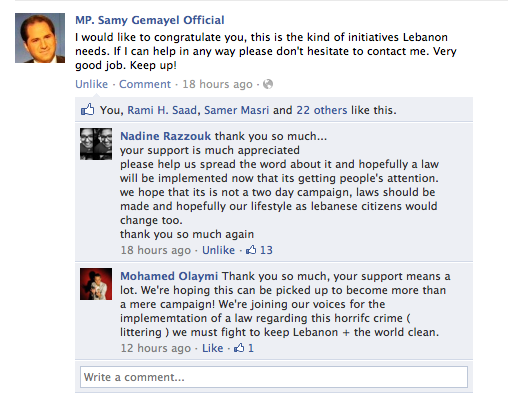
MP Samy Gemayel Supports the Metel Ma Shelta Campaign

Behold, Samy Gemayel has supported the Metel Ma Shelta anti-littering campaign, which I blogged about a few days ago:

Moreover, LBC News has also written about the campaign on their website.

I’m very glad the campaign is gaining traction. The number of likes for the Facebook page, as of the time of writing this post, has exceeded 1900. Here’s hoping the support of Samy Gemayel, and hopefully other MPs soon, results in the formulation of a much needed law to help keep our streets clean.

You might be interested in checking out their teaser video as well:

This campaign is shaping up to be quite big. Hopefully the circumstances help it assume its full potential.

The Lebanese Hypocrisy Towards Syria: Three Fishermen Kidnapped by Syrian Navy in North Lebanon

I had blogged a while back about how the Syrian occupation of Lebanon can be considered at least as bad as the Israeli occupation of the South. I still stand by what I said. You can check that post here.

The latest regarding the Lebanese-Syrian relationship is the Syrian navy kidnapping three Lebanese fishermen (Arabic article) from the North after having their boat enter four nautical miles into Lebanon’s marine territory. Perhaps a mile can be considered as a sailing error. But four? Let’s not beat around the bush here. This was an obvious breach of Lebanese sovereignty. One of the fishermen, aged 16, has died. What is our government doing about this? Absolutely nothing.

This is but one part of a series of transgressions that the Syrian army and regime do on a daily basis in Lebanon. And yet we fail to act. Our voices are never heard when we speak against the Syrian breaches. They can kidnap our people, they can enter our land, our sea, terrorize villagers on the borders…. We do nothing. We sit around and watch TV and hope for the best.

Not let’s contrast/compare this with the Israeli scenario.

An Israeli boat enters four miles into Lebanon’s nautical territory, you’d be constantly bombarded about it in the news. An hour later, Lebanon would have had an official complaint filed in the UN. If that same boat had kidnapped three Lebanese fishermen, rockets would have been fired from the South on Israel. A war might have been started (it’s not like the 2006 war had a bigger apparent reason).

The only difference between Israel and Syria? Israel is an enemy state whilst Syria is not. The difference between what Israel and Syria do regarding Lebanon? Absolutely nothing.

“Activists,” as they like to call themselves, shout and protest against anything Israel-related in Lebanon. They have the right to, obviously, freedom of speech and all. I don’t think, however, they have the right to shove their views down everyone’s throats (especially when it comes to irrelevant matters that won’t change anything). I want to see what those “activists” will do regarding this latest Syrian breach. The answer is actually already known. It’s exactly what they have done regarding the previous transgressions: absolutely nothing.

A couple of months ago, in my anatomy lab at med school, one of the doctors told us a story. He told us about when he was in Med School at USJ and one of his professors was the late Dr. Fadi Serhal. They used to discuss politics with him. Amin Gemayel, the president back then, was going to sign the May 17 treaty. So they asked Mr. Serhal, who was an MP back then, about the situation. His reply was as follows:

“Lebanon is bound in the South by Israel. It’s bound everywhere else by Syria. If there was anything happening for the benefit of Lebanon, you should be more than certain that it will be disturbed by one of those two countries: either Israel or Syria or Israel and Syria working together.”

This was about thirty years ago. It still applies today. It’s also high time we see it as such.

The Jal El Dib Bridge & The Case of Mass Lebanese Hysteria

Sure, Lebanon’s infrastructure isn’t exactly top notch. Who are we kidding, Lebanon’s infrastructure can barely be called infrastructure.  Some of the roads have massive potholes in them that can damage your car sometimes beyond repair. I saw potholes in France and Spain when I visited back in August but you know those potholes will get fixed as soon as possible there. The only way ours get fixed is someone dying because of a car accident caused by those potholes or sometime in May 2013, just before the elections.

As you know, an Achrafieh building collapsed on Sunday, taking the lives of 26 people with it. Everyone was rightfully saddened by that tragedy and many people have sought ways they could help. Soon enough, however, people started panicking about the Jal El Dib metal bridge, as well as the Charles Helou bridge in Beirut, calling them unsafe and nearing crumbling.

Those bridges are definitely high-risk. The Jal El Dib was supposed to be a “temporary” bridge until they build a better structure in its place. But one cannot but wonder, as Beirut Spring pointed out, if this is simply Lebanese hysteria (which usually lasts a few days to a week) after a national tragedy that involved infrastructure. It happened with the

Sure, both bridges are poorly maintained. The Jal El Dib bridge doesn’t even have asphalt on it anymore. We’ve been driving our cars on metal for the past four years. If that’s not enough reason to have the bridge changed, I don’t know what is. However, is the bridge about to collapse? A civil engineer friend of mine told me there’s no proof based on the pictures taken of the bridge that it is about to do so.

One of the ministers in our government, however, so aptly declared that it is about to collapse, which sent the people into a frenzy. And yet, a few days later, the bridge was still not removed. You’d think a minister declaring such a thing would get the government to work in order to expedite whatever paperwork they are cowering behind. Apparently not.

In fact, the level of panic got to a whole new level when normal Friday traffic around the Jal El Dib area was perceived by many as caused by the removal of the bridge, which didn’t as of this post happen yet. And as it is with our Lebanese lifestyle, this time next week people would have moved on to another story altogether and the bridges which should have been removed a couple of years ago will remain there for a couple of years more.

At the end of the day, life goes on, people forget… so until the next tragedy, cheers to our resilience my fellow Lebanese.