The whole “Beirut is for Beirutis” slogan that the winning Municipal board ran with is officially in full swing with them making sure Beirut is as such, for any Beiruti who can afford to pay $40 and above to spend a Saturday or Sunday at a beach that used to be the only place to unite the city’s residents, across their socioeconomic strata.
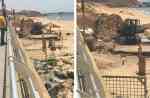
Images have surfaced yesterday of construction beginning to take place in Ramlet el Bayda, with the first step being destroying the places where the beach goers used to sip on their drinks or rest in between their swims.
Ironically, the facility being destroyed is also something that should not be there, given that it exists on public property and is most likely not regulated by any form of governance. But let’s not kid ourselves and pretend the above move is for the well-being of the beach, or for any other actual legal matter.
Rumor has it that Ramlet el Bayda will soon be turned into a private complex for cabins and chalets by Achour development. The project’s info could be found at this link.
For many, Ramlet el Bayda was the only beach in Beirut where they were able to take their children for a swim, with every single place around it becoming a location where people like them are often considered persona non grata.
They are doing to Ramlet el Bayda the same thing they tried to do to Dalieh: wall it off from us, the people, who have the right for this beach and land to become a place for everyone to visit, not just those who are able to afford it.
They want to turn Ramlet el Bayda from a beach for everyone, to a resort for the select few. As their plans start going into action, the city of Beirut bids farewell to its last free space to the Mediterranean. Everywhere else has been claimed by businessmen and politicians who know their power is always above the laws that say our shores are forever ours, and never theirs.
To make things worse, and even though these images have been online for around 24 hours, no media has discussed them or at least critically looked at the issue to unearth the deal behind it. Have we become to apathetic that this has become just another corruption entity for us to gulp down?
A resort at Ramlet el Bayda will probably also have lasting environmental impact on a city where public spaces are rarer than the tourists roaming its streets these days. Maybe they believe, after opening Horsh Beirut, that we have right to only one public space?
In the battle for Beirut to keep hold to an identity that makes it unique, one thing is for sure: we are losing. With each building they destroy, we lose. With each street they erase, we lose. With each beach they claim, we lose. When will their greed ever stop? I guess until Beirut has no more places for us to cling to.
You’ve seen the billboards all over the highway. They sort of came out of nowhere, didn’t they? The latest pop sensation to overtake the country, if you don’t account for Sejaan Azzi’s dismissal from the Kataeb party, is an 80’s influenced, mustache-heavy man who’s throwing it back to the when the overbearing Lebanese father figure was in.
Ladies and gentlemen, I’m talking about the one and only Nabil Harfouch, whose “albo” is making every other “alb” in this country swoon.
Never mind the fact that, according to twitter user @TawaNicolas, the song might be remixed to the following once they break up:
No, we are facing a serious work of art the likes of which the Lebanese republic has not witnessed since Fairuz released “Kifak Enta” back when songs had a purpose.
Please note the Cross on Nabil Harfouch’s wrist. This is a pious man, whose religiosity plays a very big reason in him becoming so “in” right now. After all, who dares not buy this man’s singles when Jesus is on his side?
In fact, Nabil Harfouch’s religion could be the exact reason why he is all over our highways today. But before we delve into the juicy details of Harfouch’s past, ones that rival Haifa Wehbe’s Hezbollah affiliated days, let us rewind.
A few years ago, Nabil Harfouch was just another middle-aged man who woke up one day and remembered he had a dream. You see, Martin Luther King had a dream, but so did Nabil. So he released a song in his attempt to become the next Ragheb Alama.
That song, titled “Touwsayeh,” was Nabil Harfouch’s combination of his two biggest passions in life: Women and God. In the song, he claims that God ordered his love interest specifically made for him. The magnum opus can be listened to below:
Almost 4 years later, and only 1200 hits on YouTube later, it’s safe to say the song did not take off. At all. So Mr. Harfouch realized that the best way to make it big in the showbiz business was to have lots of money and spend it on branding.
But where does a helpless hopeless pious man like Mr. Harfouch get all the money? Lightbulb! Religion, of course.
As reported by Rima Karaki last year (link), and as has surfaced on Facebook, Mr. Harfouch, along with his futuristic and pioneering lyricist Naji Sfeir, created a charity that they named after St. Rita which, for years, took money out of religious people’s pockets for a variety of religious reasons, such as investments and projects for Mr. Harfouch and Mr. Sfeir. The Maronite Church eventually caught up and closed down the charity, but not before the duo had made millions, reportedly.
So what does a Lebanese nouveau riche do? Buy yachts? Iftar at the Four Seasons? An apartment in Burj Hammoud? Nope! You start a singing career, of course. Or rather, restart it.
So, instilling a photoshop team from 2003, Harfouch and Sfeir decided they would take the country by storm. And hence came to be… “Dalli D7aki” (Keep Smiling), a song for Mother’s Day.
They filled our streets with the song’s billboards. They inundated our visual fields with their stellar works of art. The song, however, remained quite elusive, and the question remained: what would Mr. Harfouch’s mother do? Not listen to the song would be my top bet.
This song being extremely occasion specific couldn’t make a dent for Mr. Harfouch in the artistic domain. So he decided to go back to the drawing board. He figured people wouldn’t remember two failed attempts, so let’s plan for a summery comeback, one that would be with a bang. This time, the bang was in the hair because Mr. Harfouch got implants.
And here came to be Ya Albi, a song about Mr. Harfouch’s heart. While driving to Beirut from the North (#TeamNorth) yesterday, I decided to see where Harfouch had released the song. Like all the greats, he gave Anghami the exclusive.
“Ya Albi” has been on the region’s prime streaming service for weeks now, and has only amassed a couple thousand streams. Not to brag, but if I taped my cousin Yasmina blabbing, she would get more streams than that.
My friends and I wondered why a song that has taken up every single visual field point of our streets would fail to resonate this massively. Could it be that the song just sucked? The only way to know was to listen to it. So we did.
It started.
Albi, Ya albi
Albi albi albi, Ya albi
Albi albi albi
Albi ya albi
Albi albi albi
Albi ya albi
Wlak Albi albi albi
Albi ya albi
I’m not sure if any of you counted, but the opening lyrics of the song is nothing more than Nabil Harfouch wailing about his heart, 21 times to be exact. And then came in the first verse:
Albi ma7rou2 w mekwi
Darbetou akbar berhan
Dammak mech 3am temchi
3el2ane bi noss el sheryan
This is pure medical knowledge right there. For the few seconds in which those lyrics reverberated off my speakers and onto my ear ossicles, I felt a rush of cardiology take over me. Can anyone else even?
At this point, popular request was to stop the song and listen to anything else instead, even Maya Diab. But we persevered:
Albi albi albi
Albi ya albi
Albi albi albi
Albi ya albi
Ya albi chou sayer fik
Wa7dak b rou7e tsawik
Ya albi chou sayir feek
Rou7e enta
3omre enta
Rou7e enta
3omre enta
rou7e enta wou 3omre enta
rou7e enta wou 3omre enta
Ana 3ayesh dayib fik
In case you’re keeping count, we’re up to 34 “albi”s at this point. I won’t bother counting “rou7e” and “3omre” because why bother.
Albi albi albi
Albi ya albi
Wlek albi albi albi
Albi ya albi
Ya seken bi 2akhe
Jra7ak Jra7e
Dawahon ya rou7e
Dawahon ya rou7e
Dawahon ya rou7e
Dawahon ya rou7e
Dawahon ya rou7e
Teskon fike
w eskon fiyye
Rou7e enta
3omre enta
Rou7e enta
3omre enta
Rou7e enta
3omre enta
Rou7e enta
3omre enta
Rou7e enta
3omre enta
Ana 3ayesh dayeb fik
Albi albi albi, ya albi
Albi albi albi, ya albi
Albi ya albi
I have this feeling that, when done writing and recording, the duo behind this song couldn’t help but have a *mic drop* moment.
I, on the other hand, took a few moments to collect my jaw off the floor of my car, take my hands and pat my bleeding ears. Yes, Lebanon has a new singing sensation. And honestly, I can’t wait for when she dumps him.
The National Centre for Marine Sciences, based in Batroun, has been doing a study over the past several months about the quality of the water at several Lebanese beach areas, from the tip of the North to Naqoura in the South.
As such, they’ve come up with the following infographic about which beaches to go to and which ones to avoid this summer:
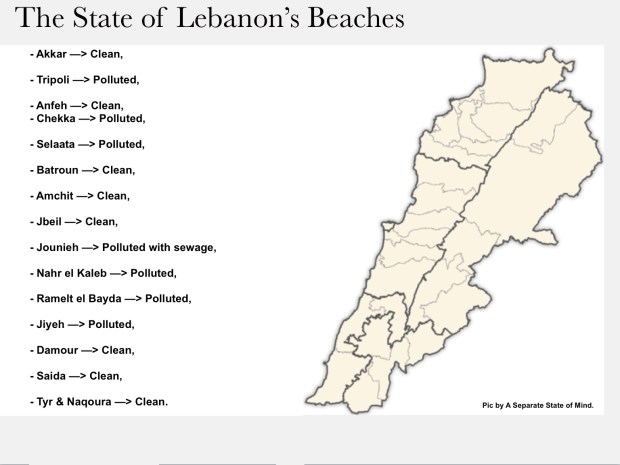
As expected, the best beaches in the country are in the Batroun area in the North and the Tyr/Naqoura area in the South, which has the country’s cleanest shores.
This means that it is our responsibility as Lebanese to avoid the beaches in areas marked as severely polluted, for the better health of ourselves and our loved ones. Polluted water may not have immediate effects from one swim, but recurrent exposures are bound to have detrimental effects on our well-being.
As such, the resorts in areas affected by high pollution rates should take it upon them to clean up their water if they still want people to pay the horrifying amounts of money they charge for entry. And if not, then we have entire areas in the North and South where many free beaches exist and where the water is as pristine as it is clean.
News of an explosion in the Verdun area of Beirut is currently the most horrifying thing to happen in Lebanon in a long time.
The positive aspect of things is that the damage seems to be only material with BLOM’s HQ being the apparent target. As of now, there are no casualties. The attack happening around Iftar time means that few people were around the area as well.
At a time when some entities want this to become a reality for us in Lebanon, no casualties is a sigh of relief.
One has to wonder though, how did the UN, Canadian and French embassies know that such a thing would happen over the weekend and we, as Lebanese, had no inkling or warning whatsoever?
The pictures at the top of the article are two statements issued by the UN and the Canadian authorities respectively to their constituents to avoid the specific area of Beirut that was targeted, and Hamra in general.
Two days ago, the French Foreign Affairs ministry escalated Lebanon’s security status and warned its citizens from visiting the country.
The above also applies to the instructions workers at international NGOs operating in the country received this weekend.
The question therefore begets itself: where was our entire security apparatus from all of this? Why is our worth as Lebanese always less than every single other nationality in our own country? If international agencies and foreign countries had suspicions that such a thing could happen, were our security forces not aware or were they not in the loop to begin with?
No casualties is no excuse for us to let such a thing pass by unnoticed. It is our right as Lebanese to live in our country with the utmost levels of security, not to be second class entities in our own land and in our own homes.
Right now is not the time to discuss the politics of such an attack and whether it occurring is obvious or not, or whether the context of such an attack and the bank it targets points fingers. Right now is the time to hope that no innocent life has been lost in this country for being at the wrong place at the wrong time once again, for us being perpetual victims of our existence in this land.
Robert Fadel, you have failed your city.
Lebanese media, you have failed Tripoli yet again and the country once more.
Lebanese people of all kinds, you have fallen once more to your preconceptions about Lebanon’s poorest city and turned it, once again, to a sectarian haven where those scary-Christian-hating Sunnis reign supreme.
On Sunday, May 29th, Tripoli entered the Lebanese history books by being the only major city this election cycle to deliver what everyone can’t but call the biggest democratic political upheaval in Lebanon.
With a dismal 26% voting rate, the people of that city shut down a list that included Hariri’s Future Movement, Miqati, Safadi, Karami, and other factions from the city, sending them to a deafening loss facing a list backed by Rifi.
Their list was running under the slogan of uniting the “Sunni ranks.” To do so, they were backed by the Mufti of Tripoli and had Islamists in their ranks. If Tripoli were sectarian, it would have voted for them. And yet it didn’t.
Say what you want about Rifi, and I’m not a fan in the very least, but there is a special air to one man single handedly beating giants who thought they could get people to fall in line once more, vote them in once again, and watch them do as they please to the place they call home, which is ruin it and make sure it never amounts to its full potential, which is what they’ve been doing all together for the past 10 years.
It is also the epitome of irony that Rifi beat Hariri, with him being a man who embodies the values that Hariri used to stand for before selling out. It is the mother of failures to be beaten by a man who promises to be harsher on those who killed your father than you.
But that’s not the full story.
Tripoli voted for change. It did what no other major city in this country did. It refused its status quo. It told the country and its major politicians with all their billions and might to go screw themselves. You can’t but salute that.
In voting for change, though, Tripoli’s municipal council turned out to be purely constituted of Muslim Sunnis. The outcry from such a council was immense. How could they? Lebanon’s media cried. I am so upset I will quit, wept now-resigned MP Robert Fadel.
It is also immensely ironic that an MP who was probably spotted in his home city around 5 times in the past 7 years resigns from a parliament in protest of Christians not breaking into that city’s municipal council, but not because he has utterly and irrevocably failed his city in his entire parliamentary tenure. Where was Mr. Fadel’s outrage when the people of Tripoli spent sleepless nights under the barrage of mortar missiles? Where was the outrage when his city’s reputation became that of a place only known for terrorism? Where was the outrage when his city became the Mediterranean’s poorest city?
The fact of the matter is that Mr. Fadel is a continuation of the horrific Lebanese mentality that an MP is only a representative of their sect, and not as the constitution says, of the entire country. Mr. Fadel, that Sunni you’re upset has taken the spot of a Christian in a municipal board is as much as your constituency as that Christian.
You can’t blame Robert Fadel much, however. He did something that 126 of his colleagues should have done years ago. It’s a shame he’s doing it under the pretext of setting himself as a Christian figure for the context of an electoral law that might see him need the votes of Christians outside of Tripoli.
But I digress. The fact of the matter is that the Sunnis of Tripoli voted for Christians and Alawite municipal members in droves. Those candidates simply did not win.
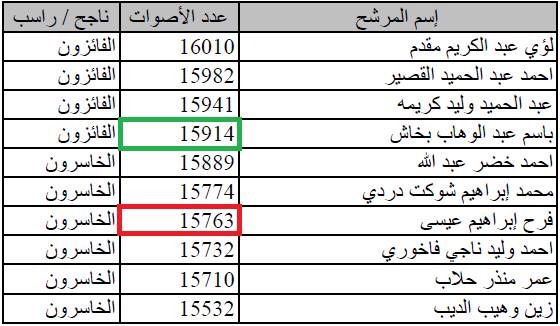
On Sunday, May 29, 700 Christians voted in Tripoli out of tens of thousands of registered voters. Christian candidates got over 15763 votes total result. The last winning candidate got 15914. That’s a 150 vote difference only that’s getting everyone to panic. Yes, those 15,763 votes are mostly Sunnis. But never mind, they’re scary.
Tripoli has sectarian people, like any other Lebanese city or town, but it’s not a sectarian city. No city with its history of diversity can be as such.
How can we cry sectarianism in Tripoli when property sale ads in Christian areas in the country specify the buyer needs to be a Christian?
How can we cry sectarianism in Tripoli for fear of the fate of the city’s Christians when they didn’t even bother to vote? Also please note that Tripoli’s Christians probably couldn’t care less and have more faith in their Muslim neighbor and friends than someone like Robert Fadel who is supposed to represent them but couldn’t even manage them to get them to vote?
How can we cry sectarianism when another major city had the list that won wage the following campaign:
A municipal council should not be defined by the religion of its members. I’m sure the new municipal council in Tripoli will work for the whole city.
Tripoli, you may not have voted the way I wanted on Sunday, but you should be immensely proud in you saying no to your reality and seeking out change. Beirut Madinati tried in Beirut. It did well but did not succeed. Other alternatives to the political hegemony tried in other places and did not succeed as well. Political hegemony was brought to its knees on your streets. Respect.






 A Separate State of Mind | A Blog by Elie Fares