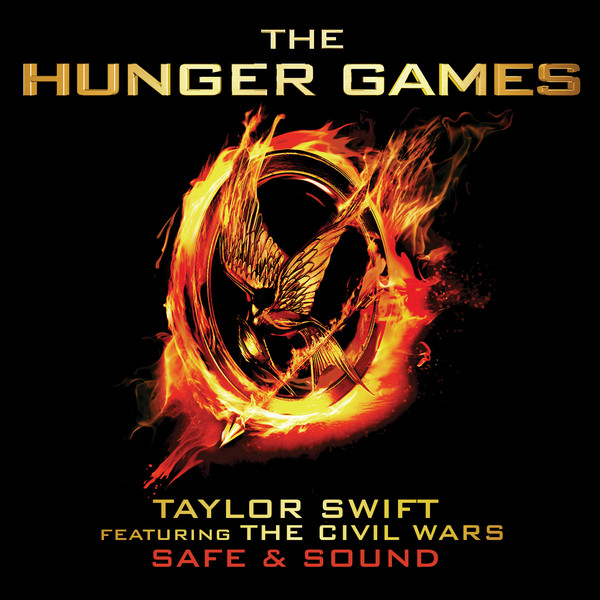
Safe & Sound (From “The Hunger Games” Soundtrack) [feat. The Civil Wars] (Single Review) – Taylor Swift

Taylor Swift’s Christmas present for her fans arrived in the form of a song titled “Safe & Sound,” which is serving as the lead single for one of 2012’s most anticipated movies: The Hunger Games.

The song opens with a guitar playing to which Swift sings eerie breathiness: “I remember tears streaming down your face when I said, I’ll never let you go, when all those shadows almost killed your light. I remember you said don’t leave me here alone. But all that’s dead and gone and passed tonight.”

The moment Swift utters the first note, you know this isn’t like any song she has written before and it’s a very welcome departure from her previous works to a more mature, mellow musical sound.

“Just close your eyes, the sun is going down. You’ll be alright, no one can hurt you now. Come morning light, you and I will be safe and sound” Swift sings on the chorus, with the hums of The Civil Wars, who are featured with her on the song, in the background only serving to increase the overall tense atmosphere of the song and make it more fitting of the movie it will be part of.

For those who don’t know, The Hunger Games is based on a book of the same title and is set in a post apocalyptic world where there is very little hope, very little potential for a better life and where the young people of that world have to kill each other for the entertainment of their ruthless governing Capitol as part of the Hunger Games. Once you have that in your mind, it’s very easy to see how this song fits perfectly that atmosphere. You can easily imagine the characters of the book sitting around a campfire and singing this to maybe bring nonexistent strength to their spirit.

Don’t you dare look out your window, darling everything’s on fire. The war outside our door keeps raging on. Hold onto this lullaby even when the music’s gone,” Swift sings on the second verse with slightly more strength to echo a buildup in the song teller’s morale. The vocals are layered and icy while trying to echo the building fire inside. It simply works.

The Civil Wars are more pronounced on the second verse onwards as their provide beautiful harmonies to Taylor’s singing, providing an eerie echo that resonates with the overall ethereal atmosphere painted in the song, adding to the folky sound the song has.

Safe & Sound is dark. Safe & Sound is anything but safe and sound for a singer who has become more known for her tween hits than her better songs that never see the light of day on radio. Safe & Sound is here to show that Taylor Swift is truly one of this generation’s best songwriters – one who is able to craft an idea into a song that can fascinate you. She uses beautiful imagery and manages to create musical hooks out of the gloomiest of songs. Safe & Sound is no exception to that rule. Safe & Sound is the most grown-up Taylor Swift has ever been on song. This is one of the few songs she has where she doesn’t talk about boys, love, fairytales and broken romances. This is a song about life, about hardships – and she pulls it off brilliantly.

8/10 

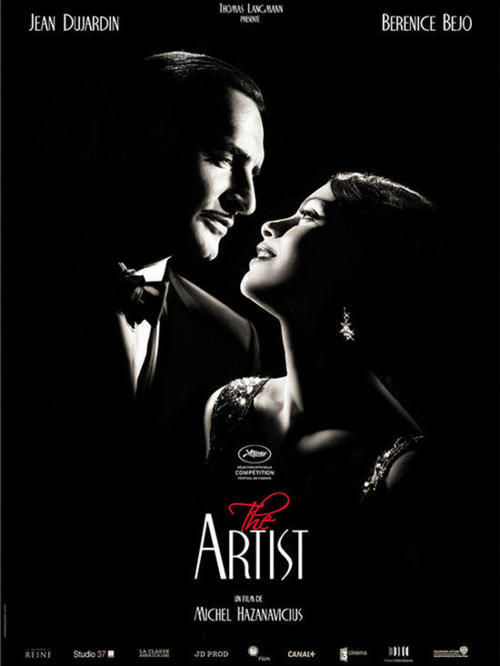
The Artist – Movie Review


In The Artist, director Michel Hazanavicius takes Hollywood retrospectively to 1927 where the age of silent movies still reigned – all with a silent black and white movie.

Silent movie star George Valentin (Jean Dujardin) is at the top of the world. His movies are always a huge success. He’s adored by his audiences for his sense of humor and all around fun attitude towards everything. 1927 Hollywood was all about Valentin.

Soon after the premiere of his latest movie, he stumbles on a girl named Peppy Miller (Bérénice Bejo) who kisses him on the cheek to newspaper headlines. Soon after, Peppy lands a role as a dancer in one of Valentin’s movies during which he gives her the advice of needing to be different to stand out, giving her the big break she needed. And with that, Peppy starts climbing her Hollywood stairs, quickly becoming a sensation by 1929. It is then that talking movies are introduced and Valentin refuses to start speaking in his movies. The reason for this refusal is ultimately answered in a subtle and touching way as only a movie like The Artist could pull off. His career quickly deteriorates and he is forced to deal with his own pride, decisions, miscalculations – all as Peppy Miller’s career soars with her talk to unreached heights.

The Artist is a breath of vintage fresh air in a Hollywood movie scene that is relying more and more on brainless blockbuster action movies than on truly artistic cinematic features that would leave you speechless as you leave a movie theatre. The Artist is one of those movies that leave you baffled as you watch it.

Jean Dujardin is absolutely breathtaking in this. He leads a masterful, brilliant, stunning performance – all without speaking a word. It is a testament to an actor’s ability when he can communicate the struggles, emotions, triumphs and defeats of his character to the audience all through his facial expressions and overall demeanor in a movie.

Bérénice Bejo is great as Peppy Miller – the actress who is taken places because of George Valentin and who eventually leads to his downfall, feeling guilty about doing so and wanting to increasingly take care of him. You can see her metamorphose on screen from an awkward dancer who wants to get places to America’s sweetheart, who knows exactly what she can leverage out of movie makers.

Despite being black and white, The Artist is visually appealing. Soon enough, the fact that you aren’t watching a movie in color goes to the back of your mind and you start enjoying the genius of it all. The score of the movie, composed by Ludovic Bource, is beyond a masterpiece. The Artist, if you don’t want to consider it a silent movie simply because of the lack of speech, is a movie without spoken words to the melody of a brilliant symphony. It’s very difficult not to be taken into the ingenuity that is the music of The Artist.

At the end of the day, The Artist is examining the extinction of silent movies in Hollywood by giving Hollywood in 2011 a silent movie that triumphs in quality most of its talkies. And that’s precisely what this is such a great movie. It is delicate and original. It is profound and fun. It makes you laugh and it has its heartfelt moments. It might be a lament to the Hollywood age it represents but it does so without being overly pessimistic. In a way, it seems that this European movie is reminding Hollywood of its roots, of its origin. Without being technically proficient, The Artist is showing exactly how much all those extras can take away from the essence of movies. It’s showing audiences that you can really enjoy a movie that doesn’t demand anything of you except to look at shadows, black and white pictures and moving people. And in return, it gives you so much more…

9/10

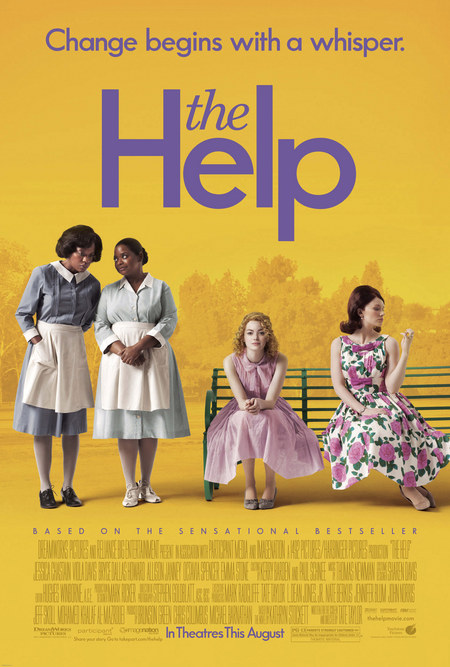
The Help – Movie Review

Based on the best selling novel by Kathryn Stockett (find my review of the book here), The Help is a drama about three Southern American women in their struggle for racial equality in Jackson, Mississippi.

Emma Stone stars as Eugena “Skeeter” Phelan, a recent college graduate going back home, who wants to break out of the mold society has limited her in. She’s an aspiring writer who happens to live during the era of Civil Rights Movements. Viola Davis stars as Aibileen, a maid working for a Mrs. Elizabeth, her main job being taking care of Elizabeth’s little girl, Mae Mobley, whose mother doesn’t care about. Octavia Spencer stars as Minnie, a snarky maid who literally can’t keep her mouth shut but whose cooking is so superb that her white employers tend to turn a blind eye to her blabbing.

After a proposal by Skeeter’s friend, Miss Hilly (Bryce Dallas Howard), to have separate bathrooms for the colored help, the idea in Skeeter’s mind of the necessity of change begins to blossom, especially after it gets fueled by an enthusiastic New York publisher who wants her to write. So Skeeter sets to write a story about the help in Jackson. Her first two maids to go on board? Minnie and Aibileen, who will tell Skeeter their deepest and darkest stories – stories they’ve hidden for such a long time they’ve become permanent scars in their souls. Aibileen tells her about all the little kids she raised, about how Elizabeth is an unfit mother, about how she doesn’t treat Mae Mobley like a real mother should. Minnie, who also happens to be Miss Hilly’s former maid, tells Skeeter about the “horrible awful thing” she did, which involves a special ingredient in a pie, to which you will have heartfelt laughs. But it is their struggle as a community that will bring the other maids on board – the chance to tell their side of the story, to be liberated – at least on paper – and to somehow seek salvation.

The performances in the movie are top notch. Starting with Emma Stone, she is one of our generation’s most promising actresses. After a great performance in Easy A and being the best of the actors in Crazy Stupid Love, she is back here not to steal the show but to offer an emotionally subtle performance that is exactly how the character she portrays is: not flamboyant but calm and reserved. Stone’s most emotional scenes come when she remembers her maid Constantine and discovers the story of how Constantine left them and it is in those scenes that she truly shines.

Viola Davis’ performance is being touted by critics everywhere as a tour de force performance. And it truly is. There’s one scene in particular, when she tells the story of how her son dies, where she plays on your emotional strings like a banjo in a country song. But her performance throughout is always nuanced, always great and always emotive. Probably the movie’s highlight scene, its ending, is purely her work. Davis is truly captivating. Whenever she focuses her eyes on another character in The Help, you almost see her gaze into that character’s soul. She is penetrating, invasive… and you welcome it with open arms.

Octavia Spencer is equally great as Minnie. She brings humor to the movie. It may be dark humor sometimes – literally – but it will still get you to feel happy that even amid all the horrible things these people had to go through, there’s still room for happiness in their lives. She gives hope to the other characters in the book and to you, as a viewer, that there could be a better tomorrow for them. She portrays Minnie’s strength subtly. She comes with a bruised eye to work and acts as if this wasn’t caused by her alcoholic husband. But deep down, below the strong outside of Spencer’s character, you can feel the volcano of hurt waiting to erupt.

The movie’s director, Tate Taylor, is Kathryn Stockett’s best friend since childhood. This deep understanding between such two friends has helped him bring her book to screen while entirely preserving the message she was trying to get across on page. While there are many differences between book and movie, some of which I had wished to be included in the movie, the screenplay Taylor wrote still works as a great adaptation, one of the better ones for a book to movie adaptation.

The Help is also a stunning movie visually. And even though there’s obviously no visual effect work here, this means recognition should be given to the cinematography crew that worked on it, most notably Stephen Goldblatt, whose previous works include Julie & Julia, Charlie Wilson’s War. etc…

If there’s anything to take out of The Help it’s that everyone is a victim – even those white socialite women. Yes, they are the victim of their ignorance, of their repressed memories of the black women that brought them up. The black women are victims of being at the wrong time. The little white girls are victims of negligent mothers.

At the end of the day, The Help can be summed up by its most emotional scene, which also happens to be its conclusion. As Aibileen leaves the house of her employer, Elizabeth, she sits by Mae Mobley and asks her to repeat what Aibileen has been teaching her every day. Mae Mobley stares into Aibileen’s deep, dark eyes and repeats: “You is kind. You is smart. You is important.”

9/10

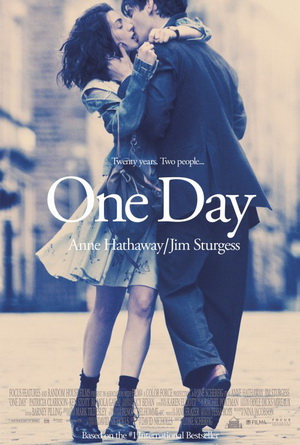
One Day – Movie Review

In One Day, Anne Hathaway is Emma, a British college graduate, who has a crush on Dexter (Jim Sturgess). On the day of their graduation on July 15th, 1988, Emma and Dex spend the night together and make a promise to catch up each year on that day to see where they both are in their lives and careers. One Day is a snapshot of 23 years in their relationship. Each scene in One Day is one particular year in the relationship of Emma and Dexter. Sometimes they spend the day together, other times they don’t. But they’re always on each other’s mind on that day.

Some might say that there’s simply too much gaps to be filled by such a premise. But the movie flows smoothly and doesn’t feel dragged out, mostly due to it being directed by the same man that brought the world An Education in 2009: Lone Scherfig. Instead of filling in the dull details and making this a three hour movie, Scherfig alludes to what happened in the year that past with each subsequent scene. Say Emma got an advance to write a book, you find the book already published in the next frame of the movie and so on and so forth.

One Day can be divided into three parts with each part representing a phase of the relationship between Dex and Emma. The first two thirds are closer in structure to each other than they are to the third even though the movie ends up wrapping up perfectly, with a little nice bow to top it all off.

Anne Hathaway as Emma tries her best to be British in the movie and for the entire length of it, she somehow pulls it off. Sure, there are moments where the role escapes her but in the grand picture, this is not the case. Hathaway is, really, a great actress. And for her role in Emma, although it feels a little restrained at times, possibly due to the nature of the character, her performance is still nuanced and emotive. You can see her showcase the struggles and the life of Emma and at times she manages to do so brilliantly. It’s definitely not her best work, however, but one cannot but see the true potential Hathaway brings to any movie she is part of. She is one of those rare actresses that have managed to escape the frame set for them by their debut Disney movie and transcended into giving the world great cinematic features. The best is yet to come from her.

Jim Sturgess, with Dexter to play with, is confident and charming as his character should be. But the moments he truly shines in delivering are those where, despite the strong exterior of Dexter, you can feel the sadness build inside him: the sadness of not reaching his desired goals in life, the sadness of losing his mother, the sadness of seeing Emma slip away, etc…

Sturgess and Hathaway nail their parts in One Day. Perhaps it would have been easier to bring British actors and actresses to do this movie. But what fun would that be? One Day is a quirky movie about a life. To have it be as authentic as possible, somehow perfect dialect would have rendered the movie less effective.

One Day is a realistic movie of a friendship. If you seek escapism in your movies, this is not the movie for you. The characters don’t always get to their goals in life and in their relationships. They don’t get to see each other whenever they want. There’s disappointment. But there’s also fulfillment. There are moments of sadness. But there are also moments of sheer happiness. Ultimately, the movie is similar to all our lives: we are but a collection of memories, some that fade away and others that are worth holding on to.

8/10

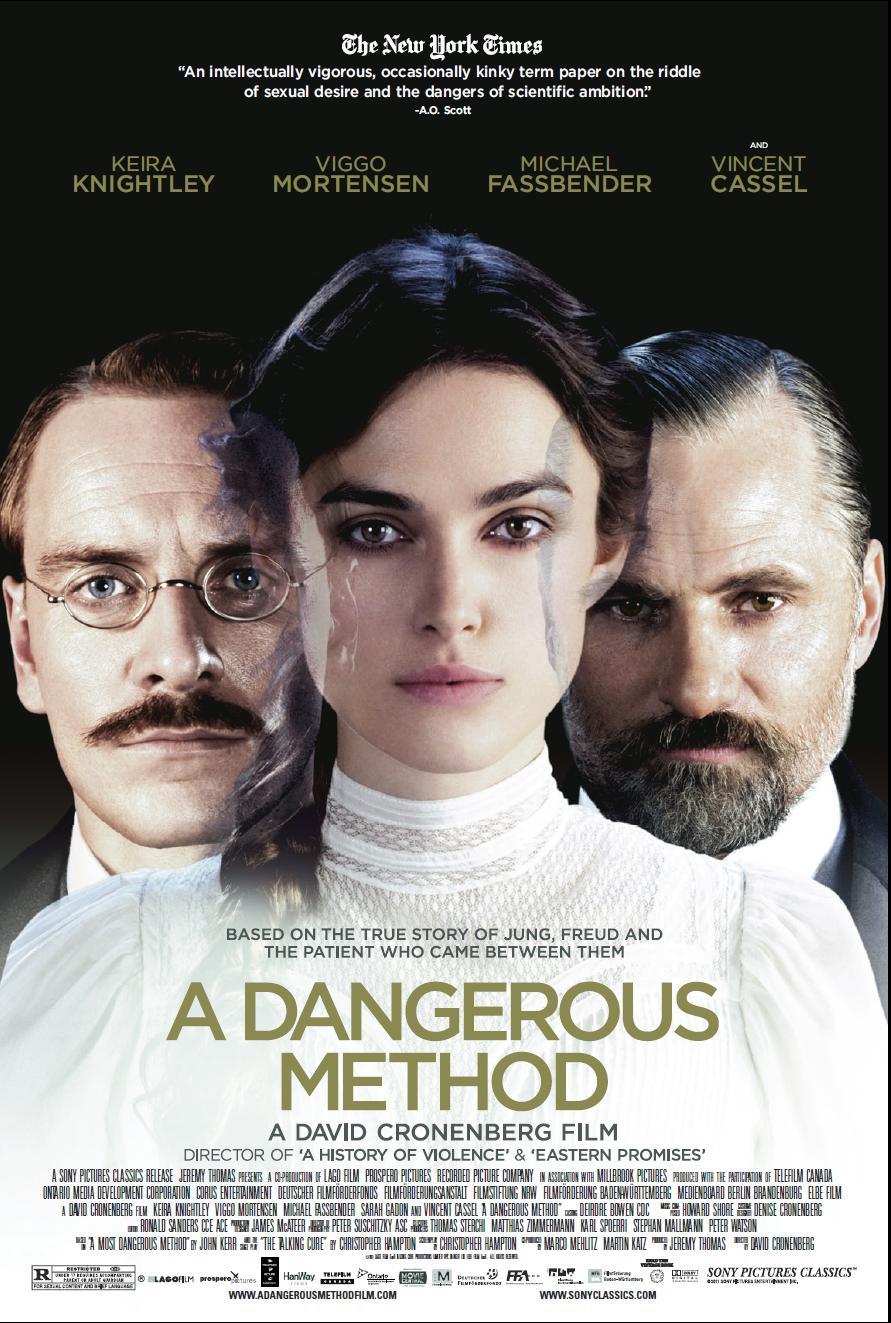
A Dangerous Method – Movie Review

Psychology and cinema have a long history together with the former often shaping the latter into delivering movies of great caliber. Last year’s “Black Swan” was a manifestation of that: a psychological thriller examining the darkness of human nature. In A Dangerous Method, psychology is literally in center-stage as this is a movie about how two of psychology’s most influential scholars came to their theories: Carl Jung and Sigmund Freud.

David Cronenberg’s new cinematic feature opens with an exquisitely chilling scene. Sabina Spielrein (Keira Knightley) is in the back of car shouting her lungs out as two men barely restrain her as they take her to a mental institution to be examined by Dr. Carl Jung (Michael Fassbender), who’s attempting Sigmund Freud’s (Viggo Mortensen) new method of treatment, called psychoanalysis. Spielrein is an unhinged Russian aristocrat who wants to become a doctor while Jung is eager to prove himself to his colleagues and the community and would, therefore, make Spielrein his main case. To his patients, Jung is superior. To his colleagues, he is always inferior. And it’s from there that his need to prove himself arises. Soon enough, Spielrein is “cured” but instead of letting her have a clean break with her sexual fantasies, Jung immerses himself in them, whipping her before having sex with her, putting a strain in his marriage where the sex is “tender” to which Spielrein offers that she “can be ferocious.” Meanwhile, Jung debates with Freud in numerous correspondances on how to improve psychoanalysis, featuring the dissolution of the relationship between them.

A Dangerous Method boasts what I believe is a brilliant and highly interesting trailer. But simply put, don’t let the trailer fool you into thinking this is more than a historical and biographical movie. It’s a history book on screen, which makes it boring, redundant and, eventually, pointless. The production feels disconnected. The movie’s pace is slow and when it picks up it’s only for a few minutes.

For a movie about emotions and feelings, the movie also doesn’t offer much in that department. Apart from a great performance by Keira Knightley who outshines both male leads, the movie is stark, grim and too safe. For a movie about psychoanalysis and the repressed sexual urges of Man, there’s simply too little of that… there’s too little visceral emotions in there for it to have any credibility outside the historical realms it’s featuring.

Let’s talk about Knightley. I mentioned the opening scene for a reason. The second half of that scene features Knightley blowing you away with her twitching, writhing, screaming, laughing…. She’s hysterical in front of your eyes and she does such a good job at it that it’s hard to think A Dangerous Method won’t be a great movie, even with her extending her jaw to cringe-inducing measures as if trying to pull that coveted golden Oscar statue towards her. But then as Jung begins his movie-long analytical character, coupled with an even more analytical approach from Freud, whatever emotion brought to table by Knightley is diluted beyond recognition to form an emotionally disembodied movie about emotions. Through the rest of the movie, even as she’s cured, Knightley retains an element of craziness to her character that keeps you on guard whenever she’s on screen. You get to certain points where you wish the Jung-Freud sequences had been rewritten to feature her: less historical accuracy, more in-depth approach, more emotions, more crazy.

As mentioned earlier, Fassbender and Mortensen’s characters are simply a psychology book in reading. Some of their script can be found in a psychology book somewhere even verbatim, perhaps.  But both actors do their best with the characters they were given. Taken in absolute value, the performances are good enough to pull this movie as it is. But when you expect much more from a movie dealing with Freud, Jung and psychoanalysis, you want the script itself to be more out of the box and their performances to be crazier.

It might be that I had too high expectations but A Dangerous Method seriously underwhelmed and disappointed me. Not only does this movie have no award-season chances (or limited chances at that) but it poses the question of how many times could the Freud-theme be handled in cinema before finally getting it right? You’d think a director like David Cronenberg would be good enough to bring the crazy of his previous movies to a movie about crazy. But it looks like it’s not the case. And ultimately, there’s nothing dangerous about A Dangerous Method except the one word in its title.