Censorship in Lebanon: Not Exemplary in the Middle East?

The Samir Kassir Foundation recently shared this study that they conducted regarding various forms of censorship in the region. It’s an  interesting read. You can get the PDF here.

What’s interesting to note about the study is that cases of censorship in Lebanon are not among the region’s best. But fear not, it’s not the state that’s actually doing all the censorship.

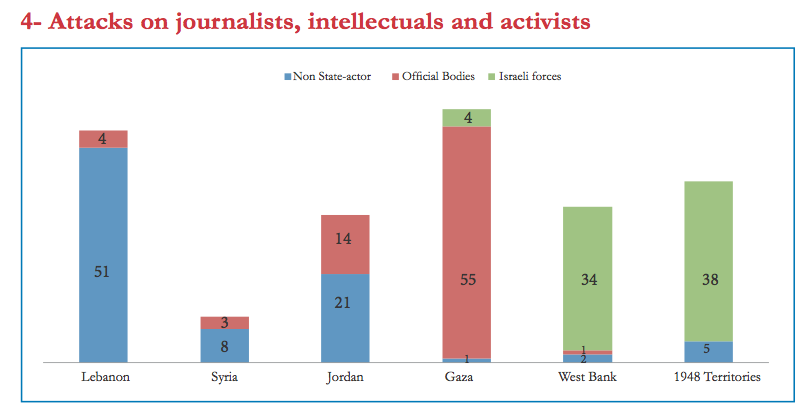
In Lebanon, two phenomena raised concerns among defenders of liberty. First, the physical assaults on journalists by non-state actors, whether members of political parties, demonstrators, or a new category of activists commonly called “the inhabitants” (Al-Ahali) of some delicate regions. All sides of the Lebanese political spectrum were responsible for such acts.

In fact, in the facts & figures part of the study, a graph showing attacks on journalists in each country of the study had the following results:

The low number in Syria is not to be interpreted positively, as the study conductors noted. The attacks, when they’ve taken place, were brutal, as others graphs of the study show: Syria has the highest rate of violence against intellectuals and journalists.

What’s interesting about the results, however, is that 51 out of 55 attacks on journalists in Lebanon weren’t carried out by State authorities, but by non-state entities. Examples given are: Hariri supporters attacking journalists on the “Sunni Day of Anger” when Hariri’s government was toppled, as well as Hezbollah forces attacking journalists investigating their transgressions in Lassa and other villages in South Lebanon.

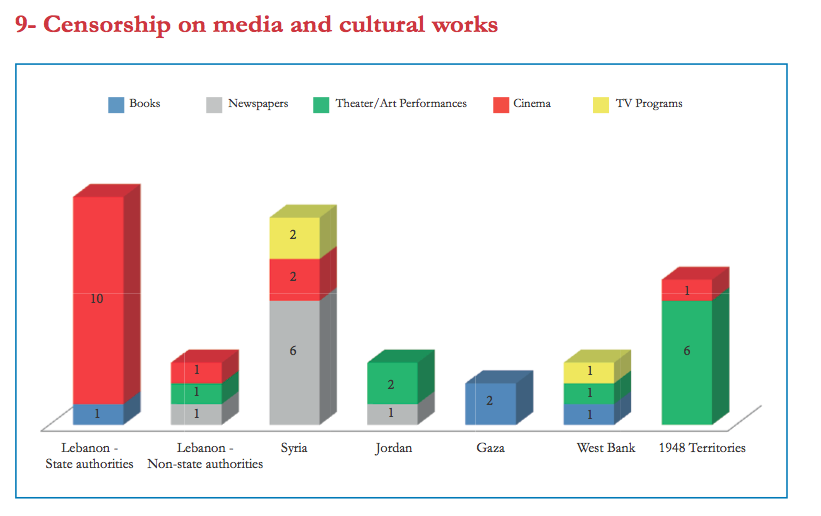
Another interesting fact to note is that the sector most affected by censorship in Lebanon was cinema with more than 10 movies being banned from being screened in Lebanon. Officials justified the decisions as a necessary precaution to preserve Lebanon’s relation with Syria and Iran and our civil peace. I think they were referring to the abysmal Beirut Hotel in one of those points.

For the non-state bans in Lebanon, one is regarding the LMFAO concert ban which happened due to some groups protesting the band’s anti-Christian feel in their song’s video. MEA has banned the newspaper Al Akhbar from being distributed on its flights. And last but not least, the infamous incident to hide Steven Spielberg’s name off the “Tintin” movie poster.

All in all, while Syria takes the cake when it comes to fighting liberties, the situation in Lebanon is not exactly peachy according to this study. Honestly, I didn’t think we had this bad compared to neighboring countries, which leads me to my conclusion.

What I think is a grave flaw in the conduction of this study is that such events in neighboring countries do not make headline news as they do over here, making our numbers seem inflated compared to them. Most of the transgressions that happen in them might be hidden or kept under the radar, making the situation seem much better than it is.

Either way, I’d take the results of this study with a grain of salt. While it is always an interesting read, I don’t think it’s correct nor is it a representative comparison between the countries of the region. Perhaps a look at the numbers of countries known for championing freedom is a clearer comparison. At least you’d know that being skeptical regarding their numbers is unfounded.

Just a Bachir Gemayel Speech from 1979

This is Bachir Gemayel

I recently started reading a book by Rani Geha, which has the speeches late Lebanese president Bashir Gemayel between 1979 and 1982, titled: “Words from Bashir.”

With the little time I have with Med School and all, my advancement with the book has been rather slow. But it’s still an eye-opening experience to see such speeches on paper and how true they reflect on Lebanese society and politics today.

In February 1979 and in a speech in front of a crowd in Jal El Dib, the main points Bachir Gemayel made are as follows:

1) There is a need for a radical change to move the Lebanese state from one that is subservient to Syria and Palestine to one that only answers to its own people.

2) We need a Lebanon where the foreign ministry is the foreign ministry of Lebanon, not a spokesperson for Syria or Palestine or any other nation.

3) The institutions in Lebanon need to be the property of the Lebanese citizen.

4) Lebanon is too small to be divided: one part for the Syrians, one part for the Palestinians and one tiny part for the Lebanese.

5) Those who want to grant the Palestinians a country, let them grant that country from their own share not from Lebanon’s share.

6) Let the West appease the Arabs as long as the Arabs produce oil. The West is losing its values and, as such, we cannot rely on it for support anymore.

7) Syrian entities in Lebanese uniforms, using Lebanese weapons, are not to be accepted as part of the country we want to live in.

8) In 1958, the Arabs had Abdel Nasser. Today (1979) they have Hafez Al Assad. The school of thought shared by these two men can bring nothing but a catastrophe.

9) From 1943 to 1975, we were ruled by a school of thought that never believed Lebanon to have a cause or anything to fight for. We were governed by a school of thought that supposed we should unconditionally align ourselves with whichever Arab nation proved to be the strongest, in a way to keep our heads, while internally we were ruled by apparatuses and typewriters. We were ruled my moral submission.

10) Many Lebanese do not have the faith and self-confidence that they have can change things on the ground, creating a de-facto situation that many nations around the globe take use of.

The fact that these 10 points are still as true today as they were in 1979 is not a reflection on our society but it’s a reflection on our region. The school of thought shared by Abdel Nassar and Assad is still alive and kicking today, actively patroned by their descendants. We even have a statue for one of them on Beirut’s sea promenade. There is constant talk about nationalizing the Palestinians in Lebanon, giving them a piece of a country they are not entitled to. There is constant talk about taking out Syrian intelligence and arms from inside Lebanon.

And it all stays as such… talks. Why? Because at the end of the day, there’s simply so much that a Lebanese can do in going against the current of what the big nations want. But you know what, for what it’s worth, and looking at the circumstances we’re living in, we’re not doing very bad for ourselves. 

Until then, long live the memory of a president whose words resonate true 33 years later.

Lebanese “Activists” Call for Lara Fabian Concert Cancellation

20120117-125805.jpg

Spread around the Lebanese highway are billboards announcing two concerts for Belgian-Italian singer Lara Fabian, on February 14th and 15th at Casino du Liban. This is the third time she has concerts in Lebanon.

All is well, right? Fabian has many fans in Lebanon, mostly of the older generation. Her repertoire includes songs that many fans of older French music know.

But as it is with many so-called “activists,” they are now calling the Lebanese government to cancel Fabian’s concert because Fabian performed at a concert celebrating the 60th anniversary of the founding of Israel.

For reference, French-Moroccan comedian Gad El Maleh had his sold out comedy show at the Beiteddine International Festival also cancelled because of his ties with Israel. Armin Van Buuren’s most recent NYE-1 concert was also met with resistance because Van Buuren has pro-Israel stance. Steven Spielberg’s name was hidden off his movie poster in Cinemacity because he donated money to Israel… And the list goes on. The latest casualty: the French singer behind Je T’aime and J’y Crois Encore.

I am not an Israel-supporter. If my country is in a state of war with a country, then, regardless of what I personally think about that war, I am supportive of my country’s stances regarding its enemies. But I, as a Lebanese, cannot expect people from other nationalities to also conform with my ideas. I also cannot condemn them if their ideas are different from mine – even if they are about Israel.

Most foreign artists are pro-Israel. It is simply a byproduct of being in the countries they come from, where the existence of the state of Israel has become associated with a redemption for the holocaust and where the Palestinian political leaders are as inept about defending their cause as the media portraying them badly. Those artists, however, are not coming to Lebanon to spread their pro-Israel ideas. They are coming here to sing, act, give you a comedy show. They are coming here to share their talent with you. The fact that some “activists” cannot see beyond their finger and are so adamant about the whole “OMG FIGHT ZIONISIM” mantra is none of my concern as an individual who simply wants to be entertained.

Look at it in a different way as well. How many of those “activists” use laptops & smartphones? How many of those “activists” go to Starbucks on daily basis for their daily “activism” meetings? How many of those “activists” are so drenched in Israeli-related products that their shouts of disdain become meaningless, childish and non-sensical?

You know, perhaps instead of shouting against Israel (which people, for the record, have the right to do) those Lebanese (and other nationalities) “activists” need to look at the injustice going on in their own backyard before lashing out for the causes of neighboring countries that have, like it or not, also caused their country harm. Are those activists as vocal about their support for the fight rape campaign as they are for artist bans? Are those activists as vocal about the eaten rights of their fellow countrymen as they are about the rights of Palestinians? Are they as vocal about the people losing their lives to Lebanon’s rent laws? Are they willing to help those people?

One only needs to look at the state of Christians in Egypt and Iraq, at the situation of women in the region, at the lack of freedom and all the other basic human rights that the region lacks to know that those “activists” are as empty as the shouts and slogans they will chant outside the Casino du Liban when Lara Fabian sings there.

I understand some of those “activists” are not Lebanese. And I always tried to steer away from discussing Palestine-related stuff on my blog. But let me tell those “activists” this: do not bring your fight to your country, especially with things as meaningless as this.

So sing miss Fabian, sing. And don’t you worry. Irrelevant people will remain irrelevant as long as their priorities are not sorted.


Update: Fabian has canceled the concerts. 

Lebanon’s Independence Day

Most countries around the world celebrate their “Independence Day” with ecstatic joy. To all of those countries, it is a reminder of their struggle to break free from superpowers that were using their land, their people, their resources…

In Lebanon, November 22nd has become a national mourning day of some sorts. What are the people mourning? The French citizenship that could have been.

What is the notion of Independence and why do many Lebanese find it easy to ridicule the independence of their country? Contrary to popular belief, I feel proud on November 22nd, just as I feel proud about Lebanon any day. My country has grave flaws but regardless of those flaws, it exists.

The reason it’s so hard for many Lebanese to see their country as independent is because the notion of independence is grossly overestimated. No country in the whole world is truly independent from other countries. Example? The USA has a national debt of over $14 trillion, a big chunk of which is to China. Why do you think the US is struggling to fix its national budget nowadays? To fix the economy? Partly yes. But mostly to lessen this national debt and its dependence on other countries, such as China.

The difference between people in the US and Lebanon is that they have national pride that does not waver while we have a national pride as firm as water. The difference between us and them is that, even though they do have poverty and even though some of their States have horrible internet and even though the 3G provided by many of their carriers is not good, they feel proud to call themselves American. How many of us feel proud to call ourselves Lebanese?

You do know that the problems in countries such as the US, France, Switzerland, etc… are very similar to our problems? You have villages in the United States whose only source of livelihood is the production of crystal meth. You have places in France, like Lebanon, where it’s so corrupt that the police doesn’t dare enter. And then you have Switzerland, a country that, despite the great diversity of its people, managed to find a way to get them to coexist.

The problem in Lebanon? Our problems are magnified because of our country’s small size.

Some of us blame our politicians. We say they got us into this predicament. But simply put, our politicians arise from our society – they are inherently part of us. We voted for them and got them where they are today. But our “Independence” day is not our politicians’ to take. It is for all of us as a nation to celebrate: the sacrifices of our forefathers against the French Mandate to establish the Republic of Lebanon.

Others still call for a French (or any other “decent” country) mandate, wishing we were still under one. You know, if our forefathers found the situation under the French to be absolutely peachy and happy, I’m pretty sure they wouldn’t have fought to get Lebanon out of the mandate. Perhaps you should contemplate what all these superpowers are secretly doing in African countries where their influence is much more penetrating, where they still control national resources and lead the people of those countries to kill each other?

At the end of the day, it is hard for many to see Lebanon as independent because we live in a very, very difficult region. I look around and see Syria where Bashar Assad is killing his people left and right. I look to the South and see Israel/Palestine, both of which want a piece of my land as well and both of whom tried to get it as some point. And then I consider all those Arab countries and see that for a small country like mine, I’m sure of utter importance to them. Why is that? Why is it that many countries around the world can’t wait to get their hands on something related to my country? No, it’s not overwhelming pride. It’s an observation. Perhaps because they know that, as divided as we are, it makes it much easier for them to put their hands on our resources, our people and our land?

Our Independence is wasted by none-other than us: the people who let other countries wage their wars on our land. And amid everything that’s happening in the region around us today, perhaps we should be less critical and more vigilant against all of these countries with messed up systems that are ready to move their fights inside our borders.

You don’t want to call it independence, fine. Call it Lebanon’s National Day. But regardless of terminology, you should at least feel a stinge of pride that you have a country and, despite all its problems and the problems thrust upon it, it exists.

9/11 Remembered. And Put in Perspective.

I still remember this September day, ten years ago, when my whole family sat dumbfounded in front of our television set, not believing what we were seeing.

How could the United States, the world’s leading country (despite some in-denial people thinking otherwise), have this happen to it? Shouldn’t they have been more prepared? After all, two airplanes hitting their country’s biggest towers and an attack on the Pentagon isn’t exactly a small feat – for any terrorist group.

Any group responsible for the attack must have taken months, if not years, to slowly brew the intricate details of the assault. Therefore, it’s very hard to believe the United States’ intelligence agencies had no idea about it. Instead, they chose to shrug these threats off. There’s no way something like this could happen to us, I’m sure they thought.

But it did happen, taking the lives of 3000 people with it and launching the “war on terrorism” propaganda that has been going on for the past decade.

I still remember holding my mom’s hand as she saw those people jump out of the building, hoping they would be saved somehow, thinking that jumping increased their chances of survival. I still remember news anchors going silent for minutes on end because they were out of words. I still remember my whole household feeling shaken. I still remember my grandma’s panic-stricken face as she stumbled towards the phone, trying to call her sons even though she knew they were far from New York City.

What we did not think of was the aftermath.

I never thought I’d be automatically labeled as a person of suspicion just because of my country’s geographical location. I never thought my aunt would have to wait three hours in LAX before they allowed her to go out and see my family. I never thought it’d become so difficult for me to go the United States, even if I hadn’t seen my family for over five years. I never thought my Muslim friends would automatically become one of the most hated groups in the world just because of their religion. I never thought things would change as much as they did.

I am not a mean person. In fact, I am probably one of the most American-sympathizers you can find – at least in Lebanon. But the thing is, 9/11 needs to be put in perspective.

It will always be a memory of hurt. But ten years later, where should we really stand regarding 9/11? The people who lost their lives should forever be remembered. They were innocent victims who fell to the brutality of a radical group that has a distorted view of their religion.

But ten years later, that’s the only thing I can take out of 9/11. And here’s why.

Sure, 9/11 revealed the United States’ vulnerability. But I’m sure the ship has sailed on that vulnerability. Following that day, the United States’ assumed the role of the policeman of the world. No one did anything unless the United States approved. And if some country happened to dare the United States, they were met with a bunch of sanctions they could never get out of.

The War on Terror has led to the death of not 3000 but more than 900,000 people, most of which are women and children whose only fault was to be in the wrong country at the wrong time of history. What do these men, women and children differ from those 3000 men, women and children that died in the World Trade Centers? Their ethnicity? I hardly think so. Their religion? I’m fairly certain all victims were not uni-religious. The main difference is that the world thinks more of those 3000 people that died on 9/11 that they do of those 900,000 that died in the War on Terror. Why? because in the world’s mind, those 3000 are innocent. The 900,000 are terrorists. Wrong place, wrong time.

The 9/11 attacks also gave the U.S government a free pass to do whatever it wants militarily until it was too late. Example? The Iraq War – also known as Operation Iraqi Freedom.

I still have no idea, even to this day, how Iraq fit into the whole Al Qaeda scenario of the 9/11 attacks. Their only fault? Too much oil beneath their soil. I am also fairly certain the United States’ intelligence agencies were more than knowing that Iraq had no weapons of mass destruction. Live and let live no more.

But why go so far back in time – even if all of this is a few years old. Let’s look at what’s happening around the world today.

There’s a famine in Somalia. Children are dying every few seconds out of hunger. The United States has the world’s highest obesity rate. They’re throwing food away because they can’t eat it anymore. The children of Somalia, on the other hand, don’t even have access to bread crumbs that fall off a table and we don’t notice.

As a result of “Operation Iraqi Freedom,” thousands of Iraqi Christians lost their lives and were forced to leave their land and country, becoming not welcome there anymore. Their only fault? They were of the wrong religion at the wrong time in the wrong place. What could have the US done, for instance? Protect them.

Massacres are taking place daily in Congo. Women getting raped has become their way of life. Children getting murdered just because they happened to be caught in a crossfire between greedy tribes, who happen to be the pawns of bigger players, in a game of gold and diamond.

Palestinians get murdered every day by Israeli “Defense” Forces. The U.S covers those murders to the extent that they vetoed the Palestinian request to become a recognized UN state. I am not the most Palestine-sympathizer. But when the United States asks for its victims to be remembered, then all victims that are falling because of the United States’ involvement need to be remembered as well. I am fairly certain Israel wouldn’t be as ferocious if it didn’t know the United States had it back, whenever and wherever.

Thousands have been murdered by a tyrant Syrian regime, since their protests began, and the international community (led by the United States) has done very little to help alleviate the suffering of those people.

And not very recently, in the calm country of Norway, a Christian fundamentalist let loose on teenagers whose only fault was, yet again, being in the wrong place at the wrong time. The American reactions to that are summed up in this video.

Yes, it has been ten years since 9/11. But that is precisely why it’s time to get over it. 3000 people that died do not compare to the thousands dying everyday because of 9/11 ramifications. 300 million Americans are not better people than the other 5.7 billion that make up the rest of the world. After all, isn’t equality one of the fundamental and founding principles upon which the American system is built?

There are way worse things taking place everyday all around the world. Their only fault? They’re happening at the wrong place.