Lebanon’s Syrian Occupation – A Persistent Matter That Should Never Be Forgotten

April 26th, 2005. As those last trucks carrying those Syrian soldiers left our land, many Lebanese drew a sigh of relief. Many thought that chapter of their present was finally going down to the history pages of the books in which it was going to be written. They also wished it would stay there, indefinitely.

What those people didn’t think of, however, was that their struggle with those Syrian soldiers and regime that occupied their land for over thirty years would be forgotten a few months after those soldiers physically left their land. Those people never thought that whenever they spoke about a Syrian occupation of the country, they’d be ridiculed by people. “There’s no such thing as a Syrian occupation. They’re a fellow Arab nation,” is many of the things you’d hear being said. As if them Arabs can never do wrong to Lebanon.

Those who say the Syrians never occupied Lebanon refer to the Israeli occupation of the Lebanese South and suggest that as a model of occupation. So let’s dissect the Israeli occupation of the South, based on what a Shiite Southern friend of mine told me on numerous occasions of what went on with the lives of the people.

Once upon a time, there lived a certain part of the Lebanese populace under the tyranny of a Zionist Israeli regime. They were afraid to go out of their houses after 6 pm because of patrol vehicles that the Israeli army would deploy. The vehicles didn’t usually do anything to them but the idea of them hovering there was unnerving and frightening. Many were forced to work for Israeli companies and, eventually, using the products made by those companies as their source for food, water, etc…

Their cars had special license plates that they removed as they got to Lebanese-Israeli checkpoints and replaced with Lebanese ones to avoid any reactions on the Lebanese side. Those license plates were reversed as they came back through the three hour checkpoint to avoid any repercussions on the Israeli-occupied side. Men, upon turning eighteen, were forced into joining the Israeli army, causing their families to get them to flee to Beirut or other non-occupied areas of the land mostly out of fear of how their sons would be seen after the South was liberated and because they didn’t want their sons serving the enemy’s army.

Their biggest fear was not of the Israeli army per se, but the idea of occupation and having those foreigners be your boss on your land. They were afraid, however, of the Lebanese people who joined the Israeli army and, to signal their power, treated the sons and daughters of their country badly. Israel ran the hospitals, school, etc… that existed in the South, simply because there was no Lebanese State down there. In a way, the occupiers were the people’s providers. The Southerners naturally and justifiably hated that.

The main fear of those Southerners after the Israeli withdrawal from their land was how other Lebanese would perceive them: would they be seen as traitors or would they be welcomed with open arms? Would those Lebanese know that it was really out of their hands or would they think that they were happy with the status-quo of the occupation?

Even after withdrawal the Israeli army kept breaching Lebanese sovereignty via their airplanes, army men, etc…  The Israeli withdrawal was not left as is after 2000 but was tarnished by many displays of force by parties on both sides: Hezbollah on the Lebanese side and the Israeli army on the other one, culminating in the 2006 Lebanon war, of which a friend tells her story here.

And as any occupier does, the borders of “their” territory were planted with landmines and other explosive weapons to deter “outsiders” from approaching.

As you can see from the little anecdote I wrote, the info in which are almost verbatim what my Southerner friend told me, the Israeli occupation can be described as follows: it was a psychologically exhausting experience where you had outsiders ruling your land, taking your men and women to enroll in their army and work in their factories. They took over the hospitals, threatened you via their Lebanese proxies and the combination of every aspect of the situation put the Southern Lebanese into a dilemma of whether they would be welcomed or not.

Now let me tell you what I lived through over fifteen years of the Syrian army occupying my hometown, district and every other part of the country except the Lebanese South.

Once upon a time, as the Southern Lebanese populace struggled with their occupation, another part of the population had a struggle of its own. And I was part of that population. We were afraid to speak out against that army. I remember finding their presence around very peculiar, especially that I rarely saw Lebanese army personnel at the time. But I was repeatedly told not to express my opinion regarding the issue by my parents and every family member who had heard my instinctive self speak out. We also couldn’t formulate honest political opinions, first and foremost because politics was rarely discussed in households mostly out of fear and second because those political opinions were mostly against the army present in your land. Syrian workers, present in a substantial majority all around you, held a power that no foreign worker should have. They walked around as if they owned the place, fueled by the protection they got from having a member of their country’s army present almost everywhere.

We were allowed to roam more or less freely  but we had to go many Syrian army checkpoints along the way to our destination. Now how is that normal? I find Lebanese army checkpoints to be out of place today. How about checkpoints made at more frequent intervals by an army that doesn’t belong there? My grandfather’s ambulance was stopped at a Syrian army checkpoint back in 1987 and didn’t let it pass. My grandfather ended up not arriving to the hospital alive. He was 45.

Many of the Lebanese who lived where Syrian influence was god found it better to leave Lebanon to countries where freedom ruled. This immigration is key to understanding the demographic differences many speak about in the country today: the big Christian minority and the dismal Muslim majority. Christian numbers were decreased through the influence of Syrian occupation over the course of its existence until their say in the country’s affairs was rendered minimal, something we’re still paying the price of today.

Whenever a leader emerged as counter-Syrian, he/she was either thrown in jail, exiled or eradicated. The oppression was so high that most newspapers ran formulated news about how peachy things were. TV networks were not allowed to speak up. Elections were rigged up to points where a dismal 10% Christian participation in the 1992 parliamentary elections was considered by the Syrians to give unearned jurisdiction for their appointed parliament. The political scene of Lebanon was stripped down from any politician who dared speak up. Those who went with the status-quo were given power. Those who did not were silenced. One way or another.

Whenever someone spoke up, they found security personnel knocking their doors down, taking them inside army trucks and taken to Anjar where the Syrian-Lebanese proxies did their work. Till this day, many Lebanese men and women are still missing after being kidnapped by Syrian forces and unlike the Lebanese-Israeli prisoner situation where all the prisoners have been liberated, no one knows where these prisoners are or if they’re even still alive. Many activists were killed for speaking up.

The only breach of Lebanese sovereignty that people speak about is the Israeli one. When Syrian army members cross the border to kidnap Syrians from inside your borders and take them to Syria, no one thinks of that as a breach of jurisdiction. But when an Israeli warplane crosses the Lebanese atmosphere some ten thousand feet up in the air, we throw fists about how that is a breach of our land. Call me old fashioned but I don’t care about an airplane hovering over my land when you have a foreign army crossing into your land on very frequent basis to do military operations and kidnap members of their country’s opposition, which came to Lebanon’s democratic atmosphere seeking refuge. This Monday, November 14th, the Syrian army entered our land and kidnapped a Lebanese citizen. The government said nothing.

As we speak, the Syrian army is putting landmines on its border with Lebanon, especially in the North, to secure those borders. This is happening without approval from the Lebanese authorities and these landmines are being placed inside the neutral region of the border. Lebanese authorities can’t do anything about it.

While Southerners were worried more about Lebanese proxies for the Israeli occupation forces, the same applied for people who lived under the atrocity of  the Syrian authorities in Lebanon. In North Lebanon, Sleiman Frangieh’s Marada ruled supreme. They complemented the Syrian army’s ruling of the land by making up the rules as they want. Their members carried out personal vendettas against people and made it all seem “legal.” My mother almost had a miscarriage when she was pregnant with me when a Marada member entered my dad’s shop and held the gun to his head. No one could have done anything had he pulled the trigger.

As you can see from that little companion to the first anecdote, the other side of the occupation of Lebanon in the later part of the 20th century (and beginnings of the 21st) was very similar to what the Israelis did in the South. The only difference between story A and story B is what my friend Elia eloquently described in a note she wrote as part of a dysfunctional family.

She comes up to her mom, in tears, more afraid of her reaction than she is of the devil that just tormented her. With her choked up voice, she said she was hurt, really hurt. Her mom was concerned, genuinely protective of that teenage spirit. Once mom knew that someone so close, her own brother, had raped her daughter, her mind went blank. Instantly, her motherly instinct was tearing her insides apart. She crumbled in a way she never thought possible, with her mouth open, and her looks hollowed out.

How can someone so close hurt this way?

Furious anger waves soon came over her crashing. She was shouting, boiling. Hot and cold emotions invaded her being so violently that she barely made sense of them. She wanted to voice out her pain, free her weeping daughter from this misery, find the culprit and strangle him with her bare hands…

But her hands were somewhere else. One was holding the poor creature so tight her shoulder went numb. The other was covering the once opened mouth. She wanted her to stop, stop crying, stop telling, stop hurting. She wanted her to be quiet, quiet about her story, her agony, her fault.

You see, the Lebanese population that was under the Syrian occupation is that little girl, the helpless person whose struggle is rarely understood and often ridiculed. After all, how can those Arabs who speak Arabic and eat tabboule hurt a people similarly to those Zionists who speak Hebrew and eat sabich. But what people don’t get is that those Arabs with whom many like to identify as brethren in a cause that knows no identity have done as much. They have killed, tortured, imprisoned, assassinated, terrorized, controlled the way of life and worked at the economic decimation of the region they were occupying – All of Lebanon, minus the South.

For many, the Syrian occupation of Lebanon is not seen as an occupation because many of our politicians (many of which are still active today) were accomplices to their agendas. After all, the president was assigned by an order from Damascus, executed via Anjar, and relayed to the parliament. Parliament members had imaginary ballots cast for them in order for them to hail a previously known victory a few minutes after the polls close.

For many also, the Hariri dynasty is to be blamed for our economic woes. What is not known, however, is that our economic woes start with the political instability that was residual from our civil war and kept floating by the Syrian regime who tore at our every foundation as a nation, taking whatever income the country generated and using it to make their country one of the few on Earth with no debt to any foreign entity.

There are some who said – to my face that is – that “Christians deserved what the Syrians did to them for their betrayals. We need to ally ourselves with the Assad regime like Michel Aoun is suggesting, against the sunni extremists of the region” This post is to that person and everyone who thinks like him. This is to tell him that the Syrians were the one who forced Aoun to stay in France for over fifteen years. But yet again, our working memory as a nation is shorter than that of a fish. How can you ask for an alliance with a leader who’d kill a thirteen year old and send his mutilated body to his parents? How can you hope for the protection of a president who turned one of his country’s major cities, Homs, into a near dead zone and is still wreaking havoc to it? How can you ask to be under the moral auspices of someone whose morality does not stop him from killing over 3500 of his people just because they opposed him? How can you ask for the protection of a ruler whose regime was thrown out of the Arab League by countries whose legacy of political dormancy is their tell-tale?

You see, I’m not saying we suffered more than the Southerners. That is not the point I’m trying to make – not even close. I’m hoping that somehow those who think we had it easy know that it wasn’t the case. They need to know that the Lebanese who suffered under the Syrian rule were as badly hurt as those who suffered under Israeli occupation. There are no superlatives to be used. It is a matter of equality in suffering.

Here’s hoping for a day where, upon writing the history of Lebanon in hope of reaching a state of national conscience, we can look in an objective eye at what everyone suffered and say: we’ve been to hell and back – all of us as a nation, that is. It is only then that we can attempt to consider a solution to our political system. What’s the solution to our political system? Federalism. But that’s for another post altogether.


Why N7W is NOT a Scam

Despite many attempts to get my lovely Lebanese compatriotes off their high horse regarding many aspects of our beloved country, it seems I have fallen short somehow. The high-horse is too high for some people to actually see that not everything is out there to get them and not everything “good” that goes on with their country needs to be torn apart.

Let me start with one simple thing. Even IF N7W was a scam, it still doesn’t discredit the immense positive attributes this will bring Lebanon as a whole if Jeita ends up winning. Sure, it won’t end our national debt as some people suggested, nor will it be a solution to our political system. But come on, anyone comparing Jeita winning with a solution to the national debt is not only delusional, they also have some logical fuse in their brain short-circuiting. No offense that is.

The N7W campaign, which has been going on for almost four years now, will have millions upon millions of votes cast – and that was before SMS votes started. That was when people voted with emails and only those very enthusiastic voted with more than one email.

But I digress.

Recently, I’ve had the “pleasure” of reading an “interesting” post by my friend Gino Raidy who immediately stamped the word SCAM all over the N7W process, as well as a picture to go with it.

When I first clicked on the link to read Gino’s post, which was immediately picked up by BeirutSpring, I expected to read something interesting. I expected to find something new. Not something rehashed, over and over again, by the same people.

I shall be addressing every point Gino made in his article, with lesser emphasis on increasing font size and such.

Multiple Voting:

First, multiple votes is not a reason for the N7W competition to be a scam. Far from it, actually. Most competitions involving email voting let people vote once per email. And when it comes to SMS voting, you can vote more than once. You are allowed to vote for your favorites to win as many times as you want. Let’s look at two trivial examples. American Idol. You can vote either by telephone as much as you want, or you can text the number of your desired candidate as much as you want. The final tally of votes ends up nearing 500 million. I don’t see anyone screaming scam about that. Or is it only a scam when the theme of the vote is different?

A second example of competitions with voting are award shows such as the ACM, or Academy of Country Music Awards. If you thought American Idol was a “silly” example, at least the most prestigious country music award show is not. And for that awards show, the public gets to vote for the highest honor that can be bestowed upon a country artist. Yes, you guessed it. They can vote as many times as they want.

Voting Since 2009 2007:

We’ve been voting since 2007, not 2009. But we’ve been voting for different phases of the competition since 2007. Four years ago, the Cedar Forest in North Lebanon was nominated with Jeita. And we were voting for both sites. Then came a time where the nominated sites had to be cut down to about seventy and each country can only have one representative. So the Lebanese committee chose to have Jeita represent us onwards and pulled the plug on support for the Cedars. You might disagree with the decision. Some people argued that the Cedars are more symbolic of Lebanon. But in all fairness, Jeita has a much higher chance of winning. The second phase of the vote was to get all the sites that qualified into groups based on the nature of that site. Jeita was in the group of natural caves. And so, yet again, we voted for Jeita in its group and got it to qualify to the final stage of voting that is taking place today.

Phase voting is a natural thing in all competitions. It’s also a very natural thing in elections. I would give the American Idol example or any award show example again but let me illustrate this with something else. US presidential elections. It starts with democratic and republican primaries taking place for over a year all across the United States. Each party ends up voting for a nominee that represents it in the general elections. Then, those two candidates go head to head and one winner emerges. Another example is the French presidential elections. Each party goes through a series of voting to choose their nominee. Then all appointed nominees go through a first round of voting, by all the people of France, which ends up narrowing down the choice to only two candidates before the president is ultimately chosen in a final round of voting.

How is sequential voting since 2007 a mark of scam, I have no idea. You can check out the steps of the vote here.

UNESCO Does Not Support It

Fine, UNESCO does not support it. I fail to see how the N7W committee asking UNESCO to back it up and them refusing reflects negatively on N7W. After all, aren’t there many things that UNESCO did not support? Wasn’t it up until very recently (Monday to be exact) that Palestine was granted full membership to UNESCO?

Besides, UNESCO already has a list of World Heritage Sites, including the Lebanese Kadisha Valley, which is threatened to be removed off the list. Now I wonder, what good did the tag of “world heritage site” do the Kadisha Valley? How known is the valley even among Lebanese? I can’t begin to tell you the number of people I know who hadn’t heard of the valley until I mentioned it.

UNESCO might not support N7W but that doesn’t reflect negatively on the competition in any way whatsoever. It just means that. A committee where political play is key decided not to back up a committee where political play is to a lesser key. Simple as that.

The Maldives Withdrew Themselves From The Competition:

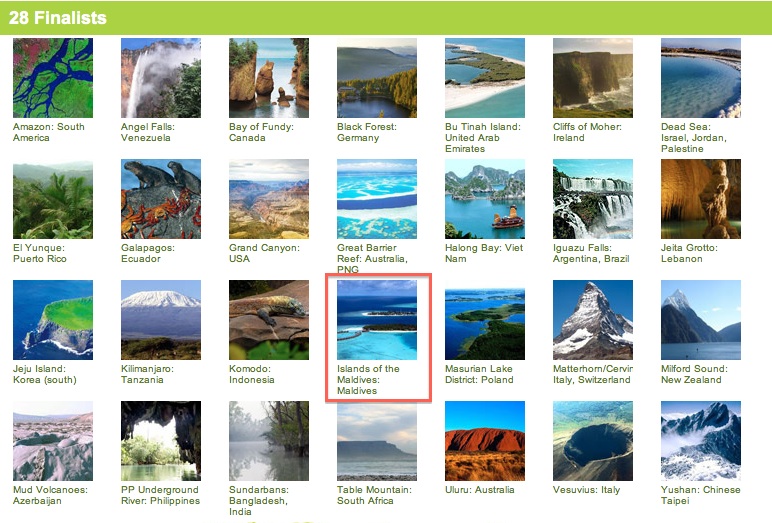
Yes, I have read that same article, back from May 2011, that the Maldives decided to withdraw themselves from the vote because the N7W organization asked for copious amount of money and financial engagements. Simple question, which I will illustrate with a breathtaking image of the Maldives:

Surprise, surprise… The Maldives are still in the competition. Their government pulled off support for the participation? It’s hard for me to believe that a flimsy Switzerland-based organization can overtake a government. I’m just saying.

Besides, to be eligible to be part of the final 28 participants, no fee had to be paid. N7W is, at the end of the day, a non-profit organization. But to be non-profit, you need to balance out your expenses. In order to do so, they offered sponsorship rights, which are elective, for the final phase of the vote, in return for a certain amount of money. In Lebanon’s case, according to officials from the Jeita Grotto committee from whom I got a statement, no such fees were paid. Jeita doesn’t have sponsors.

But let me ask this: is $500,000 too much to be paid for the amount of advertisement they’re getting from being part of this competition? Could Jeita have gotten the exposure it’s getting had it not been competing? I hardly think so. Odds are Jeita would have forever remained a landmark visited mostly by the Lebanese and a fraction of the couple million tourists we get every year.

More Tourists:

Yes, more tourists. There’s no way in hell having millions of millions of people (multiple voting included) visiting a website and voting for seven different sites without it sparking at least a curiosity to visit, with many of those acting out of it and actually visiting. Take me for an example, I really want to visit the Cliffs of Moher in Ireland, a landmark I did not know existed before the competition. Say I do go to Ireland. I won’t end up visiting the Cliffs of Moher and going back to Lebanon. I’ll stay there for at least a week, visiting other landmarks and helping out their local economy.

To assume that “NO ONE” is falling for this is absurd. Tourists who are interested in visiting a country will search for related info about their country. If Jeita ends up winning, odds are that will be one of the main points they will encounter in their search and they will most definitely want to visit it if they end up coming to Lebanon. At the end of the day, Lebanon is a country driven first and foremost by its tourism sector, which is helped immensely by such exposure. To assume that such exposure is nonsensical would be nonsensical in itself.

National Pride:

Yes, national pride. Shouting national pride from the rooftops that is. And yes, that does make me – or any other Lebanese – proud of what we have accomplished with the Jeita vote, how for one rare time in our history we’ve forgotten our differences – at least for a minute – and all voted for one common thing. Yes, that is something that makes me proud. It makes me proud to see a landmark from my country be part of a competition on such an international level, just as I would be proud to see, for example, Riyad Salameh picking up an award for excellent skills in managing our Central Bank and helped us weather the international financial meltdown. It makes me proud to see some great Lebanese icon, like Fairuz, being honored at an international level – regardless of whether I think she needs that honor or not. Sure, we need to preserve our natural sites. We need better laws. We need to take better care of our country. But I fail to see how all of that is logically deterring us from supporting the Jeita vote in any way?

At the end of the day, scam or not, official or not, N7W is doing most of the countries that have reached the finals a huge favor. When I look at their live voting map and I see someone from Vietnam or Chinese Taipei voting for Jeita, it makes me happy. Not because they voted for Jeita, but because someone, somewhere, now knows that there’s a country called Lebanon in the Middle East with a breathtaking landmark that, win or no win, is now known.

It’s clear though that some Lebanese need to stop it with the conspiracy theories and relax. If you don’t find enough reasons to vote for Jeita, then don’t vote. Don’t berate those who find the reasons to. And also, fellow Lebanese, you shouldn’t be angry people are urging everyone to vote. It will all end in nine days.

The Spanish Experience – Toledo

We, Lebanese, pride ourselves that we can speak three languages fluently. Well, you know you’re in Spain when your bus makes a pit stop and the first thing a salesperson there tells you is, in Spanish, that she doesn’t speak neither English, nor French, nor Arabic. Only Spanish.

And that was our welcome notice to Spain. Welcome to the land where you will barely manage to communicate.

Also, if you thought Lebanon’s summer was hot, wait till your every being is stricken with thirty-five degree heat, no humidity and no wind to cool it down. Then you’ll know what hot is. And I know that’s nothing compared to what some people in the Gulf get, but it’s still something. After all, the European weather misconception is: it’s always at least colder than Lebanon.

We stayed in the Southern part of Toledo, in a school in a new neighborhood. The realization that I had five days in Toledo where I had to sleep on the ground, take a shower in the parking lot with cold water using a bathing suit in front of twenty other French people took some time to sink in. Moreover, going into a school with three hundred other French guys and trying to fit in a tiny classroom or gym with them isn’t the most welcoming idea in the world. Therefore, five other Lebanese guys and I took our stuff and basically made outside our bedroom.

Toledo was the first out of two steps in our World Youth Day journey. It was a preparatory forum, one that I had my own experience at. You see, there was a fixed daily schedule of events that went on for our five day stay. So we, Spanish-less Lebanese,  since we didn’t understand 95% of what was going on, simply ditched most of what was going on and went globe-trotting around the city. Most of the Lebanese group stuck together. I, on the other hand, set out to meet people. I didn’t want to remain with a group I could meet whenever I wanted in Lebanon. I wanted to meet people whom I would only get the chance to meet in those few days I had in Toledo.

The second day I was there I bought an Orange phone line. No, do not look at me like that. I didn’t change political affiliations (if anything, Spain fortified them) but that line was so cheap! A 3.5 euro per week subscription to unlimited 3G internet as well as fifty free texts, with very cheap minutes. For my overpriced Lebanese line, it was heaven.

But I digress.

The beauty of Toledo is something that has evaded me while being in Toledo. You see, the constant worry of sleeping and showering and the heat was a constant shadow on my days. Also, the fact that I didn’t get along with a decent portion of the Lebanese group I was with left me searching for company elsewhere.

It was then that I met an awesome group of Egyptians, most of whom were of Lebanese origins. After all, it’s hard not to get excited when an Egyptian tells you they’re Maronite and that their mom is from the North and their dad is from Jezzine. What was the most awesome thing about these Egyptians, apart from the fact that they were a great company? They simply loved Lebanon. Even those of them who didn’t have any drop of Lebanese blood in them.

I still remember when a purely Egyptian Raef told me: “You, Lebanese people, don’t know how lucky you are to be living in Lebanon. You have the prettiest country, nature, cities, girls, cars, etc…”

I had told you before that my Europe trip increased my pride in my country. This is another one of those moments. Raef had visited Lebanon three weeks before his World Youth Day trip and even in Spain, Lebanon still mesmerized him. So to every self-hating Lebanese reading this, just suck it!

The events in Toledo were taking place in a huge tent that could hold up to 5000 people of different nationalities. People from Germany, Romania, Slovakia, Puerto Rico, France, Belgium, Egypt, Iraq and even other groups of Lebanese were there. Part of the events was a country festival where a group from a certain country would get a fifteen minute presentation to tell everyone why their country is special.

Our Lebanese presentation consisted of yours truly explaining the Lebanese flag, name, talking about Lebanese saints and our country in English to over 3000 people in attendance. And the best thing of all? It wasn’t even nerve-wracking! Imagine five minutes later getting the whole hall to dance the Lebanese traditional dance, the Dabke, with you and you get a feeling of how awesome the Lebanese presentation was.

It was so good, in fact, that a guy from Belgium asked to take a picture with me soon after. The following day, a French guy named Martin ditched his group to sit with the “lively Lebanese who are the heart of Toledo.”

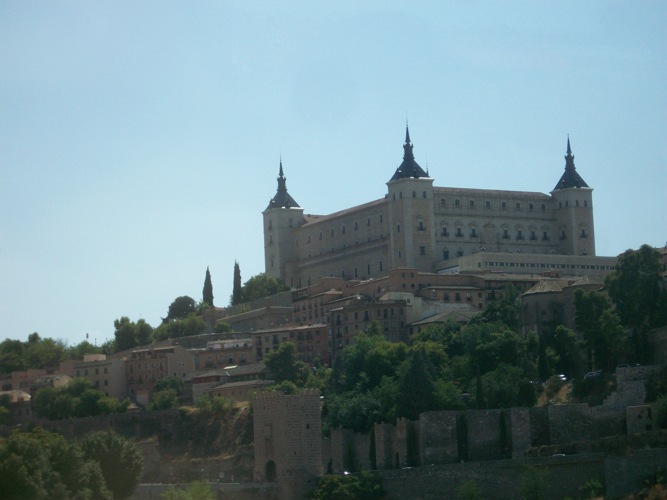
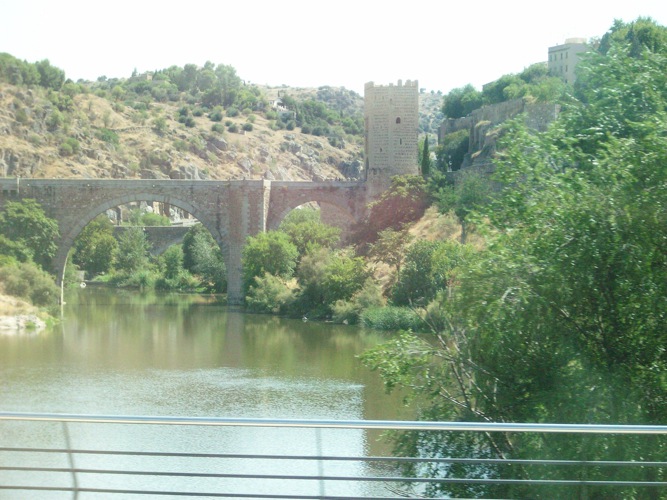
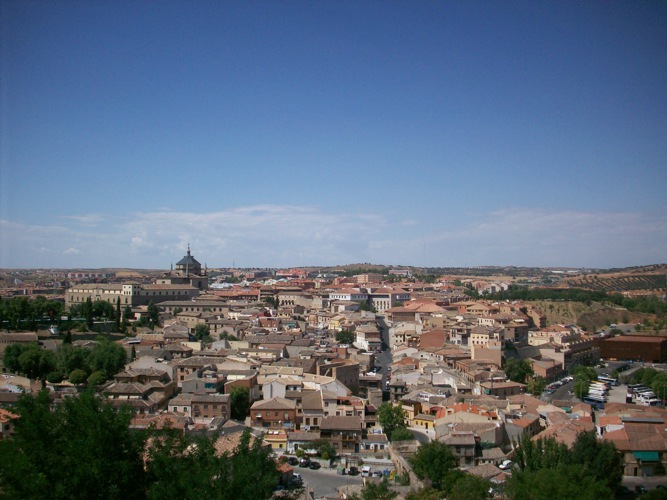
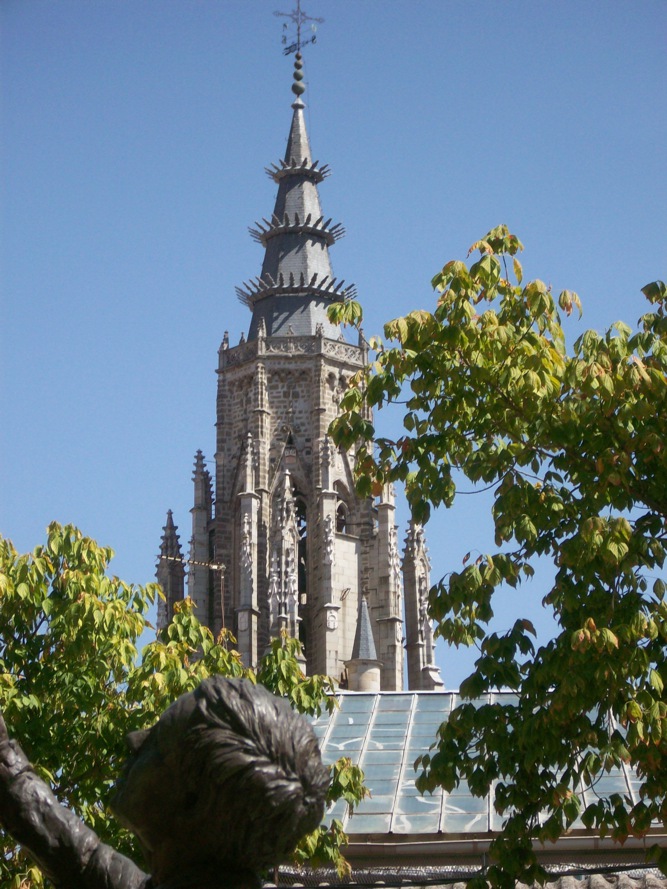
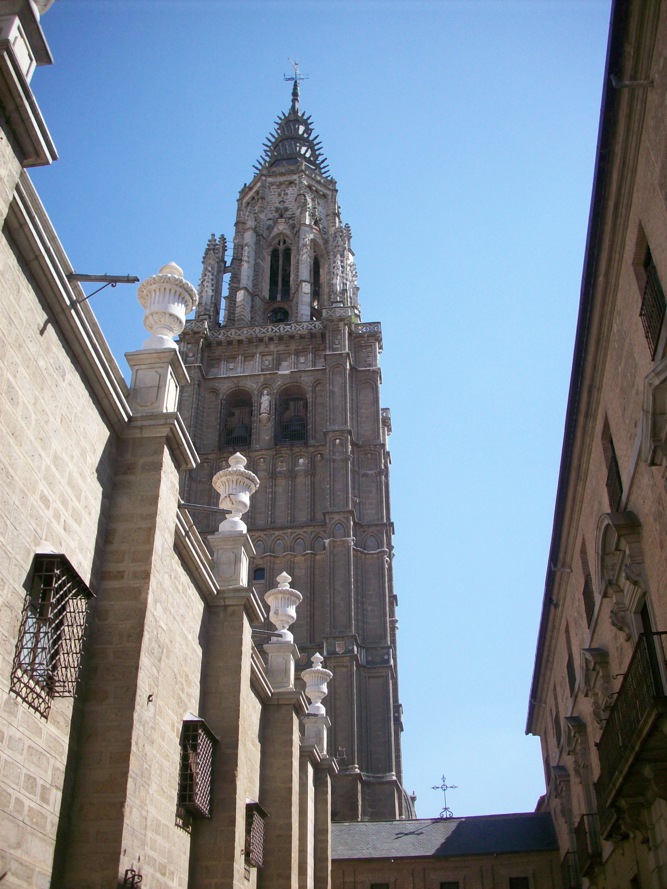
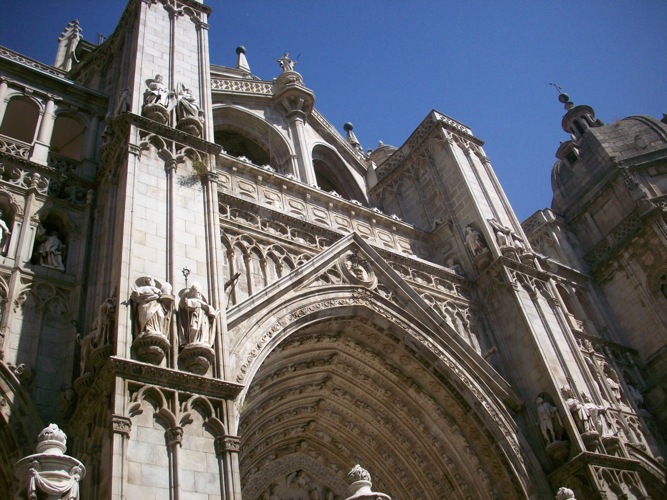
But it wasn’t all presentations and prayers. We also got to visit the ancient city of Toledo and see Cathedrals that are so breath-taking they’ve been turned into museums. I actually have a hard time imagining Mass taking place in them. It’s just so distracting to sit in them and focus on a priest praying.

I was also fortunate to meet two people in the school we stayed at in Toledo: Paul, a Russian boy who changed to Catholicism, and Sufian, a Moroccan who converted to Christianity. Sufian came over one night and said he needed to talk. Twenty minutes later, the other Lebanese around asked me to leave since they wanted to sleep. So Sufian and I went to a separate location where people wouldn’t be “bothered” by the discussion. Then Paul joined us. And what had started as my attempt to sleep early turned into me not wanting to sleep, at 3 am.

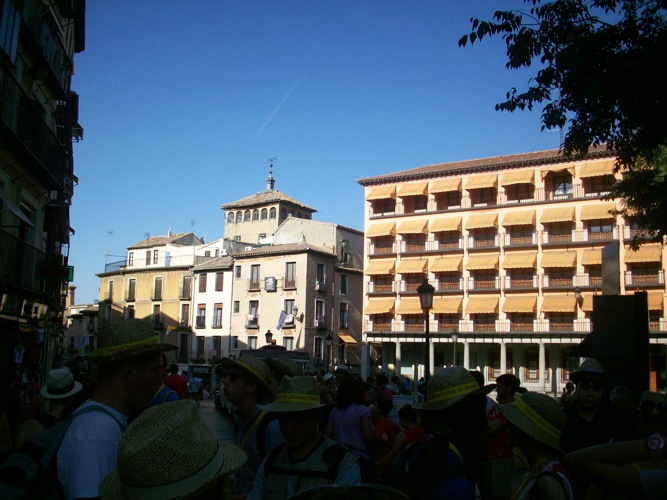
Remember how I said Spain fortified my political affiliation? Well, politics followed me all the way to Spain. While visiting the old part of Toledo, we stumbled on a Syrian group who was staying in the city as well. They were Syrian Christians from Aleppo, also in Spain to participate in World Youth Day.

One of the Syrian guys asked me where I was from in Lebanon and I answered. He then proceeded to ask me how the situation was in my country, to which I answered: “that question is more valid to Syria, don’t you think?”

He replied. “Oh there’s nothing going on. It’s all media exaggeration.”

I laughed and said: “Yeah, because the guy I saw get beheaded on YouTube is ‘media exaggeration’… anyway, let me tell you one thing: Bashar is going down!”

And then he started shouting and flashing his Bashar Assad pin at me. Moments later, I stumbled on another Syrian with yet another pin. Call me unlucky but it looks like I was in their corner of the Square. This time, however, I had two Lebanese of my group with me. So naturally, the “Syria topic” starts again and this time I blurt out the fact that most Lebanese Christians are actually against the regime in Syria because the regime has done grave things for us. Who replies? Yup, you guessed it… the two girls in my group, who happen to be of a differing political affiliation, shout at me saying: “don’t include me! I’m with the regime, long live Bashar Assad!”

I’m not the most self-restraining of people so I’d like to think some act of divine intervention took place to shut me up over there.

But if there was anything I learned from Toledo it’s that:

1) Spain is very hot!

2) Sane Egyptians, who are not all “YAY! EGYPT! REVOLUTION! OMG”, can be quite fun to be around.

3) French people are great!

4) Sometimes, the best remedy for a stranger in need would be a comforting conversation.

5) Syrian Christians, as well as some Aounists, are cringe-inducing. This realization will only get worse in Madrid.

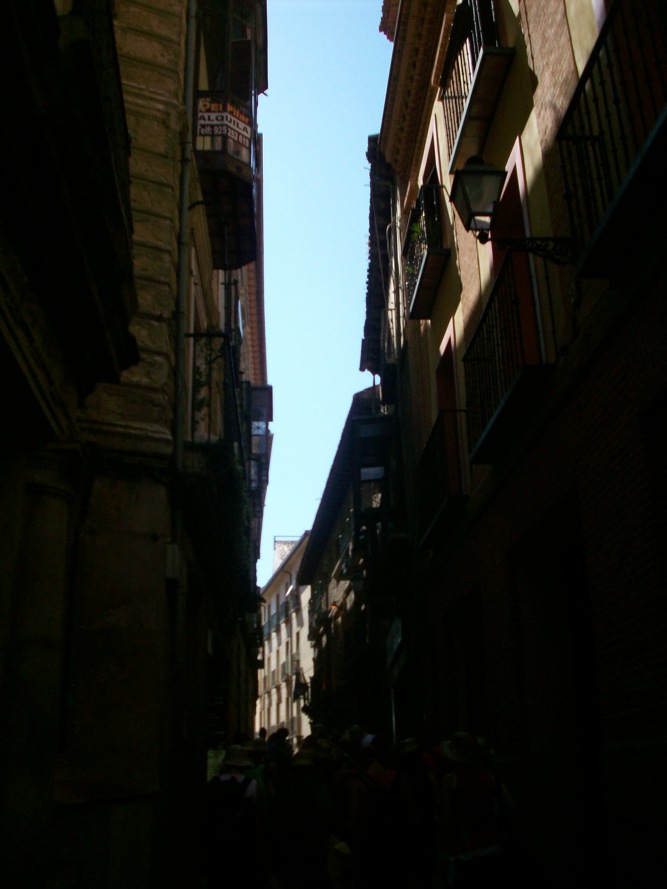
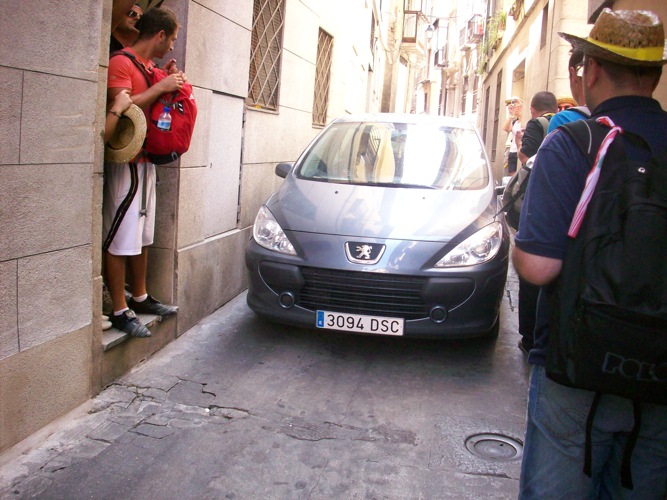
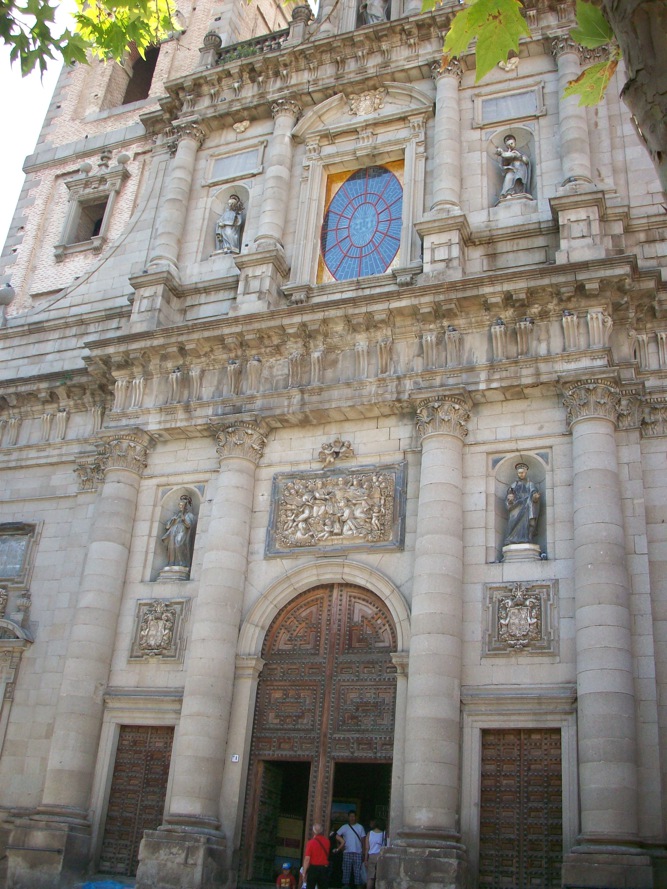
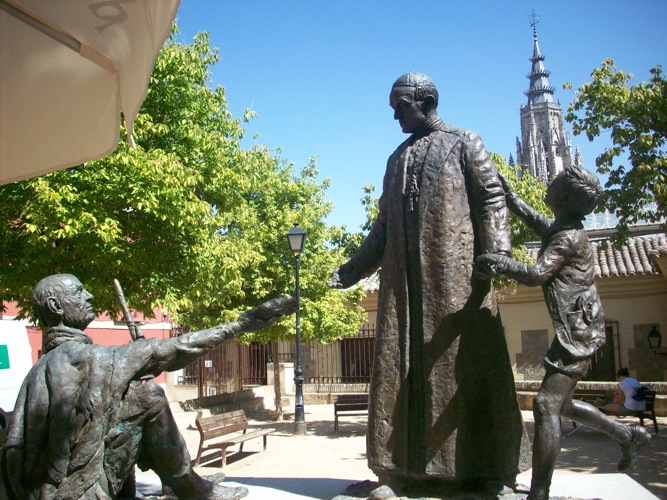
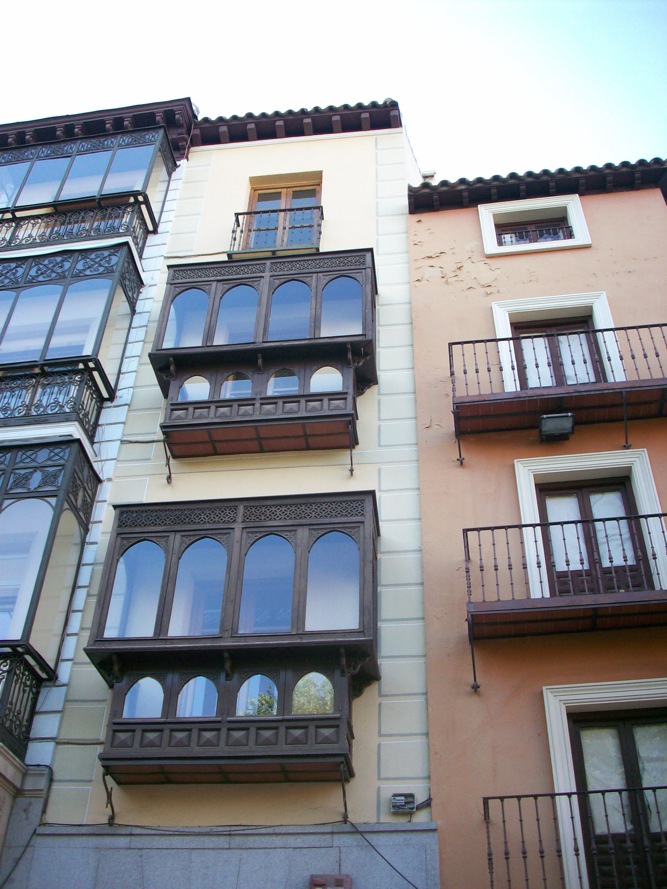
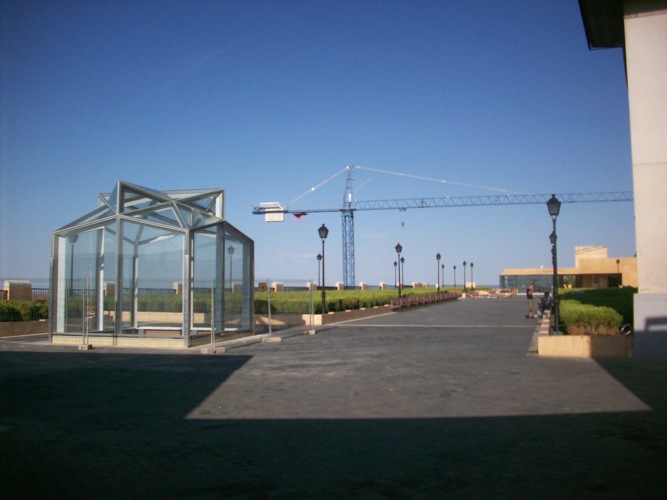
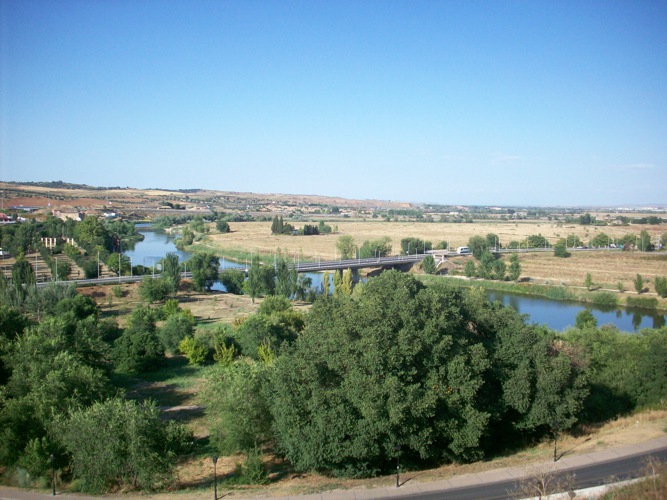
Here are some pictures from Toledo.

Rue Huvelin – New Lebanese Movie

And the series of interesting-looking Lebanese movies continues. After blogging about Nadine Labaki’s upcoming movie, Where Do We Go Now, it’s time to put the spotlight on Rue Huvelin.

For anyone who doesn’t know Beirut well, specifically Achrafieh, Rue Huvelin is considered a landmark. It is where the prestigious French system based university “Université St. Joseph” is located.

Slated for a November 17th release date, Rue Huvelin is a movie about the Lebanese student movement at the time of the Syrian (direct) occupation of the country, between 1990 and 2005.

The movie’s official summary is as follows:

In 1990, the Lebanon War ends with the Syrian army’s takeover of the Presidential Palace, signaling an ensuing fifteen years occupation. One of the consequences of this period was a general sense of collective retreat and apathy among the population. On Huvelin Street, where the Middle East’s leading Francophone university (Saint-Joseph) settles, a group of students opposed to the status-quo decide to break the silence and rally a pacifying resistance movement in the heart of Beirut at the close of the 1990s. Their resistance was a struggle between two opposing worldviews: between a liberal and freedom-loving lifestyle of a group of friends and compatriots, and between the oppression of authorities and the indifference of society.

Are you interested? Cause I sure am.

Buried – Movie Review

Buried - Movie Poster

Paul Conroy (Ryan Reynolds) is a U.S. contractor based in Iraq. He wakes up and finds himself buried six-feet-under in a wooden crate, with nothing to soothe him except a phone that is set in a language he doesn’t understand and a zippo lighter that’s consuming the very air he’s breathing.

To say this movie is every claustrophobic’s worst nightmare is an understatement. The movie runs for over 90 minutes and features nothing but Paul Conroy inside his coffin. The only hint of an outside world comes in the form of many phone calls that are made, to help move the movie forward, and provide Paul Conroy with a way to seek salvation.

You cannot but draw similarities between this movie and 127 Hours. After all, they both rely heavily on one lead, the rest of the actors/characters being only very secondary to the overall picture. And similarly to 127 Hours, Buried features a very strong performance by Reynolds. I had no idea he had it in him, to be honest, after the series of romantic comedies he was in. However, to say that he comes within a remote distance of Franco’s epic performance in 127 Hours is a gross overstatement. If anything, Buried further cements the idea that not every actor/actress can handle this type of movies, which makes Franco’s feat even more impressive.

Buried is a movie that drags its main character to the depths of fear and despair and drags you down with him as well. And although it doesn’t rely on taking the settings of the movie outside the box it’s set in, the movie wouldn’t have gone anywhere except for the interactions between Paul Conroy and the people he calls, similarly to 127 Hours’ use of flashbacks and imaginative sequences. It is, however, an out-of-the-box movie, for all matters and purposes.

Continue reading