Putting Lebanon’s First Civil Marriage in Perspective

We sure are all thrilled that a Lebanese couple defied all odds in having Lebanon’s first ever civil marriage happen on our soil (click here). They are courageous and should be commended, as we’ve all done and they have shown that, if you absolutely want to, getting a civil marriage in Lebanon is entirely possible although extremely tedious.

Some people categorized is as a triumph for a secular state to be, some were thrilled that they don’t have to go to Cyprus now to get married. Others were over the moon that this is this couple’s way of sticking it to religious figures who want to keep us down. You know how the drill goes.

But things are not that peachy. Quite simply put, if you think about it Lebanon’s first civil marriage is a triumph for our secular system first and foremost.

As I was discussing with a friend the possibility of maybe removing our sects like this couple did, I had this nagging idea in my head all the time: how much would that limit my prospects in this country?

And the answer is: a lot.

How is a couple being forced to remove their sect from all governmental papers in order to get married a triumph over the sectarian system? If anything, it’s a grave injustice for them. Not because our sectarian system is healthy but because by opting out of it through removing their sect from all their legal documents as per Article 60 LR., this couple has not only limited things for themselves but for their children and their children’s children as well.

It’s not even about governmental jobs which are allocated according to sectarian quotas. It’s about universities which admit students in a Lebanese-affirmative action sort of way whereby half of its admissions are Christians and the other half is Muslim. It’s about jobs that would hire you outside of qualifications if you’re from a certain sect. It’s about this mentality among a lot of people – arguably the majority – to help out others just because they are “men wleid l tayfe.” (from our sect).

It’s not the way things should be, sure. But it’s the way things are. Should the consequences of a civil marriage be limited opportunities for everyone involved? I hardly think so.

Whether we want to admit it or not, the current state of affairs in Lebanon is entirely run on that category in your documents labeled “sect.” Once that box is empty, where do you fit in the bureaucratical aspect of things? Nowhere. How will they register their children when the time comes? How difficult will it be for them to get things done in this country starting from getting that meaningless “ikhraj l eid?”

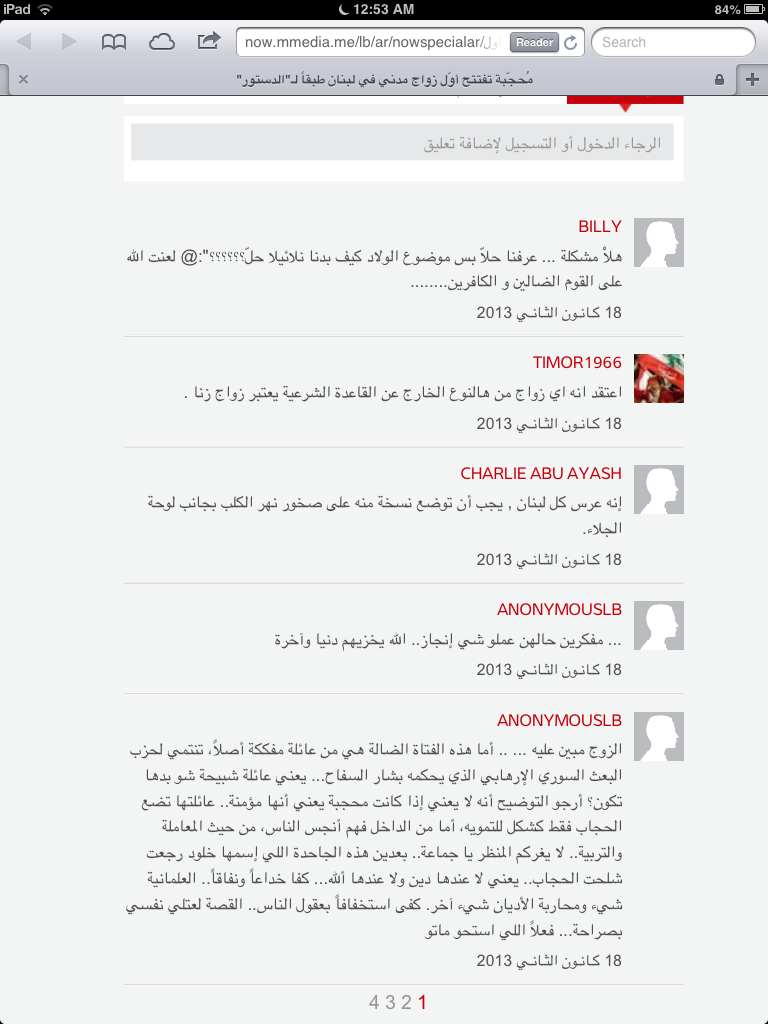
On top of all that, here’s a sample of some of the comments on NowLebanon’s article about the issue:

Civil Marriage Lebanon


Enough said, I guess.

Quite simply put: a “proper” Lebanese civil marriage should be one that takes place while all your governmental papers still have your sect written there in that box.

Either way, if you want to get a civil marriage Lebanon is not the way for you. Nicosia should still be your main destination because at least you know that if you get married there you won’t have a whole lot of repercussions to go through and you know that your children won’t have to go through hell and back in order to get a job.

Lebanon’s First Ever Civil Marriage

Civil Marriage lebanon - 2

Amid ongoing discussion about the Orthodox Law, Christian rights and naseauting political ads, there’s a piece of news which makes you hopeful about this country we live in.

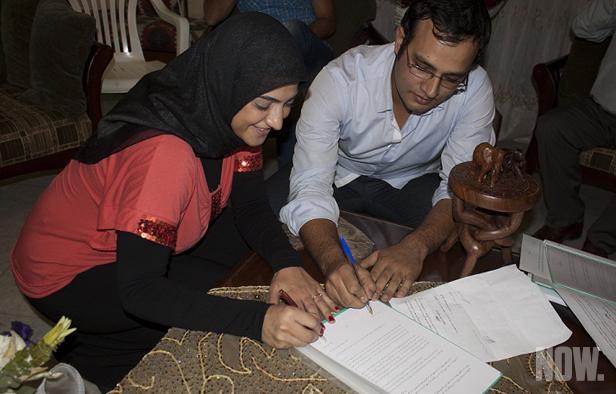
No, they didn’t go to Cyprus. They didn’t travel to the end of the world to have their marriage signed. Yes, they are religious – she is veiled. But a Lebanese couple who wanted to get married decided that they wanted their union to be an embodiment of civil, not religious, rights. And so they became the first couple to – legally – have a civil marriage in Lebanon. For the full story, click here.

What Khouloud and Nidal did was to remove their sect from their personal records according to Decree No. 60 L.R. from the Lebanese constitution, which meant there was no religious court for them to get married in. The couple signed their civil marriage document on November 10th.

Their marriage is now subject to consultations at Lebanon’s ministry of interior affairs. Because this is so big.

According to the article I linked to earlier, the decree the couple used is simply not making an administrative disclosure of your corresponding sect, which makes you liable in front of civil, not religious, court.

After removing their sect from legal documents as per decree 60 L.R., the couple went through the following process:

  • Get a paper from the “Mokhtar” allowing the marriage.
  • Publish the marriage decision 15 days in advance either in the Official Gazette or in two newspapers or on your parents’ door.
  • Get legal documents from notary public that contain all the items in the marriage contract.

This sounds like a whole lot of paperwork. And it is. But at least now we know that a civil marriage in Lebanon is possible.

The news of this marriage comes at a time when many of the country’s politicians are discussing the possibility of adding a 19th officially recognized sect to the country – the sect of those who don’t have a sect or don’t want their sect to dictate every aspect of their legal life (atheists, people like this couple who don’t wish to be identified by their sect, etc…).

Here’s hoping the ministry of interior affairs doesn’t throw hurdles in front of this couple’s union because their marriage is apparently perfectly legal. And here’s hoping our religious folk don’t start advocating to close this loophole in our constitution.

This marriage, though, needs to be put in Lebanese perspective because it’s not really a fairytale. (Click here).

Let’s Talk About Lebanon’s 2013 Elections: The Orthodox Gathering Law

One can argue that the French mandate was the root of Lebanon’s sectarian system. Its goal was to make a country that serves as a safe-haven for Maronites, with an edge in parliament seats and in governing powers. The sectarian divide in power reflected upon the people over the years. Blame the French? Blame everyone I guess.

Growing sectarianism and a feeling of injustice among sections of Lebanon’s population led to the Lebanese Civil war which culminated in the Taef agreement. The agreement took away most of the president’s powers, rendering him a near-puppet in a growingly tense political scene, and equalized between Christian and Muslim representation in parliament, despite the case not being so demographically.

Subsequently, a Syrian-led Lebanese regime managed to fragment Christian communities even more. The demographics, due to constant persecution, low birth rates and high immigration rates of Christians, continued to become even more lopsided. As it stands, Lebanon’s population is 60% Muslim and 40% Christian. That’s on a good day of statistics.

The problem with a skewed demographic, however, with an equally split parliament is that many of the minority’s seats cannot be chosen by said minority, regardless of what that minority is. This wouldn’t be a problem in a place where majorities and minorities didn’t view themselves as such: I have the power of numbers, therefore I rule over you.

That’s how the idea for an Orthodox Gathering Law came to be: the power that Christians lost over the years “must” be recuperated. And that should be done despite Christians not having the power of numbers anymore.

Here’s what’s given about the Lebanese situation today:

  • There’s no such thing as a Lebanese social fabric.
  • There’s no such thing as national unity – it only exists in the wildest fictive ideas of those who live in their own Lebanon-utopia
  • There’s no hope to achieve a state of national unity under current circumstances.
  • The biggest obstacle towards national unity isn’t regional (i.e. coming from different cazas across the country) but sectarian.
  • Sects always feel threatened by different sects in the country.
  • Sects are already more or less isolated and with rising bouts of extremism.

Apart from a minority in the Lebanese population, people identify with their sects first and foremost. They are more inclined to feel sympathy towards another person’s strife if that person is from their corresponding sect. It’s sickening, definitely. It’s horrible, you bet. But it’s the way things are. To fix this, you need to fix sectarianism.

You can’t fix sectarianism by forcing secularism upon people. You can’t tell a country with many who associate the current political system with being “religious” that the country is now secular which they will undoubtedly believe is also correlated with atheism. Off with their heads! No, the change towards secularism has to be gradual just as Lebanese gradually but surely became a sectarian state. People need to leave behind their sect-survival instincts in order to adopt a more global approach towards how they vote, towards how they act regarding others who are different from them, towards how they perceive those who are different.

For instance, here’s a little experience that I observed firsthand recently.

As news of Hay el Sellom in Beirut being flooded broke out, I saw two drastically different reactions in front of me. In my own little piece of the Lebanese Bible belt, people asked: Are those Shia? If they are, then ma3le (it’s okay). On the other hand, as Lebanese journalist commented on those people of Hay el Sellom’s grave violation of the law in where they built their houses, half of Twitter’s Shias, who tend to be on the more liberal side, were up in a fit.

Sectarianism is there – even among those who claim not to be sectarian.

As it stands, Lebanese people vote in a “to be or not to be” mantra. This needs to change. They are voting as such because:

  • Christians are made to fear wilayat al Fakih and those bearded Islamists.
  • Sunnis are made to fear the Shia weapons.
  • Shia are made to fear everyone being after their weapons.
  • Druze are made to fear anyone trying to breach their tightly-knit community.
  • Minorities are made to fear everyone else.

As this article is heading, you might believe this is in defense of the Orthodox Gathering law. If you had asked me a few days ago where I stood regarding that law, I would have told you this: Based on the current way that Lebanon is run, given the country’s state and fabric, the Orthodox Gathering Law makes sense. The way I see it, it doesn’t increase sectarianism and it might help, if sects stop feeling threatened, to get people to vote based on accountability which is very needed in this country. On the long run, if sectarian parties can no longer fuel people in a sectarian way then maybe – just maybe – that would help with things.

But that was a few days ago.

The MPs going on and on about how the Orthodox Gathering Law is unconstitutional and how it’ll increase sectarianism and whatnot are full of it. The only reason they are panicking isn’t because they want to keep the idea of Lebanon being an example of non-existent co-existence intact. They want to have their own behinds saved from the chopping block of a law that most probably wouldn’t vote them in again. Our MPs – all of them – are only seeking out a law that ensures they return to power. It’s as simple as that. The discussion isn’t about the country’s sake, it’s about their own personal interests.

Today, when I think about the Orthodox Gathering Law, I am not on the fence, I am against it. It’s not because I don’t believe it’s a must to tackle the growing “injustice” towards Lebanese Christians, whatever that may be. It’s not because it is demographically incorrect as it gives Christians more weight than they’re supposed to have. It’s not even because it’s sectarian in principle. It’s not because it makes it harder for centrists to break in. It’s not because it drowns out a secular minority that can’t identify with it.

I am against the Orthodox Gathering Law today for very simple reasons:

Why should I, as a Lebanese Christian, have the prerogative of having a law tailor-made for my sect and have it applied to all other sects as well? Don’t other Lebanese sects have woes as well? Don’t they have “minorities” whose voices are also drowned out by a Christian majority somewhere?

Why should I, as a Lebanese Christian, consider myself to be the only sect in this country who has rights eaten away and who needs some “justice” restored?

Why should I, as a Lebanese Christian, have to vote only for people who correspond to my sect without knowing if those people share my worries or if they’re even aware of the issues that I want to vote for? Does a person from a certain sect running for office automatically mean that person is knowledgeable of the issues that their sect faces? No.

My problem with the Orthodox Law today is simply that it tells me that I, Elie E. Fares, a Maronite Christian (on paper) from the mountains of North Lebanon, should have a problem in having a Sunni or a Shia or a Druze or a Catholic or an Orthodox or a Jew or a Alawite or an Ismailite or a Syriac or an Evangelical or an Armenian or whatever sect a person belonged to have a say in a parliament member that represents them all, not just me.

I believe that what the Orthodox Law is telling me is unacceptable. But I’m a Christian minority in thinking so. Most Maronites and Christians, especially some of our politician who double as Christian saviors-wannabes, want you to believe that what I believe is wrong. They are telling you that their way is the only way for you to get your rights. They want you to believe that if Christians don’t elect every single Christian-designated MP, then they’re being persecuted.

The Orthodox Law isn’t the way we get back our “rights.” We get back our rights by voting to people who can fight for those rights without turning it into a media propaganda as they kickstart their 2013 election prospects. We get back our rights by actually knowing what our rights are. And let me tell you, those rights aren’t Lebanon’s Christians selecting half of its parliament all by themselves.

So as our politicians play a game of chess with each other, you know what your rights are according to some of them? You only have the right to be afraid of everyone else all the time. You only have the right to believe you are persecuted all the time – that those big bad Sunnis and Shia and Muslims are after you all the time. Welcome to the state of mass paranoia. And we just can’t live like that – not as Christians, not as Muslims, not as Lebanese and we can’t allow laws that are based on our paranoia as Christians rule the entire country.

Lebanese Saints Are Now On Facebook

I’m sure I’m not the only one who has noticed but the amount of prayers on Facebook has increased dramatically over the past few months. There isn’t a day that passes without my timeline getting flooded with “like for Jesus, keep scrolling for satan” pictures, or people sharing their prayers for everyone or others sharing YouTube videos of Islamic prayers.

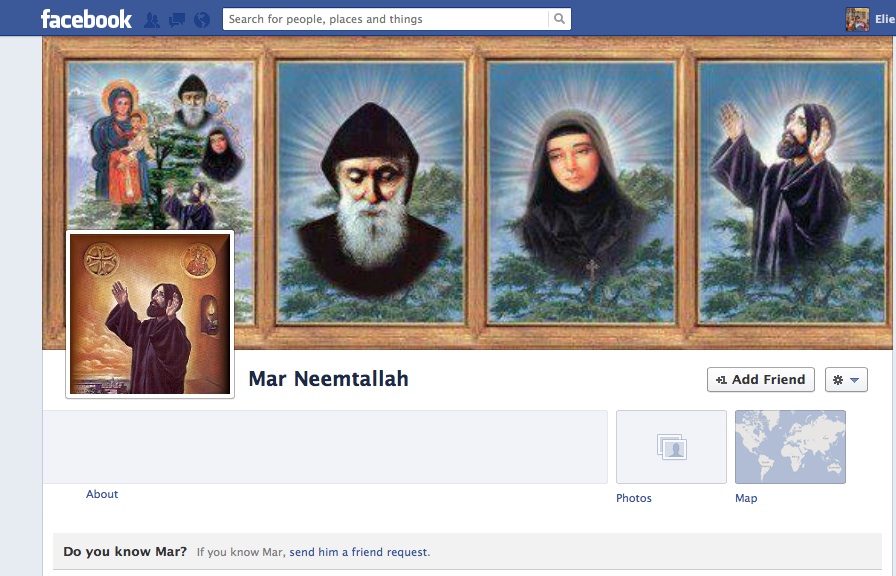
But someone has been listening up there so Lebanese Saints now have their own Facebook accounts to communicate with all the faithful seeking salvation through Facebook statuses and Facebook places check ins. The first one? Mar Ne3mtallah.


Convents are no longer the place to go to “communicate” with those saints. In the age of digital media, it seems even holy figures are jumping on the 21st century bandwagon. One does not simply stay behind the times. And because staying in convents is too mainstream.

Who’s going to be the second saint you’ll be able to befriend? My bet is on St. Rafca.

In all seriousness, start reporting these profiles. Some people have way too much time on their hands – and way too little brain matter up there.

The Rise of the Middle East’s Atheists

September 2012, Middle East:

A low-budget movie titled “The Innocence of Muslims” makes its way to the media of the region. The movie insults the prophet Mohammad and doesn’t pretend to do so innocently. The mayhem it caused became infamous, notably for the American embassy storming in Libya which made its way to the US presidential elections. Protests across the region turned bloody. Innocent people lost their lives because of cheap ten minute footage. And the image that some Muslims have been giving to Islam over the years was reinforced once again.

October 2012, Pakistan:

Malala Yousafzai, a fourteen year old girl, was shot in the head by Taliban individuals who feared her message. Malala’s message was not that of an uprising against the men who worked endlessly to make her life and the life of countless other girls like her a living hell. She was calling upon girls her age to seek an education, which most of us take for granted: the kind where we sit behind a desk and listen all day to teachers telling us things we believe we’ll never need. Her message did not sit well with the Taliban whose mission had been, in part, to eradicate education in the parts of the world where they are of influence. They had destroyed countless schools and forbade women from attending schools in their attempt to restore the days of 600AD.

October 2012, Facebook:

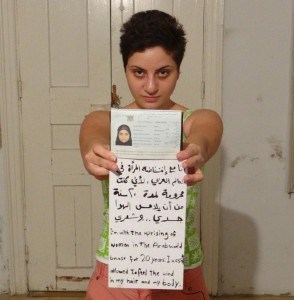
A Syrian woman named Dana Bakdounes posted a picture of herself on Facebook without the veil as part of a movement for the rights of women in the Middle East. (Check the picture here). The message Dana wrote, as part of her picture, said “I am with the uprising of women in the Arab world because for 20 years I was not allowed to feel the wind on my body… and on my hair.” The message rubbed some people the wrong way and a bunch of extremists took it upon them to silence Bakdounes, even on Facebook. So they mass reported her picture as offensive, prompting Facebook to remove it.

October 2012, Egypt:

In a post revolution Egypt where Islamists have been gaining power, two Copt boys, aged nine and ten, were arrested for defiling the Quran. Another Copt teacher was arrested after some students accused her of speaking badly of prophet Muhammad in class while another Copt is facing charges for material deemed offensive which he posted on his Facebook account. A veiled Muslim teacher also cut the hair of two girls in class who refused to wear the veil. She later explained that she had been “challenged.”

The Rise of Atheism:

The rise in religious extremism in the Middle East is touching all of its religions. Be it Christians who are worried about their fate and revert to their Bible in belief that it will somehow be their salvation. Or Jews whose reputation has become intermingled with zionism and borderline inseparable in the mind of many. However, I decided to only discuss Islam because the broader picture of the Middle East, in which there’s a tangible rise in Islamist Influence, is a canvas of Islam – as it is the region’s first and foremost leading religion, demographically.

The rise in extremism is attributed to many geopolitical reasons. It is also associated with a serious lack of understanding of religion from all involved, most notably the men of the robe who are doing more harm to their religions with their backward mentality than anyone else.

The Middle East has probably one of the world’s highest rates of religious people. And it’s simply because we were born this way. We are not allowed to choose what we want to be religiously. I was born into a Christian Maronite family. Therefore, I am a Christian Maronite. If fate had it differently and my parents were from another part of Lebanon, I may have been a follower of a different religion. And this applies to everyone. As we grow up, we are taught our religion and nothing else. Come Sunday morning, it was better for me to attend Mass. For others, they had better pray five times a day, fast during Ramadan and never eat pork or drink alcohol. During my early days at AUB, I was surprised to find that some Muslim people – obviously a minority – had absolutely no idea when Christmas was celebrated. On the other hand, I thought Achoura was a happy celebration. We rarely challenge our religious beliefs because we don’t feel the need to. Those beliefs enable us to blend in our societies and not get ostracized – at least in that regards. They enable us to connect to other people with whom we are able to identify not due to their mentality or thoughts but because of their religious beliefs. At a certain level, deep down, it’s always easier for a “Christian” to make “Christian” friends than to become friends with a “Muslim.” The reverse is also true.

Our narrow religious upbringing also limits us to the other religions present around us, especially in the region’s few relatively mixed countries. Egypt’s Muslims know very little about the Copts who were founders of their country. Lebanon’s Muslims know very little about its Christians. The opposite is also true. This lack of understanding, combined with an increased rooting in unchallenged belief, places the seed of conflict, which has been manifesting way too many times across the region.

However, religion is but one side of the coin. For with the rise of the Islamists on one side, I believe that the region’s atheist numbers are increasing dramatically, albeit most of them are probably closeted, and they are fueled by the exact same events that are getting people to become more religious, coupled with an increase of education across the board. What people turning increasingly religious see as a threat to their belief, others do not see it as such. What some increasingly religious people do to defend their beliefs, others see as a violation of freedom. What some increasingly religious people feel related to, others want to detach from it. The religious behavior that makes some religious people proud causes others to be the opposite. The picture that some extremists deem offensive, others see as a manifestation of free thought. The children seen as defiling Islam by some, others see as children being children. The girl infecting the minds of other girls with poison, which some (obviously very, very few) believe, others see as a complete violation of every single human sanctity.

One part decides to cling further to what they know because of such events. Others decide to look at alternative, which might fit better with how they see the world, away from a notion of faith that has become alien to them. After all, all they’re seeing of faith is repeated incidences of things they do not remotely agree with, despite that being as remote from what religions call for.

Religious people will call it a lack of understanding and narrow-mindedness for someone to turn atheist. They will never be convinced how someone who was born and raised on certain teachings can ditch them entirely and move towards thoughts that they find revolting. What they don’t get is that the same rhetoric they use applies in similar fashion to atheists who are moving away from teachings that they find revolting and forced upon them throughout their years.

Of course, this does not apply to all religious people as some practice their religion in silence, without letting everyone know when they’re praying and when they’re offended. But this silent majority is not the one that gives an impression. Out of a crowd of millions, the person who changes perceptions is that whose voice is heard the most. And in a time of religious insecurity, in a region of political insecurity, the voices heard the most are those of people that rub a whole lot of other people the wrong way.

Regardless of where you stand regarding the two sides of the religion-atheism coin, the image being painted is the following: religion is the bread of the poor. Atheism is the butter of the “educated.” However, the only one thing that I believe is of absolute necessity is that the Middle East needs more atheists.