The Help – Movie Review

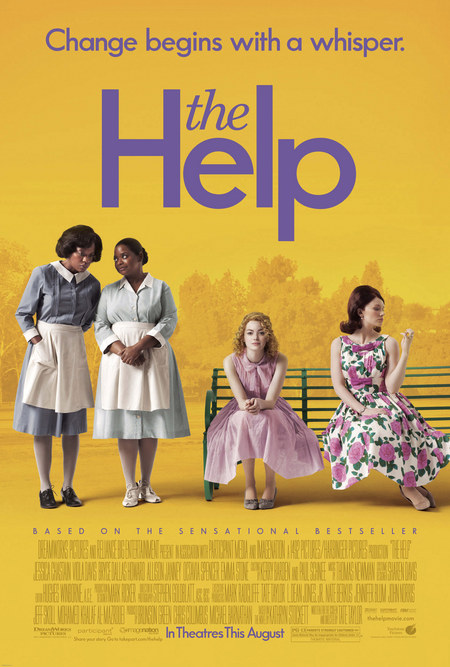
Based on the best selling novel by Kathryn Stockett (find my review of the book here), The Help is a drama about three Southern American women in their struggle for racial equality in Jackson, Mississippi.

Emma Stone stars as Eugena “Skeeter” Phelan, a recent college graduate going back home, who wants to break out of the mold society has limited her in. She’s an aspiring writer who happens to live during the era of Civil Rights Movements. Viola Davis stars as Aibileen, a maid working for a Mrs. Elizabeth, her main job being taking care of Elizabeth’s little girl, Mae Mobley, whose mother doesn’t care about. Octavia Spencer stars as Minnie, a snarky maid who literally can’t keep her mouth shut but whose cooking is so superb that her white employers tend to turn a blind eye to her blabbing.

After a proposal by Skeeter’s friend, Miss Hilly (Bryce Dallas Howard), to have separate bathrooms for the colored help, the idea in Skeeter’s mind of the necessity of change begins to blossom, especially after it gets fueled by an enthusiastic New York publisher who wants her to write. So Skeeter sets to write a story about the help in Jackson. Her first two maids to go on board? Minnie and Aibileen, who will tell Skeeter their deepest and darkest stories – stories they’ve hidden for such a long time they’ve become permanent scars in their souls. Aibileen tells her about all the little kids she raised, about how Elizabeth is an unfit mother, about how she doesn’t treat Mae Mobley like a real mother should. Minnie, who also happens to be Miss Hilly’s former maid, tells Skeeter about the “horrible awful thing” she did, which involves a special ingredient in a pie, to which you will have heartfelt laughs. But it is their struggle as a community that will bring the other maids on board – the chance to tell their side of the story, to be liberated – at least on paper – and to somehow seek salvation.

The performances in the movie are top notch. Starting with Emma Stone, she is one of our generation’s most promising actresses. After a great performance in Easy A and being the best of the actors in Crazy Stupid Love, she is back here not to steal the show but to offer an emotionally subtle performance that is exactly how the character she portrays is: not flamboyant but calm and reserved. Stone’s most emotional scenes come when she remembers her maid Constantine and discovers the story of how Constantine left them and it is in those scenes that she truly shines.

Viola Davis’ performance is being touted by critics everywhere as a tour de force performance. And it truly is. There’s one scene in particular, when she tells the story of how her son dies, where she plays on your emotional strings like a banjo in a country song. But her performance throughout is always nuanced, always great and always emotive. Probably the movie’s highlight scene, its ending, is purely her work. Davis is truly captivating. Whenever she focuses her eyes on another character in The Help, you almost see her gaze into that character’s soul. She is penetrating, invasive… and you welcome it with open arms.

Octavia Spencer is equally great as Minnie. She brings humor to the movie. It may be dark humor sometimes – literally – but it will still get you to feel happy that even amid all the horrible things these people had to go through, there’s still room for happiness in their lives. She gives hope to the other characters in the book and to you, as a viewer, that there could be a better tomorrow for them. She portrays Minnie’s strength subtly. She comes with a bruised eye to work and acts as if this wasn’t caused by her alcoholic husband. But deep down, below the strong outside of Spencer’s character, you can feel the volcano of hurt waiting to erupt.

The movie’s director, Tate Taylor, is Kathryn Stockett’s best friend since childhood. This deep understanding between such two friends has helped him bring her book to screen while entirely preserving the message she was trying to get across on page. While there are many differences between book and movie, some of which I had wished to be included in the movie, the screenplay Taylor wrote still works as a great adaptation, one of the better ones for a book to movie adaptation.

The Help is also a stunning movie visually. And even though there’s obviously no visual effect work here, this means recognition should be given to the cinematography crew that worked on it, most notably Stephen Goldblatt, whose previous works include Julie & Julia, Charlie Wilson’s War. etc…

If there’s anything to take out of The Help it’s that everyone is a victim – even those white socialite women. Yes, they are the victim of their ignorance, of their repressed memories of the black women that brought them up. The black women are victims of being at the wrong time. The little white girls are victims of negligent mothers.

At the end of the day, The Help can be summed up by its most emotional scene, which also happens to be its conclusion. As Aibileen leaves the house of her employer, Elizabeth, she sits by Mae Mobley and asks her to repeat what Aibileen has been teaching her every day. Mae Mobley stares into Aibileen’s deep, dark eyes and repeats: “You is kind. You is smart. You is important.”

9/10

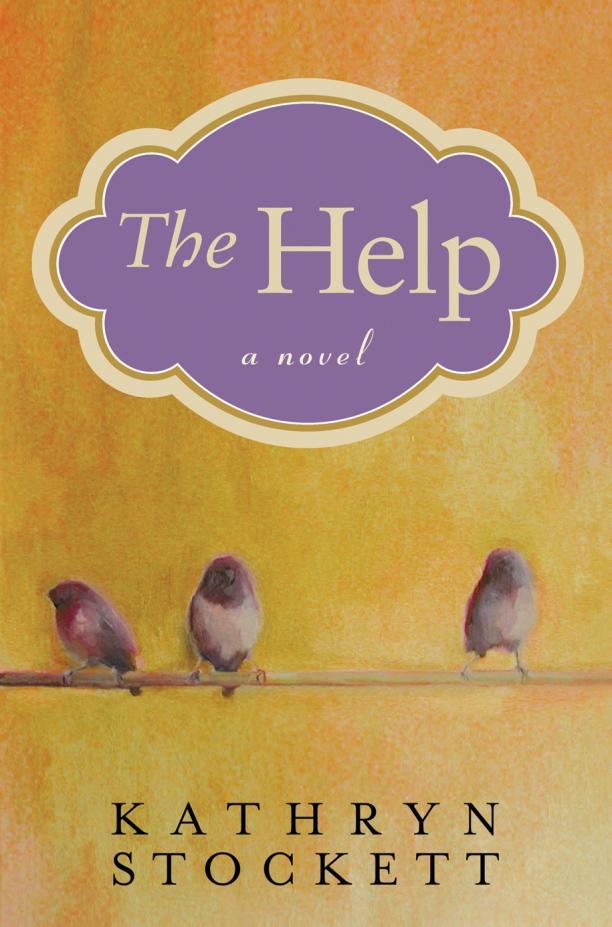
The Help (Book Review) – Kathryn Stockett

For the movie review, click here.

Born in Jackson, Mississippi and raised at the hands of a maid, Kathryn Stockett knows firsthand how it was to be a “superior” white person in the American South in the 1960s. The black maids tend to the white children, watch those children grow up and eventually become their bosses.

So it is with that sort of autobiographical flair that Stockett approaches her debut novel: The Help. No, the book is not an autobiography but it feels very real because it draws upon life-like elements and historical events to drive its plot. Eugena “Skeeter” Phelan is a fresh college graduate going home to Jackson in 1962 after a failed attempt at securing a job with important New York publishers. As she settles in the hierarchal routine of her hometown, Skeeter starts to realize that she doesn’t really belong in the bridge circles her friends have every week or their banquets. She’s also not as interested in the mundane elements of their lives that they love to share so much. So as Skeeter looks upon her friend’s maid, Aibileen, she asks her if she wished things were different. Aibileen cannot reply. But in a world where the white people of Jackson were trying to pass a regulation whereby colored individuals would have a different bathroom just because “they” carry different germs that do not go well with them while folks, Aibeleen has every reason to want change.

It is to the backdrop of racial segregation, fear, the KKK and white supremacists, mostly in the form of Skeeter’s friend, miss Hilly, that three women: Skeeter, Aibileen and a third maid, Minny, embark on an extraordinary quest that is really ordinary in all of its details: write a book about the stories of the maid of Jackson, a book that talks about the help including all of the bad, the ugly and the beautiful moments they have lived with their white employers.

The Help is told in three main parts, divided according to each character. The three parts intertwine as the story progresses but they are as distinct as they can be mostly due to the drastically different natures of the characters outlining and driving each part. Even the english language employed by Stockett is drastically different for each part: Aibileen’s part is mostly slang, Skeeter is proper English and Minnie finds a middle ground between them.

What is common to the three parts, however, is that all three characters driving them jump off the page due to their complex structure, warmth and exquisite character. Aibileen is the mother who cares about her employer’s little girl, Mae Mobley, as much as she cared about her son. Minnie is the angry, scrappy character who can’t stand silent to her employers berating her, who can’t stand by as Miss Hilly accuses her of being a thief. Skeeter is the woman wanting change in a time when people like her even existing is frowned upon, in a time where even the people she was trying to help are wary of her.

All of this is exposed in Stockett’s The Help in three-dimensional glory.

What leaves you as you finish The Help is a sense of happiness. It is a book about tormented lives seeking emancipation from the bonds of society. It is a book that gets you to laugh at points and sit in reflection at your own life at other points, especially as we, the Lebanese, have many of the incidences taking place in this book happening in own households with our “help”.

The Help, at the end of the day, is a book about empowerment. Be it the white woman empowering the black women to rise beyond their predicaments or Aibileen empowering Mae Mobley to be more than what her mother tells her: “Mae Mobley is kind. Mae Mobley is smart. Mae Mobley is important.”

The Help is kind. The Help is smart. The Help is important.

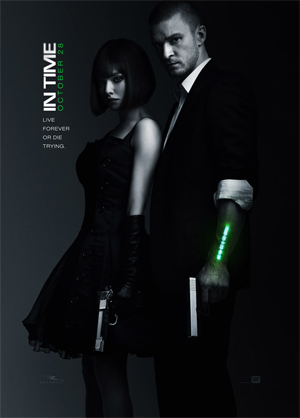
In Time – Movie Review

Set in a futuristic alternative universe, In Time is a sci-fi drama about a world where currency is time. People are born with thirteen yellow digits imprinted on their forearms. Once they turn a certain age, these digits give them a year to live. It is then that their strive for more life starts. Bargaining, buying more time, playing poker for more time, etc… become common activities.

And as it is with our world, that world is also divided into a downtown called “New Greenwich” and the ghettos. People living in New Greenwich have too much time whilst those in the ghettos don’t have enough. They live in fear of their seconds ticking away and that is the world Will Salas (Justin Timberlake) lives in, at least until he randomly stumbles on a man in a bar with over a century on his watch, getting him to go on a journey that leads him to Sylvia Weis (Amanda Seyfried), daughter of a time-company tycoon.

The premise of the movie is fascinating to say the least. It’s very easy to get engrossed in the whole idea of the movie – at least for the first half, after which it becomes dreary. The problem with the story of In Time is that it goes nowhere. While the foundation of the idea is great, the execution is less than stellar and sometimes cringe-worthy, especially when you couple it with Justin Timberlake’s acting.

Imagine a man whose mother dies in his arms… his reaction would be weeping. Justin Timberlake does that but it’s so unconvincing that it becomes borderline comical. And this spotty performance persists throughout the movie, leading to one unconvincing scene after another – scenes that could have been much more had they brought some better actor.

Compared to Timberlake, Amanda Seyfried looks good in the movie – and I do not mean her natural looks, although those eyes are a sight to behold. Her character starts by telling Salas that people in new Greenwich don’t live; everything there is slow and redundant. But she wants to live. And that is precisely the transition she acts out well enough: from a robotic rich girl to a feisty woman.

I can only begin to think what some brilliant director like Christopher Nolan could have done to a movie with the premise of In Time. He would have delivered a cinematic masterpiece, à la Inception or The Dark Knight. But sadly, a masterpiece is far from being achieved here. Couple horrible acting at times with a weak storyline and you have a movie that is spotty at best – although it does have some scenes that will get your heart pounding. But at the end of the day, it’s nothing more than a waste of time. Don’t watch it if you have something better to do. My problem was I did not.

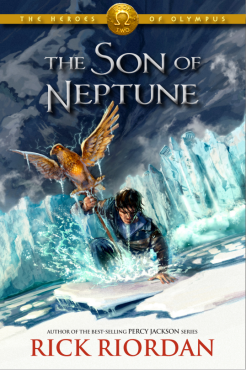
The Heroes of Olympus: The Son of Neptune (Book Review) – Rick Riordan

The second installment in Rick Riordan’s new Greek (and Roman) mythology series: “The Heroes of Olympus,” was released a couple of weeks ago and immediately shot up to the top lists of best sellers. The book’s publishers prepared a 3 million copy first run print, something unprecedented in their history.

“The Heroes of Olympus” picks up where Riordan’s first series: “Percy Jackson & the Olympians” left off. With the first book, “The Lost Hero“, released last Fall, we were introduced to Jason, a demigod with no memories whatsoever about his origins or how he ended up with two other demigods named Piper and Leo. Together, they faced a terrifying quest where they had to save the goddess Hera from having her force absorbed by Mother Earth Gaea who sought to rise, as our regular cast (comprised of Annabeth, Grover and Tyson) searched frantically for a missing Percy Jackson.

As “The Lost Hero” ends, it is revealed to us that while the events of that book were taking place, Percy Jackson was taking part in the events of another demigod camp (illustrated in “The Son of Neptune”) – one where descendants of the Roman gods train. Both camps had been kept separate because Greek and Roman demigods – although they share godly parents – have different forms of those same gods and tend to get into brutal fights around each other.

In “The Son of Neptune,” Percy Jackson also has no recollection of who he is – apart from his name. He is taken to Camp Jupiter where he is immediately perceived as an outsider, with more than one person knowing who he truly is and refusing to tell him. Soon enough, he finds himself on another quest with Frank, a Chinese-descendant boy with a heavy burden and family secret, and Hazel, a girl with a mysterious past: two demigods with secrets they would like to keep hidden. And as the trio travel to Alaska – a land beyond the protection of the gods – they will grow a tight bond that helps them through all the ordeals they will face to finish their quest and come back to Camp Jupiter before it is destroyed by an army sent by Gaea.

The interesting thing about “The Heroes of Olympus” is that it is way more interesting than “Percy Jackson & The Olympians” book for book. While the first two books in the latter series struggle to keep an older reader interested, these ones do so right off the bat, simply because Rick Riordan doesn’t have the need to establish a readership for them anymore. Those who are reading “The Heroes of Olympus” have already read “Percy Jackson & The Olympians” – and stuck with Percy to the end.

Rick Riordan manages to create interesting new characters without you feeling they are overloaded with too much side story. And in books made out to be a light, breezy read, this helps the purpose while keeping those characters interesting enough for you to keep reading. The main fuel for “The Son of Neptune” – what gets the story going the most – is not the necessary need to advance the plot but rather the small revelations you get about those characters, especially Frank and Hazel.

The Son of Neptune” is a must read for whoever has stuck with Percy Jackson and Rick Riordan up to this point. This is definitely not the time to let go. And being an easy read, it won’t take much of your time, and with it alternating between the points of view of its three protagonists, provides you with different approaches to the plot. There’s everything you search for in a Rick Riordan book in this one: fight scenes, comedy, intrigue… and as usual Riordan delivers.

The third book in “The Heroes of Olympus” series, titled “The Mark of Athena” is scheduled for a Fall 2012 release.

Rick Riordan also has another series out – The Kane Chronicles – about Egyptian Mythology. Check out my reviews for The Red Pyramid and The Throne of Fire from that series.

Stronger (Album Review) – Kelly Clarkson

I’ve been a Kelly Clarkson fan since her Breakaway days. It’s probably her success that introduced me to American Idol – and ultimately my favorite artist Carrie Underwood.

Stronger is Kelly Clarkson’s fifth studio album and the follow up to All I Ever Wanted, which she released in 2009. Two years later, she is on the music scene again: promos, singles on radios and the rest of the shenanigans. But things drastically changed since 2009. Radio is obviously not as receptive anymore even though –  granted – her debut single “Mr. Know It All” was drastically different than the pop jam “My Life Would Suck Without You,” which I prefer.

Does Stronger live up to the hype set up for it by Kelly’s fans, numerous leaks over the course of several months and Kelly herself who stated this is her “strongest” album yet? The answer is a succinct no.

Stronger starts with Mr. Know It All – a song about a guy who thought he knew everything there is to know about the girl but she’s telling him otherwise. As I said in my review of the song, it’s not necessarily a bad song. It’s not what I would have envisioned as a strong debut single and its performance on the charts and iTunes, compared to Kelly’s previous lead single, proves my point so far.

The second song on the album, and the announced second single, is “What Doesn’t Kill You (Stronger)“, the most obvious pop smash on the album. The Nietzsche-“inspired” single has Kelly belting out the chorus at full force: “what doesn’t kill you makes you stronger, stand a little taller, doesn’t mean I’m lonely when I’m alone!”

Stronger then delivers one of its better songs with “Dark Side,” a solemn song about a girl professing to the guy and asking him if he could love her even though she had a dark side: “Everybody’s got a dark side. Do you love me? Can you love mine?”

Honestly” is another of the album’s better songs – and one of its highlight ballads. You can feel the anguish on the song as Kelly sings: “Would you face me, make me listen to the truth even it breaks me? You can judge me, love me. If you’re hating me, do it honestly.” It’s a song about regret, about a love lost and you can feel the emotions on it. The transition from delicate to intense vocals on “Honestly” is captivating.

You Love Me” has a 80’s reminiscent beat going for it. It’s Kelly’s reply to a guy who thought she wasn’t good enough for him. “You didn’t let me down. You didn’t tear me apart. You just opened my eyes while breaking my heart. You didn’t do it for me; I’m not as dumb as you think, you just made me cry by claiming that you love me, you love me, you love me.”

Einstein” is a song with an interesting concept and catchy beat. But ultimately, it comes out as a little silly. It’s basically a giant mathematical equation where Kelly is telling the guy that she “may not be Einstein but I know dumb + dumb = you.”

Standing In Front of You” has an ethereal feel to it. It’s a ballad that is not as strong as “Honestly.” I found myself enjoying the melody and the tone of the verses much more than the chorus, which has a very subdued feel to it, making the song definitely skippable.

I Forgive You” is another uptempo. However, unlike the catchy “What Doesn’t Kill You,” I cannot wrap my head around this and it’s not catchy enough for it to stick without me wanting it to. The lyrics are a mess as well. “I forgive you, I forgive me. Now when do I start to feel again? Cause the lights are on but I’m never home. But I’ll be back with a brand new attitude, cause I forgive you.”

The album then proceeds with a “Hello,” a song where the lyrics are quite dark but the melody is a happy uptempo. It’s a song about loneliness – even among people. “Hello, is anybody listening?” Kelly asks. “It’s everyone that’s calling me. Won’t somebody show me that I’m not alone?

On “The War Is Over,” Kelly is facing the guy who doesn’t deserve him telling him that the war between them is over. It’s the perfect song to tell anyone they don’t deserve you. “All I have to say is you don’t deserve me. I’m finally walking away cause you’ll only hurt me,” she sings. “And I won’t let you pull me in because I know you’re gonna win. The war is over, the war is over…”

Let Me Down” is another highlight of the song for me. Sure, it’s a typical pop song. But it’s insanely catchy. It sticks halfway through your first listen of the chorus and stays there. “You’re only gonna let down. When it counts, you countdown,” Kelly fiercely sings. “You’re only gonna me turn me out. As I burn, you burn out. You’re only gonna make me feel so crazy but when I think we can be something, you go ahead and let me down.”

You Can’t Win” is about a girl who can’t win when it comes to men, about how everything she does comes back to bite her. It’s a clever little song with an interesting drum-based beat behind it. The cleverest line? “If you’re straight, why aren’t you married yet? If you’re gay, why aren’t you waving a flag?”

The last song on the album’s standard version is another ballad titled “Breaking Your Own Heart” and it has the crystal clear Kelly vocals with her head voice moments that I love. The problem with this song as an album closer is that it goes nowhere and doesn’t serve as a really strong closer. I prefer the verses to the chorus. “Too many tears, too many falls,” she sings, “it’s easier here behind these walls. But you don’t have to walk in the shadows when life is so hard. Breaking your own heart, taking it too far down the lonely road…”

The Deluxe version of the album has four extra songs, one of which being Kelly’s country duet with Jason Aldean: “Don’t You Wanna Stay,” the best song out of bunch – and not really hers. In fact, the closing song on the deluxe version, “The Sun Will Rise” should have replaced “Breaking Your Own Heart” as the closing song on the regular edition of the album.

It could be that I think Kelly’s talent is too great for her to make such an album but I’m definitely disappointed by “Stronger.” The lyrics are more often than not cliched and the melodies too familiar. It could be that after the Adele invasion of US pop radio, I thought someone with Kelly’s vocal chops would make an album of the level of epicness that is in 21 – one that represents her life as it is. But alas, Stronger falls to the same issue with almost every other pop artist today: making an album that is catchy enough while staying artistically relevant. In Kelly’s case, the album has its shining moments here and there. But on the overall, it falls short from expectations, especially after having such high expectations from an artist that I cannot but respect especially after giving the world songs like the epic “Already Gone,” “Because of You,” etc…

While the marketing strategy has not been all over the place as it was with her previous two albums: she is actively promoting it, going on TV shows, countering the leaks with song uploads to YouTube, etc… I hope this album does well on the charts for Kelly because I truly want to see her succeed. Hopefully for her next album, she’ll have enough room to maneuver around the tight boundaries set by her label and make an album that truly represents her artistically – one that isn’t coloring by numbers to get a radio hit here or a cool video concept there. I also have hope that Texan Kelly Clarkson would fuse more country music in her upcoming albums because that is a genre where she can truly shine, as was obvious on her duet with Jason Aldean.

Should you buy Stronger when it comes out on October 24th? It’s not a bad album per se, but if you’re a casual Kelly Clarkson fan more into her “Already Gone“s than her “Since You Been Gone“s, you will find little solace on “Stronger.” For many, that’s not necessarily a bad thing. But when you see her cover songs like Carrie Underwood’s “I Know You Won’t” and make a great job at it, it’s tough to see such talent wasted on songs like many of the ones on “Stronger,” an album I’ve had for a few days now and don’t find myself interested in listening to in its entirety. Now many people will feel the same – and that is a bad thing.

Songs to download: What Doesn’t Kill You (Stronger), Dark Side, Let Me Down, Honestly.