Rebuilding & Restocking Tripoli’s “Al Sa’eh” Library: The Full Story

Al Sa'eh Library Tripoli

It takes a lot to get the whole country to gather behind a national tragedy lately. They tend to be more in the political eye of the beholder as we feel compassion with the people we can relate with more. It’s sad that we’ve become a nation where we can somehow, in some twisted logic, fathom the death of people as political collateral damage in a game that’s ripping our country apart.

The books that resided in that forgotten library, nestled in Tripoli’s Al Nouri area, ran by Father Ibrahim Sarrouj, managed to shake the country and some aspects of the international community. Terrorism wasn’t just targeted at innocent people. It was also targeted at books whose only fault was to exist on shelves, gathering dust in an age where less and less people liked to read, burned by people who didn’t know how to do so.

The burning of “Al Sa’eh” library was heavily discussed. Some people ran with the theory of it being the work of Islamists. Others ran with the theory of it being the work of the contractors who wanted to evict Father Sarrouj and his books from the historic building in which they resided in order to dismantle it and ruin the city with another high rise. Information that I have gathered, however, from sources close to the priest and the group that is renovating the library indicated that certain mosques, known for their extremist sermons in Tripoli, preached against Father Sarrouj that Friday. Many of the perpetrators have also been identified and they fit with the former theory, not the latter. Although there’s probably nothing that money cannot bring together in Lebanon.

The initiative aimed to better “Al Sa’eh” started before the library’s burning on Friday, when Father Sarrouj started receiving threats, but it caught up like wildfire immediately afterwards. The activists who were working for the library’s sake wanted to organize a protest in support of Father Sarrouj when he started receiving the threats in question but Tripoli’s officials reassured them that the situation had settled.

They were mistaken.

At around 10 pm that night, those in charge received a phone call to notify them that the place they had been working diligently to protect was up in flames. It was a work of terrorism. The situation had not settled as they were promised and their knee jerk reaction was to get to work.

Their first plan was to set up a large protest for the library and Father Sarrouj. While working out the details of the protest, the organizers decided to become even more proactive and take it upon themselves to see what they can do with “Al Sa’eh.” So they started working in order to save the books that hadn’t been burnt yet, move them to a safe location where they’d be catalogued and preserved, while working to save what could be saved from the partially burned books.

They stayed there till 4AM that day working against the flames, working with local officials and sheikhs to secure the area in question for them to get safe access. The following morning, after forensics had taken the evidence they needed, work started.

In total, the library contained north of 85,000 books. Two thirds of those books were saved by the people of Tripoli. The remaining third contained many rare books, many of which had been first edition pieces. That third, unfortunately, was not as lucky.

The protest they organized was among the biggest in Tripoli. More than 500 people showed up. None of those people came in with political motives. Politician who had showed up were asked to leave. Those people continued cleaning after the protest, saving the books that were intact or partially burned. Those people were from different ages and sects. Some were veiled, others weren’t. Some were bearded, others were clean shaven. It was a mini representation of the community of Tripoli under the vaults of that ancient library, working to save a relic that had become synonymous with the city they held dear.

The organizers have met up with people from USEK and USJ regarding the books in question. Those experts are being enlisted to help the library save the books. The books that can be restored will be restored. The books that should be digitized will be digitized and the books that are available and could be ordered will be ordered. Moreover, the entire library’s location will be renovated, as well as clean and paint the small street at which the library could be found.

The funds for such an endeavor were via donations from sympathizers who wanted to save the library and its books. The organizers have also contacted well-known crowd-funding website Zoomal. Any help from politicians was refused and will be refused.

The plan for now is to move all the books to a safer location where they can be preserved and catalogued while the library gets renovated and its burns washed away. This is where we come in to help. If you can donate money or books, contact the people running the following Facebook event (link). Other concerned people are also running book drives to gather as much donations for the city as possible (link). Others are organizing their own book donation campaigns for the library’s sake.

BdXrOr0IAAAZgwn.jpg-large

Al Saeh Book Drive

So if you’ve got any books to donate or any means with which you can help, drop those people a line either on Facebook or with any other contact methods they have provided. We can all help rebuild and reshelf “Al Sa’eh.”

Update: Zoomal has set up a crowd funding to rebuild “Al Sa’eh.” (Link)

The following are images taken by Natheer Halawani (his blog) and other people of them saving the library and its books:

Cheers to those people living in a forcibly forgotten city, in a place where their dreams are forcibly killed and who can still find the will to fight for what they believe in and work to save their community. I salute you all, however simple and useless of me that might be.

A Tale of Two Cities: Lebanon Edition

I went to watch a movie in Beirut yesterday. It was done by 1AM so I simply went back home. As I walked up the sidewalk leading to my apartment, I could hear the parties bustling around me. Gemmayzé was gearing up to lose its cars. Cars were still circling the roads fervently in search for their next destination.

Even the movie that I watched was marred by the beats being dropped at a nearby nightclub. It was one of those old cinemas that didn’t bother invest in soundproof systems. Or was the club too loud? I guess nightlife in Beirut is alive and well. All was well.

As I walked back home, there was probably someone my age also making his way back to his place in the Northern city of Tripoli. Unlike me, however, he did not walk carelessly to his apartment, carefully examining his surroundings. That man was probably too wary of the bloodshed taking place in his city as he walked, of all the people that died, of his life that hung with the balance of every footstep he took on that cold bloody and empty Tarmac.

My day prior to the movie had been meaningless. I have a ton of exams to prepare to and anyone who has dabbled with medical school exams knows the material I’m supposed to cover by next week is basically uncoverable. But I persevered anyway. My friends asked me if I wanted to go out to their favorite burger joint. I declined. They went anyway, had ice cream afterwards. Nothing like some calories to burn off the stress.

And as I worried over my exams, there was a 16 year old boy not far from where I was trying to escape the school he attended, whose area had been overtaken by bullets and missiles. As he ran for cover, his every instinct pulling him for safety, the 16 year old boy existed no more. I don’t even know his name. He is but a number in a growing list. He is but one of many similar schoolchildren who escaped their schools by jumping over the fences, running through sniper-filled streets for their lives. Typical.

I do know, however, the name Paul Walker. As I woke up today to a house that feels cozier by the Christmas Tree I decorated a day prior, my social media timeline was lit with people who were upset that an American actor had died. I didn’t appreciate how they were more upset at a guy’s demise while trying to be fast and furious while the death of one of their own, that 16 year old whose name we don’t know, didn’t even resonate.

A few hundred meters away from me, Gemmayzé’s car free day, part of the Achrafieh2020 plan, was in full swing. The street was packed with people who had taken their children out on a sunny Sunday, benefiting from a neighborhood that had become synonymous with traffic, a day or so before it starts raining, finally.

The street was filled with children who had no other worry on their mind apart from the schoolwork they were returning to in a few hours. Those children were having fun, lots of it. They were safe. They were sheltered. They were protected. They were being brought up exactly as children should be.

And then I started thinking of the children I knew in Tripoli, how they were not being brought up exactly like children ought to be. I thought of two adorable twin girls and it broke my heart that at the tender age of three, they’ve been exposed to more gunfire and missile sounds than almost everyone else that I know. It saddened me that those two little precious girls couldn’t enjoy the same joys in life that the children roaming around Gemmayzé had, only because it was not safe for them to leave their house.

I also thought of all the children in that city who, with each passing day of violence, are forced to take sides, to become radicalized even if only in thought, and to possibly take arms later on.

These are two cities that are about 80 kilometers and a few decades apart. This is to the children of that city no one likes talking about. May they have better days someday. I wish they were sheltered, carefree and unaware sometimes. The sad part is that nobody really cares.

Tripoli And “El Khetta L Amniyé”

I’m not the kind of people to get deterred from going to Tripoli by the sporadic fights that erupt there or the occasional bomb that finds itself to explosion. It’s not that I have a death wish – it’s that 1) the fights are often not close to the places I frequent, 2) the people I visit there are like family and 3) I  love the food.

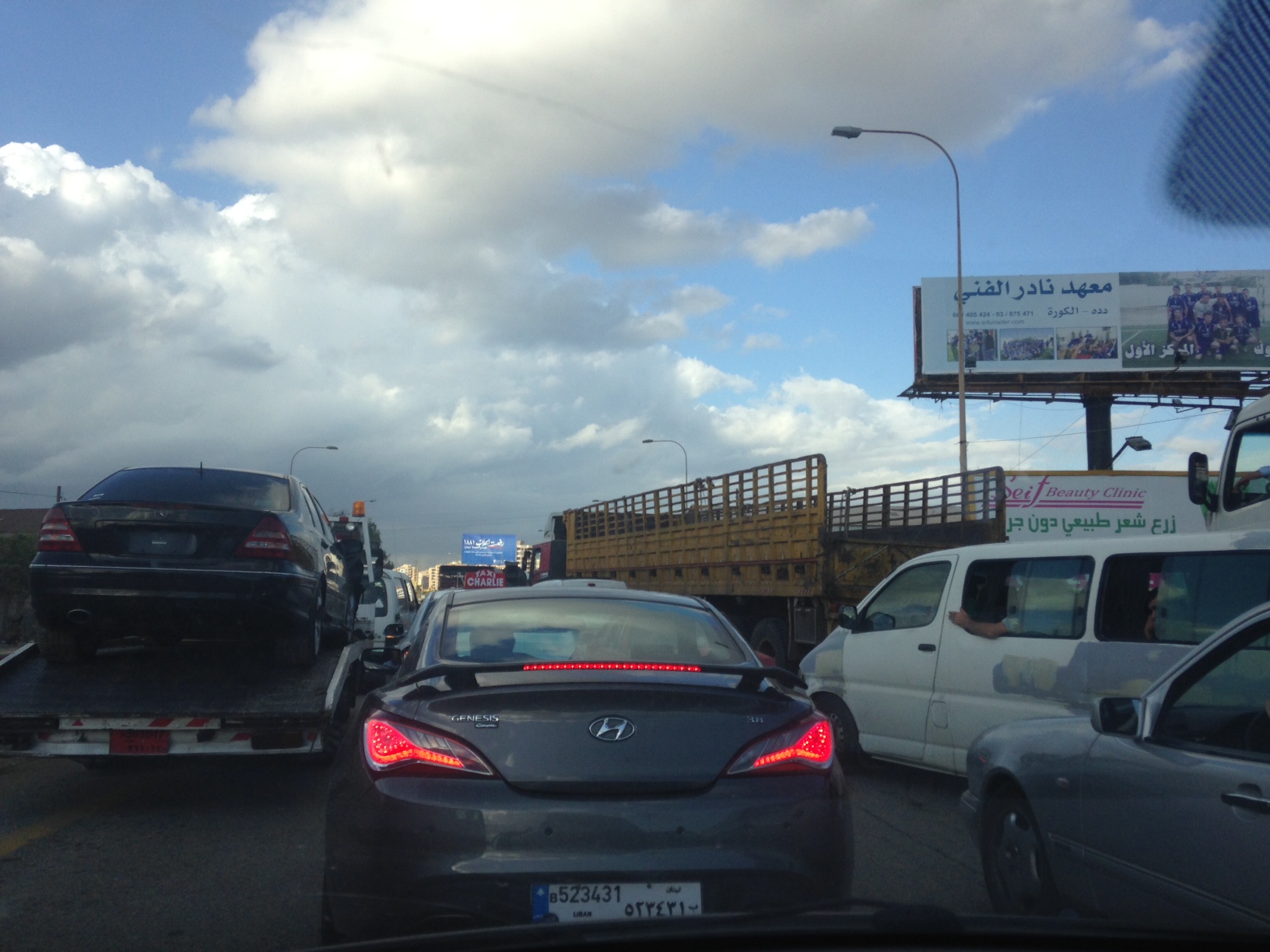
Around late September, I was driving to Tripoli, rolling fast on the highway, when I was shocked to find traffic. Those of you who have been there know it’s near impossible to have a congested highway. But it was. And it took me almost 30 minutes to cross those few kilometers into the city.

Why did that traffic exist? Because a “khetta amniye” (security plan) was put forth. I’m not following the news so I had no idea. I grabbed a picture then of the cars piling up above each other and figured I’d write a blog post about it: security vs efficiency – we just couldn’t have both. Should we accept to compromise over the other?

But I let it pass.

photo-14

Today, all entrances to the city are blocked by checkpoints that screen every car as well as rude officers that don’t even try to make it The army is also present across the city and it’s all part of said “khetta amniye.”

The catch? These past few days have witnessed a resurgence of the fights in Tripoli. And the fights are heavy – heavier than in the last round the city witnessed. Of course, no media will talk about these things because, you know, must keep perfect image about Lebanon (as many of the comments on this suggest we should). But the question is no longer of security vs efficiency in Tripoli. We’re getting neither.

My friends from Tripoli call their city jokingly the Qandahar of the North. We laugh about it because there’s nothing else to do but make fun of  the situation that has befallen their city. But the question to ask: if a security plan as stringent as the one imposed on Tripoli now can’t keep the city safe then what can?

What’s the point of making the lives of its people a military mess if said military can’t keep the city safe when the going gets tough? There’s no point I guess.

My friends in Tripoli, your city is not tragic in itself. It’s a manifestation of the utter failure of the Lebanese state. It’s sad that you have turned out to be the scapegoats of a government and a country that can’t keep its citizens safe even if it tried. The story of Tripoli and said “khetta amniye” is one sitcom waiting to happen. Just make sure to never tell that officer monitoring those many checkpoints “bonsoir” and you’ll be saved.

A Phone Call with Lebanon’s Police

I keep hearing about security plans for this country, especially for the places where security has been non-existent. My idea of a security plan, despite me not being an expert whatsoever, involves – at the very least – a sense of involvement from the police seeing as we are asked nowadays to report any suspicious behavior because you never know if that behavior might lead to us getting blown up.

For instance, one of the two bombers in Tripoli apparently parked double parked the car in broad daylight and simply walked away. People called after him and I’m sure someone might have tried to call 112. What would 112 have done in that setting?

I present to you a transcript of a phone call of a man from Tripoli, the city that was victim of two explosions on Friday, with the police in his city. I’m not sure if this is funny or harrowing.

Police: Alo, police.

Man: Alo, I want to report a person who set up a checkpoint while carrying a weapon.

Police: Where?

Man: Next to the Ayyoubi store for paint products.

Police: Where? Bab el Ramel?

Man: At Muharram, yeah. He’s standing there, asking people where they’re coming and going.

Police: There are 5000 armed men in Tripoli, okay, habibi.

Man: But he’s setting up a checkpoint!

Police: There are 5000 armed men in Tripoli doing like him.

Man: Do I shoot him then?

Police: I don’t know. You can do whatever you want.

Man: Seriously? Are you the state or not?

Police: It’s fine, may God give you strength.

(hangs up).

I especially liked the fact that the policeman told the civilian to do whatever he wants when the latter suggested to shoot the gunmen. Is this what they’re expecting of people nowadays? Self-security because our police are too nonchalant and passive?

What’s next if every region or sect sects up its own brand of self-security? What’s the point then of having a state from which we need protection?

Check out the video here.

Day One: Rebuilding Tripoli

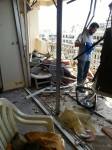
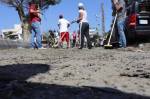
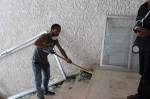
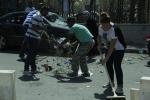
Day one post two blasts that killed 45 of its sons and daughters, this is Tripoli.

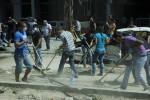
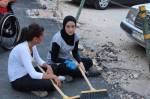
This morning, these young men and women are not pointing fingers and expressing blame. They are not sinking to the sectarian rhetoric that many people believe will change how this country is going. They are mourning their city in the way they know best: by cleaning up the rubble and the destruction so they can at least have part of the place they call home back.

For many Lebanese, Tripoli is a city that exists way up there, beyond that army checkpoint, that we don’t need to visit. For many Lebanese, Tripoli exists only as a city that is ravaged by Islamists and militants and violence and destruction. But this city, which currently sits in a near-comatose situation, is – thanks to the efforts of those young men and women – trying to get its spirit back, fully knowing that it may not be for long in a country that has become nothing more than the playground of the struggles of others.

Today, I will not bore you with political extrapolations about what might have been and what could be. I won’t state of the obvious and remind everyone how bad the situation is, something all of us know and live. Today, I salute those young men and women of Tripoli who, in that simple act of sweeping the rubble off the streets of their city or visiting the wounded of yesterday’s acts of cowardice, are trying their best to achieve some form of normalcy. And isn’t normalcy what we all long for nowadays?

The above pictures have been obtained through this Facebook page.