On The Maronite Patriarch, Samir Geagea & Michel Aoun

Left: Michel Aoun, center: Patriarch Raï, right: Samir Geagea

When it comes to the Maronite Patriarch, Bechara Al Raï, I feel I have to be extra careful. The line between criticizing the individual and his stances is very thin and it is one I do not want to cross because he is, first and foremost, the head of a Church I feel proud to be part of for various reasons.

The leading Maronite politicians in Lebanon have found themselves at opposite sides of the aforementioned line. Being very kind-hearted, I’ll assume the line is very blurry for proper discrimination. But don’t be fooled, there’s a very important distinction between the stances Samir Geagea took regarding the current Patriarch and those adopted by Michel Aoun towards the former one.

The year is 2005.

Michel Aoun is preparing a parliamentary bid with an almost exclusively Christian coalition of political forces. At the end of May 2005, Aoun has gotten a sizable portion of the Christian votes – 70% in some areas. The patriarch at the time, Nasrallah Sfeir, had openly endorsed Aoun for trying to bring Christians together under a political idea that was, at the time, opposite to the alliance that included Hezbollah.

The year is 2006.

Michel Aoun signed an agreement with Hezbollah as the latter slowly drifted away from the electoral alliance it had forged a few months earlier. The agreement served to create a “Christian cover” for Hezbollah’s arms. It backfired. Aoun’s popularity began to slip, whether his followers like to admit it or not. The patriarch, following the political doctrine Bkerke has always been known for, began to criticize Aoun’s drastic shift in political positions. Subsequently, Aoun began to attack the patriarch both on personal and political levels. The attacks ended in 2011 when Sfeir resigned and Bechara Al Raï took over.

The year is 2012.

Samir Geagea is being interviewed on a political talk show, Bi Mawdou3iye, on MTV. He declares that the recent pro-Syrian stances of the Maronite Patriarch do not represent the historical path Bkerke had drawn for itself. He also asserted that the position of Bkerke as a leader in Lebanese society has dramatically decreased as a result of the erroneous stances taken by the patriarch.

Moreover, commenting on recent declarations by a mufti in KSA that the Arabian peninsula should not have any church standing in the near future, he replied that the stances coming out from the Azhar are the ones to be considered as legitimate and that the xenophobic declarations of Saudi Arabia’s mufti are very similar in crude nature to what the Patriarch had said about him being afraid for the Christians of the East because of the Islamists rising around us.

The time is now.

I am faced with a torrent of people sharing certain articles about how Samir Geagea is a hypocrite in criticizing the patriarch. And it is here that I bring back the initial point I mentioned in this post: there’s a thin line between criticizing a person, which Michel Aoun flagrantly did for years, and criticizing a person’s stances, which Samir Geagea has been doing for the past year.

It is a very thin line but it exists. And you cannot compare both men with regards to how they behaved towards the Maronite Patriarch without taking that into consideration. The fact of the matter remains that when Samir Geagea’s pardon went through and he was released out of prison in July 2005, the months when Patriarch Sfeir and his party had been at odds were not marred by discordance.

The fact of the matter remains that even when Samir Geagea is in grave disagreement with the current patriarch, his critiques cannot but be considered respectful. Or need I remind people of “the patriarch must have gotten horny” comment by one of Michel Aoun’s allies, a statement which was not condemned by Aoun’s party, or when the patriarch was called senile by Michel Aoun’s close entourage, a statement that the General did not, also, condemn.

The fact of the matter remains that the patriarch, with his current stances, is not helping to elevate the position of the Church he was appointed in charge of. Many bishops have even expressed discomfort in the way he is handling things. Patriarch Raï might be taking the power his congregation vested in him for granted. You cannot simply support the regime of a man who has been killing your people for years and years and expect then not to react negatively. You cannot expect your congregation to fathom supporting one of the main reasons their role in Lebanese society has degraded this substantially and pretend as if the years of Syrian occupation had never happened.

The difference between Michel Aoun and Samir Geagea goes back to principles. One has principles, the other simply lacks them. One expected Bkerke to change the way he saw fit and was disappointed when it didn’t. The other was disappointed as Bkerke strayed from the principles it built for hundreds of years and used to cement itself as a champion for the rights of Maronites in particular and Lebanese in general.

After all, how can we forget when Aoun’s supporters stormed Bkerke in a riot years ago? And they have the audacity to criticize Geagea for speaking up.

Yet again, people tend to jump the boat of hype without looking at the underlying current. But every now and then, a slight nudge of their memories is in order.

Can we move on now?

Beirut Hotel – Movie Review

Beirut Hotel Movie Poster
I finally watched Danielle Arbid’s infamous Beirut Hotel, the Lebanese movie that has spurred a huge controversy back in November due to it being banned from Lebanese theaters. The reason I took time to watch it is twofold: one because I hadn’t heard of any good responses towards it. And two because I didn’t want to waste my time on a movie whose trailer made it look cheesy and whose hype was only generated by the simple fact that everything forbidden is usually wanted.

Upon watching Beirut Hotel, I can say for myself that my initial thoughts about the movie were perfectly on point – and no, this is not a case of a self-fulfilling prophecy.

Zoha (Darine Hamze) is a sultry singer, more often than not out of tune, at one of Beirut’s bars. The purpose of her singing is not to please the ear as it is to please the eye and Zoha knows this perfectly well. She then meets an enigmatic French man named Mathieu (Charles Berling) with whom she has a late night talk, including informing him of the bar she sings at, before going back home, after a late night kiss of course.

Soon enough, Mathieu is infatuated by Zoha and starts following her around, which she finds creepy (as well as charming). So she storms into his hotel room the following day and before you know it, the anger subsides and turns into sex. But Mathieu may not be the lawyer he claims he is. And with a man wanting to exchange information about Hariri’s assassination for safe-haven in France, things will get messy. Add to that Zoha’s husband (Rodney Haddad) who can’t seem to let her go.

All of this may sound interesting. But trust me, the script is as cheesy and useless as it gets. Remember when Zoha tells Mathieu where she works? Well, when she storms into his hotel room the following day, she actually asks him how he knew where she worked – that is before they sleep together.

In fact, the Darine Hamze sex scenes in the movie are so out of place you can’t but feel they’ve been put there solely for the reason of making an uneventful movie talk-worthy, along the lines of: “There is a moment where Darine Hamze’s breasts show” – cue in thousands of Lebanese who are shocked that a Lebanese actress actually went there.

It is here that I have to commend Darine Hamze for the guts it took her to bare it all in this movie, be it through the various sex scenes or through the obvious sexual appeal she conveyed. She may be the only “good” thing about Beirut Hotel. It’s sad that what she does comes off as forced in the movie.

If Beirut Hotel had been let be – not made into a big media frenzy because of the Hariri plot line it contained, the movie would have crashed and burned at the Lebanese box office because, whether we like to admit it or not, most of us are very cautious when it comes to Lebanese movies. We only watch them when word of mouth is substantial enough to convince us to spend the ticket money on them. Word of mouth would have failed Beirut Hotel, as it should. The movie which takes Beirut’s name not only shows the city in a negative light, I was more than often surprised to see this is the Lebanese capitol we all cherish, coupled with a silly storyline that grasps at straws to become eventful.

2/10

The Lebanese Help

As I was sitting with some family members who were visiting my mother after a recent surgery, the issue of the “help” in Lebanon came up.

I sat and listened as the “grown-ups” spoke about the maids that entered their homes and left. One of my family members, however, had never had a maid. With her turning 40 and an increasing backache, she was considering the idea – especially with one being available at her disposal the moment she says yes to her sister’s offer.

But that woman was worried. The cause of her anxiety? She only had one bathroom at her house and God forbid the maid uses the same bathroom she uses.

I snapped.

I never thought the passages present in the book, The Help, would actually pop up in such dramatic fashion in a Lebanese society. I never thought for a moment the bathroom issue was actually an issue in Lebanon. Aren’t those maids cleaning the bathroom to begin with? Aren’t we, in 2012, at a level of culture and knowledge that is sufficient to know that, unlike popular belief, those maids are not bringing in with them a ton of foreign viruses the like of which Lebanon has never seen before?

I replied to my family member. I was strict and somewhat rude in my reply. I think she was offended but I didn’t care. I knew Lebanese society was racist but you never think it goes on in your family until it actually takes place in front of you.

But that wasn’t the end of it. Flash forward a few days later, I was having dinner with a couple of friends my age. And if you thought the older generation, with its minimal contact early in life with “the help,” may be justified somewhat in the racist ideas that swirl through their heads, then what “excuse” could you come up with when a twenty two year old agrees with my 40 year old family member about the bathroom issue? The justification given was: but they are “dirty.”

And it is then that the need for a Lebanese version of The Help became obvious to me. Many people had spoken about how that book, and movie, were very relevant to our society today. Most of those people had thought about that only fleetingly, for the few moments after having finished the book or the movie. Some had even blogged about its relevance

But then I thought, why not have an online version of The Help, adopted to Lebanese society, that tells stories of the maids that come to our homes, before something bad happens to them and their story becomes top news and activists get outraged at the injustice in our society when it comes to “the help.”

If you have your own maid story you want to share, don’t hesitate to contact me. I’ll start with telling the story of one of the maids that came into our home really soon.

Emergency Contraception in Lebanon: The Morning-After Pill – The Scientific Reality

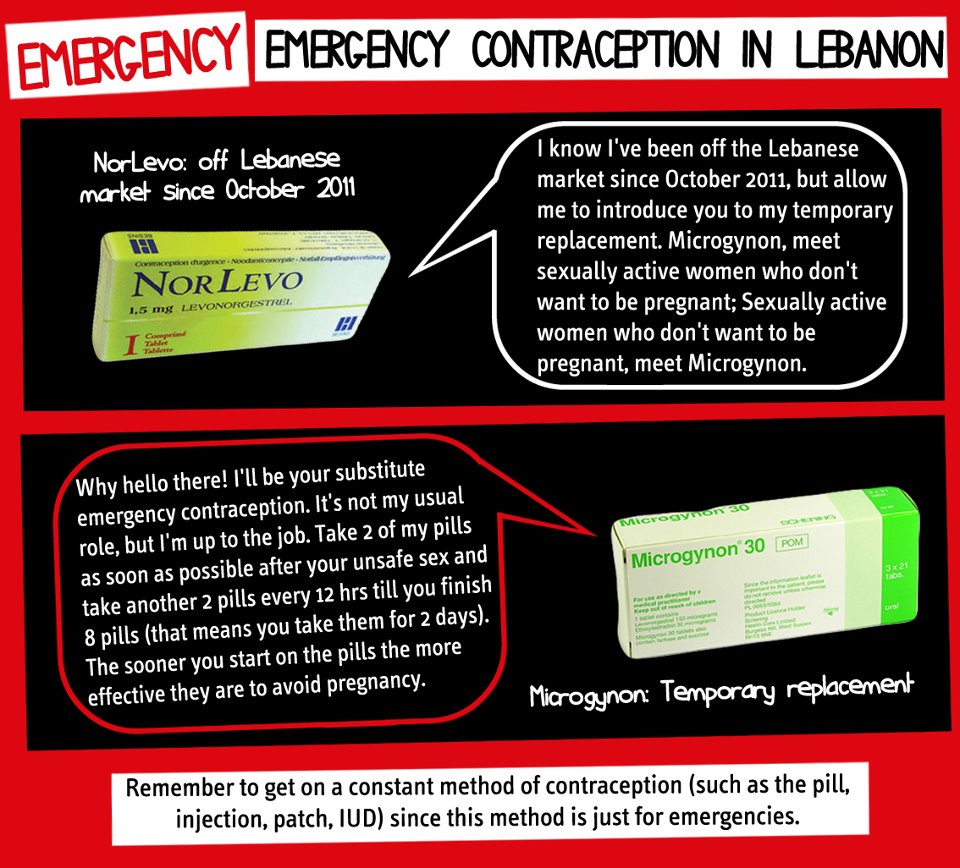
The picture making the social media rounds

This is a guest-post by Christian Sawma, a pharmacy student at the Lebanese American University, in reply to the Nasawiya post on the matter.

We need to start by differentiating between monthly contraception and emergency contraception. The monthly regimen consists of taking one pill per day, regardless of sexual encounters, in order to suppress the normal monthly period and ovulation; this regimen is used for sexually active women who are not wishing to get pregnant. On the other hand, the emergency contraception is used after an unprotected sexual intercourse in order to prevent pregnancy from happening.

The best choice of emergency contraception is a progestin only pill that increases the cervical mucus production and thickness; hence, inhibiting the sperm passage to the fallopian tubes. It is available as OTC (over-the-counter) in the United States and of course in Lebanon under the brand name of Norlevo (levonorgestrel 1.5 mg) – commonly known as the morning-after pill. The latter drug has no purpose other than emergency contraception; it cannot be used as normal monthly contraception.

Pills containing a combination of low concentration of estrogen and progesterone in one pill are used to suppress the ovulation and normal female cycle, therefore, they are used as a monthly contraceptive technique and prescribed as a once per day pill, taken at the same time every day for this purpose.

In contrast, before discovering the effectiveness of Norlevo (levonorgesrtrel 1.5 mg) as an emergency contraception technique, the regimen used was called Yuzpe (named after its founder Dr. Albert Yuzpe). It consisted of giving the combination of those low concentration estrogen and progesterone pills, discussed above, to inhibit pregnancy (before it happens) after an unprotected sexual intercourse, but they are given as multiple pills per day for the emergency contraception purpose. Now that Norlevo hasn’t been available on the Lebanese market since October 2011, the Yuzpe regimen can be used instead.

Estrogen is highly emetic (induces nausea and vomiting), and that is one of the main problems of this regimen: It consists of giving 2 or 4 tablets, of the monthly contraceptive pills, as soon as possible and repeat the same dose after 12 hours. The number of tablets to take is chosen according to the estrogen concentration in the tablets. For the 30 mcg ethinyl estradiol (EE), 4 tabs should be taken, and for the 50mcg EE, 2 tabs are advised. It is important to mention that the tablets of each dose should be taken all together and not separated.

This is a table that clarifies the aforementioned point:

Yuzpe (Microgynon 30) is effective in 75% of the cases, which is not a good statistical number, making it not a very good alternative to Norlevo. In addition, this regimen shouldn’t be followed without referring to your physician or a pharmacist and if vomiting occurs in less than 2 hours post dose, the dose should be repeated.

On the Lebanese market, a lot of brands containing 30 and 35 mcg EE are available. The one that contains levonorgestrel (Norlevo’s active ingredient) in an acceptable concentration for emergency contraception is Microgynon 30, and it is the best choice in Lebanon for a Yuzpe regimen. According to my knowledge, no 50 mcg EE is available in Lebanon for contraception.

In the case of Norlevo or combined oral contraceptive, the effectiveness is not studied beyond the 3 days period. Although the Yuzpe regimen can be given up to 5 days post intercourse, no safety and effectiveness has been proven. In addition, some studies have confirmed that beyond the initial 3 days, it’s neither safe nor effective to use Norlevo or Yuzpe (Microgynon 30).

Always refer to your physician or pharmacist before using a new drug especially if taking other drugs with it or if using it for its unlabeled use (such as in this case). In case of emergency contraception, it is important to refer to them in any case of bleeding or pregnancy post a dose of a progestin only pill, Yuzpe regimen or Ella pill, a new experimental FDA-approved drug that is not yet available in Lebanon.

Lebanon’s Electricity Crisis: The Gebran Bassil Paradigm

As I’m writing this, I’m looking at the light bulb we have installed in our house to let us know if the electricity we’re having is provided by our “moteur” subscriber or by Electricite du Liban. It is lit. So much for EDL.

What’s troubling is that this lightbulb has been lit a lot these past few days. Hold on, I stand corrected. This light bulb has been lit a lot these past two months. I know this firsthand because my father is one of those moteur providers you like to hate so much for overcharging you. But when you don’t get electricity for 330 hours in a given month, the moteur provider will have to charge you.

What I don’t get, however, is why Lebanon’s electricity has suddenly gone into dying mode, especially in the last two months. I understand having to go through a weekend of total blackout in Beirut due to a protest in a power plant. But to go on for two months without getting half a day of coverage is way exaggerated if you ask me.

Has Lebanon’s need for power suddenly exponentially increased beyond what it was a couple of months ago? I hardly think so. Did the dismal capacity of our power plants exponentially decline in the past two months? I hardly think so as well. What has changed in the last two months is the way the Minister of Energy’s brain neurons are firing.

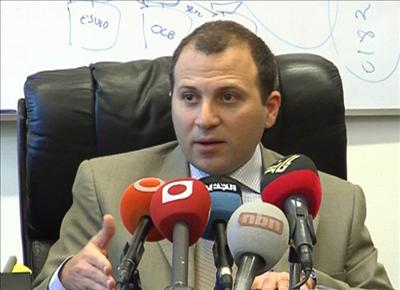
This is Gebran Bassil – Batroun’s “pride and joy”

I’ll just come out and say it. I do not like Gebran Bassil. Never have and I’m guessing never will. Perhaps that’s why we voted against him and got him to lose twice. But how good is that when he’s always finding his way to power?

Gebran Bassil reminds me of kindergarten days. That short, plumped bully kid you all hate and have no idea how he can actually bully everyone. Then you remember. Someone has his back. The fact that he lost two successive parliamentary elections and still made his way to three successive cabinets, even becoming a major hurdle to the instillment of the second, is only indicative of how spoiled he is and how used he is to getting his way, never hearing no as an answer to anything he requests.

The latest? He’s actually threatening the current government of taking it to the streets to get his way when it comes to the proposed electricity bill. I’m not sure he knows this but wouldn’t he be protesting against his own allies? And wouldn’t taking it to the streets to fight for a proposed law be a hurdle towards the advancement of a state the way Michel Aoun & co want it – “change and reform”?

As far as I’m concerned, when it comes to the electricity situation in Lebanon nowadays, Gebran Bassil is not reforming. He is deforming. There’s nothing working about it. And as long as he keeps acting like an insolent brat and not a minister, it will not head in the right direction anytime soon.

Perhaps when a politician’s allies are not responsive to the “plans” he or she is introducing would be an obvious enough hint that they’re doing something wrong. But I guess that logic doesn’t flow well with Mr. Bassil. The fact that he is part of a one-sided government and is constantly facing hurdles doesn’t warrant him to feel paranoid and targeted. It simply means he’s not doing things right.

So dear Lebanese, plan your showers according to the electricity cycles in your correspondent region. If your electricity coverage is not adequate, there’s always a bucket and a stove for you. Or better yet, plan your whole life to constantly fluctuating electricity cycles. Let’s add another fear to the long list a Lebanese society suffers from: electrophobia.