The Lebanese Help: New TV Hosts Ali Mahfouz – The Man Who Beat Up The Ethiopian Maid

The “Lil Nashr” TV show, hosted by Tony Khalife, had Ali Mahfouz as one of its main guests for its Saturday March 17th episode. Mafhouz is the man that beat up the Ethiopian maid in front of her embassy. The maid has since committed suicide.

Using the platform of the TV show, Mafhouz tried to come off as an affectionate man who deeply cared for the girl and was trying to sort out her affairs. He even went further than that and said he would never beat her up and that moment outside the embassy was unlike him.

The rest of this post will be assuming that Mr. Mafhouz was, indeed, acting outside of his character – although I have to say that modern psychiatry and psychology would assert that this violent behavior is, in fact, within his character, whether he wants to admit it or not.

Now, Mr. Mafhouz goes even further and argues that the maid, whose name is Alem Dechasa, was mentally ill and an unstable presence for him and the people she knew. He even cites a coroner’s report that she was having auditory hallucinations while still alive to “prove his point.”

The end result of the episode, which I was able to touch from both my parents, is that many individuals have lost their compassion to the maid and are now seeing her as an insane person, which clears Mr. Mahfouz. He is not in the wrong anymore.

Let’s get a few things straight.

1) A coroner’s job is to examine a dead body for a cause of death, among other factors. There is no way that a coroner (or medical examiner) can tell if the deceased person they’re examining was having psychotic episodes while they were still alive. It is beyond their scope. It is impossible to tell if a dead person was mentally ill via an autopsy and more importantly, there’s no way a coroner would have the authority to write a report containing such information.

2) I am very dismissive when it comes to Lebanese media for many reasons. But I never expected a TV show to host a man like Ali Mahfouz without advocating the victim’s side. This is not how proper journalism works, especially if it’s a TV station that supposedly respects itself. For the entire duration of the show, the arguments of the Ali Mahfouz camp were so front loaded that any attempt to speak on behalf of Alem Dechasa were rendered meaningless. This leads me to point 3.

3) The purpose of the episode, which I’m sure Tony Khalife is very proud of, was not to showcase the Alem Dechasa abuse in an objective manner. It was simply to help clear Ali Mahfouz’s reputation and to convert him from the man who led an innocent woman to her death to a man who was simply escaping the ramblings of a lunatic. Judging by the reactions I got from my parents, which I’m sure echo many other households that decided to tune in, their goal was achieved. New TV must be very happy with themselves.

It is a sad day when a victim’s reputation is tarnished just so an influential Lebanese man can escape the consequences of his actions. A few days from now, the whole affair will be forgotten. It has already started. Those who had thought Alem Dechassa was innocent are now believing the contrary. The rationalization of the Lebanese ego that a Lebanese can never behave this way is starting to work full throttle. The government will soon follow suit, especially as the wheels of Mr. Mahfouz’s “wasta” start spinning.

Alem Dechassa was killed three times. Once when her body was violated in front of her embassy and dragged into Ali Mahfouz’s car. The second time was when she got so desperate and took her own life. The third time was with the Lel Nashr episode that portrayed her as insane. The end result is simple: the victim becomes the abuser and the abuser becomes the victim. Well done New TV. Well done.

Save Beirut’s Heritage: The Roman Hippodrome To Be Demolished

Discovered in 1988, the Roman Hippodrome in Beirut is situated in Wadi Abou Jmil, next to the newly renovated Jewish Synagogue in Downtown Beirut. This monument, dating back for thousands of years, now risks to be destroyed.

The hippodrome is considered, along with the Roman Road and Baths, as one of the most important remaining relics of the Byzantine and Roman era. It spreads over a total area of 3500 m2.

Requests for construction projects in the hippodrome’s location have been ongoing since the monument’s discovery  but were constantly refused by former ministers of culture of which we name Tarek Metri, Tamam Salam and Salim Warde. In fact, Tamam Salam had even issued a decree banning any work on the hippodrome’s site, effectively protecting it by law. Salim Warde did not contest the decree. Current minister of culture Gabriel Layoun authorized constructions to commence.

When it comes to ancient sites in cities that have lots of them, such as Beirut, the current adopted approach towards these sites is called a “mitigation approach” which requires that the incorporation of the monuments in modern plans does not affect those monuments in any way whatsoever. The current approval by minister Layoun does not demand such an approach to be adopted. The monument will have one of its main walls dismantled and taken out of location. Why? to build a fancy new high-rise instead. Minister Layoun sees nothing wrong with this. In fact, displacing ruins is never done unless due to some extreme circumstances. I highly believe whatever Solidere has in store for the land is considered an “extreme circumstance.”

The Roman Hippodrome in downtown Beirut is considered as one of the best preserved not only in Lebanon, but in the world. It is also the fifth to be discovered in the Middle East. In fact, a report (Arabic) by the General Director of Ruins in Lebanon, Frederick Al Husseini, spoke about the importance of the monument as one that has been talked about in various ancient books. It has also been correlated with Beirut’s infamous ancient Law School. He speaks about the various structures that are still preserved and only needing some restoration to be fully exposed. He called the monument as a highly important site for Lebanon and the world and is one of Beirut’s main facilities from the Byzantine and Roman eras, suggesting to work on preserving and making this site one of Beirut’s important cultural and touristic locations. His report dates back from 2008.

MP Michel Aoun, the head of the party of which Gabriel Layoun is part, defended his minsiter’s position by saying that: “there are a lot of discrepancies between Solidere and us. Therefore, a minister from our party cannot be subjected to Solidere. Minister Layoun found a way, which is adopted internationally, to incorporate ancient sites with newer ones… So I hope that media outlets do not discuss this issue in a way that would raise suspicion.”

With all due respect to Mr. Aoun and his minister but endangering Beirut’s culture to strip away even more of the identity that makes it Beirut is not something that should concern him or Solidere. What’s happening is a cultural crime to the entirety of the Lebanese population, one where the interests of meaningless politicians becomes irrelevant. Besides, for a party that has been anti-Solidere for years, I find it highly hypocritical that they are allowing Solidere to dismantle the Roman Hippodrome.

The conclusion is: never has a hippodrome been dismantled and displaced in any parts of the world. Beirut’s hippodrome will effectively become part of the parking of the high-rise to be built in its place. No mitigation approach will be adopted here. It is only but a diversion until people forget and plans go well underway in secrecy. But the time for us to be silent about this blatant persecution of our history cannot continue.

If there’s anything that we can do is let the issue propagate as much as we can. There shouldn’t be a Lebanese person in the 10452 kmthat remains clueless about any endangered monument for that matter. Sadly enough, this goes beyond the hippodrome. We have become so accustomed to the reality of it that we’ve become very submissive: the ancient Phoenician port is well behind us, there are constructions around the ancient Phoenician port of Tyre and the city itself risks of being removed off UNESCO’s list for Cultural Heritage Sites.

The land on which ancient monuments are built doesn’t belong to Solidere, to the Ministry of Culture or to any other contractor – no matter how much they’ve paid to buy it. It belongs to the Lebanese people in their entirety. When you realize that of the 200 sites uncovered at Solidere, those that have remained intact can be counted with the fingers of one hand, the reality becomes haunting. It’s about time we rise to our rights. Beirut’s hippodrome will not be destroyed.


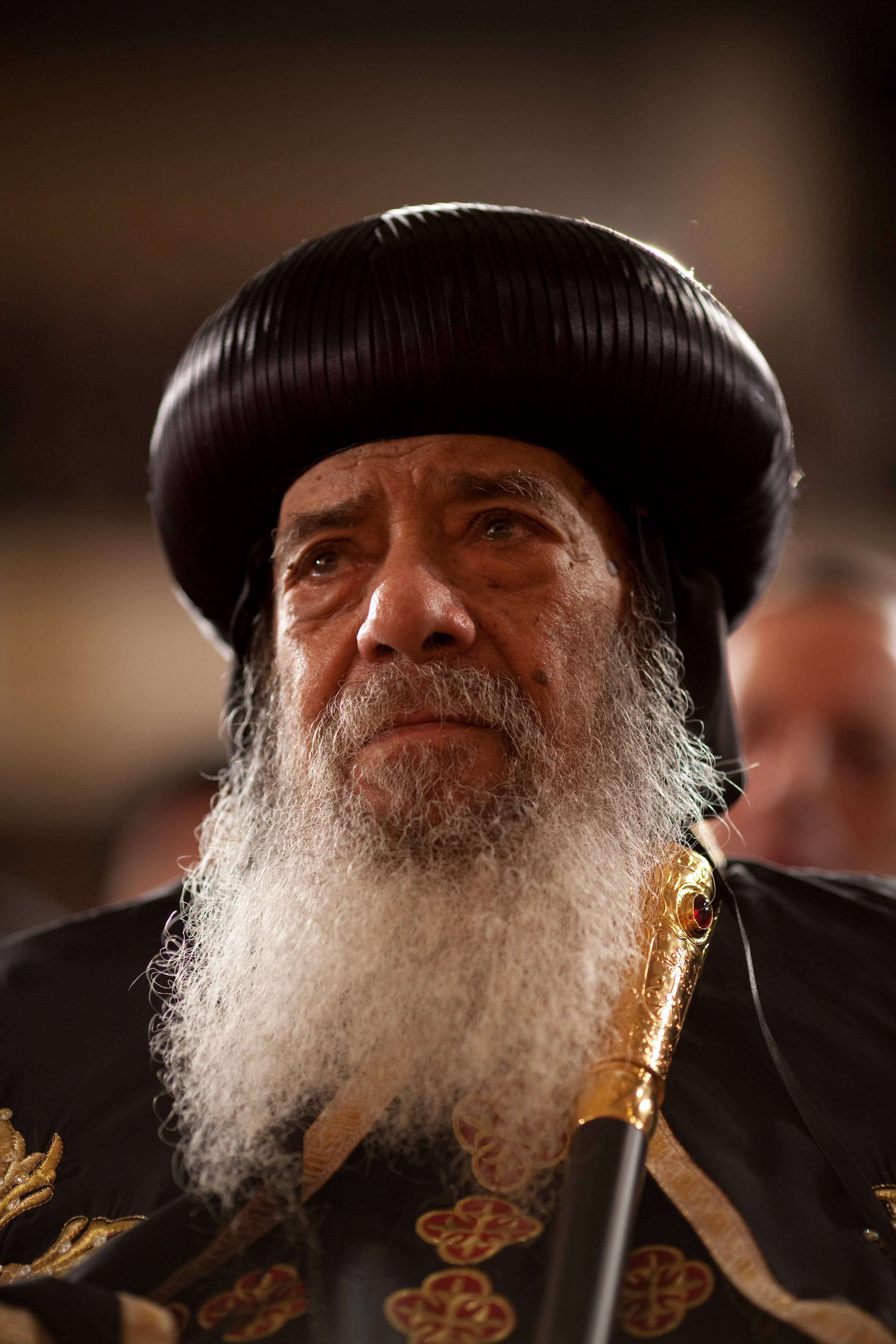
Rest in Peace Pope Shenouda

With Lent halfway through, one of the Christian sects that observe this time of year the most has lost its leader and mentor. The Copts have lost Pope Shenouda today, at an age of 89.

I have met many Copts throughout my life . And what I’ve touched from them all is their deep belonging to their church and their commitment to their faith. In a time when relinquishing such things for the pleasures of life has become a way of life, them clinging to their heritage has always been admirable to me.

Pope Shenouda has had a great deal with the Copts’ attachment to their faith. For a sect that is so heavily persecuted, they do not relent. They do not fear dying for their rights. They do not fear dying to keep their voices high and heard. In a way, the Copts are examplary for the Christians of the East. They are a minority that doesn’t act like one: it’s not subdued, it’s never rendered insignificant and over the past forty years of forced marginalization, they still exist.

They have been the central pillar in the foundation of the country whose name is as it is today because of them. The Copts were an essential part of Egyptian history and are considered by many as the founders of that country. Pope Shenouda was the 117th Pope to preside over them.

It may be because of their resiliency as people and their clinging to their heritage. But the leadership of Pope Shenouda had a great deal to do with the preservation of the Copts in such tumultuous times. Not only did he keep the Coptic church alive, he also expanded it in various countries around the world.

Pope Shenouda had been exiled for defending his people against Egyptian presidents who didn’t think those people deserved to be defended. He let his own health deteriorate to breathe life into his own congregation. He was an advocate for ecumenism (Christian unity) and showed strong commitment to the inter-dialogue of different Christian denominations.

I, as a Lebanese generally and Maronite precisely, am saddened by the passing of such a man. I truly hope his passing is one of the last days of sorrow for the Copts and Christians of Egypt. Pope Shenouda’s departure from this world couldn’t have fallen at a more appropriate time – if there’s ever such a time. Easter is one of the favorite periods of the year for Copts. Pope Shenouda must have been serene knowing he was moving on during his favorite time of the year, smiling, sure that the Church he worked forty years to protect is here to stay.

Rest in peace Pope Shenouda – and to all Copts in the world, may your struggles find their conclusion with the conclusion of his life.

Mirror Mirror – Movie Review

2012 can definitely be considered as the year of Snow White. The story has two movies coming out this year, one of which is Mirror Mirror, and a TV series, Once Upon a Time, by the creators of Lost no less.

This adaptation of the infamous fairytale strives to balance comedy with drama – it seeks out light-hearted moments and intersperses them among the storyline’s darker elements, giving a rather refreshing approach to the story we all know.

The movie starts with the Evil Queen (Julia Roberts) telling what she calls her story of which the little girl, whose skin is white as snow and hair dark as night and so called that pompous obnoxious name, Snow White, is of little importance. As Snow White grew and her father, the king, realized he was unable to teach her everything she needed to know, he decided to remarry. The king was bewitched by the dazzling beauty and charm of a woman – the Evil Queen compliments herself plenty – and marries her. But a dark magic sweeps the land and the king is forced to go save his kingdom, never to be seen or heard from again.

As Snow White grows, the Evil Queen tries to keep her at bay, safely tucked away at the castle. But the Evil Queen knows that there will come a time when Snow must do what snow does best and Snow must fall.

Julia Roberts is riveting as the Evil Queen. Even though the movie is not really her story, she manages to make it all about her and she pulls it off remarkably. Whenever she’s on screen, she dominates – be it with her charm or uncanny ability to fool you with an innocent looking smile. Julia is a major contributor to Mirror Mirror‘s two faces. She can be hilarious at times and  downright chilling at others. In fact, the moment the credits started rolling, the people I was watching the movie with were positively surprised that Julia Roberts had it in her to portray an evil role. Even the comic relief moments she introduces here and there are of evil nature. For the doubters about Roberts’ ability to portray the Evil Queen, you will be impressed.

The rest of the cast, even Snow White (Lilly Collins), do very well with the characters they’re given. Those that are asked for seriousness are serious and those from whom comedy is required are often hilarious. Acting-wise, Mirror Mirror is simply charming and fun to watch, especially with the interactions of Snow White with the Dwarves or the Evil Queen with her minion.

The interesting thing about Mirror Mirror is that it doesn’t go along the typical Snow White storyline we’ve all known. The whole poisoned apple storyline is downplayed, the Evil Queen doesn’t want to kill Snow White because of her ethereal beauty but because she got active in the affairs of the kingdom. The band of dwarves, usually thought as kind, happy or grumpy or sleepy or whatever their names are, are not like that at all in Mirror Mirror – they are a band of thieves who pry on unsuspecting strangers passing along their path. These little detours from the fairytale we’ve all memorized are what keep Mirror Mirror an interesting movie to watch.

Mirror Mirror is a fun and entertaining movie, be it with its plentiful humor, Julia Roberts’ sarcasm, Lilly Collins’ innocence or Prince Alcott’s (Armie Hammer) facial expressions. As the title implies, the movie has two sides: one is comedy, the other is a fairytale and both work really well together. The happy ending doesn’t feel forced on it, the movie builds to it – what it doesn’t build to, however, is that Indian dance scene it concludes with. But even that ridiculously out of place ending sequence cannot derail what is a strong movie from being bogged down. Even Game of Thrones fans will be surprised by a brief appearance of the series’ most prominent characters and that’s always a good thing.

7.5/10

Beirut Nominated for New7Wonders Cities

It is that time of the year when something Lebanese gets nominated – again – for this competition that doesn’t know when to end. The first version of it was an interesting idea. The New7Wonders of Nature, in which our own Jeita Grotto competed, was fine.

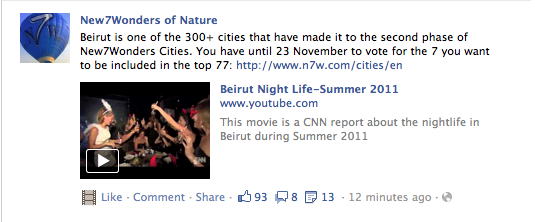
But with New7Wonders Cities, they’re taking it way too far. The city representing Lebanon in the competition is Beirut and just today, the New7Wonders Facebook page promoted voting for Beirut in the following manner:

Yes, they are marketing Beirut solely for its night life. The video they linked was a revelation to me and I have a few things to note.

1) Do we have nothing else to brag about in Beirut apart from Skybar and other clubbing places? If that’s the case, then we either don’t know Beirut or we simply disregard the parts of the city that are not hyped enough. Have you ever taken a walk around from Sioufi to Sodeco in Achrafieh, for instance, on a Saturday night after dinner using those streets that cannot fit cars?

2) The former (or is he still around?) minister of Tourism Fadi Abboud specifically says about the night life scene: “this is the reality of Beirut.” The question asks itself: is he serious? But he doesn’t let it go there. He proceeds: “la joie de vivre is our brand.” Sure, we are a lively people. Sure, we have faced many adversities in life and came out triumphant. But what kind of “joie de vivre” is he talking about when the only “joie” being discussing is drinking your mind away? Don’t get me wrong. I appreciate a drink every now and then. But I sure don’t want my happiness in life to revolve around how many clubs I go to on a given Saturday night and how many drinks I can take in before my body says enough.

3) The SkyBar owner Chafik el Khazen is sure “this is what makes Lebanon very special. There’s no planning so we try to [cut in with picture of hot girl dancing] have as much pleasure and fun as possible as if there’s no tomorrow.” I beg to differ with Mr. el Khazen but not planning and pretending as if there’s no tomorrow is not what makes Lebanon “very special.” What makes Lebanon special is not the copycat nightclubs their owners try to advertise as pioneering.

4) We need to stop acting as if “tomorrow” is such an uncertainty in Lebanon. It will happen, whether we like it or not, and more often than not, nothing out of the ordinary happens “tomorrow.” We need to stop using the civil war as an excuse for the “joie de vivre” portrayed in the video. We are not the war generation. Most of us have never even seen a bomb explode, let alone seen a person die because of such a traumatic experience. We do not get to use our parents’ daily struggle as children to justify our own lifestyle. Pretending as if there’s no tomorrow doesn’t make our society special. It’s a major reason as to why we’re barely advancing as a country.

5) Pier 7’s owner considers Beirut’s nightlife scene as its way of comeback to its former glory of “Paris of the Middle East” [not Switzerland]. Exactly how night clubs benefit a city when it comes to the things that truly matter, I have no idea. Achrafieh has barely any parking spaces. Old buildings are being torn down on daily basis for ugly looking new high-rises. Our public transportation sector is despicable. Beirut still gets power outages and they are increasing. We don’t have urban planning. But yes, building Pier 7 just outside Beirut is affirming Beirut’s position as the Paris of the Middle East because having a nightclub is what makes or breaks a city.

I fail to see the correlation between the history of Beirut and how its turbulent past led to the “hedonism” of the present. I actually fail to see how promoting Beirut and Lebanon as the party capital of the Middle East will achieve anything. If non-Arab tourists wanted to party, they’d be doing it in their own backyards, in their own pubs and nightclubs, which may well be better than ours. This is why the New7Wonders marketing of Beirut is such a failure – if this is what they believe Beirut is all about, then we should be ashamed.

Lebanon and Beirut have much more to offer than Monday at Skybar, Tuesday at White, Wednesday at Pier 7, Thursday at Gemmayze, Friday at Hamra, Saturday at Monot and then Sunday for sleep. Beirut is a city that embraces its chaotic side – it is what makes it alive. We may not like the randomness of life and the lack of law-abiding citizens but it is actually what gives Beirut its feel.

What makes Beirut special is the fact that it was destroyed and rebuilt seven times. Beneath every layer of the current Beirut is an ancient city waiting to be unraveled. But we’re so afraid of Beirut’s heritage that we are tearing it away at any opportunity we get.

What makes Beirut special is the fact that when walking around the new Downtown, there are Roman columns still standing erect around the renovated buildings.

What makes Beirut special is that St. George’s Cathedral in Downtown has ruins below it that few people know exit. Those ruins tell the story of a city that been around for thousands of years – that has survived countless civilizations, wars and destruction. I doubt our forefathers would be happy the city they worked so much to build has become known as a haven for “hedonism.” And if anyone’s proud of the image some agencies are trying to propagate just to increase their business, then they don’t deserve Beirut.

I may have come off harsh towards Beirut in previous posts. But it is only because I love this city so much that I hate to see it misrepresented in such a way. Tourists who come to Beirut don’t want to experience the nightlife only – they want to see what we’ve been taking for granted all along. They want to see the things their own cities lack. And that is why I love Beirut.

As for the N7W competition, I’d hate for my capital to be subjected to what Jeita went through and as such, on top of their nonsensical promotion, I will be abstaining from voting.

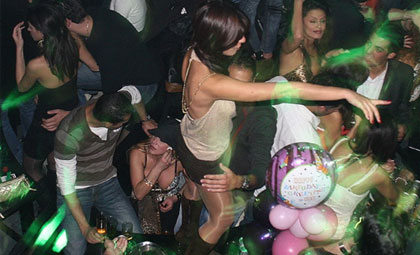
Simply put, this is not Beirut:

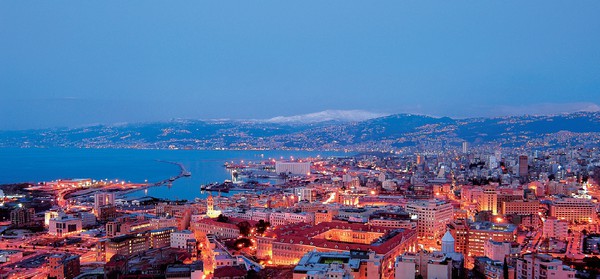
But this is Beirut, nightlife and all: