Those Bomb Detectors Still Used In Lebanese Malls Didn’t Save 280 People In Iraq

Bomb detector fraud Lebanon

Security at Lebanese malls is like the ups and downs of alternative electrical currents. Whenever the situation in the country or around us becomes worse, if that’s even possible, you see them create all kinds of new methods to make sure your car doesn’t have explosives.

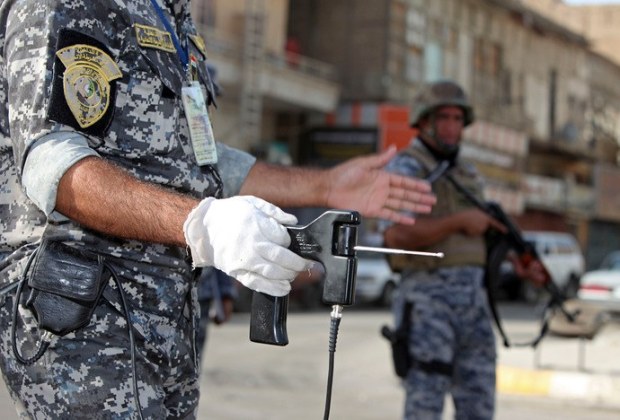
The common fixture, among all Lebanese malls, is those handheld detectors they keep on using. We’ve been saying for years that those detectors don’t work, and the horrifying tragedy of Iraq last year was proof enough: 280 people have lost their lives at a mall because those detectors didn’t capture an explosives-ridden vehicle.

And yet, Lebanese malls still use them like scripture.

The same detectors we are using have been the same ones failing to detect bombs all over Iraq for years. Vanity Fair reports that it was as early as 2009 when those pesky devices proved their uselessness as they failed to detect a van carrying 1800 kilograms of explosives, killing around 150 people next to a governmental building.

Those bomb detectors bought by Iraqi government, as well as security personnel from a dozen government around the world, were devised by American and British con-artists who made millions off of their sales. The gadgets started off as a game, and have been modified to look more security-appropriate, and given fancy names.

And yet, they still never worked. The device remained absurd and useless. Yet, it was bought like candy.

The list of apparatuses that bought the device include:

  • The Lebanese Army,
  • Mexican Army,
  • Belgian police,
  • Mövenpick Hotel group in Bahrain,
  • Romanian government,
  • Georgian government,
  • Various countries such as Jordan, Qatar, KSA, Syria, UAE, Iran, Kenya, Tunisia, etc…

The device was tested by the F.B.I, as well as British intelligence. Both declared it a fraud, and governments still bought it. The person that made them was convicted for fraud and sentenced to 10 years in prison. And yet, the devices he sold have proven to be extremely difficult to remove out of the market.

Was it piece of mind they gave? Perhaps people felt at ease thinking that their cars being “scanned” by an antenna that moved by gravity?

Despite of the mounting evidence against them, including an attack in Karachi just last year, those same devices, which have failed to save thousands of lives they pretend they should have saved, are still used en masse at Lebanese malls.

You go to ABC, and you go through a metal detector before you are met with that antenna. You go to LeMall, and it’s the same thing all over again. City Centre, CityMall, the list goes on.

I’ve also gotten the same security measures when I visited Amman around 8 months ago. It’s probably a Middle Eastern thing.

You go to those malls believing their measures will keep you as safe as you can be in a place as crowded, in a country as teetering on the age of a Middle Eastern political volcano. Few of us think we are endangering our lives by counting on those devices, and yet here we are.

Today, two hundred and eighty people in Iraq were in our shoes last week. They didn’t think going to a mall to buy gifts and clothes for Eid would get them killed, that it would be the last thing they did especially that they got searched, and their cars scanned, and everything that should have prevented that bomb from killing them actually took place.

So where do we go now? Public awareness is key. Those detectors are not protecting you. They are not detecting cars with explosives entering those malls you are visiting. The only thing they’re doing is take up your time for utterly useless reasons.

Lebanese malls, it’s time to invest in measures that actually work if you actually care about protecting your customers. Get on it.


Victims, Not Threats: The Massacred In Iraq, Lebanon, Turkey, Syria, Yemen Are Not Terrorists For Hateful Rhetoric

Meet Adel Al-Jaf. He also calls himself Adel Euro, so you might know him by that. He was a rapper, a dancer and a man who tried to do the best that he could with what he had in his country. Last year, Adel said he was lucky enough to narrowly escape an explosion in Baghdad so he could dance again. This time, Adel was not as lucky.

Adel Euro Adel Al-Jaf

He is one of the 200 people in Iraq who, instead of buying Eid gifts these days as Eid el Fitr comes tomorrow, are buying coffins for their loved ones.

In the blink of an eye, an explosives-ridden van detonated itself through a busy shopping mall in Baghdad. Two hundred families, as a result, lay shattered, maimed, beyond repair, beyond the ability to heal.

It’s become way too easy to dismiss the deaths of those two hundred innocent people as just another thing that happens in *those* parts of the world, in a country (like Iraq) where suicide bombs are an every day occurrence.

But it’s not. And even if it is, the normalization of their tragedy makes the brutality of reality even more horrific. These were people, just like a regular American or European – because we all know your worth is higher the whiter your skin is – who could have been going to the Mall to buy their children and loved ones Christmas gifts.

And yet today, the Eiffel tower didn’t light up to remember them as it did yesterday to commemorate France’s victory in a football game. Even Burj el Arab, which remembered the victims of Brussels and Paris, while failing to remember the massacred of Beirut and Istanbul, couldn’t care less about the brutality of what took place less than 2 hours away. I guess keeping up with the westernized value of human lives is more befit of the image Dubai wants to give itself, so who are we to judge?

Today, those two hundred people that were brutally massacred as they went about their daily lives in Iraq are considered terrorists to be by many. The forty that died in Beirut almost 8 months ago are also considered as such. The hundreds of thousands that died and are dying in Syria are nothing but pests who have, thankfully, not encroached on the holiness of Western values, and so are the people of Yemen.

Good riddance, Donald Trump and his supporters would say. They had it coming, the far right across the world would point its finger and blurt out. And to those people, at the wake of my region being burned once again partly because of the repercussions of the actions of their people, I can’t but say: the only terrorist is you.

Sarah Sadaka, an Arab living in the United States, was going to a Best Buy store today. She went into that store speaking on her phone in Arabic, only to be circled by a woman who made it clear that her presence, her skin, her language made her uncomfortable. No one came to Sarah’s defense: she was just another sand nigger, breathing that free American air on the fourth of July. She did not deserve to have her right as a human being not to be violated that way taken away, she is, after all, only Arab.

Sarah, today, is the living embodiment of what it is to be the victim of terrorism in the United States, except this time it’s the brand championed by the likes of Donald Trump and the people with whom his rhetoric resonates.

When Omar Mateen went to a gay night club in Orlando and killed fifty people, mainstream American media only saw his name Omar as enough reason to justify his actions. He was just another Muslim. He was just another Middle Eastern offended by “our” way of life. Except Omar Mateen did not do so in the name of Islam, he did it in the name of his own insecurities, the insecurities of a man who is afraid of his own sexuality and who is so deluded in his own belief that he’d support two politically opposed factions in Hezbollah and ISIS as vindications for his action.

Omar Mateen’s characterization, and the repercussions that follow it, are a direct result of the kind of terrorism that Arabs and Muslims have to endure at the hands of people like Donald Trump, the Far Right across the world, and the minds that listen to them.

My mother tongue has become synonymous in people’s minds with death. If I speak it on a plane, I become an automatic threat, forced to undergo security checks, apprehended by officials because the words I utter from lips only resonate with fear, even if it’s to say: peace be upon you.

Victims, not threats. The more we are silent towards our murder, our decimation, and our characterization as people who do not deserve to live, the more we perpetuate the notion that people who think of Muslims, Arabs, Middle Easterners and those that live in the area are worth nothing is true. The more we are subdued in not demanding our deaths be remembered, be proclaimed, be cared for, the more our inherent value slips even further, even less than it already is, down an abyss in which the least valuable lives on this planet are Arab lives.

I should not be living in a world where I need to convince a friend of mine not to name his son Abdul Rahman because the name is “too Muslim.” I should not be living in a world where I have to defend myself at my own funeral. I should not be living in a world where the deaths of two hundred Iraqis is considered as just another bleb on the evening news, as they are just a waste of space.

We are people too, and we are worthy of life, one in which two hundred of us do not die at a mall buying new clothes for their children. We are victims, not threats.