From Halaweh Tarts To Achta & Honey Eclairs: The New Fusion Ramadan Sweets You Can Find In Tripoli

Over the weekend, I ventured out to Akkar’s Ammou3a area for the first time ever with two friends tagging along. After a super long and arduous drive – those roads are horrendous – it only felt fitting to make a pit stop in Tripoli for a much needed food break. Naturally, Hallab is where we went.

Off-topic, but Ammou3a is a very beautiful area to visit and to do some hiking. The drive via the Fnaydeq road is much easier than driving up their through Akkar El 3ati2a, and discovering Akkar is an eye opening experience that every Lebanese should do.

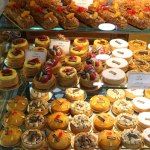
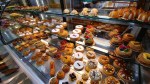
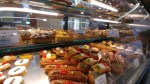
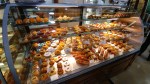
Anyway, we got those menus and were informed that, exclusively for Ramadan – at least for now – they’re introducing new fusion sweets that they’d recommend we try. The three of us figured that would be more interesting than going for simple ice cream or knefeh, so off to that fridge we went and got an assortment of items, the most expensive of which is $3.

To say we were blown away is an understatement. I don’t even normally blog about food or anything remotely related to it, unless it is to turn it into a “to be or not to be” story of course, but this felt like it needed the exposure.

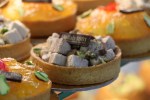
The amount of creativity in those new Ramadan fusion sweets is amazing, and most of them are based on Ashta, which is a Hallab specialty. As a person who absolutely loves halaweh and will miss it very much when I move to the U.S., the sight of that Halaweh tart was enough for me to foresake all reminders of diet and binge.

To say that tart was heavenly would be an understatement. As my friend put it, the most accurate description is: this is blasphemy.

We also tried the Ashta & honey eclair, and I have to say it was as good as the halaweh tart. The mix between what you’d expect to be a Western delicacy and what is very decidedly oriental works very well. I have to say, it was even better than the normal uneventful eclairs we’re all used to having at the many patisseries around the country.

The selection isn’t only summarized with those two items. There’s also an Apple and ashta tart, a tart with mhallbiyeh, as well as raha. A new maamoul with chocolate ashta, a tart with amareddine and a bunch of other items.

My friend tried the apple and ashta tart and texted – I quote: “The apple ones are orgasmic even after two days in my mom’s tupperware.”

Those items are only available at Tripoli’s Hallab, and trust me they’re worth the drive. In another highlight for the massive creativity, especially when it comes to the culinary field, that exists in Tripoli, there’s nothing I’d love more than to highlight this triumph for everyone’s taste buds that exists up North.

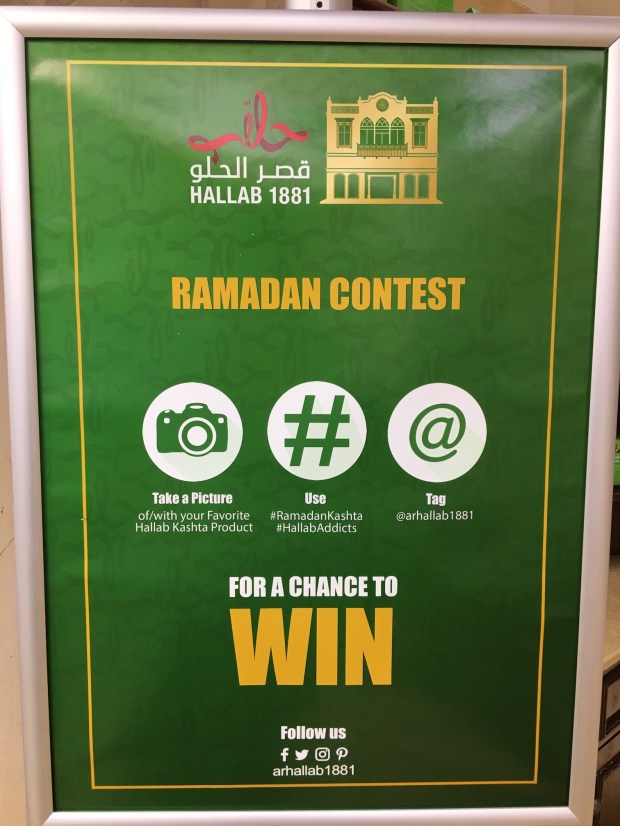
Another reason to make the drive is the possibility to win a suhour at Hallab. All you need to do is to take a picture of one of their ashta items – that Apple tart or eclair come to mind – and Instagram it with the hashtags #RamadanKashta and #HallabAddicts while tagging their Instagram account (@arhallab1881).


P.S.: This is not a sponsored post, nor was I given any freebies to write it. 

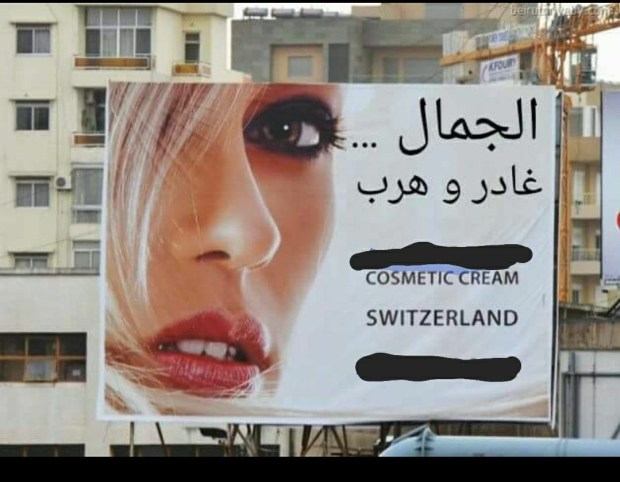
In The Lebanese Jungle, (El Jamal) Nader (Wa) Saab Can Practice “Medicine” … While Laws Look Away

When I graduated from medical school about two years ago, the most important part of the Hyppocratic Oath that we took was to “do no harm.” It’s our moral and legal obligation as doctors to do the most that we can to improve our patients’ health, while making sure that our work does not prove to be at the detriment of their health and, even worse, constitute us taking advantage of them to increase our bottom line.

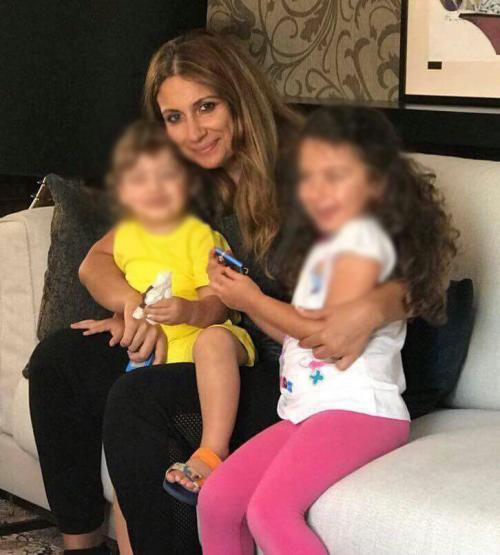
Farah Kassab was a 32 year old Iraqi-Jordanian mother of two, previously healthy contrary to the rumors trying to defend the surgeon who killed her, who presented to (El Jamal) Nader (Wa) Saab’s clinic, by virtue of the ads he has inundated the country and its airline carrier with, to do a procedure that would help her lose weight. It wouldn’t have been considered an expensive plastic surgery: an injection to her stomach area that would regulate the amount of food she could eat.

Instead, Saab worked at convincing Farah Kassab that she needed to do liposuctions to her entire body in order to reach the figure she wanted, along with an eyebrow lift and a rhinoplasty. Saab took advantage of a woman who sought the care of a physician hoping he had her best interest at heart, and managed to convince her to sign on to a drastic procedure that would cost her north of $50,000 and involve more than 4-5 hours of operational work.

Later on, (El Jamal) Nader (Wa) Saab started operating on Farah. 19 injections later, the 32 year old suffered a rare complication that usually occurs when patients suffer fractures in some of their long bones, but has been shown to exist in liposuctions, especially when they’re as massive volume as hers: a fat embolism.

Essentially, fat tissue that gathers together travels through the patient’s vessels and targets multiple organs, the most dangerous of which is the lungs which could lead to death especially when the patient in question is not in an equipped hospital to deal with such things.

Of course, (El Jamal) Nader (Wa) Saab’s hospital was not equipped to deal with any of the complications that arise of his surgeries. His hospital did not have the facilities needed to monitor patients post operation to manage any arising complications. Farah was transferred back to her room. Soon enough, she became a frigid body whose mother had to frantically shout for the medical crew to come give her attention. Farah had passed away.

Instead of taking the blame, (El Jamal) Nader (Wa) Saab proceeded to do what he does best: bend the system that he’s been bending for years to his advantage. He contacted his friend who works at Notre Dame du Liban hospital and they agreed to transfer Farah to that hospital and make it look like she died there, while issuing official death certificates with that information.

His friend agreed, but their plan did not go as planned when Farah’s family found out what happened with her forcing the other hospital to admit they received the patient already dead, according to Arabic news site Ammon News.

(El Jamal) Nader (Wa) Saab has since fled to Cyprus, and his hospital has been closed down.
If there’s anything for you to wish in life, especially if you live in Lebanon, it’s for a wasta that’s as strong as consistent as the one (El Jamal) Nader (Wa) Saab has enjoyed over the years.

Facing recurrent suspensions from the Lebanese Order of Physicians because of him breaking their law that forbids physicians from advertising for themselves (Al jamal Nader wa Saab), he should have not been legally allowed to practice medicine in the country, especially on such a high level. And yet, he did.

In fact, he faced suspensions from the Lebanese Order of Physicians for the past five years, including one for 6 months, as well as a one month legal ban from pursuing what he calls “medicine.” He was still brought back to the frontline, in the full sight of the Lebanese government, without anyone addressing it, and not even with a higher level of vigilance from concerned authorities.

(El Jamal) Nader (Wa) Saab has been banned by more than one Arab country already from practicing his brand of medicine there, including the U.A.E, K.S.A and Kuwait. The reason for those bans are not perfectly clear, but even then he was still allowed to practice medicine in Lebanon with full liberty.

Farah Kassab isn’t the first victim of (El Jamal) Nader (Wa) Saab, albeit she’s the first one to have died because of his negligence. The patients we’ve seen who have presented to clinics for other reasons with massively botched operations at his hands are recurrent, and have always found deaf ears in any governmental function they pursued. Refer to the insurmountable wasta that allows him to do so. He has already harmed a Jordanian woman before as he operated on one in his hotel room in Amman. He was still allowed to practice here afterwards.

For a hospital doing such high level surgeries, the Lebanese government, especially through the Ministry of Health, should have made sure that the minimum required facilities to monitor patients post-op and to manage any arising complications that occur is there. How could they allow operations with general anesthesia to occur without high level of pre and post op monitoring?

With (El Jamal) Nader (Wa) Saab’s hospital, high profile as it is, they did not. In fact, his center getting the hospital label occurred through a governmental decree without passing through the necessary regulatory bodies, as per LBC, and without it being part of the Lebanese syndicate of hospitals which would have oversight over regulation.

Of course, his hospital is not the only lacking one in the country, but his hospital is not one that exists in the middle of nowhere and whose shortage in facilities is because our government doesn’t have the capacity to provide them. A physician such as him was allowed to operate a plastic surgery hospital without the minimum requirements to operate it in in the first place in full sight of the law.

How can a hospital based on surgical procedures not have any post-op monitoring? How is this severe lack of oversight even allowed? Or is our government only capable of banning movies? With no decent hospital, no legal basis to work here, (El Jamal) Nader (Wa) Saab still did surgeries. Why?

How many more of these horrible stories are we supposed to hear, of physicians who give all of us a bad name because they are allowed to practice by a government who doesn’t bother to check and doesn’t listen to the many victims they’ve left in their path over the years?

Today, this 32 year old mother of a four year old girl and a one year old boy exists no more not only because of (El Jamal) Nader (Wa) Saab, but because the Lebanese government in this jungle they call a country has allowed such a creature to not only exist, but to thrive.

Islamic Extremists Threaten Ahwak Ben Tafesh Coffee Shop In Tripoli Because Their Mosque’s Electricity Went Out

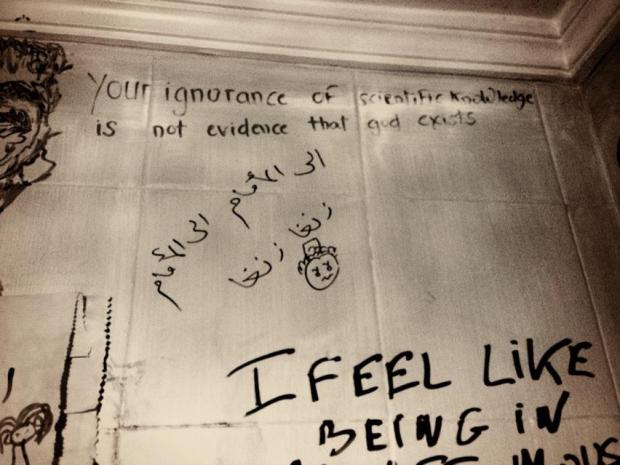
Tripoli’s Ahwak Cafe is a lot of things. Nestled right across a Mosque in the Dam w Farz area, in the newer parts of the city, a stone’s throw away from the gorgeous Rachid Karami forum, it’s a place that’s become synonymous with the city’s most liberal youth frequenting it. In that coffee house’s bathroom is collection of graffiti, one of which reads: “Your ignorance of scientific knowledge is not proof that God exists.”

That’s probably the only place in Tripoli where you’d find such a statement, but it exists.

Ahwak Ben Tafesh did not have as easy an existence in Tripoli as you’d normally think a coffee place would be. I made it a habit to support it every time I went to the city, precisely because it represented the kind of Tripoli that I can relate to, that makes you hopeful of a better future for the city.

It was threatened by Islamists more than once. It was in fact attacked by Islamists back in July of 2013 when one of their newly-released extremists rode up with his goons in an SUV, stormed the place, trashed it, threatened people with weapons, and left.

Lebanon’s government did nothing about the incidence.

Fast forward nearly 4 years later. It’s May 31st, 2017, almost a week into the Muslim month of Ramadan and that mosque across the street – known as the Abdul Rahman Mosque – loses the electricity to its outdoor space and speakers.

In one moment, all hell broke loose. And what turned out to be a damaged electrical wire was turned into an attack on Tripoli being the citadel of Muslims in Lebanon, an attempt to silence the sound of Mosques.

So naturally, the day after, on June 1st, this statement was made, not by the Mosque but by Islamists who have not yet been identified:

Its overall essence translates to:

“Ahwak Ben Tafesh coffee shop in the Dam w Farz area has had a problem with the nearby mosque for a long time, and is known to have atheist clientele. They’re the prime suspect in  what happened at the Rahman Mosque. To its owner and clients we say: close the premises and stay home or move somewhere outside of Tripoli the city of Muslims, within 48 hours as a maximum. You’ve been worked.

Signed the Propagation of Virtue and the Prevention of Vice.”

Said “Propagation of Virtue and the Prevention of Vice” or الأمر بالمعروف والنهي عن المنكر is considered to be a Muslim duty and has been distorted by Islamic extremists, notably in Saudi Arabia, to issue fatwas and decrees.

The mosque in question has denied to have issued the statement through a Facebook post. The area affected by the electrical cut was the outer courtyard as well as nearby locations which offered their rooftops for extra speakers to broadcast the tarawih.

By threatening Ahwak Ben Tafesh that way without any ounce of proof, with a government that has yet to act in any way to protect the coffee shop, its owner and its clients, these extremists are giving a carte blanche to the brainwashed masses that listen to them to go and destroy the coffee house in the name of religion. This is uncharted territory in Lebanon, and simply terrorism.

Some of the mosque goers were not particularly happy:

That particular mosque has a history of banning speakers they don’t agree with from being given the chance to hold conferences in Tripoli, to accusing everyone who doesn’t follow everything they say of heresy. Anyone could have cut that wire or damaged it. Ramadan is one of that mosque’s busiest times with the tarawih. One of the worshippers could have inadvertently damaged it.

And yet here we are.

Why Tafesh?

Because of its resistance to bans on breakfasts during Ramadan when the city’s administration was over-run by spineless politicians who succumbed to every threat by Islamists that thrived in the forgotten capital of the North,

Because of it serving alcohol and all kinds of haram things on the down low,

Because of the unabashed atheism of some its customers, their resistance to the hateful messages of those Islamists, their disdain of their city being turned into a safe place for every bearded man with poison to spew,

Because the place is a beacon of Tripoli’s liberal youth, who don’t conform to the status quo that’s forcibly enforced on their city by those who want it to be seen as the “castle of Muslims in Lebanon” and nothing more.

And this is disgraceful.

It is on the hands of the Lebanese government to find whoever cut that wire, if it’s a deliberate act, and to make sure that those who frequent the Ahwak Ben Tafesh coffee shop are safe and that the shop is protected from vandalism as well as terrorist attacks from extremists who refuse to have anyone who disagrees with them live in the same city.

Tripoli is not a city where such people should be allowed to thrive unchecked anymore. And it sure as hell is not a city where some creature can decide to ban establishments outside of its city limits with a 48 hour window and be met with complacency or even agreement. They may be a fringe minority but their political protection is becoming cancerous and detrimental to all attempts at improving Tripoli’s reputation and future.

The mosque’s speakers going out is unfortunate. If those extremists actually truly cared about the message of those tarawih and the true spirit of Ramadan, they’d have continued praying and forgave however and whatever caused that wire to break, not threaten and terrorize. I may not be Muslim or knowledgeable of Islam, but I daresay that means their fasting is not valid anymore.