The Salaries of Lebanon’s MPs

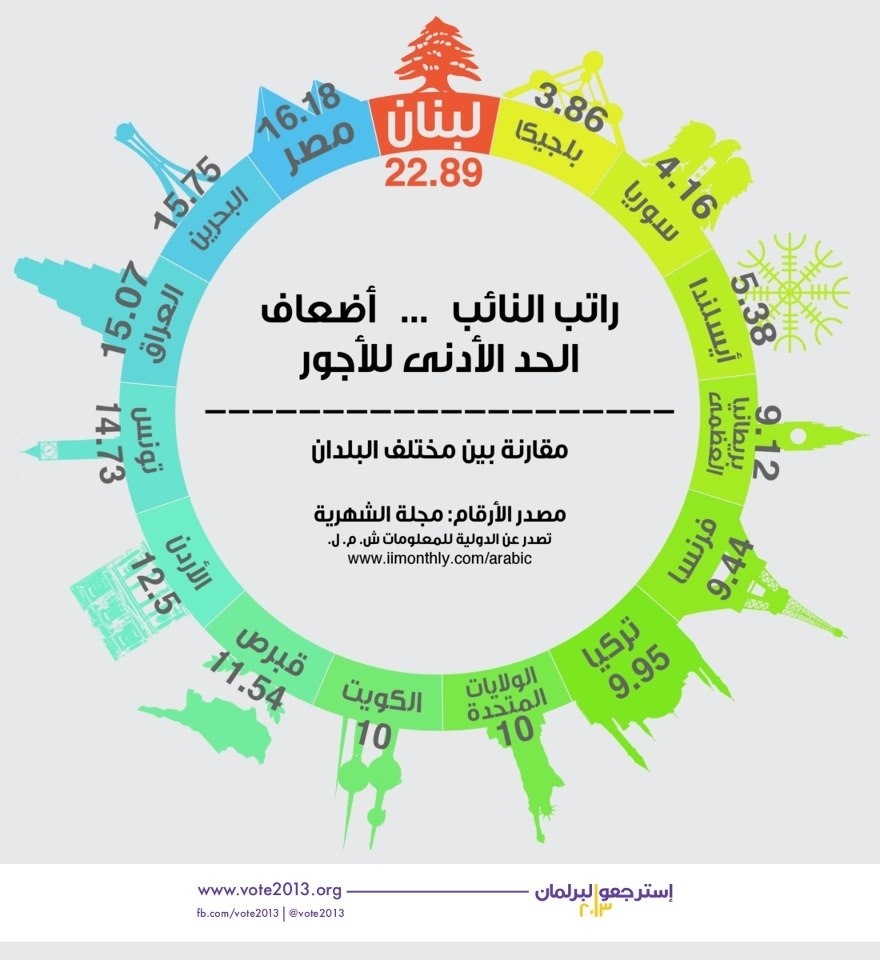
Update: The 22.89 figure is apparently extremely erroneous. Minimum wage in Lebanon is $500. An MP’s salary is slightly less than $8000 when you include all benefits so in the best case scenario, the factor to multiply is 16 nothing more. Moreover, I was also informed that comparing the salary of a Lebanese MP with benefits to the basic salary of MPs (without benefits) only leads to a severely skewed representation. 


14
is the number of laws our parliament passed in 2012, even less in 2011.

2 is the number of general sessions it holds per year.

128 is the number of its current members, set to become 134 soon (link).

23 is approximately how many times the salary of a Lebanese MP is above and beyond that of Lebanon’s minimum wage. That number is set to increase soon because “they need more money to do their jobs.” (Number is from this infographic, which might be false).
20130502-151654.jpg

A chat with one of our MPs a while ago revealed to me that some members in our parliament are actually poor. Stop laughing, okay?
It turned out they need the extra money in order to be able to do their “job” in better ways. You know, not writing laws.

What are we paying our MPs for exactly and who is to blame for this? Not the MPs.

Being a Lebanese MP means you’re surrounded by a clout, a prestigious halo that needs to be maintained at all times. To that effect, there are certain standards of living to be kept. We pay for their convoys, their bodyguards, security measures (and maybe yachts, fancy apartments, etc.) But it’s not because the MPs demand it (I’m sure they don’t mind it), it’s because we expect it of them.

There’s a mentality among Lebanese people that if someone is not fancy enough, then that person is not cut out for certain jobs. I know this firsthand now that I’m entering the practical aspect of my future profession. The residents and interns at Lebanese hospitals are forced to wear ties and suits because – and I paraphrase – some patients immediately dismiss doctors not wearing ties and designer shirts because your dress code reflects on your medical knowledge that’s for sure.

Our country is also run on a clientalism system. The more money our MPs get, the more personal favors they can bestow upon their voters, the more votes they get and the longer they stay in office.

We perpetuate this every single time we ask one of those MPs to help us secure a job, get admitted to some university, secure a building license, lay down some asphalt on our houses’ driveways. As a way to compensate them, we go and drop their name in a voting box while wearing a custom-made shirt with his or her name emblazoned on it.

As long as we keep voting for people because of who they are and how they served us personally instead of what they actually accomplished while in office – not that we have a decent media source for such things to begin with – we don’t really get to complain about overblown MP salaries.

It’s a sad reality. But it’s not changing anytime soon.


Turning Lebanon Green?

Lebanon is anything but an environmentally friendly country. A simple five minute drive is always littered with people throwing things out of their car, with pile-ups of garbage on the sides of the highway, with smoke emanating from factories aptly located on our beaches…

Our electrical resources – whatever’s available of them at least – all rely of fossil fuel. The list of Lebanon’s lack of environmental friendliness can include non-existent sewage systems, non-insulated housing, etc.

The root of the problem, however, isn’t in houses and fuel electrical plants. It’s in the idea that throwing a (non-biodegradeable) bag out of your car is better than keeping it inside. As simple as that idea is, it happens very frequently and is a testament to the mentalities of people regarding the matter. The danger of such an idea is in its reflection on higher-up authorities, manifesting in an absolute lack of policies regarding the environment.

Perhaps turning Lebanon green isn’t among our priorities as a nation. After all, the current political debacle is about anything but the environment. However, with impeding gas and oil drilling, shouldn’t we start thinking more about how such projects impact where we live given that we might end up with the resources to think about such entities?

But it’s not all bad. There are current projects aimed at harnessing renewable energy for electricity purposes, of which I note Lebanon’s first win turbine (info) and covering the Beirut River with solar panels (info), regardless of any comments I might have on the projects. There are also people working to turn Lebanon green and more environmentally aware in the form of NGOs and environmental organizations.

Of those organizations is a new one called Lebanon Going Green (Facebook page) which is working at getting people to adopt a “greener” lifestyle. To illustrate what they’re trying to do, the following is something they highlighted.

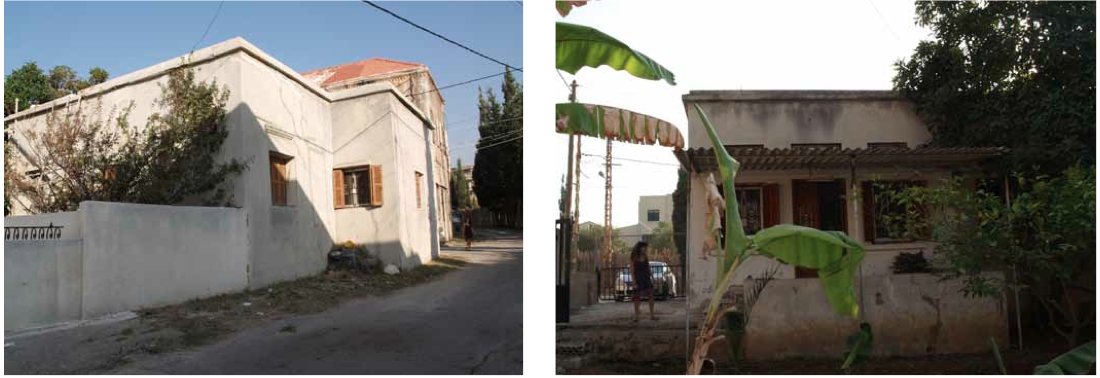
Take a look at this house in Batroun:

Batroun House Environment

It’s an old, typical house. I’d say there’s nothing really special about it besides the location – it faces the sea. Perhaps it might be charming for some.

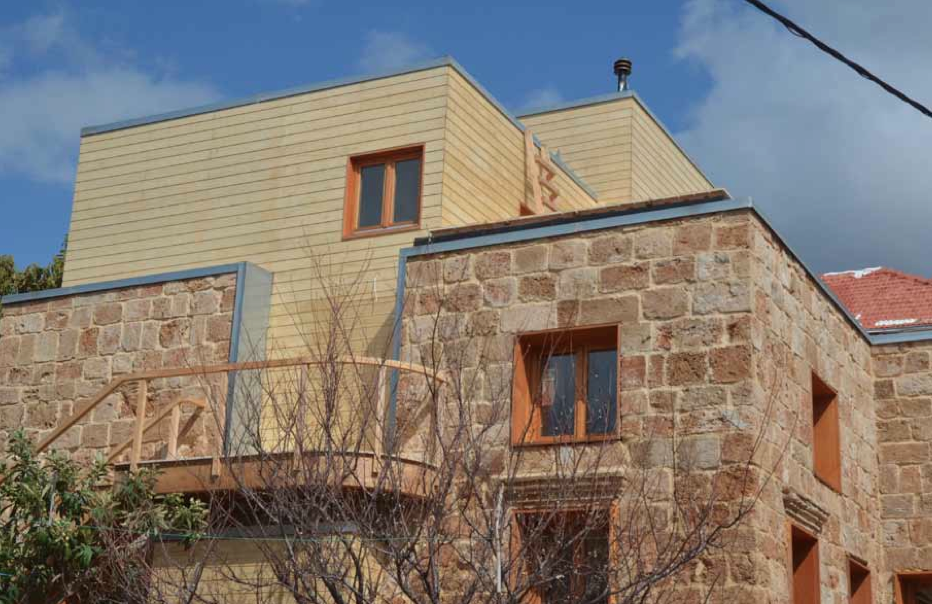
Now take a look at the same house again, this time in its current state:

Batroun House Environment 2What if I told you the above renovation was completely green-friendly and doesn’t cost more than similar luxury houses built in non-enviornmental ways?

The house has a green rooftop with an irrigation system that re-uses the water utilized by the house. The home appliances employed are all energy friendly, effectively reducing the house’s electricity consumption considerably. The wood you see is all treated and was used to replace cement in order to reduce the house’s carbon footprint. The walls inside the house were reinforced with reused wood. The house is also completely insulated, which further reduces the inhabitant’s need for heating.

Another example of Lebanese environmentally-friendly companies is Cedar Environmental, which has built 11 facilities since 1999 to  accommodate up to 47,000 tons of waste. The waste received is turned into EU-certified fertilizers, furniture, etc…. Many of the furniture they make is donated to schools.

Perhaps people are becoming more aware about the need to be more careful with how they treat the place we’re all living in. For instance, the event Lebanon Going Green held at AUB a couple of weeks ago was completely booked, which indicates interest. But it’ll be a while before Lebanon goes green. However, with firm steps in that direction and no politically motivated people to create hurdles, I don’t see why those steps will stop.

Kudos to everyone involved in the aforementioned projects.

When Haifa Wehbe Went To The SMAs

I watch Lebanese award shows occasionally when they air on some television channel. I laugh at the amount of plastic in them, the people kissing up to each other only because social class dictates as such, the winners who are so shocked it’s obviously fake, etc…. The thing about those Lebanese award shows is that no one is taken aback and starstruck by some megastar, effectively making the entire show about that person. I never thought I’d attend a Lebanese award show, let alone be nominated in one. But the Social Media Awards were a Lebanese award show by excellence.

The worst part about the SMAs wasn’t performers such as Poly singing to empty chairs or as a friend said having a “Paris Hilton winning best neurosurgeon award” with Lebanese Memes beating out Donner Sang Compter in a category for NGOs, something I had predicted 11 days ago (link) or how Anis Tabet’s blog somehow lost. The worst part wasn’t the fact that trying to get food at the food court could have resulted in some form of asphyxia because of how many people were there. It wasn’t the dress code that was resoundingly disassociated with social media.

Haifa Wehbe came around 10:30. No pun. She was obviously three hours late because someone as busy as her cannot mingle with the commoners who had been sitting there for three hours prior listening to one category after the other and who are not used to flashy award shows. She came to accept the award she hadn’t won yet for best celebrity on social media.

So in case it wasn’t obvious she was going to win, you should have taken a hint. Elissa was definitely rolling in her bed at that point. It wasn’t as if Haifa Wehbe winning wasn’t expected. But she sure knows how to make an entrance. The entire award ceremony was stopped so she can have her photoshoot and her poses and people scrambling to take pictures with her. Even the category being announced at that moment was put on hold for her. How respectful is that to the winner? Well, what do I know I guess.

Many minutes later, someone came back to their senses. And because Haifa is a very busy woman who doesn’t have time to wait for the rest of the categories in the evening’s planned proceedings, her category was brought forward. And surprise surprise! She won. She went on stage and accepted her prize. Was it deserved? I don’t follow her but “Twitter is my bodyguard,” she said in a speech that she wanted to say in “Arabic.”

And the same mania repeated itself, this time ten times over. The cameras, the flashing lights, the poses, the air kisses. Again, who cares about the other categories of the people who were waiting almost four hours for their turn to come up? Those people – like yours truly – are obviously irrelevant.

I wasn’t sure at that point if I was attending the Social Media Awards or the Haifa Wehbe Show. The award show that was supposed to be about 200 nominees, most of which had worked really hard  for a year to get nominated, became about this woman’s ability to make men drool and preteens go gaga. And they love it.

Note to self: must visit Nader Saab to improve my assets in preparation for next year. The Elie Fares show sure has a nice ring to it.

Haifa Wehbe showing up put things into perspective. The SMAs weren’t about really honoring the year’s best blog with those 50 people in the room at the time of the announcement. It wasn’t about the irrelevant categories sprinkled here and there to which we campaigned and had fun doing so even if we knew we weren’t going win. It was about getting the flashiest result possible. A few days from now, few will remember who won what. But they’ll only remember that Haifa Wehbe attended. Everyone & everything else is simply besides the main point.

Note 2.0:

Thank you to every single one of you people who took the time to vote for A Separate State of Mind. You people are beyond brilliantly awesome. 

How Annoying Are The Convoys of Lebanese Politicians?

I was going back home to Batroun on Friday, stuck in typical traffic overload in Jounieh, when a GMC Yukon suddenly appears behind me, flashing my eyes out for me to give him the left lane.

It was late at night. The right lane was all blocked with cars. It was beyond obvious I couldn’t change lanes except if I wanted to cause some interesting car accident for news services to report the following day. And still he flashed his headlights on and off at me.

Soon enough, when the right lane barely managed to clear, the GMC car bypassed me with another similar car immediately behind it. Up to that point, I had thought it was just one of your regular Lebanese douchebag drivers who think they’re in more hurry than everyone else. However, both GMC cars were exactly the same color and make. They were without license plates and both of them were acting as if the highway belonged to their mother.

A few minutes later, I saw similar headlights beaming at my rear-view mirror. I manage to cede lanes. And behold: two similar GMC cars, without license plates, same color and make. It was another of case of Lebanese politician highway-titis.

Those 4 cars managed to hijack the highway for my entire trip back home. They try to block you from passing them if you tried. And that wasn’t the first time nor was it the last time in recent days when I ran into such convoys.

A few months prior, 4 similar cars created some sort of a cross on the highway, occupying all three lanes, effectively blocking the entire traffic behind them: 2 cars in the central lane and one on each side. I had no idea what they were so I tried to go past them. They almost rammed by car into the separator. It was my one and only warning.

Yesterday, as I took a cab to the Beiruti neighborhood of Hamra, we encountered a fancy car with a “parliament” license plate. That vehicle didn’t care we had right of passage. It almost slammed into us as it tried to overtake us. Douchy Lebanese driving, perhaps. But at least they had a license plate this time.

So the question is: how annoying are the convoys of Lebanese politicians? Very.

Perhaps the extra security measures are warranted. But how can I explain the lack of license plates, for instance? What’s to say those four cars are for some major politician from the North and not for some criminal who knows his way among high-end people? And how is a politician allowed to break the law just because he is whoever he is, effectively making the lives of other Lebanese a worse driving hell because no one dares to double cross those tainted cars that rule the road when they pass?

Our politicians are the primary douches of driving. The mark of the sophistication of a country’s ruling class starts with the way they drive. Let’s just say our politicians drive as if the highway is their jungle.

And you know what’s worse? We’re paying for that.

How Corruption in Lebanon Remains

My hometown, Ebrine, and the Batroun region overall, have been “plagued” over the past few months with an ambitious developmental project to establish a sewage and water pipe network. The former pipes are supposed to connect houses to treatment facilities, the first of their kind in the country. The latter pipes are supposed to increase and make water distribution more efficient across the region.

To that effect, relevant governmental bodies hired contractors. To say the contractor chosen for the project has been doing a crappy job would be the understatement of the year. Take a look at these pictures (link) to know what we’re going through.

Coupled with the lack of competence is a serious lack of efficiency and waste of resources. They finish a section of a road, wait a couple of months to actually lay down some asphalt, make us enjoy the patches for a week or two and then dig it again because they remembered they need to lay down some other pipes. And repeat asphalt-less process.

The question that I asked repeatedly was the following: how did our government accept to hire someone as incompetent as that contractor  to do a project as ambitious as the one at hand?

But the contractor in question is but one example of what happens around this country to perpetuate the entrenched corruption in governance. How they do that is fairly simple.

Take a look at this very interesting report by Executive Magazine (link) about Lebanon’s debt, now around $60 billion. The most interesting part to me in that report, which confirmed what I had previously heard about these contracting jobs, is the following:

Most public debt is held by Lebanese individuals and institutions. While approximately 20 percent is held by foreign governments and multilateral institutions, nearly 80 percent is held by bond and note holders.

The contractor handling the project in my region is one of those people. Our government owes him so much money that they cannot not give him the projects he asks for and pay him money to “execute” them. The execution plan – at least in my hometown and region – went in the following way:

  1. Make sure you get the project from the government.
  2. Get paid a huge amount some of which the government may not be able to pay and increase the debt loop.
  3. Find a cheaper contractor who’s willing to do the job for a fraction of the money. In our case, a little investigation revealed the project wasn’t done by the contractor mentioned previously but by a Syrian contractor who got hired to do the job.
  4. Give that subcontractor a ridiculously low amount of money.
  5. Sit back and relax and try to watch as politicians try to save face.

Those Lebanese individuals to whom the state is indebted with approximately $45 billion keep our governments hostage to their power: if they want certain projects, they get them. If they want certain policies passed, the policies will pass. If they want anything to happen, it will happen. And the merry goes round in other regions, in different ways and forms.

So next time you feel like investing copious amounts of money in this country, invest them in making the government owe you money.