Ziad Doueiri’s “The Attack” Banned in Lebanon

The Attack is that kind of movies that spring controversies without people even watching it. When I first blogged about it (link) back in December 2012, I asked the obvious question: will the movie having to do with Israel, being shot there and whatnot, deter it from being screened here?

For a while, it seemed the answered would be no – the movie had gotten its permit for screening approved back in September:
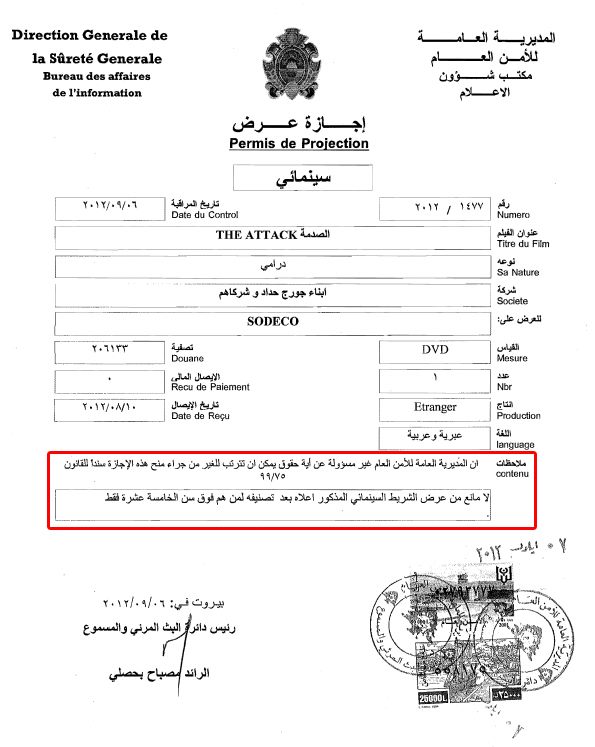
 

Ziad Doueiri The Attack Permit Lebanon


Then came Oscar time and the movie’s director made a big deal out of our ministry of culture refusing to have his movie represent Lebanon at the Oscars. People panicked: what an act of cultural terrorism, etc… I thought the ministry of culture’s decision was spot-on. It was simply choosing not to submit the movie for an award show, not banning people from watching it. Regardless of how excellent the movie is, does it represent Lebanon enough for it to be our submission for the Oscars? I hardly think so (link).

However, things have taken yet another turn. The permit shown above was asked to be returned by relevant authorities because minister Marwan Charbel decided to ban “The Attack” from being shown in Lebanese theaters. The justification for that was exactly the initial question I had asked way back when: part of the movie was shot in Israel.

Now the decision to ban the movie is downright unacceptable:

  1. Lebanon has had Palestinian movies released in it, some of which have had parts of them shot in Israel. Paradise Now anyone?
  2. The movie is not an Israeli movie for us to maybe fathom banning it. There are Israeli actors in it but that doesn’t mean the movie is funded by the Israeli government.
  3. How about we start banning all movies with parts that may have been shot in Tel Aviv? I can think of many American movies with Israel-centric scenes. Or do we just panic when it’s a Lebanese filmmaker?
  4. What’s the point really of banning a movie with a sequence shot in Israel? It doesn’t end the occupation, it doesn’t serve a higher moral purpose and there’s no point to it at all.
  5. Shouldn’t the ministry of interior affairs have more serious things at hand? For instance, shouldn’t they be working on an electoral law? How about working on all the racist municipalities issuing curfews against Syrians? Or better yet, why not work on the deteriorating security situation in the country? Oh wait, movie shot in Israel trumps all of those anytime of the day.

We have reached a time where our government doesn’t even know that I can download whatever movie they ban with a few clicks (and a 24 hour waiting time given our internet). The moment “The Attack” becomes available online is the moment I get to watch it. And I’ll see that Tel Aviv scene and I won’t panic nor will I become a traitor nor will some feeling inside me move towards our Southern enemy. Who’s the only entity hurting from such archaic and irrelevant bans? The filmmaker who’s hurting financially and Lebanon’s reputation as a country for freedom, being dragged daily towards the abyss by minds still stuck in 1864.

Good job Marwan Charbel. One day you sign a civil marriage contract, the other you ban a movie – because keeping a good streak is too mainstream.

(Source).

Comparing Beirut To Dubai

An American writer for the Huffington Post wrote an article today titled: “Thank you, Beirut. Your Friend, Dubai” in which she basically paralleled the rise of Dubai to the gradual decline and possible near-demise (never ever?) of Beirut.

The writer’s opinion of the Lebanese capital was favorable – even favorable of the go-to Lebanese scarecrow for Americans Hezbollah, trying to explain its popularity among many Lebanese and the reason for its increasing political strength.

In typical fashion, Lebanese across the internet have been sharing the article fervently. It’s about Lebanon. It’s about Beirut. It’s by a very prominent publication. Click, click away.

However, the question I want to ask is the following: is comparing and contrasting Beirut to Dubai warranted?

I, for one, think drawing similarities between the two cities is comparing apples to oranges for the following reasons:

1) Beirut was never made out of money. When you talk about Beirut, you don’t talk about an economical hub for a region or a city made entirely because they discovered oil beneath its soils. You talk about a city which made itself by itself and who, when the factors leading to its prosperity are affected, undoes itself by itself.

2) Beirut has never had poured into it the same amount of money going into Dubai daily. The Lebanese economy – even in its heyday – has never been as strong as the Emirati economy is (or was if we’re accounting for the recession). Up until a few years ago, we didn’t have oil. We won’t see any benefits from that oil until 2018 at the most optimistic expectations (link) and I’m sure the economy driving Beirut won’t be nowhere near comparable to that of Dubai anytime soon.

3) Beirut and Dubai have two entirely different experiences to give their visitors. The joke goes “I’ve never been to Dubai but I’ve been to Zaytounay Bay.” Many moguls are sure trying to turn Beirut into a new Dubai. But I believe their attempts will end up futile. They can build as much malls as they want and spend copious amounts of money into flashy projects that pale in comparison to any developments in more developed countries. They can build the fanciest hotels and the most hedonic of night clubs. But the fact of the matter remains, and it shows in the point the article’s author tried to make: Dubai is for show and Beirut is for heart, however tacky that might be. Can you compare both?

4) By comparing Beirut to Dubai, the comparison can be extended to the countries holding the two cities. Is the “Lebanon” experience of tourism compared to the “UAE” experience? I highly doubt it.

5) The governing bodies behind Beirut and Dubai are highly different. On one hand, you have an iron-first ruling with a twist of enough liberalism not to step on bigger political toes. On the other hand, you have a state barely keeping it politically together as everyone fights for a piece of the Lebanese cake.

Beirut is a city with woes. There’s political instability at every turn. Civil strife can erupt at any moment. The city is that of 18 sects trying to live together while working for their communitarian benefits, some of which are mutually exclusive with those of others. But don’t you think that for a city as chaotic, with a serious lack of infrastructure and urban design, to be compared to Dubai at every point is poignant enough to tell which city has more promise? And If Dubai’s oil reserves ran out tomorrow and its economy started going down the drain and the expats in it decided their futures better be spent elsewhere, would it still be the mega-brilliant city everyone makes it out to be today?

Lebanese Slang

Take a moment and ponder on the phrase: “shi tik-tik shi ti3a.” I’m sure – or at least I hope – the expression makes sense to all Lebanese out there. Ask anyone else and they’d stare at you as if you spoke Gibberish, which that sentence may as well be.

The Lebanese dialect, which – in my very biased opinion – is the most beautiful Arabic dialect out there, is filled with these slang expressions that only make sense to us.

The thing about those slang expressions is that you never give them a second thought until you see them listed and explained for those who don’t speak your dialect. Other expressions include:

  • De2 el may, may
  • Jeet w Allah jeibak
  • Ghechech w mecheh
  • Metel neswein el feren
  • Those aren’t the best ones. Check out the interesting and hilarious full Iist here.

    The Genocide They Want Removed From Our Collective Memory

    I imagine life would have been much different for me had my last name ended with -ian. I’d have come from a very different place than the one I currently come from. I would have spoken yet another language.  I would have grown up listening to stories that morphed into darker and darker territory as I grew older: stories told by my grandparents, stories of my friend’s great grandparents, stories of entire families and homes and communities and towns and cities that exist no more today.

    If I were Armenian, I’d have been an immensely proud person of those people who are the reason I am here today, the people who defied the cold, the heat, the hunger and the systematic killing at the hand of a ruthless sultan, the people whose stories would give me strength, enriching my view of the world, making it more and more certain each day that this is not – as many want everyone to believe – a just world.

    If I were Armenian, I’d carry around a baggage of horrors around with me of things that happened to my ancestors, things few dare to speak of because of how ruthless they are. I’d never let go of those horrors, clinging to them even more when the hands of time try to take them away. Those horrors would have made me who I am.

    If I was Armenian, I’d be mad as hell today that the death of 1.5 million ancestors of mine is – to some countries – nothing more than a political pawn for them to play with, for them to have a political auction with, for them to try to forget, for them to try to make me forget. for them to try to take down historical memory lane: never written, never discussed, never acknowledged, never recognized.

    If I were Armenian, I’d be livid that the memory of 1.5 million of my countrymen, all martyrs because of their ethnicity and their religion, is being tarnished by some who want to portray it as nothing more but a collectively inserted piece of fiction in the memory of a far-away nation I’d still feel belonging to, a nation that is still hurting 98 years later.

    If I were Armenian, I’d still be hurting today and I’d hurt everyday people across communities do not recognize my people’s struggles the way they are eager to recognize the struggles of others, just because it soothes their guilt. I’d be angry no one feels remorse and guilt for the cold-blooded murder of my people, one by one – women and children and elderly and men.

    But I am not Armenian. I am but an irrelevant Lebanese with a voice that doesn’t matter in the grand scheme of things. But I feel it’s my duty to tell whoever listens that there is a people of this world who was systematically killed for just existing and whose killing isn’t recognized by everyone the way other genocides are. I’d tell that a country that plays with my country like a yo-yo killed those people and has been trying to convince its own people for 98 years now nothing wrong happened. And I would never forget and – until everyone acknowledges what happened – I wouldn’t forgive.

    May all the martyrs and innocent souls of the Armenian Genocide rest in peace.

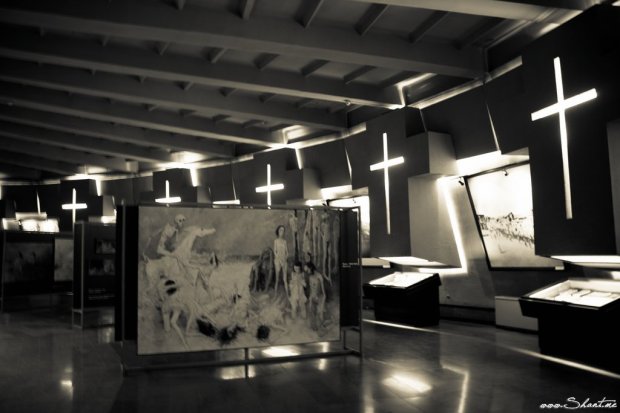
    Tsitsernagapert, inside the museum: A photo of the museum next to the memorial, Yerevan Armenia. - Photo by Shant Demirdjian

    Tsitsernagapert, inside the museum: A photo of the museum next to the memorial, Yerevan Armenia. – Photo by Shant Demirdjian

    The Closing of Ghost & Lebanon’s LGBT “Crust” Activism?

    “Gay people should not exist. They are an abomination.” Raise your hand if you’ve heard this countless times in your life.

    It doesn’t matter what your sexual orientation is. Homophobia is entrenched in Lebanese society and pretending it doesn’t exist because you live in a more “liberal” place in Beirut doesn’t mean it’s not there.

    People see someone wearing something they may not fancy and they say he’s gay. People see a girl with super-short hair and not-so girly clothes and she’s a lesbian. People see two close friends from the same gender walking on the street and they’re automatically dating.

    And sometimes, when someone has enough power, they act out on their homophobia. It’s very easy to freak out how someone as homophobic as the mayor of dekwane, the newest a place to close down a gay pub, made it to office. But is it any surprise?

    Is it any surprise really and honestly that your security task force, which has no problem wolf-whistling your women on the streets, also has no problem in violating people that your law considers as “unnatural?”

    I had no idea what “Ghost” was until today. I asked a few LGBT friends the following question: if it had been a hetereosexual place, do you think it closing would have been justified if the same stuff were happening in it?
    They answered yes. The question begets itself: is it okay to do whatever people did at Ghost just because it’s a gay place?

    Of course, Ghost closed down because it broke one particular Lebanese law, not the many others that, in any normal setting, should have counted. Of course the mayor wanted to protect his city against the “louwat” and whatnot. And you know what’s also interesting? For everyone person outraged by what happened and by what that mayor said, there are many more others who were just convinced to re-elect that mayor. No amount of Facebook sharing and Tweeting will change what people believe in deeply, surely and resoundingly: gay is not right and should not exist.

    You know what’s the best way to tell a homophobic official to go to hell with his decisions? To have the law on your side to protect you, to have a law that doesn’t label you as an inferior human being just because of who you want to sleep with.

    Until a time when closing down pubs because they’re gay-friendly becomes illegal and raiding cinemas because someone thinks “unnatural” things are happening there becomes not allowed, isn’t getting up in a fit because of those events happening while forgetting the base of the issue sort of like crust-activism whereby the small victories that might result are celebrated but the underlying cause for the struggle leading to those victories remains?

    Until a time when homosexuality is removed form Lebanon’s penal code and homosexual men and women are not considered in law with a prefix, pubs will keep closing and cinemas will keep on being raided and activists will keep on panicking. It’s a cycle that will repeat itself indefinitely – until Lebanon’s LGBT community manages to get LGBT-friendly officials on their side in order to advocate for their rights and make laws that can be shoved in the mayor of Dekwane’s face.

    I don’t see that happening anytime soon.