Foreign Journalists, Can You Stop The Cliche & Poorly Researched Articles About Lebanon?

Dear Foreign Journalists,

We, as Lebanese people, absolutely adore the pride booster injections that you give us whenever you write about Beirut or our country.

In other words, the country gets a massive hard-on whenever you take the time to write an article about Beirut, or about how much of an “exotic” destination for tourism Lebanon is. Many of us (not me, to be honest) rise above the cliche of the articles because we believe they serve the greater good: to show the country in a better light, to show Beirut as a cosmopolitan city, and what have you.

But – and to put this gently – there’s just so much that you can say about a city being a party capital and about a people being party-loving before it becomes not only redundant, but utterly nauseating to read à la “oh look, it’s another one of those articles.”

I know that writing those articles gets you a lot of clicks and attention – blame our clicking-loving-Lebanese-fingers for that, but what needs to be said is the following.

Over the past couple of days, an article by The Telegraph by Ruth Sherlock – a foreign correspondent based in Beirut – has been making the rounds, aptly titled: “War is a million miles away when the Lebanese begin to party.” 

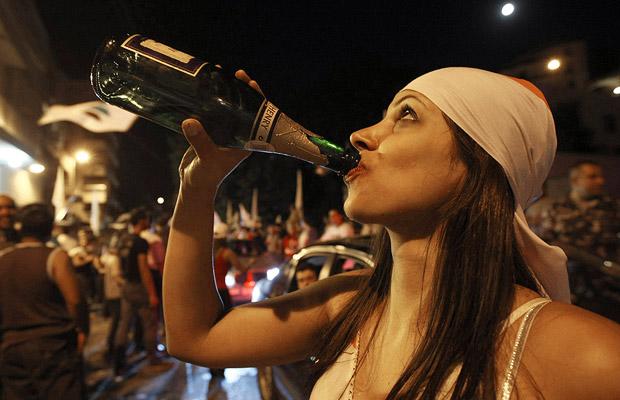
The article started off with a picture of a woman drinking champagne, with the caption indicating that the woman was doing so at a recent election, noting that the most recent election we’ve had was in 2009. But that’s not the “best” part about the picture.
Lebanon Telegraph Article

The author naturally assumed that the woman in question was Christian, because sectarian and religious designations by Western Journalists are perfectly fine when talking about Lebanon.

How is that woman Christian? I guess it’s because she’s unveiled? Because as we all know, there isn’t a single Muslim woman in the country who isn’t veiled. I should get the memo out to my friends. Or is it because she’s drinking alcohol? Because, as we all know there isn’t a single Muslim who happens to be female who likes to drink alcohol in this country? I should also get the memo to my party-loving friends; but please don’t get any ideas about writing articles about alcohol-loving Lebanese-Muslim women, I beseech you.

The article then goes on and on about Lebanon’s love for plastic surgery, because this is not new. What is new, however, is that we – as Lebanese – like to throw extravagant parties worth over $200,000 and weddings worth over $300,000.

I don’t know about you but I, as a Lebanese, currently have $30 in my bank account. Not only does my entire worth not equate $200,000, but I’ve never seen such money in my life before. This is to say that when you talk to an event organizer serving the Lebanese 0.3% in order to get an assessment of the other 99.7%, you are bound to – and forgive my French – fuck up. For reference on Lebanon’s distribution of wealth and why the notion of $200,000 events being the norm is completely erroneous, check the following article.

And because the Lebanese cliché is never really fulfilled without mentioning religion a few dozen times in a 500 word article, The Telegraph article made the very astute observation that Lebanese put sect before country, also known as something my not-yet-born cousin would gladly tell you on any of her sonograms.

The religious cliché also needs a good dose of how communities are segregated into East and West, Christian versus Muslim and how they rarely interact, with the occasional sectarian and probably senile man still living in 1965 who thinks those who pray differently are inherently bad people, although I have to admit the notion is not particularly erroneous among many people of the Lebanese populace, but it’s all very “been-there-done-that” topic wise, especially when name-dropping neighborhoods for their sectarian affiliation, and doing so erroneously; as far as I know, Basta is very Sunni.

Do not, however, and I beseech you again, go into how the Sunni-Shiite conflict of the region is having repercussions on Lebanon because that’s another overdone topic or how precious and vital Lebanon’s Christians are for the region because they, out of all denominations in the country, don’t need their self-worth inflamed any more.

Then, because it’s never an article about Lebanon without mentioning power cuts and how we don’t agree on our history post 1943, The Telegraph article aptly drops those, as if they’re coloring by number. Pastel color green goes into box number 3.

When you want to write an article about Lebanon, please don’t interview a party planner for the 1%, a businessman who is among the 1% and an old man who was probably taken aback by the presence of a foreigner, and was more than willing to blurt out anything, pile up the bunch together and call it an “article.”

I understand that Lebanon is not your target audience in such pieces; but we will be reading them anyway. Similarly, I assume you’d also be appalled if I wrote an article about the United Kingdom and mixed up Scotland with England, or if I wrote an article about New York City and I assumed the entire city is nothing more than Manhattan’s Financial District.

The Telegraph isn’t the only publication to do this. The examples are endless, from the Guardian to the Washington Times. It’s always the same topic over, and over again.

As a rule of thumb, the following headlines are so overdone they’re dead: Lebanon and parties, Lebanon and war, Lebanon and religious diversity, Lebanon and electricity &/or internet, Lebanon and the proximity of the beach to the mountain, Lebanon and skiing plus swimming in the same day, Lebanon and the active presence of Christians.

If you absolutely feel the need to write about any of the aforementioned topics, however, please, please do read the other twenty million articles written in the same vein, and try to give a new perspective, one that local media fails to produce because of the toes they’re afraid of stepping on, and one which both your Lebanese and local readers alike will find refreshing.

PS: The picture of the Church next to the Mosque in Downtown Beirut is a big no-no.

beirut-church-mosque

Best,

A disgruntled reader.


#JusticeForGeorges: When Lebanon Is A Jungle, Not A Country

This is what I do when someone cuts me off on the road.

1) I honk at them as loud as I can,

2) I call them an asshole because that’s what they are,

3) I curse whoever taught them how to drive because, well, someone who knows how to drive should know right of passage,

4) I move on, turn up my radio and blast some song my friends agree I should probably not be listening to.

What happens, however, when a right of passage dispute happens with an asshole, who – like many Lebanese in this God-forsaken country, happens to be well-weaponized?

The answer is short: you die. This is exactly what happened to Georges El Rif, in the streets of Gemmayze.

His story is as follows:

Georges and his wife were driving on the airport road when they got into a right of passage dispute with Tarek Yatim. Tarek and the woman driving him, whose name is Lina Haidar, tried to cut off Georges who didn’t let them through. So they forcefully hit his car and kept going.

So Georges followed the man who hit his car to write down his license plate number. They called the ISF, gave them a description of the car and its license plate number. They were rebuffed by the ISF because no personnel were nearby.

They were eventually led to Gemmayzeh, where Tarek Yatim got out of his car, ran towards Georges and started stabbing him with the knife he had in his possession.

No amount of pleading from Georges’ wife, no amount of running away from Georges deterred Tarek Yatim from attacking the man, stabbing him repeatedly. Whenever the wife would try to help her husband, Tarek Yatim slapped her and pushed her away.

A few meters away from them was the house of Lebanon’s Minister of Energy Arthur Nazarian, who also stood on his balcony observing what was happening, not bothering to send his own bodyguards to help.

Georges was then taken to a nearby peripheral hospital where doctors could not resuscitate him. He had three episodes of cardiac arrest before he passed away, leaving behind him a wife and four kids.

Georges’ killer is a man of priors. He was involved in a shooting at the White House restaurant in Sodeco in February 2010, as well as drug trafficking and drug use. The question is: why wasn’t he in jail to begin with?

The answer is two folds.

He wasn’t in jail because this fucked up country is not a country, but a jungle where animals like Tarek Yatim run wild, unafraid of retribution because we don’t have a functional justice system and we don’t have a functional security apparatus to make sure such assholes are where they’re supposed to be: behind bars, away from people who just want to make a living, drive to work, go home to their kids and families, and just live.

Tarek Yatim wasn’t also in jail because he’s connected, because he’s a Lebanese politician’s, reportedly Antoun Sehnaoui, henchman: someone to do their dirty bidding while they sit behind podiums and preach “order” to anyone who listens, or govern us “legally” as they pass their illegal biddings without us knowing.

Tarek Yatim is the kind of “people” who are not afraid of retribution because they know they can get away with it. He’s the kind of animal who’s not afraid to kill someone in broad daylight because he knows how to get away with murder.

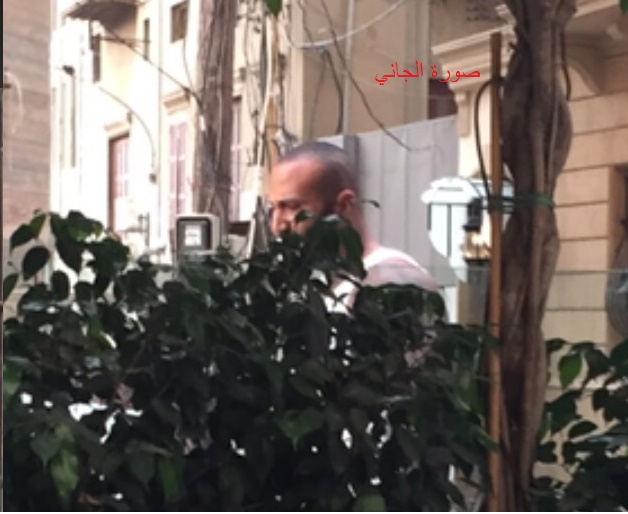
This is Tarek Yatim’s face. Memorize it. He may be apprehended now, but be sure he’ll be back on your streets as soon as his wasta allows:

Tarek Yatim - Georges el Rif #justiceforgeorges

The more heartbreaking side of Georges El Rif’s story is how the people around him stood there and watched. I’ve seen many videos of the incidence. They have different angles, but they all show the same thing: Georges el Rif being chased by his murderer, and people standing there idly watching. The only thing they needed, I suppose, was a batch of popcorn.

It’s hard for me to imagine that there was nothing the people standing there, watching Georges die, could have done. It’s hard for me to imagine that the cars circling that road, probably slowing for a few seconds to see what was happening, had no reflex to help a man thrown on the ground, getting stabbed to death, psychology’s bystander effect non-withstanding.

A minister stood there and did nothing. His bodyguards did nothing. A police station that’s a minute away did nothing. How is this acceptable? 

It is easy for me to imagine, however, those people that were there, rushing home to tell their family all about the very, very exciting thing they witnessed on the streets of Gemmayze that day. I have no idea how much further our apathy can rise.

Many in Lebanon keep weapons and knives in their cars. They roam our streets, threaten our security and our lives, aware that their threats will never be faced with any repercussions. A few months ago, Yves Nawfal was the victim of such people as well (link).

One day, someone you know or maybe you could fall victim to such people. I just hope our names don’t get turned into a hashtag just because our politicians are too comfortable keeping their henchmen out of order, our security apparatuses are too comfortable not making sure that anyone with finger can pull a trigger, and that the people of this country are apparently convinced that something happening to someone on the street can never happen to them.

Lebanon is not a country; Lebanon is a jungle. Deal with it accordingly.

Update: An IndieGogo campaign has been started to fund Georges’ family’s legal case. (link). 

“Brands For Less” Employees in Dekwane Beat Up African Woman & Get Away With It

This story will make your blood boil. 

NowLebanon broke the story of Nafi, a worker from Abidjan, who was visiting a “Brands for Less” store in Dekwane to buy gym clothes at a cheap price. 
While at the shop, she was accused of being a thief, naturally because she was black, not Lebanese and not white. She was searched. They didn’t find anything on her. She tried to leave, and they searched her again, because you know strip searching her the first time was not enough and who knows, she might have stolen something while being eyed by every racist asshole in the store. So Nafi accused the workers of racism towards her. That was when the manager pushed her to the ground and beat her up until she started bleeding.

It didn’t end there. One of the employees there, another racist asshole with no ounce of humanity, shouted at her “leave now or I will cut you in half,” followed by insults that included calling her a “black prostitute.”

Ironically, the employee who called Nafi a prostitue was a woman. Then the woman tried to hit Nafi who, with her sister, tried to defend herself. The other employees joined in on the beating. 

Nothing like a lynch mob to brighten up someone’s day.

When the manager suspected that someone might have called the police, he made sure to call them and tell them that she was *clearly* on drugs and drunk and that they tried to make a mess at his shop.

So he beat them up.

Read the full story by NowLebanon here.

To say this is despicable is an understatement.

Here are a few words for these Brands for Less employees, those who beat up Nafi and those who stood there idly doing nothing, watching her privacy get invaded by two searches after being accused of being a thief, then not interfering as she was beaten up twice:

They are abominations. They are the filth of the filth of this country. They are a waste of oxygen. They are a waste of space. They are a waste of the energy I’m using in order to write this about them.

They are undeserving, racist, despicable, disgusting, inhumane. Calling them animals elevates their status. They are not animals. They are parasites whose entire existence is contingent upon feasting on those that are weakened by this country that doesn’t respect anyone and makes sure no one is respected.

They are those Lebanese that prosper in the fact that this country has no rules, has no respect for human rights, that this country has police that will believe your lies over another person’s bloody face just because of the color of her skin, that this country lets you exist.

I call on whoever reads this to boycott that “Brands For Less” store in Dekwane. Those employees shouldn’t just be fired; they should be jailed.

I’m terribly sorry that Nafi has to work in this country, that she has to be subjected to such levels of racism that are not allowed in 2015, that she was violated and will not have her rights defended by anyone with power.

Why Michel Aoun Trying To Silence MTV Is Beyond Unacceptable

Welcome to the land of political diarrhea.

A few days ago, Michel Aoun – head of Lebanon’s FPM – called on his supporters to go protest for their Jesus-given Christian rights. Some of those supporters immediately sported orange ribbons across their rearview mirrors, plastered posters on their cars, stood out of windows and took it to the streets.

The following day, a minimal number of those protesters decided to do what they ridiculed the Future Movement for doing back in 2012, and storm the Grand Serail. They failed. Some of Aoun’s MPs were pictured beating on the Lebanese Army – army love is only yet another entity in Lebanon’s spectrum of political diarrhea – and the army was pictured beating on some of Aoun’s protesters. A hilarious press conference, ensued, the highlight of which is the following:

Flash forward a day later, and the politician in question has banned MTV from covering his press conferences and any other political activity related to him in Rabiyeh.

Naturally, MTV replied:

The translation of MTV’s video goes as follows:

And on July 11th, of the year 2015, of the 21st century, Michel Aoun banned MTV from entering the Rabieh paradise. The General of Change & Reform hasn’t changed a thing in his behavior: he’s a military man when he’s supposed to be a politician, and he’s a politician when he’s supposed to be a military man. More than 25 years of this Aounist pattern has gotten Michel Aoun to make politics militia-like, while he’s seeking without success – and thank God for that – to politicize the military. The General is showing us with his stubbornness where he shouldn’t, and in him changing faces where he shouldn’t and in his constant bias to favor what’s specific over what’s general, and in his constant hate for the media, that he is not fit to become president of the republic.

He is always ready, however, to attack the Republic. As a reminder, the General has always resorted to the tactic of “après moi, le déluge.” That is how he ruined the first Republic and brought the Taef agreement on Lebanon’s Christians, and this is how he is now working on ruining the second Republic.

Regardless of how he has benefited from the Taef Agreement until the very last possible benefit that said agreement gave him, building on its ruins the Republic of the son-in-law, the son of the Republic and its president, on the struggles of all of FPM’s activists and their sacrifices. And now that the Taef Agreement has dried up, General Aoun is divisive, federalist, Christian, Syrian, Iranian, petrolic, electric.

You want us to talk to you in your language, and here we are ashamed to do so. A little bit of shame, General. The MTV can survive without you, but you were not alive for over 15 years if MTV hadn’t carried your cause and that of your persecuted activists until its own head was cut. But how can your selective memory remember us when you disowned the best of your army’s officers and your party’s activists, excluding them without batting an eyelid.

How can someone who can’t tolerate a question from a journalist to manage an entire country? If only General Aoun you liked your own activists as much as MTV did, and still does.

It’s a sad, terrifying moment when a Lebanese politician – regardless of who he is – tries to silence any form of media because the questions they’re asking are making him uncomfortable.


Michel Aoun is not a lone example of a politician who tried to silence people and media because the challenge got too much to handle. Every single Lebanese political party has a track record of squashing liberties, whether it’s Hezbollah apprehending bloggers when they visit Dahyeh, or the Lebanese Forces suing people for libel whenever Geagea is placed in a sentence, and the examples are endless.

The danger in these examples is that not only are they increasing, they’re also becoming the norm. We get used to our politicians telling us to shut up and stand in a corner. Nay, some people actually applaud a politician when they shout at others.

The country cannot function when our voices are being squashed slowly but surely by those in power, just because they can, after they’ve successfully squashed our democratic right to vote not once, but twice. The country cannot also function when any entity’s freedom of speech is not absolute, but relative and contingent upon that entity’s leanings.

The sadder part is that there are people today that side with their politician of choice in such a power struggle with news corporations, those same people that were complaining not very long ago about having their own freedom of speech squandered, and their liberties trampled on like cockroaches.

Michel Aoun banning MTV from covering him is ridiculous. In this neo-media age, any press conference of his is broadcast for everyone to see, criticize and even – gasp – make fun of. The danger, however, is when those people in power, like Aoun and his friends, think that them being in power places them beyond reproach, beyond critique and beyond questioning.

It is my right as a Lebanese as a Lebanese citizen to ask questions. It is my right as a Lebanese citizen to get answers. It is my right as a Lebanese citizen to challenge those that call themselves my leaders without having my arms bent, twisted and broken. It is my right as a Lebanese person to live in democracy, and democracy cannot prosper in the shadows of a forced silence. It is my right as a Lebanese citizen to be critical, of not being forced to fall in line whenever push comes to shove, of not being co-erced to applaud just because.

No politician in the country has the right to ban any form of news outlet. No politician in the country has the right not to answer a question that bothers them only because that question bothers them. No politician in the country has the right to get away with being a new-age dictator, and get applauded for it by a bunch of “za22ife” that would cheer beyond critique.

I’m not an MTV fan, but Michel Aoun banning them from covering him is disgraceful, disgusting, horrifying. Yet again, this is not unlike Lebanese politicians who think they are God.

PS: This is the same man who is now sporting a crusader flag for Christian rights as his new political existential cause. 


Being Gay Is Worse Than Being ISIS: 2 Lebanese Men Tortured For 3 Weeks in Prison Over Their Sexuality

You, as a Lebanese, are as irrelevant as a cockroach. Your rights are the doormat every single person with power steps on to ascend up the scale of political prowess.

A couple of weeks ago, two minute-long videos were leaked out of Roumieh jail. They featured security officers beating up on Islamist suspects – people who have not been convicted yet. I won’t be sharing the videos here, because there’s no point in propagating such barbaric things.

Mini-Lebanese-hell broke loose as a consequence. In the quiet Ramadan month, politically, the bombshell of torture happening in Lebanese jail – surprise, surprise! – got some people on the streets burning tires, blocking roads. It got Ashraf Rifi, our minister of justice, up in a fit as to how such a thing could ever happen – how shocking – but we all know it was because those tortured are Sunni.

Many were ecstatic about the videos, as I was able to assess with the sheer enthusiasm that many of my Facebook friends shared them. Human rights are not an argument to some people it seemed: those people killed our soldiers, they’d shout at you. Sure, they might have… but how are we better than them if we film them being humiliated and then use those videos for political fuel? Oh, you just love ISIS. 

But this post is not about ISIS torture videos.

Another reaction that took place when the Roumieh videos surfaced was utter shock that such stuff happen in Lebanese jails. Torture? In Lebanon? Mais c’est pas possible? Le liban est le plus beau pays du monde, oh mon dieu. 

Those people clearly lived in their version of Lebanese Switzerland where Beirut served as a Middle Eastern Geneva. The wake-up call that they got to realize that they were indeed living in a third world country where their value is worthless was shocking: this is not a land where human rights are scripture, where your value as a human being is paramount and where your sanctity is holy.

The story of Roy Azar, who had a sound grenade aimed at his chest, killing him a few weeks before his release time, was never front-page news. Roy Azar is not fuel for Ashraf Rifi to ride on the Sunni-anger bandwagon.

The story of Jamil Abou Ghina who died of a heart attack due to the severe torture he experienced at the hand of sadists in Lebanese jail was not front-page news. Jamil Abou Ghina was not filmed being beaten up and laughed at by some irrelevant security officer who probably got orders from high above to do so.

But this isn’t about Jamil or Roy either.

L’Orient Le Jour broke a story a few days ago that I think everyone should read (link). It’s the story of torture that also took place recently, but clearly did not get the attention that a terrorist getting beaten up in Roumieh got.

On June 9th, 2015, Omar and his friend Samer were on their way to spend the weekend in the South when they were stopped at a checkpoint that found a few grams of weed in their car. So they were arrested, their belongings confiscated, and were taken to be interrogated and ended up spending the night in jail where they were subjected to drug testing, all of which turned out negative.

So with no more charges under their belt, our lovely police officers went through Omar’s phone conversation with his friend Samer and noticed that he called him “habibi.” So they accused Omar of being homosexual, which he denied. Then they took out the negative drug test result, told him it was positive, in an attempt to get him to give out details about drug dealers in Beirut. When that failed, they brought out his friend Samer, stripped him and started beating him up with their hands, with their canes. They submerged his head in icy water, in attempt to get them to confess to both drugs and homosexuality charges.

Samer was beaten up, drowned, electrocuted. He ended up confessing to the charges. Then they started torturing Omar to give our names of people in the Lebanese gay community, which he didn’t do. It was then that the police called Omar and Samer’s parents and told them that their children were gay.

When Omar and Samer’s parents arrived to the place where they were held, they were not allowed to see their children. When they asked if their children had been tortured, the officer assured them: walaw? Where do you think we live?

The two men spent 6 days in Tyre where they were faced with a choice: either get beaten up or give out names of gay men in Lebanon. Then they were transferred to the infamous Hobeich police station, where they stayed for 5 days, in a 20 squared meter cells with 20 other people. Then they were transferred to holding in Saida where they stayed for 8 days, with 200 other prisoners who were informed by the security officers there that Omar and Salem were homosexuals.

Omar was then released two days later after being seen by a judge. His friend Samer was kept in jail, until L’Orient Le Jour contacted Nohad el Machnouk who took it upon himself to address the issue. Samer was liberated 30 minutes later.

Of course, the story of Omar and Samer did not receive front-page attention in Lebanon. No one burned tires. No one closed roads. No one got upset. It simply passed by, like any other piece of news, irrelevant and useless.

Why would a Lebanese MP care? Defending the rights of two men who were violated in such a way does not help him with a populace that only seems to care when the issue is sectarian.

Why would Ashraf Rifi, the minister of justice, care that severe injustice has befallen Lebanese citizens when those citizens are maybe not Sunni, or not in any way material for him to further fuel his ascension atop the Future Movement in the absence of Saad?

Why would the Lebanese populace care about two men who were beaten up, electrocuted, humiliated, and have their reputation ruined?

Why would the staunch new-found defenders of human rights who popped out of the blue after the surfacing of the Roumieh videos also rise up to the mantel after such a horrific story as well?

Omar and Samer are just one example in a growing list of stories of torture across the Lebanese Republic. The only difference is this time Omar spoke up for himself and his friend.

How many Lebanese are there among us who have had to suffer horrific transgressions just for falling under the pawns of some barbaric animal with power and are too afraid to tell their story for fear of repercussions? How many stories are there, similar to that of Omar and Samer, of people who are being violated just because someone in power felt like it? How many Lebanese are there, who have been accused of drug possession, of drug use, of homosexuality, or any other charge, had to be subjected to severe transgressions just because?

The sad part is that there will be people in the country to say that Omar and Samer deserve what they got, just as there were people who say those prisoners in Roumieh deserve what they got as well. Welcome to the Republic of shame, we offer you 18 sects, diversity, a capital with identity issues, mountains close to the sea, and 21-st century torture to feast your eyes, senses and human rights.