After weeks of suspense, the country can rejoice today with the news that our long forgotten national television, Tele Liban, will broadcast the FIFA World Cup, set to begin in Brazil in just a few hours.
After months of kissing Qatar’s ass once again, our government officials have succeeded in procuring this wonderful gift upon the Lebanese populace. No, you won’t have to pay any Liras to watch your favorite team attempt to win that cup. How awesome is that? How privileged are we to have a government care for us so much that they had no problem in begging Qatari princes for the rights to broadcast the World Cup for the entirety of this country free of charge?
How privileged are we that our government had no problem in making sure the company that procured the rights for the World Cup in Lebanon gets royally screwed over just because we simply refuse to pay?
Thank you Qatar once again. Thank you Qatar for providing us with jobs. Thank you Qatar for building our bridges, putting asphalt on our roads, investing in our infrastructure, funding whichever parties agree with your politics and making sure we remain in the sports loop. How can one not be thankful for that?
Unpopular opinion over here, but watching the World Cup is not a right. It’s a privilege. It’s sad that our government has worked tirelessly to secure the World Cup when we have so many more important things they should be working for. But we’ve never been a country of priorities. What we have been for a long time, however, is a country built on begging, read شحادة.
We’ll know tomorrow how it feels to watch yet another World Cup we begged to watch. Mabrouk everyone. And mabrouk Tele Liban – you will become the “it” TV of every Lebanese for the next 30 days. Enjoy it while it lasts.
Update: According to new reports, BEIN Sports has not granted Tele Liban the rights for the World Cup. This is becoming a ping-pong game if you ask me.
Let’s consider this a break from a state of Lebanese depression.
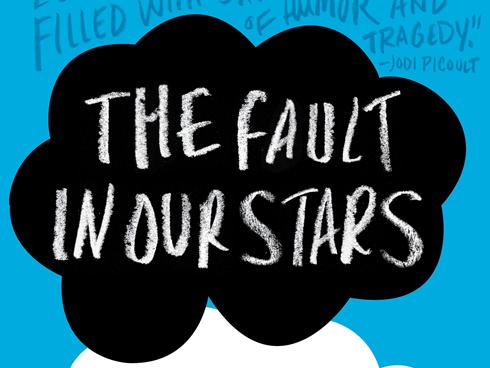
The new “it” movie that everyone’s talking about, based on John Green’s novel of the same title, is The Fault In Our Stars. Teenage girls have already lined up in theaters to weep their eyes out, jokes ensued. Others have already dismissed the movie as yet another teenage drama they will not bother with.
And here I am to tell you that “The Fault in Our Stars” is something worth giving a shot to. No, it’s not because it’s an epic love story that transcends time and place as movie or novel tag lines tend to say, but because it’s such a simple story in itself, told in a remarkably real way, that it can’t not resonate with you.
Popular culture has always found a way to turn cancer into a simple matter that entails losing one’s hair, vomiting in a bucket because of the chemo and ending up unscathed at the end. The truth of things, however, is anything but.
As someone whose mother battled the disease and survived, I know how it is to see someone get weakened by those treatments, seeing them waste in front of you because of the drugs saving their lives. As a medical professional, I know how it is to deliver cancer diagnosis to people. I know how it is to see children in front of you wearing a Superman cape as they exit their chemo sessions. It’s not Hollywood, it’s real life that happens every day right next to your workplaces and homes, in locations you don’t give a second look at.
“The Fault in Our Stars” gets cancer. It may not employ the most precise of medical jargon all the time, but its portrayal of cancer is one that I wouldn’t feel horrified reading. It tells the story of the disease the way it is. There’s no sensationalization, no glamorization, no poetic justice. It’s not full of errors, cliches and whatnot. It shows cancer the way it is: a disease that ruins lives, leaves people impaired and takes away loved ones. But a disease that doesn’t put life on pause.
The might of “The Fault in Our Stars” is in how it communicates the topic of cancer in the way that it does. Hazel Grace and Augustus Waters are not the cliche Hollywood fiction power couple going about their days as they await to be cancer free. They are not a saccharine representation of thyroid cancer or osteosarcoma. They are not people who just exist with cancer. The cancer stories of Hazel Grace and Augustus Waters are as real as a story of a relative you’d tell to a friend over coffee. This authenticity when it comes to the disease at hand is unparalleled. I’ve personally never seen it in fiction before. And it’s heart-warming to read.
It’s easy to dismiss “The Fault In Our Stars” as another cliche love story aimed at hormonal teenage girls and their pockets. Sure, marketing the movie and book as an out of the box love story is the surest way to ensure profitability, get girls and their tear ducts functioning in hyper-drive, but the story in itself isn’t just about love. It’s the story of two people who might as well have been patients at the hospital I’m working at and who could have been battling osteosarcoma or thyroid cancer.
The book also deals with the issue of teenage sex in a way that is so casual and yet so intimate at the same time. It tackles sex as it is: a reality. That’s a rare thing to read or watch currently, in a culture of either over-sexualization or lock it away and don’t talk about it. The book finds the middle ground between the two extremes and handles it exceedingly well.
“The Fault in Our Stars” is not a perfect book. Given the mania around it, it’s also beyond easy to dismiss it as a current fad that will fade away when the mania subsides, and perhaps it will. But as it currently stands, regardless of young love, death and getting susceptible people to weep uncontrollably, “The Fault In Our Stars” deals with old themes in a very new way. You may look at it as sick people in love, rendering it meaningless and silly. Or you can look at it as the lives of people who happen to be sick. I chose the latter because those lives are so realistically written they could easily jump off that page.
“The Fault In Our Stars” is not an easy read or an easy movie to watch. It may seem contrary to popular belief to believe so, but I – for one – had dismissed it straight out of the bat a few months ago when I first started hearing about it. I was very glad I gave that book a shot. It’s not a literary masterpiece but its topics are crucial for discussion. It’s the closest you’ll ever get, hopefully, to see such diseases in their most realistic forms. Such things exist. Be part of them, even if in fiction.
Lebanon’s parliament has failed yet again. It failed to elect a president for the Republic over the past 3 months. It failed again yesterday. It failed to secure the promised demands of Lebanon’s workers syndicate. And it will keep failing because that’s how our excuse of a legislative body functions.
10 minutes was all it took for this parliament to pass the law that extended its mandate for a year and half last year. This same parliament has failed to manage a two third majority for almost all of its sessions following our presidential election attempt, also read charade, back in early April.
The issue at hand is a debate worth having: rightful demands versus economic responsibilities. It’s also a debate that this country, where flashy headlines always take the cake, does not have the ability to hold. Our parliament, however, is not held back by the economic woes that such demands would hold. They’re held back by the typical political tug-of-war we’ve had for the past five years, if not more, and by them trying to come up with ways to circumvent having their properties taxed and finding ways for us to carry the burden of the workers’ demands.
In this ongoing war between Lebanon’s classes, the only entity lost in limbo is Lebanese students who have no idea what’s happening with them and their official exams, which will determine the course of their future.
Last week, Lebanon’s current minister of education postponed official exams by about a week in order to see what transpires from today’s parliamentary session. Perhaps it was a move to press on our legislators to see if they actually cared about the students. Well, if it were it turns out they don’t.
So what’s happening to those official exams now? The minister is saying that the students will go on and present those exams but the teachers will not correct, which begets the obvious question: what’s the point of holding exams if the papers are to sit in some warehouse, ink on paper without grades?
Our speaker of parliament, Nabih Berri, just announced as well that Lebanon’s current climate is not one where official exams can be held. Ladies and gentlemen, our country is a place, it seems, where holding exams is now a matter of national “climate,” which is the excuse given last year not to hold parliamentary elections. I wonder, when is the climate in this country ever suitable for things that should function seamlessly for them to do so?
Meanwhile, about 100,000 Lebanese students are falling hostage to the ongoing political bickering taking place in the country, their entire future in limbo. For the past two months, these students have been sitting at home studying and preparing for exams they didn’t even know would happen.
Can you imagine the amount of stress that these fifteen and seventeen year olds have to withstand not knowing what’s happening with them, having their exams postponed one minute and then not knowing if they’re taking place the next? We were lucky back then that our only worry was about passing, not about whether all the studying would actually culminate in an exam taking place or not.
Those 100,000 students, spread upon brevet, baccalaureate and technical eduction, will be stuck if those exams don’t happen. Those in brevet won’t pass to secondary classes. Those presenting their bac will not go to universities. What’s worse is that everyone knows this exceedingly well and still those students are used as a bargaining chip to advance rights or lack thereof. What’s even worse is that those 100,000 students have nothing to do with the issue at hand. Shouldn’t their future be off limits to the ongoing bickering?
It doesn’t matter where you stand regarding the demands of Lebanon’s syndicate of worker, but using Lebanon’s students and their future as a bargaining chip, keeping them hostage to the current situation is not something anyone should stand with.
This is a country without a president, without a decent functional working body, without legislation, without parliamentary elections, without security or sovereignty. But no worries everyone, our government is hard at work making sure you can watch the World Cup on Tele Liban. Yes, that’s what truly matters now. Forza Azzurri everyone.
Here’s another concept that it seems to be tough for Lebanon to grasp: sportsmanship.
For the second time in two consecutive games, Lebanon’s top 2 basketball teams were found at each other’s throats as the games they were playing ended. You’d think someone would have learned from the first round but it seems we were too foolishly optimistic. One can not hope for any form of civility in this country, even in sports.
The stories over what happened are numerous. The one that was relayed to me by a relative who was at the game is the following: Towards the end of the 4th quarter, when it was obvious that Sagesse had won and tied the tiers 2-2, the players had apparently an agreement to pass the remaining seconds with the score unchanged. Dewarik Spencer, Sagesse’s player, then decided to score a two-point basket at the last second which angered Lauren Woods, who plays with Riyadi, leading to an altercation between the two men as is obvious in the following video:
Subsequently, the very civil crowds attending the game decided to join in on the fun. Next thing you know, the players had joined in on the fighting while LBC’s Gayath was lost for words commenting on the absolutely beautiful scene in front of him. But does the story of the fight, regardless of sides, even matter?
A player participating in the beating
The fight, however, is not that of a simple two points scored.
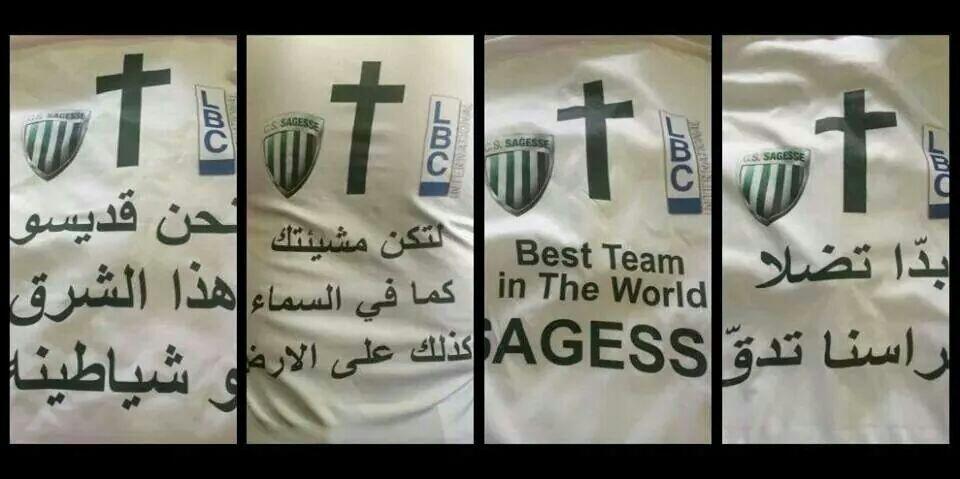
Prior to the game at hand, Sagesse’s fans were circulating the following picture online to flex their muscles. Who can beat them if Jesus was on their side?
These are Lebanese Forces Civil War headlines
The chants by Riyadi’s supporters at the previous game are the other side of the coin. It felt like 1997 all over again when the fights were a constellation of sectarian-political causes. Christians versus Muslims. Lebanese Forces persecuted as they were at the time versus Future Movement, then working with the Assad regime.
Our Lebanese time machine still works. We always find ways to put ourselves back in time, because who doesn’t like familiarity?
It’s weird how these two teams, belonging to two political parties that are currently in bed with each other, still manage to hate each other as much as they do. You can’t help but wonder what would have happened had Riyadi been a Shiite-centric party with Hezbollah funding? Count your lucky stars people the party of god has not ventured into basketball yet.
The main problem at hand is not that Lebanese Christians hate its Muslims (and vice versa) or that the Lebanese Forces and the Future Movement cannot eradicate the history both of them share by a few years of alliance.
The problem is that these problems, held at bay with Lebanon’s fragile politics, are finding their way to erupt at something as meaningless in the grand scheme of things as a championship basketball game. What do these people have left for when something major actually happens? Will they bring out their tanks and missiles and work their way through the argument then?
The problem is that our sports are so infiltrated with politics they’ve lost the true meaning of what sports should be: something to bring people together in a friendly competition. If you support Sagesse, one can assume with a high degree of accuracy that you are Christian and prefer the Lebanese Forces politically. If you support Riyadi, one assumes you’re Sunni and a fan of Hariri. Is that how it’s supposed to be? Isn’t sports about supporting the team you believe has the best game not the one which satisfies your sectarian itch?
The even bigger problem is that people are proud of the fights at hand. Sagesse’s supporters call Riyadi’s supporters tatar. The reverse is also true. If you check both teams’ Facebook pages, you will find a slew of hateful speech towards each other that struts the lines of sectarianism and civil war rhetoric quite proudly. Here are a few screenshots, with next to no voices of reason:
It hasn’t even been long since the world basketball federation lifted the ban on Lebanese basketball for the clear infiltration of the sector by our horrid politics. The many months the sector spent in limbo, not knowing whether it would be able to launch again or not, were not enough to teach anyone a lesson.
No one learned, fight after fight, that there’s a tangible need to raise ticket prices. No one learned that there’s a dire need for new regulations that limit politics and political money, effectively removing that extra player each team has on court. It’s not a surprise though that there are no lessons learned because since when do we as Lebanese actually do that?
Of the many things Lebanese pretend to have is an open mind, notably when it comes to those who are of a different sect. The catchphrase goes: welcome to the country where 18 sects live together peacefully. The reality is anything but. We pretend otherwise anyway.
Lebanese peace, fragile as it is, is always at the breaking point of a sect feeling threatened. Sometimes the mayhem that ensues is tangible, with guns and arms and black shirts. Other times, the mayhem is a scandal at a local school.
You’ve probably heard of SABIS by now. They have a bunch of well-renowned schools across the country and the region. They will also soon open a university in my hometown in Batroun. Education is what they do. Their tuition fees are steep and their students receive the best facilities possible. What SABIS also does is enforce the notion of secularity at its establishments and in doing so, it has gotten itself in some deep trouble.
A Christian Problem:
Recently, SABIS Adma issued new regulations that forbade religious signs from being displayed among students, unless such a sign was an obligation. Parents and students have therefore risen in uproar against the regulations that they believe unfairly targets Christians who wear Crosses around their necks while allowing Muslim girls who adorn the Hijab to continue wearing their religious garment at school. Crosses are meant to be worn under the vest. Hijabs can’t obviously be hidden.
This comes a couple of months after another regulation by SABIS which forbade students with an ash cross on their foreheads from attending classes on Ash Monday, at the beginning of lent.
There’s even a news report about the matter for you to check:
Half-Assed Secularism?
In typical Lebanese Christian fashion, the problem at SABIS got turned into yet another existential crisis that targets their existence in Lebanon. Do Christian parents and students have a point in being angry? Perhaps they do. Do they have a point in feeling like their entire presence is targeted in Lebanon because their children can’t flaunt a $1000 golden Cross? I daresay they don’t. In fact, on that particular point there’s a substantial amount of chill pills which need to be taken.
The regulations at hand, in delineating a clear difference between obligatory religious rules and non-obligatory rules, seem to be aimed squarely at those Christian parents and students. But is the comparison between the Cross and a Hijab a fair one to begin with with one being facultative in its religion and the other being obligatory?
There are other items worn by Muslims that could be forbidden with such regulations such as a necklace with the word Allah or a necklace with Ali’s Sword. But is the point of enforcing secularism at SABIS, whatever that means, ending up with a list of what to wear and what not to wear that is well accustomed to the religion their students were born in?
The problem at hand is that this notion of secularism at SABIS is half-assed at best. It’s like someone who has a foot in the door of modernity with all their other limbs staying outside, clinging to familiarity. You either enforce full secularism at your schools, affecting all students regardless of their religious obligations, which is how it happens in some European countries, or you ignore your students’ religious views by simply not caring whether they wear a Cross or an Allah pendant or a Hijab while not providing them with religion classes, facilities for prayer and whatnot.
SABIS‘ half-measures when it comes to their secularism emanate from their regional context with their schools in the Gulf not facing such a problem due to those countries’ demographics. But is applying regulations emanating from the Khaleej in Lebanon a good idea? Christian anger seems to indicate otherwise.
The problem with applying half-assed measures, with subtle nuances ignored, to a well-rooted Lebanese problem such as sectarianism is that it always brings out sectarian anger, regardless of how well the original intention of the proposal is. It’s easy to say why bother and to just leave things the way they are, but wouldn’t secularism at the school level at least help towards alleviating sectarianism at the national level with subsequent generations taking charge? And would a lacking notion of secularism, which pushes people towards adopting a sectarian speech, lead to the change we hope to have in Lebanon?
It’s ironic that when Lebanon attempts modernity, with neo-regulations at new-styled schools, the overall outcome turns out to be the same-old, same-old regression towards the us versus them mentality: cross versus hijab all over again. It really shows, doesn’t it, how far we are from actually becoming a modern nation where our children don’t go to school to flaunt their religious views, whether knowingly or unknowingly, where a school enforcing such a regulation is met with actual dialogue and where that precise us versus them mentality is buried way too deep for it to pop up at any given moment.
Back in my days, the point of going to school was to get an education, plain and simple, not to learn the art of provocation. It seems the former has become too mainstream these days.








 A Separate State of Mind | A Blog by Elie Fares