Midnight in Paris – Movie Review

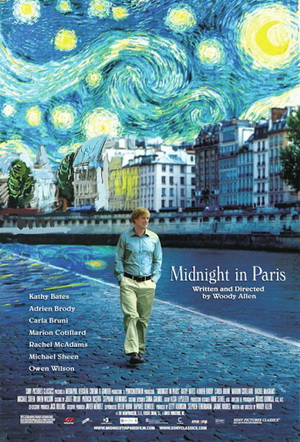
Presenting Woody Allen’s latest cinematic offering, Midnight in Paris is magical – be it in its plot or its effect on you as a viewer.

The moment the movie starts, you know you’re in for a ride. Flashing scenes from the breathtaking French capital, from Versailles to its rooftops. From the Louvres to les Champs-Élyséesit’s all there, to a backdrop of true Parisian music. That opening scene sets the tone of the movie: this is a feature from Paris, to Paris, about Paris. And it doesn’t disappoint.

Gil (Owen Wilson) is a highly successful Hollywood screenwriter on a vacation with his fiancée, Inez (Rachel McAdams) in Paris. Despite his job being very lucrative, Gil doesn’t feel satisfied. He is trying to write a novel about a man who works at a nostalgia shop and has no idea why he can’t truly connect with what he’s writing. He feels out of place in the the world of 2010. His dream world is a rainy 1920’s Paris. Inez disagrees.

On one fateful night, as a Parisian clock strikes midnight, a slightly drunk Gil hops in an old-fashioned peugeot that takes him to meet people he had never thought he’d meet: Scott F. Fitzgerald, Ernest Hemingway, Cole Parker, etc… He sits with these giants of his favorite epoque and discusses with them his life, his hopes, his fears. He also meets Gertrude Stein (Kathy Bates) who gives him some valuable advice about his novel. And while in her study, he looks at Pablo Picasso painting his mistress Adriana (Marion Cotillard).

A relationship soon develops between Adriana and Gil, as he “time travels” to see all of his idols night after night, all after the clock chiming midnight.

Owen Wilson delivers a credible performance as an aspiring novelist, trying to find who he is in the world. His performance is nuanced, especially when he comes off as goofy as he admires his idols of the past. He embodies the Woody Allen-persona to a great extent, as it is the case with most Woody Allen movies that the protagonist is an extension of himself.

But the person that shines the most in this movie is – naturally – Marion Cotillard. Whenever she’s on screen, she steals the scene. It could be her splendid beauty, but I’m sure it’s more her superb acting that doesn’t come off as acting at all. She’s oozing sultriness while staying grounded. She radiates sexuality but manages to be conserved. Just place Cotillard in her natural French element and she’ll give you a tour-de-force breath-taking performance. In a way, she knows how great she is. But she doesn’t dwell on it. She knows she’s stealing every second she is on screen, but she doesn’t let it get to her head, similarly to the city Woody Allen chose to center his movie around.

Other interesting appearances in the movie are made by Carla Bruni, current French president Nicolas Sarkozy’s wife, as a museum curator whom Gil asks: “Do you think it’s possible to love two women at the same time?,” and while Woody Allen has recurrent elements to his movies about infidelity, gorgeous women, etc… his treatment of those themes in “Midnight in Paris” comes off as fresh and sweet, probably helped by the backdrop he uses.

Gad Elmaleh, infamous Moroccan-French comedian, makes a brief appearance as a private detector hired by Inez’s father to check on Gil and his midnight Parisian wanderings.

And out of all the performances by the first rate actors and actresses, it’s Rachel McAdams that comes out short, simply because she has the most underdeveloped character out of the bunch. McAdams gives her best to bring life to her character but to no avail, as Inez ultimately comes off as materialistic.

At the end of the day, “Midnight in Paris” is Paris. It bewitches you, enthralls you, takes you on a magical journey you will not forget. It’s not set in stone, like most of Woody Allen’s movies. Its ending is not resolved, it’s left to be discovered… the purpose of the movie is not to provide answers, as much as to give a general perspective. The movie does give the viewer one message though: live your life fully in your time – there will always be times you think are better. But your time is now.

The Lion King (3D) – Movie Review

This is probably the toughest movie review I have to do. Simply because there’s no way you can judge Lion King without being substantially biased. After all, out of all the movies I’ve reviewed so far, this is probably the one that has been around with me the most.

Back when it was first released in 1994, I remember obsessing over Timon, Pumba and Simba. Five year old me had those drinking cups with figurines on top from which you nuzzled water or juice. I remember also buying a $20 book filled with pictures from the movie, retelling the story. That book passed away soon after due to my overwhelming interest in the pictures and some accidental water damage.

I also remember being amazed by the scene when Mufasa appears to Simba towards the end of the movie to remind him who he truly is. And five year old death-ignoring me had no idea what that meant. So my parents’ explanation was: his father was alive all this time, taking care of him without Simba knowing.

Yes, there’s a lot of history in all our lives that revolves around The Lion King. If there’s one Disney movie that touched generations, it’s this one. Hakuna matata, anyone?

So it was with childish glee that I went to the movie theatre with my friends Elia and Paul to watch the 3D re-release of this movie. In my head, any 3D re-release is a shameless way to make money out of an already lucrative movie. And naturally, being the sucker that I am for such sentimentalies, I couldn’t resist. After all, who could resist watching The Lion King – or any Disney movie from your childhood for that matter – in full surround sound, on the big screen, in a movie theatre, which is something most of us didn’t get the opportunity to do, becoming stuck with worn out video cassettes that got played over and over again?

The moment the opening music starts – that deafening shriek that should be trademarked – you know you’re in for a ride. I will skip the usual plot framework that I do in my reviews because I believe whoever ends up reading this has watched the movie at least forty five times in their lives, six of which are in the recent five years. Therefore, no need for me to reiterate the obvious.

And the ride continues. You listen to songs like “Circle of Life” and you can’t help but feel all warm and fuzzy inside. Yes, apparently Disney still has that effect on me. (I’m pretty sure it has that effect on you too. Admit it. Now.) As the movie proceeds, the 3D in it appears seamless. It doesn’t jump out at you like in movies where 3D was a last minute post-production decision to bring in more money.

The surround sound experience of The Lion King was a revelation of how absolutely kick ass the music in it is. Yes, I used that terminology. And you would too if you got goosebumps every time that somber music plays. We’ve all grown to appreciate the music in The Lion King. But it wasn’t as obvious – at least to me – as it was when I watched it with a full blown sound system.
And let me tell you, The Lion King is a very witty movie. I never knew there were so much jokes in it, most of which are uncannily smart. It could be that all my previous screenings of the movie were via my French-dubbed version, but this was another revelation for me.

Do I recommend you going to watch the movie about the coming of age of the innocent cub as he transforms into a lion? Absolutely. Why? Because out of all the other options of movies at your local theatre, this is the only movie from which you are guaranteed to come out with a grin. Out of all those movies, this is the only one where a twenty five year old guy sitting next to you would be singing along to Hakuna matata. And yes, you would be too. And out of all those movies, this is only one that will touch you the same way it did when you first watched it seventeen years ago.

The Lion King is a timeless movie that transcends generations. It is a tale about survival, betrayal, importance of family and love. It is a tale that ought to stay with us every day of our life. It is a movie that doesn’t shy away from hurt – even if it is masked often by protective parents and their explanations. The Lion King is a movie for the ages. And we are lucky we happened to be those ages.

For your general info, my favorite Disney movie ever, Beauty and the Beast, will be re-released in 3D on January. Yes, I’m uber excited too.

Nadine Labaki’s New Movie: Where Do We Go Now (W Halla2 Lawein) – Review

Lebanese cinematic talent has not been given much room to grow. In a country where art is the least concern, cinema has found it especially hard to take off. However, a stream of Lebanese movies has been finding its way to our theaters. Some like Nadine Labaki’s previous movie, Caramel, were a huge hit with viewers. Others were not as lucky.

But the fact remains that the Lebanese audience is hungry for movies that describe its society, its problems, its worries and woes.

And then comes Nadine Labaki’s new movie: Where Do We Go Now, with its Lebanese title: W Halla2 La wein (also in French: Et Maintenant, On Va Ou?)

The premise of the movie is quite simple – and for many Lebanese, worry-inducing for fear of overuse of cliches. The overall basis of the plot is the coexistence of Lebanese Muslims and Christians in one community, sometimes peacefully and other times not. Many, like yours truly, felt the issue was overdone. Maybe not in cinema but in everyday life. Most of us are sick of being bombarded with commentary about the struggles that face our very diverse community. But this is not the case in Where Do We Go Now.

An unnamed village during the later part of the 20th century has its only connection with the outside world in the form of a very rudimentary bridge, around which landmines had been planted and never removed. Even TV reception is very poor to the village and the movie begins with a few youngsters searching for a broadcast signal to set up a TV night for the town-folks. This village is also a religiously divided community where the Church and the Mosque are only a house apart. And more often than not, the people live together happily.

But as it is, and despite barely having any access to news from the outside world, the men of this village start to confront each other in violent ways. Little things that would pass unnoticed cause them to explode, signaling the anger they’ve been bottling in. And it is then that the few women of the village start to devise plots to keep the men busy, entertained and get their minds off being violent. These plans will vary from fake miracles to putting hashish in cakes. But these women will go to every measure possible and break every limit imposed on them by society to keep their town together. And it is for these women, representing a vast majority of our Lebanese mothers, that this movie is so aptly dedicated.

Nadine Labaki, director of the movie and starring as Amal, is astonishing as always. You, really, cannot see her eyes on screen and not be mesmerized. She’s simply entrancing, even when she doesn’t speak. Then how about when she delivers a tour de force performance as one of those women, who happens to be in love with a man from the town’s other religion. But to be perfectly honest, the accolades one ought to give Labaki are not for her acting but for her directing. Never have I imagined a Lebanese movie can turn out this good and she makes it seem effortless. Her camera shots, her focus on details, her keen eye… all of this combine to give you a cinematic experience that will entrance you.

This movie, like Caramel, features mostly unknown faces and all of them deliver as well. It is hard to believe – and yet in retrospect so evident – that such acting can come out of common people that we all meet on the street. Where Do We Go Now is a movie of such epic proportions that these “unknown” actors and actresses (mostly actresses) deliver performances that are so subtly nuanced, so exquisitely flavored and so astonishingly well-done that they would put the best actresses and actors of Hollywood to shame. Yes, I have said it.

The score of the movie is chilling and haunting and wonderfully executed by Nadine’s husband Khaled Mouzanar. The movie also features a few highly intelligent songs, written by Tania Saleh.

And let’s talk about the script. What an ingenious way to tackle the subject at hand. Not only did Nadine Labaki not fall to any cliche known to us as a Lebanese community, but she managed to introduce them in a subtle comical way that would make us laugh at ourselves for uttering or doing them in the first place. The script is so strong it will turn you bipolar. Yes, lithium is advised to be taken at the door while going in. Why? Never have I laughed so hysterically one moment and just wanted to cry the other. And then after being utterly devastated, it brings you back to laughter. The movie plays with you like a ping pong ball. And you cannot but love every moment of it.

I was talking to my friend Elia the day before we went to watch Where Do We Go Now, which happened to be the day it won the People’s Choice Award at the Toronto Film Festival, and she said: “Elie, I’m very cautiously optimistic about this. I’m not letting my expectations overreach because I don’t want to be disappointed.” Well, I’m pretty sure Elia agrees with me on this: Where Do We Go Now brings out things in you that you didn’t even know you had. It brings out the best in you, as a Lebanese, sitting in that cinema chair for ninety minutes. And you need the best of the best to do that. Nadine Labaki, you deserve more than the few minutes of applause the people in the movie theater gave you. You deserve a full blown standing ovation. You have done the impossible. Again. Lebanese cinema has no excuse but to overreach for excellence now. And this movie deserves an Oscar win. Cheers to our mothers.

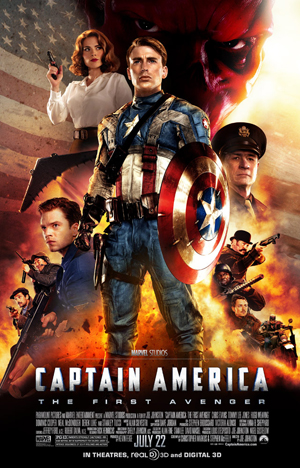
Captain America: The First Avenger – Movie Review

Having nothing planned on a Saturday night, my friends and I found ourselves going to the movies with this being as the only viable movie choice available.

Set in 1942, the movie stars Chris Evans as Steve Rogers, a disease-ridden and poor built American wanting to serve his country. Steve attempts to enroll the army many times, under different names and different hometowns, and gets refused every single time. On the eve of his best friend reporting for duty, Steve is overheard by Dr. Abraham Erskine (Stanley Tucci) and is taken to a special training program. There, he proves to be the best candidate for the secret project the government is preparing, not because of his physical built but because of his great heart. The project turns out to be a set of injections with a serum that will transform Steve into a superhuman.

At the same time, Johann Schmidt, a Nazi officer, invades a town in Norway and steals an artifact with untold powers that he starts harnessing in building weapons. And soon enough, it’s up to Steve Rogers, who becomes known as Captain America, to stop Johann Schmidt.

Captain America is nothing groundbreaking. But it has heart. It’s rare to see a superhero movie where the main protagonist is unaware of his own power. The vulnerabilities of Steve Rogers’ weaker self are transmitted to his stronger self. And that is refreshing to see on screen: a superhuman who is, at the end of the day, human and weak and vulnerable.

Moreover, there’s an artistic tint to Captain America that you cannot help but notice. The movie feels like it was produced with old-fashioned craftsmanship: the movie cinematography feels associated with the era in which the events take place. After all, the plot is a retrospective view, similarly to X-Men: First Class.

The performances in the movie are nothing over the top but they do not underwhelm. And after all, a movie featuring both Stanley Tucci and Tommy Lee Jones cannot be that bad – no matter how hard it tries. And no, Captain America does not try to be bad.

The plot might be color-by-number, especially with the overdose of superhero movies that Hollywood keeps throwing at us, but unlike other superhero movies, this one is charming. Sure, it doesn’t come close to greatness like The Dark Knight but it holds its own and manages to entertain you at the same time. The action sequences are nothing extraordinary but they are very well done and complement the plot without overdoing it, like superhero movies tend to do.

At the end of the day, Captain America is a breath of fresh air and an enjoyable cinematic experience that will entertain you for the duration of the movie, serving as a good prequel to next year’s The Avengers. You will love the innocence and the genuine characters it portrays. At the beginning of the movie, and part of why Dr. Abraham Erskine takes on Steve for his project, he asks Steve: “do you want to kill Nazis?” to which Steve replies: “I don’t want to kill anyone. I just don’t like bullies.” And that’s precisely where this movie differs from other superhero flicks: the ultimate message it attempts to convey. The 3D in it, however, is mostly useless.

Nadine Labaki’s New Movie, Where Do We Go Now (W Halla2 La Wein), Wins Best Film at Toronto Film Festival

Lebanon, WE REPRESENT! Finally!

Nadine Labaki’s new movie, set for a Thursday release in Lebanon, has shocked everyone by winning the People’s Choice Award for best movie at the Toronto Film Festival. To put this in perspective, Slumdog Millionaire and The King’s Speech won this award before their Academy Award rampage.

This festival is renowned for picking movies that end up winning big in award shows, so my hope for a Lebanese nomination for Nadine’s movie at the Oscars has suddenly exponentially increased.

Telling the story of the women of a closely-knit town, where people of both Christian and Muslim faith coexist, trying to keep their town united, the movie debuted at Cannes without winning anything there. However, it came out on top at this festival beating other movies like George Clooney’s The Descendants, thought by many to be his best work to date and Sundance winner Like Crazy.

Is anyone suddenly more excited than they could possibly be to watch the movie Thursday? Cause I sure can’t wait for Thursday to come.

And if the movie is as good as some Lebanese who already watched the movie in Paris are saying, I think we’re all in for a treat.


For my review of the movie, click here.