Wildflower (Album Review) – Lauren Alaina

Lauren Alaina’s greatest challenge with her debut album was to deliver something that represented both her young age, appealing to listeners her age, and to which older listeners could also relate.

With the release of her first album, Wildflower, she does just that. Showcasing her young, vibrant personality, she doesn’t shy away from discussing complex themes. Her approach to the love theme is not just fairytales and princes à la Taylor Swift, the soulfulness of her voice adds depth to all her songs.

The album opens up with a highly catchy uptempo and Lauren’s second single “Georgia Peaches,” her ode to her home state’s girls. “Well, our shorts a little shorter,” she sings, “’cause the sun’s a little hotter, sippin’ lemonade while we’re playing in the water. Ain’t nothing sweeter than us Georgia peaches.”

She proceeds with the midtempo “Growing Out Her Wings,” where she sings playfully about growing up in the shade of overprotective parents, without being overly critical about it. In fact, she doesn’t criticize. She sings how they got “her whole life on lockdown, doing time behind her bedroom door… dreaming ’bout the girl she’s gonna be, growing her wings.”

The third song is “Tupelo,” a well written remembrance to a summer road trip with a loved one, all the way down to Tupelo. While Lauren needs a few years to nail the sultriness of the chorus, she will definitely get there. And “Tupelo” remains a very enjoyable song.

The album then proceeds to a a very inspirational ballad called “The Middle” about making the best of the time you have. It is the album’s first track where Lauren Alaina’s emotions shine as she tries to convey the message she’s beginning to learn herself. And she does convey the message at hand, which makes the overall feat even more impressive. “The day you’re born is a start,” she sings, “your last breath is a question mark. The story of your life is in the in between.”

Like My Mother Does” is the album’s first single, released soon after the American Idol finale and it is about a girl being thankful to her mother. It is a highly emotional song that is bound to get anyone smiling, with their mother’s face flashing before their eyes. “When I love, I give it all I’ve got like my mother does. When I’m scared, I bow my head and pray like my mother does. When I’m weak and unpretty, I know I’m beautiful and strong because I see myself like my mother does.”

The album’s title is based on the song “She’s a Wildflower,” an uptempo about a girl that did not fit in, dreading going on with her life because of the taunting, not knowing that “she’s a wildflower, just waitin’ on the winds of change to blow.”

On the uptempo “I’m Not One Of Them,” Lauren Alaina is telling the boy she wants to date that many girls “might fall for what you got but I’m not one of them.”

And then comes one of the album’s true highlights and a song that will leave you mesmerized: “The Locket.” “Back in ’41, you met a brown-eyed boy, who called you pretty,” she sings. “He’d walk every day, couple miles out of his way to hold your hand and keep you company… he gave you his picture in a locket that you wore around your neck. Left it right beside your heart so you would not forget the way it felt when he held your hand.” The song then proceeds, two years later, and the boy left for war, swearing he’d marry the girl and as she cried while he rode away, she clutched the picture in her locket so she wouldn’t forget how he kissed her, how he spent time with her. 60 years later, the girl is struggling to remember. She’s a grandmother now, her granddaughter by her side writing down her memories of the man she spent 60 years with and who left her two month prior. “And it breaks my heart to see you struggle to remember. I’ve been writing your memories down and I stopped by today to read a couple pages. Grandma, you sure look pretty. And you smiled that smile, the one I haven’t seen in a quite a while. And you said to me I want you to keep his picture in the locket that I wore around my neck, the one I left beside my heart so I wouldn’t forget…”

Following up “The Locket” is the album’s second highlight, the Carrie Underwood co-written midtempo: Eighteen Inches,” about a young couple who elopes to California. “Eighteen Inches” delivers the album’s strongest hook in the form of the chorus: “Cause when you’re young and in love, you might do some things that don’t seem all that smart. Cause there ain’t no greater distance than the eighteen inches from your head to your heart.” The song features Carrie Underwood’s preferred narrative style of having three parts to the story in three different verses. And while the song wouldn’t have worked for Carrie’s albums, it sure works for Lauren. She doesn’t romanticize their decision. She doesn’t judge them either, which is surely helped by the lyrics. But Lauren’s delivery helps as well. It is Lauren’s youthful innocence that colors this song.

“Eighteen Inches” is followed up by the uptempo “One of the Boys” where Lauren Alaina lays our her preference: “he ain’t too pretty, he ain’t too sweet. A little rough around the edges, cute and country just like me. One of those t-shirt, blue jean wearin’, riverside Saturday night and Sunday mornin’ church kinda goin’ boys.”

“Funny Thing About Love” is a song co-written by Lauren Alaina. Co-writer Luke Laird and Brett James said how she came to them and wanted to write a song about how complicated love can be for her age: “you used to want me but I didn’t want you. Now I want you but you don’t want me. Why can’t our two hearts just make up their minds and want the same thing at the same time.” What’s interesting about this song is Lauren Alaina’s candid approach to the topic at hand. At one point, she sings: “we were best friends until I kissed you. You know you liked it and I did too. As soon as you admit you’re crazy about me, I’m off and running…” While the first verse is the weakest part of the song, Lauren’s conviction while singing it is enough to deliver this song.

And the album concludes with “Dirt Road Prayer,” a prayer to a girl’s family members: her mother, father, brother, grandfather… There’s an element of vulnerability to this that makes it a highlight. It’s a reach out to those family members to feel close again. It’s a reach out to God so He protect them.

Wildflower” is a very strong album. Debut or no debut. Many country artists, regardless of age, would readily give an arm or a leg to have the caliber of songwriters and artists that worked on Lauren Alaina’s album. Her talent shines through on each track and gives the listener – regardless of age – a highly joyful experience that will fluctuate between getting you emotional to making you smile. The album is safely country-pop. It has a healthy dose of both. Those who watched American Idol will recognize Lauren Alaina’s personality on the album. Those who have not will hear a strong young lady, who knows what she wants and who knows exactly where she wants her career to go. Her songs are rooted in reality. They revolve around friend, family, heartache.

If this is an indication of how Lauren Alaina’s career will unfold, I think country music listeners are in for a treat.

Eighteen Inches (Lyrics) – Lauren Alaina [Written by Carrie Underwood]

These are the lyrics for the song Eigtheen Inches, written by Carrie Underwood, and featuring on Lauren Alaina’s upcoming debut album: Wildflower. For the album’s review, click here.

It’s about fifteen hundred miles to California,
they’ll get there Friday if they leave tonight,
she sneaks out at three thirty in the morning,
leaves a note so she won’t see her daddy cry.

He cuts the engine when he coasts in the driveway,
she slides in and gives him one kiss for the road,
no friends and no family, no job out there waiting,
the whole town will call them crazy but they gotta go.

‘Cause when you’re young and in love, yeah,
you might do some things that don’t seem all that smart,
’cause there ain’t no greater distance than the eighteen inches from your head to your heart, yeah.

They can barely make rent on a rundown apartment,
she’s waiting tables and he’s a valet,
they’re behind on the bills and the car’s barely running,
but he buys a ring with the tips that he’s saved.

When you’re young and in love, yeah,
you might do some things that don’t seem all that smart,
’cause there ain’t no greater distance than the eighteen inches from your head to your heart.

Last thing they need is another mouth to feed, but they want one,
just kids themselves but that’s all to change in nine more months,

she wakes him up at three thirty in the morning,
ready or not their new life’s going to start,
seven pounds and eighteen inches,
the doctor lays that new baby’s head right on her heart.

When you’re young and in love, yeah,
you might do some things that don’t seem all that smart,
but thank God for those eighteen inches,
the distance it is from your head to your heart, yeah, yeah, yeah.

I have to say I’m very impressed. Carrie is telling a story here without taking sides: she doesn’t showcase the pregnancy in a positive light, which would have turned this song into a saccharine love song and she doesn’t condemn it, making it preachy. On the contrary, she’s simply narrating a segment of someone’s life and uses beautiful imagery to do so, mostly revolving around the double meaning of eigtheen inches.

Favorite line?

“Cause there ain’t no greater distance than the eighteen inches from your head to your heart” – Lyric GOLD!

The song is not out yet but listen to a live version:

We Found Love (Single Review) – Rihanna

Rihanna keeps churning these singles and albums, faster than any market can contain them. Wasn’t it less than a year ago that she released her most recent album, Loud!, and aren’t we being bombarded with her most recent single Cheers (Drink To That) on radio as I’m writing and you’re reading this?

Well, no matter… she’s ready to release yet another album, set for a November 21st release date and she has teamed up with Calvin Harris to deliver the lead single off the album, a club-banger titled: We Found Love.

“Yellow diamonds in the light And we’re standing side by side,” she sings to an electropop beat behind her. “As your shadow crosses mine, what it takes to come alive. It’s the way I’m feeling I just can’t deny… But I’ve gotta let it go.” And then she breaks into the chorus.

What’s the chorus, you might ask? It’s just one sentence. But unlike Lady Antebellum’s We Owned The Night, she doesn’t say it only once. She repeats the sentence four times. The sentence in question: “we found love in a hopeless place.”

The song’s second verse goes as follows: “Shine a light through an open door, love and life I will divide. Turn away cause I need you more. Feel the heartbeat in my mind. It’s the way I’m feeling I just can’t deny… But I’ve gotta let it go”

Insert repeat chorus.

So it’s needless to say that there’s not really much lyrical backbone for We Found Love to go on. What the song relies on is, however, some very tight production that gives you a result that is nothing short of incredibly catchy, with a great beat to go with it.And that’s pretty much it with We Found Love. It’s a dance song that is sure to become a radio hit. After all, almost anything radio friendly that Rihanna releases finds itself in the highest possible rotation on radio – no matter how frequent her releases come to be.

Will you be blasting this in your car on repeat? I don’t think so – well, unless this is your kind of music. Will it be blasted in night clubs across the world on repeat? Yes, it will. And at the end of the day, it’s not really a bad song. There’s just not much substance going for it. And in a time where pop radio is slowly changing, one wonders why Rihanna did not wait longer and release something with more power. After all, the fact that Adele’s Someone Like You is exploding on radio and Lady Gaga’s You and I is also doing well, as well as Lady Antebellum’s newly released (to pop radio that is) Just a Kiss, should be indicative enough that change is on the horizon – and it’s not just because of the names associated with those songs.

Maybe Rihanna’s label should stop making her their only viable source of income and give her some room to breathe. God knows it’d be good for her and us.

But I need to repeat this… We Found Love is not a bad song. It’s just same old, same old.

Listen to We Found Love here

Nadine Labaki’s New Movie: Where Do We Go Now (W Halla2 Lawein) – Review

Lebanese cinematic talent has not been given much room to grow. In a country where art is the least concern, cinema has found it especially hard to take off. However, a stream of Lebanese movies has been finding its way to our theaters. Some like Nadine Labaki’s previous movie, Caramel, were a huge hit with viewers. Others were not as lucky.

But the fact remains that the Lebanese audience is hungry for movies that describe its society, its problems, its worries and woes.

And then comes Nadine Labaki’s new movie: Where Do We Go Now, with its Lebanese title: W Halla2 La wein (also in French: Et Maintenant, On Va Ou?)

The premise of the movie is quite simple – and for many Lebanese, worry-inducing for fear of overuse of cliches. The overall basis of the plot is the coexistence of Lebanese Muslims and Christians in one community, sometimes peacefully and other times not. Many, like yours truly, felt the issue was overdone. Maybe not in cinema but in everyday life. Most of us are sick of being bombarded with commentary about the struggles that face our very diverse community. But this is not the case in Where Do We Go Now.

An unnamed village during the later part of the 20th century has its only connection with the outside world in the form of a very rudimentary bridge, around which landmines had been planted and never removed. Even TV reception is very poor to the village and the movie begins with a few youngsters searching for a broadcast signal to set up a TV night for the town-folks. This village is also a religiously divided community where the Church and the Mosque are only a house apart. And more often than not, the people live together happily.

But as it is, and despite barely having any access to news from the outside world, the men of this village start to confront each other in violent ways. Little things that would pass unnoticed cause them to explode, signaling the anger they’ve been bottling in. And it is then that the few women of the village start to devise plots to keep the men busy, entertained and get their minds off being violent. These plans will vary from fake miracles to putting hashish in cakes. But these women will go to every measure possible and break every limit imposed on them by society to keep their town together. And it is for these women, representing a vast majority of our Lebanese mothers, that this movie is so aptly dedicated.

Nadine Labaki, director of the movie and starring as Amal, is astonishing as always. You, really, cannot see her eyes on screen and not be mesmerized. She’s simply entrancing, even when she doesn’t speak. Then how about when she delivers a tour de force performance as one of those women, who happens to be in love with a man from the town’s other religion. But to be perfectly honest, the accolades one ought to give Labaki are not for her acting but for her directing. Never have I imagined a Lebanese movie can turn out this good and she makes it seem effortless. Her camera shots, her focus on details, her keen eye… all of this combine to give you a cinematic experience that will entrance you.

This movie, like Caramel, features mostly unknown faces and all of them deliver as well. It is hard to believe – and yet in retrospect so evident – that such acting can come out of common people that we all meet on the street. Where Do We Go Now is a movie of such epic proportions that these “unknown” actors and actresses (mostly actresses) deliver performances that are so subtly nuanced, so exquisitely flavored and so astonishingly well-done that they would put the best actresses and actors of Hollywood to shame. Yes, I have said it.

The score of the movie is chilling and haunting and wonderfully executed by Nadine’s husband Khaled Mouzanar. The movie also features a few highly intelligent songs, written by Tania Saleh.

And let’s talk about the script. What an ingenious way to tackle the subject at hand. Not only did Nadine Labaki not fall to any cliche known to us as a Lebanese community, but she managed to introduce them in a subtle comical way that would make us laugh at ourselves for uttering or doing them in the first place. The script is so strong it will turn you bipolar. Yes, lithium is advised to be taken at the door while going in. Why? Never have I laughed so hysterically one moment and just wanted to cry the other. And then after being utterly devastated, it brings you back to laughter. The movie plays with you like a ping pong ball. And you cannot but love every moment of it.

I was talking to my friend Elia the day before we went to watch Where Do We Go Now, which happened to be the day it won the People’s Choice Award at the Toronto Film Festival, and she said: “Elie, I’m very cautiously optimistic about this. I’m not letting my expectations overreach because I don’t want to be disappointed.” Well, I’m pretty sure Elia agrees with me on this: Where Do We Go Now brings out things in you that you didn’t even know you had. It brings out the best in you, as a Lebanese, sitting in that cinema chair for ninety minutes. And you need the best of the best to do that. Nadine Labaki, you deserve more than the few minutes of applause the people in the movie theater gave you. You deserve a full blown standing ovation. You have done the impossible. Again. Lebanese cinema has no excuse but to overreach for excellence now. And this movie deserves an Oscar win. Cheers to our mothers.

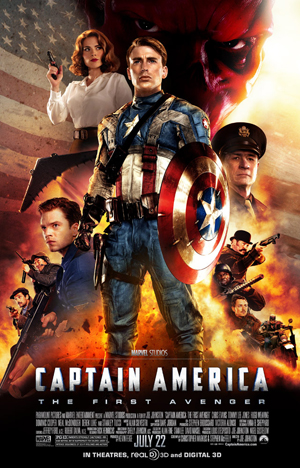
Captain America: The First Avenger – Movie Review

Having nothing planned on a Saturday night, my friends and I found ourselves going to the movies with this being as the only viable movie choice available.

Set in 1942, the movie stars Chris Evans as Steve Rogers, a disease-ridden and poor built American wanting to serve his country. Steve attempts to enroll the army many times, under different names and different hometowns, and gets refused every single time. On the eve of his best friend reporting for duty, Steve is overheard by Dr. Abraham Erskine (Stanley Tucci) and is taken to a special training program. There, he proves to be the best candidate for the secret project the government is preparing, not because of his physical built but because of his great heart. The project turns out to be a set of injections with a serum that will transform Steve into a superhuman.

At the same time, Johann Schmidt, a Nazi officer, invades a town in Norway and steals an artifact with untold powers that he starts harnessing in building weapons. And soon enough, it’s up to Steve Rogers, who becomes known as Captain America, to stop Johann Schmidt.

Captain America is nothing groundbreaking. But it has heart. It’s rare to see a superhero movie where the main protagonist is unaware of his own power. The vulnerabilities of Steve Rogers’ weaker self are transmitted to his stronger self. And that is refreshing to see on screen: a superhuman who is, at the end of the day, human and weak and vulnerable.

Moreover, there’s an artistic tint to Captain America that you cannot help but notice. The movie feels like it was produced with old-fashioned craftsmanship: the movie cinematography feels associated with the era in which the events take place. After all, the plot is a retrospective view, similarly to X-Men: First Class.

The performances in the movie are nothing over the top but they do not underwhelm. And after all, a movie featuring both Stanley Tucci and Tommy Lee Jones cannot be that bad – no matter how hard it tries. And no, Captain America does not try to be bad.

The plot might be color-by-number, especially with the overdose of superhero movies that Hollywood keeps throwing at us, but unlike other superhero movies, this one is charming. Sure, it doesn’t come close to greatness like The Dark Knight but it holds its own and manages to entertain you at the same time. The action sequences are nothing extraordinary but they are very well done and complement the plot without overdoing it, like superhero movies tend to do.

At the end of the day, Captain America is a breath of fresh air and an enjoyable cinematic experience that will entertain you for the duration of the movie, serving as a good prequel to next year’s The Avengers. You will love the innocence and the genuine characters it portrays. At the beginning of the movie, and part of why Dr. Abraham Erskine takes on Steve for his project, he asks Steve: “do you want to kill Nazis?” to which Steve replies: “I don’t want to kill anyone. I just don’t like bullies.” And that’s precisely where this movie differs from other superhero flicks: the ultimate message it attempts to convey. The 3D in it, however, is mostly useless.