After publicly beating her up, right at the doors of her embassy, Mahfouz dragged his Ethiopian maid into his car and out of sight. The government had noticed the event and is now working to bring the man to court. But what good is it for that woman and her family back in her home country?
Mr. Mahfouz and his family created such an unstable work environment for the Ethiopian maid, whose name we still don’t know, that she drank detergent in an attempt to kill herself. That attempt was thwarted, leading to him beating up her in front of the embassy and somehow, in an interview conducted with LBC, he put the blame on the maid, denying he had even beaten her up. As if videos actually lie.
This Ethiopian maid’s death will, unfortunately, go in vain simply because there are a lot of people in Lebanon who share the same mentality as Ali Mahfouz, who see these Ethiopian (and other nationalities) maids as their “slaves,” who see nothing wrong in abusing them, be it by overworking them, beating them up, verbally abusing them, banning them from contacting their families…. Many simply don’t see them as human being. They don’t see them as people who, like us, have their own story in life, who have a voice and who need people to hear that voice.
Do you want to help me make the voices of maids heard? Then get aboard The Lebanese Help. If we manage to stop one family from being this abusive to their maid, then we can deem the plan a success.
Johny Maalouf is a Lebanese contestant who recently made it to the second round of the newly launched French version of the American TV Show The Voice, La Plus Belle Voix, airing on TF1. Leave it to the French to make a two letter title a whole phrase.
The premise of the show consists of three phases: a blind audition where the contestant sings with the judges having their chairs turned away from him (this is the phase Jhony got past). The second phase is called the battle phase where contestants face off in duets and the third phase is the live performances show, which is judged according to audience voting.
Jhony still has a long way to go and it’s our duty as Lebanese to support him. He’s actually quite good, although he seemed very nervous (and justifiably so).
Good luck to Mr. Maalouf on his future progression on “La Plus Belle Voix.”
Left: Michel Aoun, center: Patriarch Raï, right: Samir Geagea
When it comes to the Maronite Patriarch, Bechara Al Raï, I feel I have to be extra careful. The line between criticizing the individual and his stances is very thin and it is one I do not want to cross because he is, first and foremost, the head of a Church I feel proud to be part of for various reasons.
The leading Maronite politicians in Lebanon have found themselves at opposite sides of the aforementioned line. Being very kind-hearted, I’ll assume the line is very blurry for proper discrimination. But don’t be fooled, there’s a very important distinction between the stances Samir Geagea took regarding the current Patriarch and those adopted by Michel Aoun towards the former one.
The year is 2005.
Michel Aoun is preparing a parliamentary bid with an almost exclusively Christian coalition of political forces. At the end of May 2005, Aoun has gotten a sizable portion of the Christian votes – 70% in some areas. The patriarch at the time, Nasrallah Sfeir, had openly endorsed Aoun for trying to bring Christians together under a political idea that was, at the time, opposite to the alliance that included Hezbollah.
The year is 2006.
Michel Aoun signed an agreement with Hezbollah as the latter slowly drifted away from the electoral alliance it had forged a few months earlier. The agreement served to create a “Christian cover” for Hezbollah’s arms. It backfired. Aoun’s popularity began to slip, whether his followers like to admit it or not. The patriarch, following the political doctrine Bkerke has always been known for, began to criticize Aoun’s drastic shift in political positions. Subsequently, Aoun began to attack the patriarch both on personal and political levels. The attacks ended in 2011 when Sfeir resigned and Bechara Al Raï took over.
The year is 2012.
Samir Geagea is being interviewed on a political talk show, Bi Mawdou3iye, on MTV. He declares that the recent pro-Syrian stances of the Maronite Patriarch do not represent the historical path Bkerke had drawn for itself. He also asserted that the position of Bkerke as a leader in Lebanese society has dramatically decreased as a result of the erroneous stances taken by the patriarch.
Moreover, commenting on recent declarations by a mufti in KSA that the Arabian peninsula should not have any church standing in the near future, he replied that the stances coming out from the Azhar are the ones to be considered as legitimate and that the xenophobic declarations of Saudi Arabia’s mufti are very similar in crude nature to what the Patriarch had said about him being afraid for the Christians of the East because of the Islamists rising around us.
The time is now.
I am faced with a torrent of people sharing certain articles about how Samir Geagea is a hypocrite in criticizing the patriarch. And it is here that I bring back the initial point I mentioned in this post: there’s a thin line between criticizing a person, which Michel Aoun flagrantly did for years, and criticizing a person’s stances, which Samir Geagea has been doing for the past year.
It is a very thin line but it exists. And you cannot compare both men with regards to how they behaved towards the Maronite Patriarch without taking that into consideration. The fact of the matter remains that when Samir Geagea’s pardon went through and he was released out of prison in July 2005, the months when Patriarch Sfeir and his party had been at odds were not marred by discordance.
The fact of the matter remains that even when Samir Geagea is in grave disagreement with the current patriarch, his critiques cannot but be considered respectful. Or need I remind people of “the patriarch must have gotten horny” comment by one of Michel Aoun’s allies, a statement which was not condemned by Aoun’s party, or when the patriarch was called senile by Michel Aoun’s close entourage, a statement that the General did not, also, condemn.
The fact of the matter remains that the patriarch, with his current stances, is not helping to elevate the position of the Church he was appointed in charge of. Many bishops have even expressed discomfort in the way he is handling things. Patriarch Raï might be taking the power his congregation vested in him for granted. You cannot simply support the regime of a man who has been killing your people for years and years and expect then not to react negatively. You cannot expect your congregation to fathom supporting one of the main reasons their role in Lebanese society has degraded this substantially and pretend as if the years of Syrian occupation had never happened.
The difference between Michel Aoun and Samir Geagea goes back to principles. One has principles, the other simply lacks them. One expected Bkerke to change the way he saw fit and was disappointed when it didn’t. The other was disappointed as Bkerke strayed from the principles it built for hundreds of years and used to cement itself as a champion for the rights of Maronites in particular and Lebanese in general.
After all, how can we forget when Aoun’s supporters stormed Bkerke in a riot years ago? And they have the audacity to criticize Geagea for speaking up.
Yet again, people tend to jump the boat of hype without looking at the underlying current. But every now and then, a slight nudge of their memories is in order.
The news about an internet regulatory act, targeting Lebanese bloggers mainly, surfaced a few months ago and then died down. No one had taken the whole affair seriously. After all, in the country of freedom of the Middle East, such a thing could never be viable – or so we thought.
Efforts by minister Walid Daouk to pass the law have exponentially increased recently, including him bypassing parliament and taking the law immediately to his cabinet, an obvious breach of hierarchy, but what could you expect from a minister in a cabinet that has done next to nothing in the year it has been ruling except create hurdles for itself, protest on itself, quit within itself and preach about “shortcomings” of previous governments?
Al-Nahar has published the law in its current form. Blogger Joseph Choufani has translated it to English as well, for those of you who cannot read Arabic.
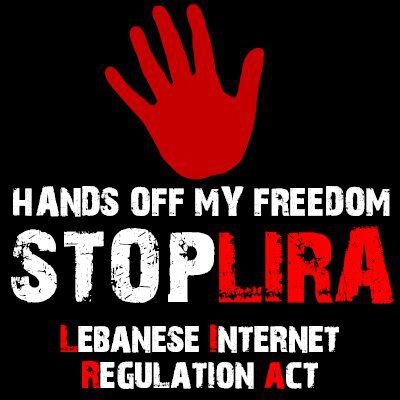
The law has been dubbed LIRA – the Lebanese Internet Regulatory Act, an interesting name if you ask me. It is the Lebanese version of SOPA and PIPA, which took the internet by storm back in Janurary.
What does the average Lebanese user need to know about LIRA?
Simply put, for a blogger like me, I’ll have to register my blog with the ministry of Information. For me to be able to run this blog, I shouldn’t have committed any crimes or misdemeanors. So if your judicial record is not “clean,” you cannot express yourself online (or even in voting but that’s a different matter) – so your voice is quenched. I also cannot run more than one blog at a time. So you’re stuck with “A Separate State of Mind” by yours truly.
For people using electronic media, the same rules regarding journalism will apply to you. Never mind the fact that most of us use electronic media as a carefree medium to express ourselves, the minister expects us now to behave on our blogs, online accounts and any other social network we are present on as if we are journalists in some fancy Lebanese newspaper – with punishments applicable.
On top of that, the law is actually very vague. It states that every Lebanese website needs to go through the proposed regulations. But what’s the definition of a “Lebanese” website? Is it one hosted in Lebanon? Is it one whose domain has been purchased by a Lebanese?
In simple and concise terms, your whole online presence will have to go through in a way that is approved and clear to the Ministry of Information, conforming with the rules it has set for you.
As BeirutSpring points out, the motivation behind such a law is not to “protect” Lebanese internet users but rather to have a 21st century big brother presence over them, punishing those who stray away from the pack set forth by the law at hand. In a time when neighboring countries are moving towards more freedom (regardless of what you think of the process taking them there), Lebanon, the country which has the most freedom out of the bunch, is taking steps backwards.
This is not only detrimental to us as individuals, it is also detrimental to us a society at a time where online presence has become a make it or break it deal for businesses, people and everything in between. If Lebanon’s online presence, however dismal that may be with our horrible internet, is threatened by regulations on top of our pitiful bandwidth, then we might as well kiss our position in the 21st century bye bye.
Minister Daouk must heard Somalia’s information darkness is very nice all year round. If you care to join him, be my guest. If you don’t, Lebanon’s online community has decided to fight the bill using the medium the act is trying to regulate. The hashtag #StopLIRA will be used on Twitter. Sharing articles with your friends (such as this one) to raise awareness about the issue is a must. Get going, everyone.
Leave it to the Lebanese to forget every bit of “civilization” they’ve learned in Paris the moment their plane leaves the tarmac to their home country.
The first is “ebn l Chouf,” the second is “ebn Baalbak” because one’s region is enough threat apparently. Soon enough, the crew is involved in calming the men, followed by calls for every Holy figure known to man. Yes, a typical Lebanese fight – at several kilometers in the air – down to those filming planning to post it on YouTube the moment they land.
Well, the video is on Facebook and you can watch it here or on YouTube:
Does anyone know why they were fighting in the first place?







 A Separate State of Mind | A Blog by Elie Fares