Emergency Contraception in Lebanon: The Morning-After Pill – The Scientific Reality

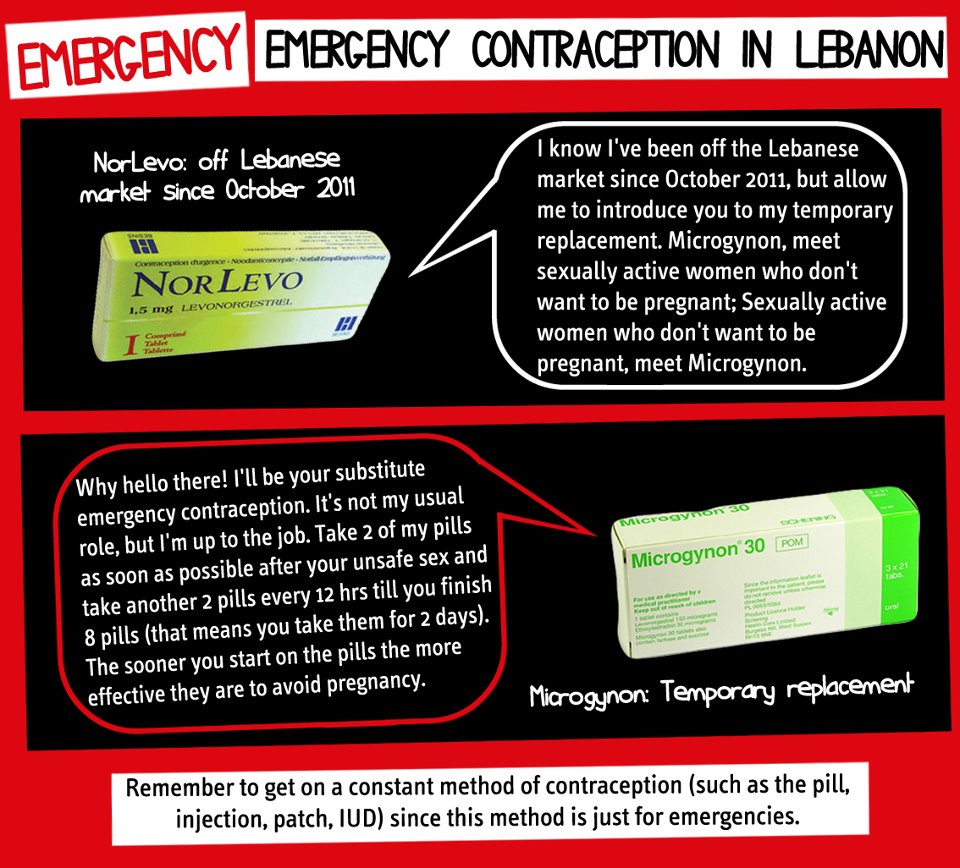
The picture making the social media rounds

This is a guest-post by Christian Sawma, a pharmacy student at the Lebanese American University, in reply to the Nasawiya post on the matter.

We need to start by differentiating between monthly contraception and emergency contraception. The monthly regimen consists of taking one pill per day, regardless of sexual encounters, in order to suppress the normal monthly period and ovulation; this regimen is used for sexually active women who are not wishing to get pregnant. On the other hand, the emergency contraception is used after an unprotected sexual intercourse in order to prevent pregnancy from happening.

The best choice of emergency contraception is a progestin only pill that increases the cervical mucus production and thickness; hence, inhibiting the sperm passage to the fallopian tubes. It is available as OTC (over-the-counter) in the United States and of course in Lebanon under the brand name of Norlevo (levonorgestrel 1.5 mg) – commonly known as the morning-after pill. The latter drug has no purpose other than emergency contraception; it cannot be used as normal monthly contraception.

Pills containing a combination of low concentration of estrogen and progesterone in one pill are used to suppress the ovulation and normal female cycle, therefore, they are used as a monthly contraceptive technique and prescribed as a once per day pill, taken at the same time every day for this purpose.

In contrast, before discovering the effectiveness of Norlevo (levonorgesrtrel 1.5 mg) as an emergency contraception technique, the regimen used was called Yuzpe (named after its founder Dr. Albert Yuzpe). It consisted of giving the combination of those low concentration estrogen and progesterone pills, discussed above, to inhibit pregnancy (before it happens) after an unprotected sexual intercourse, but they are given as multiple pills per day for the emergency contraception purpose. Now that Norlevo hasn’t been available on the Lebanese market since October 2011, the Yuzpe regimen can be used instead.

Estrogen is highly emetic (induces nausea and vomiting), and that is one of the main problems of this regimen: It consists of giving 2 or 4 tablets, of the monthly contraceptive pills, as soon as possible and repeat the same dose after 12 hours. The number of tablets to take is chosen according to the estrogen concentration in the tablets. For the 30 mcg ethinyl estradiol (EE), 4 tabs should be taken, and for the 50mcg EE, 2 tabs are advised. It is important to mention that the tablets of each dose should be taken all together and not separated.

This is a table that clarifies the aforementioned point:

Yuzpe (Microgynon 30) is effective in 75% of the cases, which is not a good statistical number, making it not a very good alternative to Norlevo. In addition, this regimen shouldn’t be followed without referring to your physician or a pharmacist and if vomiting occurs in less than 2 hours post dose, the dose should be repeated.

On the Lebanese market, a lot of brands containing 30 and 35 mcg EE are available. The one that contains levonorgestrel (Norlevo’s active ingredient) in an acceptable concentration for emergency contraception is Microgynon 30, and it is the best choice in Lebanon for a Yuzpe regimen. According to my knowledge, no 50 mcg EE is available in Lebanon for contraception.

In the case of Norlevo or combined oral contraceptive, the effectiveness is not studied beyond the 3 days period. Although the Yuzpe regimen can be given up to 5 days post intercourse, no safety and effectiveness has been proven. In addition, some studies have confirmed that beyond the initial 3 days, it’s neither safe nor effective to use Norlevo or Yuzpe (Microgynon 30).

Always refer to your physician or pharmacist before using a new drug especially if taking other drugs with it or if using it for its unlabeled use (such as in this case). In case of emergency contraception, it is important to refer to them in any case of bleeding or pregnancy post a dose of a progestin only pill, Yuzpe regimen or Ella pill, a new experimental FDA-approved drug that is not yet available in Lebanon.

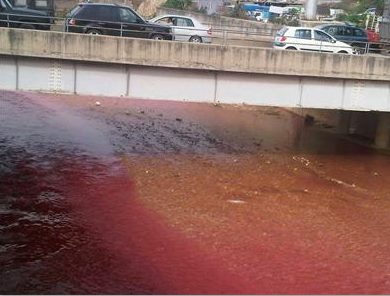
Beirut River Turns Red

People in Lebanon’s capital woke up to the following scene of the river that runs at the edge of the city:

Since we’re very close to lent, some people have gotten a new feel for religion and called this a miracle, à la Jesus turning water into wine.

Greenpeace, however, has decided to investigate the matter and has taken water samples from the water. Or it could be a consequence of snow melting, soil erosion, dust or any other natural consequence of the current weather.

Either way, I still have no clue why people call this a river.

AUB Greenpeace Club Unveils AUB Carpooling

As a former AUB student whose life was turned a living hell because of the transportation to and from uni, I have decided to throw my full support behind this idea, hoping it will be very helpful to someone who’s suffering today like I was a couple of years ago.

To make their plan successful, they will need our help in spreading the word. So go to this link and help them out. Share this post, share the link. Do what you have to do.

You need an AUB email to be able to login and register.

Not only will you be helping fellow students who are not “lucky” enough to have their own car, but you will also be helping in your own way in lessening the traffic around Beirut and that horrible parking situation at AUB’s lower campus.

What I hope this becomes is a national initiative of carpooling. God knows we need it. Good job AUB students. Again.

February 14th in Lebanon: Should It Become Hariri’s Day?

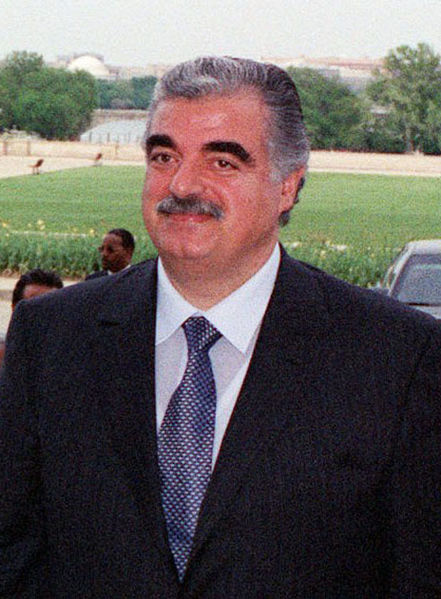
Every year since 2005, February 14th has served a double meaning in Lebanon, as I’ve tried to convey through this meme. For many, it’s your regular Valentine’s day: a chance to take your loved one out, etc…. For others, however, it serves as a commemoration to the late prime minister Rafic Hariri. Schools and universities close, as well as governmental offices – the whole country is shut down for one day in mourning for Mr. Hariri.

And it is here that I have to ask a question: 7 years after his assassination, aren’t we overdoing it?

Simply put, yes we are.

Sure, Hariri was considered a great man by many. Sure, he was prime minister for a very long time. And yet, we do not mourn any other politician by shutting the country down on the memory of their death. Case in point? He’s not the only politician that got assassinated. I can think of at least two Lebanese presidents that met the same fate.

Isn’t it unfair to the memory of those presidents that the only thing that takes place on their day in the whole country is a mass? Weren’t those presidents as cherished in their communities as Hariri was in his? Don’t they deserve a day off as well? Don’t all the other politicians that died before and after Hariri also deserve to be commemorated in such a way?

I understand taking the day off the first or second year after the assassination. But 7 years later? I hardly think it’s justified. If anything, I think it’s high-time that we, as a Lebanese society, work on moving on – especially that the wheels are in motion to bring
justice for Mr. Hariri. February 14th has quickly become a day where Hariri’s assassination is used for a political agenda, more so than to actually remember the man who was killed on this day. And frankly, we cannot as a country afford to add extra days off to our already extensive list. And when the Hariri off day is being added and the government was speculating about removing Good Friday from the list, you know they’re doing it wrong.

If anything, the political meaning the occasion has taken on February 14th is a detriment to the memory of Rafic Hariri, a man who managed to bring together people from different sects and religions together under one roof to work for Lebanon. I’m certain he wouldn’t appreciate using the memory of his death as a way to increase the divide in the country.

And note, I’m a supporter of the current political movement that Rafic Hariri’s movement, headed by his son Saad, is part of. So take this to heart. Don’t hate. I’m not saying ignore the occasion. I’m not saying we should forget what happened to Rafic Hariri. On the contrary, we should always remember because his death has turned into a turning point for the nation. I’m saying remember without shutting the country down in remembrance. And that would be a first step in advancing as Lebanese society: make it less about glorifying individuals and work towards bettering the country as a whole.

Regardless, rest in peace Rafic Hariri. It’s been 7 years and the country is in a worse situation than ever before.

A Few Words From an Angry Maronite

[Notice] For those who think talking about one’s sect is sectarian, this post is not for you. For everyone else, proceed with caution. 

Today, February 9th, marks the memory of the founder of the Maronite Church: St. Maroun. Most Maronites would start exhibiting pride in their heritage on (and leading up to) this day. I’m fairly certain if you look at your Facebook news feed at this very moment, you’ll find about five or six friends sharing pictures of St. Maroun.

Of course, Maronites have every right to be proud of their heritage. They have simply withstood so much in the rough mountains of Lebanon, they have fought for Lebanon like possibly no other sect has done and they have the greatest hand in the founding of the state of Lebanon. I’d give historical proof here but I don’t think that’s necessary.

Among all the Lebanese sects, the only sect that kept believing in the idea of “Lebanon” throughout the years was the Maronite sect. And for that, as a Lebanese nationalist, I am proud.

But today, as I write this, I cannot but feel angry at Maronites: church, politicians and people.

The land:

I’m angry because the people are selling our land to whoever, however, whichever and for whatever reasons. I get infuriated when I hear that most of the land in certain villages has been sold to foreigners, regardless of the sect of those foreigners. It pisses me off that nobody seems to care about this as well. We actually care more about valet parking fights and useless comedy skits than about our own land. And that is very sad. It angers me that some of our politicians are among the people selling their land, as if they needed the money. You know, the monthly payment they get for life for being voted into office isn’t enough for expenditures. I’m angry because our church keeps preaching about not selling the land but does nothing with the wide resources it has about it. I’m angry because our grasp on our country is lessening not because of outsiders but because we, as insiders, are weak and easily tempted by everything materialistic that you don’t necessarily need.

Persecution:

I’m angry that the Maronite community is panicking regarding what’s happening in the region while they have no reason to be this afraid. Cautious, perhaps. But panic? Definitely not. I’m angry that certain politicians fuel this panic to serve their agenda. It angers me that the Maronite church is not doing anything to lessen this. On the contrary, it’s preaching that we should be afraid for our heads. Why should we afraid? What worse can happen to us as a community after the fragmentation we had to endure for over fifteen years because of the Syrians and because of our internal differences? What could be worse than to be constantly afraid because of something that is not threatening you directly? What could be more debilitating that to constantly live in fear?

Let me answer that for you. Nothing. And yet we live in fear. We are constantly worried that our thirty parliament seats will be taken away from us, that the president will no longer, someday, be forced by law to be a Maronite, that our homes will be ripped off from under our feet and that we’ll be shipped off to Canada or some other Western country that would accept us.

Politics is cyclical. Maronites had their reign, the Sunnis had their reign, the Shiites are having their reign. And the cycle will turn, however vicious it may be. I’m angry that we didn’t learn from our mistakes when we were in power and we will probably repeat them when we find power again.

The Politics:

I’m angry that our politicians cannot agree on anything regarding our community, regardless of who they are. We vote for them, we put our trust in them and yet nothing happens. And then we vote for the same people again because the alternative makes us rightfully cringe, regardless of where you fall on the cringing spectrum. We cannot agree on an electoral law that would serve our best interests. We cannot agree on managerial appointments that we are “entitled” to in order to run the country. We cannot agree about a grand scheme that we believe the country should be heading to. What we can agree upon is that each politician is living in the delusion of being the representative of Maronites when, at the end of the day, we are as fragmented, as divided, as weak and as paranoid as we’ve always been and we can also agree that the state of our politics is disheartening, miserable and dishonest.

The Grandeur:

I’m angry that we, as Maronites, have a false sense of grandeur about us – of the sort “Alla khala2na w kasar l aleb.” Modesty goes out the window when we’re discussing our sect, even without practicing it. Who, among you, actually goes to church every Sunday? Not many, I suppose, including me. Who, among you, actually knows something more about St. Maroun apart from the fact that we get a day off on February 9th because of him? Not many, I suppose, including me (unless what I read on Wikipedia can be considered valid). Who feels proud that they are Maronite just because of the “perks” it entitles you? Many people, I suppose. Who feels proud to be a Maronite just because it makes you not “them”? Many people, I’m sure. Who feels proud to be a Maronite just because…? Many people as well.

I guess I have many reasons to be angry, as a Maronite, as a Lebanese, as a resident of a certain caza, of a certain town. I am a Lebanese angry about many things in my country, especially Maronites because we keep messing things up. And the worst part is? We take pride in messing things up.

Yen3ad 3leikon jami3an w 3a2bel kell sene.

PS: I made this post not detailed on purpose, so an element of vagueness remains to it; thus, making it applicable to everyone, regardless of political affiliation.