Cultural Terrorism in Lebanon: The Adventures of TinTin in the Country of Brainless Censorship

Welcome to Lebanon, the country where blocking a director’s name off his movie poster is apparently our *awesome* government’s way of affirming its power.

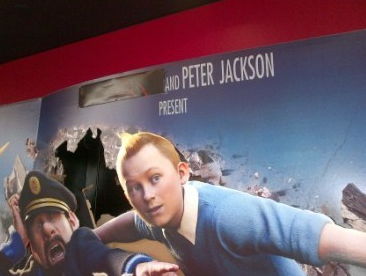
The latest incident of cultural terrorism in Lebanon is having Steven Spielberg’s name hidden off TinTin’s movie poster, simply because Spielberg donated $1 million to Israel during the July 2006 war. While I am firmly against what Spielberg did, as I am against anyone who actively supports acts of violence either financially or morally, does this really warrant this ridiculous act of hiding his name?
Spielberg is Jewish so it is natural for him to feel some compassion for the state of Israel – regardless of whether we like that or not. The same applies to many Sunnis in Lebanon who feel loyal towards Saudi Arabia and many Shiites who feel loyal to Iran. It’s just the way things are. If religion is important to you, you feel strongly about countries where your religion has a good stronghold. It doesn’t mean it’s right, it just means it’s there. If religion is the least of your concern, well, power to you for being”free”.

But before we start thinking about banning movie directors’ name off their movie posters, why don’t we contemplate this:

1) If we’re going to have a problem with every Hollywood director or producer who has Israeli-ties, then the only array of movies we’ll have in our theaters will be the crappy Egyptian movies we get and the occasional Nadine Labaki movie which takes our theaters by storm (PS: If you haven’t watched Where Do We Go Now? yet, what are you waiting for?)

2) The act of blocking Spielberg’s name off the poster is simply ridiculous. What end is served through the decision to do so? People won’t know that he’s involved in the movie when his name is flashed on a huge screen in front of them? It would have made more sense to have the movie banned in its entirety, not that would be acceptable in itself. Tintin is an animated movie based on a hit comic series that many of us have grown up reading. The fact that this agenda-less movie is being targeted in a flimsy “ban” is beyond ridiculous. It’s simply egomaniacally stupid.

3) For those who are probably furious that I’ve somehow, in a nonexistent way, shown “compassion” towards something Israeli, this is far from the case. In fact, if Tintin had been “Waltz with Bashir,” I would have probably been less offended by whatever’s taking place with Tintin today. While I could simply download the aforementioned movie, I would have understood not having it play in our theaters, simply because it’s an Israeli production. But Tintin is not an Israeli production, even if an Israel-compassionate person had a role in doing it. If Tintin had been serving some hidden pro-Zionist agenda, which as I’m writing this seems hilariously ridiculous, then perhaps I would have understood an act of banning in any form towards the movie.

4) Our country needs to start getting accustomed to the idea that, even in these simple ways that it does, it shouldn’t “silence” those that are different from us. We pride ourselves that we are a beacon for freedom of speech in the region and we most definitely are. But things like this “ban” put a damper on what is, truly, an innovative country that we have. The fact that Tintin was played in theaters across the region without a hitch is a clear indication that our lovely government (or whoever issued the Spielberg ban) is out of its mind. Maybe the government should start caring less about blocking a director’s name because of a Wikileaks article and more caring about fixing the internet situation of the country (I still haven’t gotten my upgrade!).

5) Just for your reference, this is a list of actors, actresses, directors, producers & singers who have ties with Israel, be it moral or financial: Adam Sandler, Annette Bening, Arnold Schwarzenegger, Ashton Kutcher, Ben Stiller, Billy Crystal, Bruce Willis, Dustin Hoffman, Halle Berry, Harrison Ford, Kathy Bates, Kevin Costner, Kobe Bryant, Madonna, Frank Sinatra, Natalie Portman, Nicole Kidman, Paula Abdul, Norah Jones, Robin Williams, Sarah Jessica Parker, Tom Cruise…. and the list can go one to list hundreds of other names. All of these people are entertainers that provide us with movies and songs that we love. How about we ban all of their movies, music and anything they’re affiliated with?

The sad thing is this isn’t the first time this happens. First it was Gad Elmaleh, then Lady Gaga’s album, which was later unbanned, passing by an Iranian movie against the Islamic revolution: Green Days. When will Lebanese cultural terrorism stop and we begin to care less about a person’s political,  religious or whatever affiliation they may have and care more about what they’re providing the world with. If you think it’s offensive, you can CHOOSE not to be exposed. But you have NO RIGHT to force your own views on other people who don’t share them in any way whatsoever. As for me, I may have not wanted to watch Tintin but I’m definitely going to now.

So dear Hezbollah, protecting your precious arms doesn’t start with you blocking every single that that is related to the root of your weapons. Culturally terrorizing the whole Lebanese population into believing that if something isn’t approved by you then that thing shouldn’t work is NOT acceptable. Instead of having Lebanese traitors, whose dealings with Israel are as clear as the sun rising every morning, almost getting no jail time (Fayez Karam in case you’re wondering), Hezbollah is offended by Steven Spielberg’s name on a movie poster. You see, a movie poster is simply a weapon of mass destruction.

Hezbollah allies speak of “change and reform.” Well, where is change and reform when you truly need it? Or does it apply to some internet upgrade through a submarine cable that’s suffering from more outages in its month of service than the whole Lebanese internet sector has had over the past two years? Perhaps Mr. Aoun, instead of being Hezbollah’s little minion 24/7, you’d pass some of the freedom values you might have learned in your fifteen year stay in France because of Hezbollah’s BFFs?

Year 21: The Highs and Lows

Well, today is my birthday. You might have wondered why I love number 13. Well now you know. 13/11.

And for the first time in eleven years, I have the same digits forming my age. 22.

Many people would be overly happy when their birthdays come up. But to me, they serve as an opportunity to reflect on what happened in the year that preceded. In a way, it’s my version of new year’s eve – except that it’s my year.

Year 21 was an alternative current in its highs and lows. When it sank, it sank. When it rose, it soared. When I look back on “21” now, I see a year where I was happy. And that’s almost always the case with life – you consciously forget the bad things that happened, only recollecting them upon an active conscious effort of remembering. The good times are the ones that stay.

So for some introspection and retrospection as my 22nd year starts, I’ve decided to put 21 in perspective.

 The lows:

Prior to 21, I was faced with one of the first key decisions of my life – when I was rejected in the three med schools that I applied to and not knowing what to do next. A biology degree, which I got from AUB, was rather useless in the work field, especially that I didn’t want to teach. So the opportunity presented itself for me to enroll in a rather useless program where I’d be wasting a year, biding my time before I attempt med school again. And that was the crux of 21 – going to classes, attending lectures that you knew had a rather short usefulness span. Many had said that one year is nothing when you look at the big picture. But it’s hard to look at a bigger picture when you see your accepted friends, whose grades are not much higher than yours, nagging about med school when you know you’d do anything to be there. You see, I am not a bad student. Sure, I don’t study as much as I should but I feel I don’t need to. I felt I had done enough to get in and in any normal year I would have gotten in. But the wind blows where it will.

21 was also accompanied by an increased sense of mortality. Soon after my birthday (3 days later to be precise), my mom’s cousin died. He was a great family friend and his death was tragic. I had become accustomed to people I knew passing away then. But you don’t really think about it much, except when you sit with your parents and you start talking about the people you knew. You get to a point where you’d be like: I’m 21 and damn, I know too many people that have passed away. And that number is only going to increase as I move on.

I look at my grandparents and hope nothing happens to them anytime soon. I also look at them during the funerals of their loved ones and I can’t but feel devastatingly sad as I think that most of the people they spent their whole lives with are no longer here. It hurts me when I see my grandfather not bid farewell to his best friend saying: “I don’t say goodbye” as if knowing that his time is coming soon.

We’re all going to die – but you push the idea out of your head as much as you can. Sometimes, you even learn to live with it, thinking you’ve gotten okay with the idea. But what hurts the most is the tears of those that matter to you the most. And then you realize, it will never be easy.

The highs:

I can vote 😀 Anyone who knows me knows I’m very competitive when it comes to elections and such. Back in 2008, I was named “Mr. Republican of AUB.” John McCain lost then but you get the picture. So when I turned 21, and later saw my name on the voter’s register, I felt great. Anyone who says they don’t care is bluffing. You can’t but feel happy when you know you’ve crossed that milestone.

I rocked the MCAT. I admit the program I was enrolled in wasn’t going too well. I mean, I was getting really good grades but the idea of competing again with people who were out of your league back in AUB, well, that’s not the most encouraging of premises for you to want to excel. So it boiled down to the MCAT, which I was taking again. And what do you know, I got my results at an El Molina Tweetup. I can’t tell you how awesome that moment felt when I opened the website and saw my grade which shouted at me: YOU’RE ACCEPTED! GO PARTY!

Subsequently, I got accepted into med school on July 6th, 2011, which also happens to be my little brother and cousin’s birthday. Even though I didn’t feel as happy when I got the news as I felt when I got my MCAT grades, it still felt great to finally have closure for that part of my life. Once you’re in Med School, it’s very hard for you to fail yourself out. Once you’re in, you’re practically there – unless you decide you don’t want it anymore. And for the record, I still want it.

21 also had the honor to be the year where I saw my dad’s family, all his brothers and sisters, together under one roof for my aunt’s wedding. It was the first time in over 17 years that I saw my aunt who came especially to be her sister’s maid of honor at the wedding. I also met my cousin technically for the second time, but for the first time realistically. And if you ever thought that there’d be awkwardness, that was thrown out of the window the moment I sat with my cousin and we started chatting. She was such an awesome person with whom I had more in common than I thought possible. My aunt, also, turned out to be such a lovable person. She cared more than she should and, well, she’s all kinds of awesome. I can’t wait to see them when they come back from Australia this Tuesday.

And speaking of weddings, 21 also had me attending the first wedding ever of a direct family member. My aunt got married on June 17th and the event was just magical. Living with her in our Beirut apartment, I had to bear with months of Bridezilla moments but they all transformed into the best wedding I was ever part of, the testament to that being my whole hometown talking about it two weeks later.

21 was the year when I first hopped on an airplane to spend 17 days in France and Spain. Although those 17 days had their fair share of lows, the moment I rode the plane back to Lebanon, only good times stuck in my head: the moments I spent in France, Lourdes, Toledo, Madrid, etc….

I also started blogging during “21” and I think my attempt so far can be deemed as a success based on the amount of response I get on what I write and the amount of people that are interested in reading what I have to say.

21 was also the time when I met awesome people with whom I’ve become great friends, such as Paul Gadalla whom I helped in procuring a job in Lebanon. I was the first person he told when he got the job. He exposed me to his culture as an Orthodox Copt and showed me their struggle before it became headline news, confirming his fears all along. Paul also helped me in many of the posts I wrote, which many of you read.

And in 21, I became even better friends with the awesome people that were there all along. So thank you Nathalie, Sonia, Elia, Maguy, Hala, Roland, Howaida, Kris for always being there.

PS: spoiled rich girl needs to get a job; Roland and I are rocking med school; Cell biology nerd needs to figure out how to get those basal membrane proteins figured out already… :p

And last but not least, my great family has always been there. I couldn’t have asked for better people to be my parents and brothers. One of my brothers is busy being a womanizer 24/7, the other one is in the US. And although I miss my little brother who’s busy being an exchange student (and rocking at it), this didn’t put a damper on the later quarter of 21. In fact, I feel proud whenever he tells me about the “A’s” he’s getting in his courses. I feel happy for my aunt who’s starting to build her own family now and I can’t wait for her to have little kids that I can boss around. I feel ecstatic for having the warmth of my grandparents’ love surround me. And my parents are the best parents that could be – the sacrifices they make, the sweat they pour and the energy they put to give my brothers and I the best life possible. You can never but be forever grateful to them.

I daresay 21 was great, which is probably why I feel happy writing and reading this. It reminded me of all the good times I had. Some might have been less good. But never bad times. The lows might have gotten me down but the highs came right back there to push me up. Life goes on either way, and, wanting not to sound too cliche, with great family and friends around you, the hard times get easier and the happy times get so much more joyful.

Here’s to 21… hopefully 22 will be even better.

13 Facts About Steve Jobs

I recently finished reading Walter Isaacson’s biography of Steve Jobs titled, well, Steve Jobs. It was a fascinating read with more than a few insights into the life of this man that enchanted millions with his creations and who, like it or not, changed the world.

So I’ve decided to list thirteen interesting facts that I learned about Steve Jobs from the book. Hope you find them as interesting as I did.

1) Romance: he was a hopeless romantic – at least when he wasn’t busy bossing everyone around. Steve Jobs fell in love with two women his whole life one of which was his wife, Lauren Powell, with whom he shared more than twenty years of married life. As a testament of his love and gratitude to Lauren, here’s what he wrote her on their 20th anniversary:

We didn’t know much about each other twenty years ago. We were guided by our intuition; you swept me off my feet. It was snowing when we got married at the Ahwahnee. Years passed, kids came, good times, hard times, but never bad times. Our love and respect has endured and grown. We’ve been through so much together and here we are right back where we started 20 years ago – older, wiser – with wrinkles on our faces and hearts. We now know many of life’s joys, sufferings, secrets and wonders and we’re still here together. My feet have never returned to the ground.

2) Middle East: He didn’t care about the affairs of the Middle East. In fact, he never bothered in pursuing a meeting with his father, even though he met him without either one knowing who the other was as Jobs was a frequent customer of his biological father’s restaurant. Regarding the Middle East, Steve Jobs had this to say: “I don’t think anybody really knows what we should be doing over there. You’re fucked if you do [interfere in Middle Eastern affairs] and you’re fucked if you don’t.”

3) Simplicity: His mantra in life, which he translated to Apple was: “simplicity is the ultimate sophistication.” In fact, all of his designs for Apple products had this theme as their basis: can we take off this part and keep full functionality? If he thought it was doable (and more often than not, his engineers disagreed), he pushed them to do it. And they always pulled through.

4) iPhone & iPad: The iPad was being developed prior to the iPhone. The multi-touch technology which Apple invented was kept hidden from Jobs for fear he would find the technology ridiculous. When presented with it, he was fascinated by it and immediately recognized the potential. In fact, the only reason Steve Jobs wanted to develop a tablet computer was to “stick it” to a Microsoft engineer who kept bombarding him with his stylus-using tablet, which Jobs found to be dead on arrival.

“This guy badgered me about how Microsoft was going to completely change the world with this tablet PC software and eliminate all notebook computers, and Apple ought to license his Microsoft software. But he was doing the device all wrong. It had a stylus. As soon as you have a stylus, you’re dead. This dinner was like the tenth time he talked to me about it, and I was so sick of it that I came home and said, “Fuck this, let’s show him what a tablet can really be.”

5) iCloud: The idea of iCloud was conceived by Mr. Jobs back in 2008 but he never found the proper framework to introduce the service in a fluid way. Apple had an attempt with “MobileMe” which Jobs completely hated. Soon after its introduction, he gathered the team responsible for it, reprimanded them and sacked their lead engineer. As he went back home to his family and looked at his son, he thought about the families of those he sacked and how their fathers would be coming with the bad news to their families. But he didn’t let himself feel bad because he knew that hard decisions needed to be taken and if no else did, he was the one who would.

6) Antennagate: His handling of the iPhone 4’s antennagate issue (where touching the iPhone 4 in a certain way on the lower left side would reduce cellular signal) was hailed by many professors as groundbreaking. Going on stage and proclaiming that the issue was blown out of proportion, that phones were not perfect and if anyone’s not happy with their device they can bring it back to Apple, Steve Jobs not only changed the context of the conversation from an opportunity of ridicule against the iPhone 4 but to one where he showed the shortcomings of smartphones across manufacturers. According to Scott Adams, created of comedy strip Dilber:

“If Jobs had not changed the context from the iPhone 4 to all smartphones in general, I could make you a hilarious comic strip about a product so poorly made that it won’t work if it comes in contact with a human hand. But as soon as the context is changed to ‘all smartphones have problems,’ the humor opportunity is gone. Nothing kills humor like a general and boring truth.”

7) Illness: Steve Jobs’ cancer treatment was groundbreaking in the sense that more often than not, he was one step ahead therapy-wise. He had his full genome decoded, costing him more than $100,000 at the time, as well as the genome of his cancerous cells, and he had a molecular therapy approach that targeted all the little mutations of the cancer as it progressed. His pancreatic cancer had an early diagnosis as well but Steve Jobs refused to have the required operation because he didn’t want to open up his body and be violated like that. Six months later, he figured – under pressure from many people – that his alternative treatments and wanting to distort reality wasn’t working. So he had the operation, which was not a full wipple procedure. It was then that the doctors suspected the cancer had spread. This was the start of his physical demise.

8) iPad: Steve Jobs was very displeased by the press reaction to the initial iPad. He wasn’t sure what was the cause of the overall negative reaction and he decided that the iPad 2, which was conceived even as the first iPad was being introduced, would be even more groundbreaking. Soon after the iPad was released to immense success, his greatest reward came from a Forbes article by Michael Noer, who was reading off his iPad in a rural part of Bogota, Columbia when an illiterate six year old came over to him and was intrigued by the iPad. Noer handed it over. The boy managed to scroll around the apps and play a round of pinball – all on his own.

“Steve Jobs has designed a powerful computer that an illiterate six-year-old can use without instruction,” Noer wrote. “If that isn’t magical, I don’t know what is.”

9) Think Different: Steve Jobs wanted people to “think different.” If the idea to “think different” required them to use LSD or Acid, he didn’t care. He calls using those substances one of the most enlightening events of his life, getting him to see things more clearly and in a different light. Years later, this extra-depth, so to speak, that Jobs acquired would translate in his work first at Apple where he designed the Macintosh, in NexT and then in Pixar before returning to Apple and pulling out of the grave it was digging for itself with subsequent CEOs who cared more about profit than about products.

10) AppStore: Steve Jobs was against the introduction of third-party apps to the iPhone. He felt that would be a betrayal of some sort to the closed system that he envisioned. By having third party apps introduced on the iPhone, he would be creating a way for people to abuse the tightly engineered software-hardware combo that Apple made. However, after many people started pressuring him to allow it – including John Ive, designer of the iPhone and one of the few people Jobs trusted immensely. He decided to sleep on it before coming back with the idea of the App Store where developers would develop apps subject to strict rules and Apple would be testing all the submitted apps, which would give iPhone users a more enriching experience on their phones and wouldn’t relent the protective control Apple had over the device.

11) Closed Systems: Steve Jobs’ “need” for control is seen by many as contrary to the hacker mentality that he had as  Apple was launched – the rebel against the big brother establishment. And this is one of the main discrepancies between him and Bill Gates where the latter believes in openness while Jobs believed in closed systems for the simple matter that coordinating hardware and software delivers the best possible product to the user. When you start giving users room to do as they please with the product, the quality of the product dramatically decreases. Steve Jobs wanted to provide the users who opt for his devices the best possible experience and for that, he figured a closed system would be the best way possible.

12) Pixar: Steve Jobs is responsible for many of the animated movies that we consider as cartoon-gold in the last ten years. As CEO of Pixar, he gave us Toy Story, Toy Story 2′ A Bug’s Life, Finding Nemo…. As head of Pixar, he got into many disputes with the CEO of Disney who saw them as dispensable animators while Jobs saw Disney as a mere distributor. Disney hadn’t given the world a decent cartoon movie in a long time and their major revenue was beginning to shift towards amusement parks. Their animation department was reporting losses… In a way, Steve Jobs also saved the animation industry from being overtaken by creatively blind CEOs at Disney whose sight was set only on the profit margin they made.

13) Genius: Steve Jobs was not super smart. He was a genius. The difference between the two is subtle and yet existent. He did not have raw processing power, which is intelligence, but he was genius in the sense that he was able to see what others couldn’t. He was able to think outside the box set by the corporates of our time to deliver great products that would help bring humanity forward, which was Steve Jobs’ goal all along. His invention of the iPod was not groundbreaking in the sense that music players existed before. But it was groundbreaking in the sense that he saw the shortcomings of all those music players and was able to use resources that he did not have to change the music industry forever. Sony, for example, has a music recording branch as well as a technology branch but they never got the idea to make the iPod. He also saved the music industry by launching the iTunes Store, which lessened the blow of the mass hemorrhages due to piracy. With the iPod and the Macintosh before it, Steve Jobs managed to create a need for a digital hub that many thought they didn’t need. His business strategy was not one based on market research but on insight. He didn’t care what customers needed now. He cared about what they would need tomorrow. That’s how he made the iPhone and subsequently the iPad. That’s why Apple is the world’s leading company today – all because of this man who saw out of the box, by standing on the “shoulders of those that preceded [him].

And one more thing…

Steve Jobs was the biggest business executive tycoon of our time. There is no doubt about that. Anyone who is trying to discredit him based on some non sequitur argument is delusional. If our legacy as people is to bash the accomplishments of those that preceded us, helping us move forward, then I have no idea where we are heading.

If you are in Lebanon and want to buy the book, it is available at Libraire Antoine from whom you can buy the book online. If you’re outside Lebanon, you can buy the book off amazon.

Why N7W is NOT a Scam

Despite many attempts to get my lovely Lebanese compatriotes off their high horse regarding many aspects of our beloved country, it seems I have fallen short somehow. The high-horse is too high for some people to actually see that not everything is out there to get them and not everything “good” that goes on with their country needs to be torn apart.

Let me start with one simple thing. Even IF N7W was a scam, it still doesn’t discredit the immense positive attributes this will bring Lebanon as a whole if Jeita ends up winning. Sure, it won’t end our national debt as some people suggested, nor will it be a solution to our political system. But come on, anyone comparing Jeita winning with a solution to the national debt is not only delusional, they also have some logical fuse in their brain short-circuiting. No offense that is.

The N7W campaign, which has been going on for almost four years now, will have millions upon millions of votes cast – and that was before SMS votes started. That was when people voted with emails and only those very enthusiastic voted with more than one email.

But I digress.

Recently, I’ve had the “pleasure” of reading an “interesting” post by my friend Gino Raidy who immediately stamped the word SCAM all over the N7W process, as well as a picture to go with it.

When I first clicked on the link to read Gino’s post, which was immediately picked up by BeirutSpring, I expected to read something interesting. I expected to find something new. Not something rehashed, over and over again, by the same people.

I shall be addressing every point Gino made in his article, with lesser emphasis on increasing font size and such.

Multiple Voting:

First, multiple votes is not a reason for the N7W competition to be a scam. Far from it, actually. Most competitions involving email voting let people vote once per email. And when it comes to SMS voting, you can vote more than once. You are allowed to vote for your favorites to win as many times as you want. Let’s look at two trivial examples. American Idol. You can vote either by telephone as much as you want, or you can text the number of your desired candidate as much as you want. The final tally of votes ends up nearing 500 million. I don’t see anyone screaming scam about that. Or is it only a scam when the theme of the vote is different?

A second example of competitions with voting are award shows such as the ACM, or Academy of Country Music Awards. If you thought American Idol was a “silly” example, at least the most prestigious country music award show is not. And for that awards show, the public gets to vote for the highest honor that can be bestowed upon a country artist. Yes, you guessed it. They can vote as many times as they want.

Voting Since 2009 2007:

We’ve been voting since 2007, not 2009. But we’ve been voting for different phases of the competition since 2007. Four years ago, the Cedar Forest in North Lebanon was nominated with Jeita. And we were voting for both sites. Then came a time where the nominated sites had to be cut down to about seventy and each country can only have one representative. So the Lebanese committee chose to have Jeita represent us onwards and pulled the plug on support for the Cedars. You might disagree with the decision. Some people argued that the Cedars are more symbolic of Lebanon. But in all fairness, Jeita has a much higher chance of winning. The second phase of the vote was to get all the sites that qualified into groups based on the nature of that site. Jeita was in the group of natural caves. And so, yet again, we voted for Jeita in its group and got it to qualify to the final stage of voting that is taking place today.

Phase voting is a natural thing in all competitions. It’s also a very natural thing in elections. I would give the American Idol example or any award show example again but let me illustrate this with something else. US presidential elections. It starts with democratic and republican primaries taking place for over a year all across the United States. Each party ends up voting for a nominee that represents it in the general elections. Then, those two candidates go head to head and one winner emerges. Another example is the French presidential elections. Each party goes through a series of voting to choose their nominee. Then all appointed nominees go through a first round of voting, by all the people of France, which ends up narrowing down the choice to only two candidates before the president is ultimately chosen in a final round of voting.

How is sequential voting since 2007 a mark of scam, I have no idea. You can check out the steps of the vote here.

UNESCO Does Not Support It

Fine, UNESCO does not support it. I fail to see how the N7W committee asking UNESCO to back it up and them refusing reflects negatively on N7W. After all, aren’t there many things that UNESCO did not support? Wasn’t it up until very recently (Monday to be exact) that Palestine was granted full membership to UNESCO?

Besides, UNESCO already has a list of World Heritage Sites, including the Lebanese Kadisha Valley, which is threatened to be removed off the list. Now I wonder, what good did the tag of “world heritage site” do the Kadisha Valley? How known is the valley even among Lebanese? I can’t begin to tell you the number of people I know who hadn’t heard of the valley until I mentioned it.

UNESCO might not support N7W but that doesn’t reflect negatively on the competition in any way whatsoever. It just means that. A committee where political play is key decided not to back up a committee where political play is to a lesser key. Simple as that.

The Maldives Withdrew Themselves From The Competition:

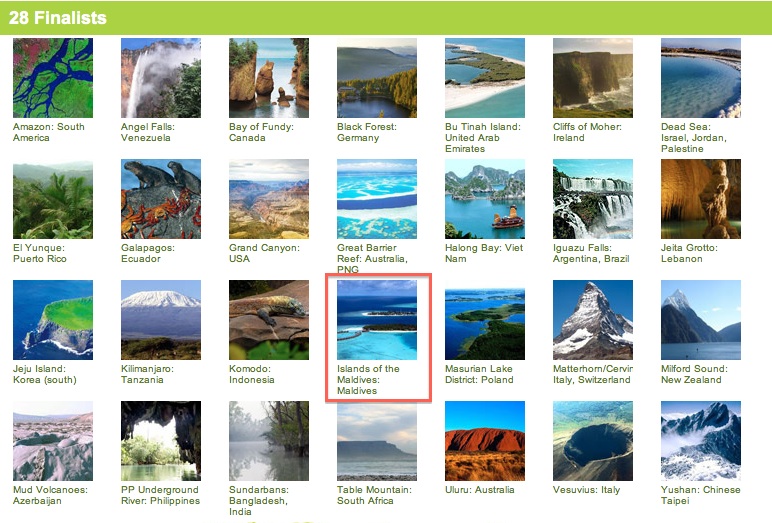
Yes, I have read that same article, back from May 2011, that the Maldives decided to withdraw themselves from the vote because the N7W organization asked for copious amount of money and financial engagements. Simple question, which I will illustrate with a breathtaking image of the Maldives:

Surprise, surprise… The Maldives are still in the competition. Their government pulled off support for the participation? It’s hard for me to believe that a flimsy Switzerland-based organization can overtake a government. I’m just saying.

Besides, to be eligible to be part of the final 28 participants, no fee had to be paid. N7W is, at the end of the day, a non-profit organization. But to be non-profit, you need to balance out your expenses. In order to do so, they offered sponsorship rights, which are elective, for the final phase of the vote, in return for a certain amount of money. In Lebanon’s case, according to officials from the Jeita Grotto committee from whom I got a statement, no such fees were paid. Jeita doesn’t have sponsors.

But let me ask this: is $500,000 too much to be paid for the amount of advertisement they’re getting from being part of this competition? Could Jeita have gotten the exposure it’s getting had it not been competing? I hardly think so. Odds are Jeita would have forever remained a landmark visited mostly by the Lebanese and a fraction of the couple million tourists we get every year.

More Tourists:

Yes, more tourists. There’s no way in hell having millions of millions of people (multiple voting included) visiting a website and voting for seven different sites without it sparking at least a curiosity to visit, with many of those acting out of it and actually visiting. Take me for an example, I really want to visit the Cliffs of Moher in Ireland, a landmark I did not know existed before the competition. Say I do go to Ireland. I won’t end up visiting the Cliffs of Moher and going back to Lebanon. I’ll stay there for at least a week, visiting other landmarks and helping out their local economy.

To assume that “NO ONE” is falling for this is absurd. Tourists who are interested in visiting a country will search for related info about their country. If Jeita ends up winning, odds are that will be one of the main points they will encounter in their search and they will most definitely want to visit it if they end up coming to Lebanon. At the end of the day, Lebanon is a country driven first and foremost by its tourism sector, which is helped immensely by such exposure. To assume that such exposure is nonsensical would be nonsensical in itself.

National Pride:

Yes, national pride. Shouting national pride from the rooftops that is. And yes, that does make me – or any other Lebanese – proud of what we have accomplished with the Jeita vote, how for one rare time in our history we’ve forgotten our differences – at least for a minute – and all voted for one common thing. Yes, that is something that makes me proud. It makes me proud to see a landmark from my country be part of a competition on such an international level, just as I would be proud to see, for example, Riyad Salameh picking up an award for excellent skills in managing our Central Bank and helped us weather the international financial meltdown. It makes me proud to see some great Lebanese icon, like Fairuz, being honored at an international level – regardless of whether I think she needs that honor or not. Sure, we need to preserve our natural sites. We need better laws. We need to take better care of our country. But I fail to see how all of that is logically deterring us from supporting the Jeita vote in any way?

At the end of the day, scam or not, official or not, N7W is doing most of the countries that have reached the finals a huge favor. When I look at their live voting map and I see someone from Vietnam or Chinese Taipei voting for Jeita, it makes me happy. Not because they voted for Jeita, but because someone, somewhere, now knows that there’s a country called Lebanon in the Middle East with a breathtaking landmark that, win or no win, is now known.

It’s clear though that some Lebanese need to stop it with the conspiracy theories and relax. If you don’t find enough reasons to vote for Jeita, then don’t vote. Don’t berate those who find the reasons to. And also, fellow Lebanese, you shouldn’t be angry people are urging everyone to vote. It will all end in nine days.

Lebanese & Halloween

Over the past five years or so, Halloween grew exponentially in popularity among the Lebanese population. Halloween parties started to take place a couple of days in advance with people celebrating the holiday – like – well, like Americans.

Part of what bothers me about this is that most Lebanese nag about losing some of our culture and traditions in the shuffle of globalization. And that is apparent the most when it comes to Halloween. After all, it is not a holiday that is Lebanese. There’s nothing Lebanese about it to be exact. It’s like many of those other things we take in like a sponge: Halloween is cool. Let’s celebrate it.

Back in my days, which are still here since I’m only 21, our version of “Halloween” although different in meaning yet very similar in form, took place on December 3rd. I remember going house to house with my friends and sitting on sofas in the warmth of stoves, waiting as those families tried to know who was behind the mask.

Do any of the people celebrating Halloween today (or celebrated it over the weekend) actually celebrate the “Lebanese” version of that day, which holds some significance by being St. Barbara’s day, a Christian martyr who had to disguise herself to escape the king’s persecution?
I guess not. After all, it’s much “cooler” to celebrate something where getting wasted under a mask than to go all rustic and knock on people’s doors to let them guess who you are…

Call me old-fashioned, but if there’s something I would like to keep “Lebanese,” it’s the day where we wear masks just for the fun of it. There’s no reason for us to copy other people’s holidays just because it has been shoved down our throats in movies, series, pop culture… to the point where it has officially been deemed cool by the masses.

What’s the difference between wearing a Jack Sparrow costume on October 31st and December 3rd, other than the date? A whole cultural identity.