Disgusting Lebanese Basketball

I used to follow Lebanese basketball as much as I can. I supported Sagesse. Not because of the party they are apparently affiliated with but because I grew up in a house that supported them because it had alumnus from that school and – for a while – they were the best.

However, I believe I’m not the only one who finds Lebanese sports in general and basketball in particular, seeing as it’s the most popular Lebanese sport, to be downright disgusting lately. Even our football league is miserable – not that it was in better shape before. Check this link out.

Every single game to be held lately has to be postponed for some amount of time in order to get the fans to cool off… politically, even the games of teams many thought were irrelevant or had no political backing. Even the Lebanese president now has his own basketball applaud squad in the form of the Amchit team. And here I was thinking I was way behind the times in not knowing Champville was FPM-centric.

I’ve been so disassociated from what was happening actually that I had no idea until recently about all the major scandals that were taking place, most of which were politically coated sport affairs. Most of them revolved around my former go-to team Sagesse and a growing rivalry with Champville with some businessmen thrown in the fold. The “scandal” was all about the Lebanese Forces and the Free Patriotic Movement. Then try to tell a supporter of either parties who’s absolutely elated by what went down that this isn’t how things should go: “Man, l ouwet reb7et...” or “Shou baddna, 3al tayyar ma bi3alle2.”

Every single team playing today has a go-to political affiliation. They are not playing the game, they’re playing for their politician. If they win, they bring his reputation pride. If they lose, it’s his reputation that’s on the line. But fear not, the “supporters” will wreck havoc and make sure no one takes their political affiliation lightly.

But Lebanon’s basketball league is but an absolutely minute representation of the even more disgusting state of Lebanese politics today: the election law “talks” leading to nowhere, the visits between smiling foes when you know they are bottling in every single curse word known to man, the ultra tense mood regarding everything there is. We’re not getting anywhere. Deadlines are looming. And here we are applauding.

The tension on the courts is the tension on the streets. The words going across fields are the words we hear on TV. The slogans shouted are a regurgitation of the ones our politicians franchise.

Talk about sportsmanship. At least someone mathematically wins in basketball. Lebanese politics, on the other hand, is all in the eye of the beholder supporter.

The Myth of All Terrorists Are Muslim

Bad luck Muslims: they drew a deep sigh of relief when the Boston bombings turned out not to be done by a Saudi citizen… it turns out they were European Muslims who, ironically, are literally Caucasian. I guess racial profiling is out the question now?

I didn’t know that a simple comment on a BuzzFeed article from yours truly would spark a debate of over 50 comments and a hundred “likes.” The article in question was simply about the Islam leaning-Youtube page of one of the bombers. My comment was: how is this relevant?

Many sided with me. Many called me overly politically correct. Many others said that even though not all Muslims are terrorists, all the terrorists are Muslims.

If you ponder on that last statement, you are sure led to believe it’s true: the Boston Bombings, 9/11, etc…. However, it turned out to be the furthest thing possible from the truth.

There’s a hypocrisy when it comes to the categorization of “terrorism” in American media. For instance, the Aurora and Newton shootings were not carried out by a “terrorist” but by someone who was mentally unfit. If in a hypothetical scenario that person worshipped Allah instead of God, the “terrorist” label would have been used. Labels tend to stick.

The American and international media have been doing a “fantastic” job at highlighting select bits of acts of human violence and throwing them as representative of an entire sociological or religious aspect. Their portrayal of any violence that happens to come from Muslims tends to be sensationalized à la Middle Eastern way of reporting and, since their extent of knowledge regarding Islam and Muslims is very limited, it also comes off as ignorant. But not to those who take that media as scripture.

Moreover, the numbers to back up the “all terrorists are Muslim” claim is simply not there.

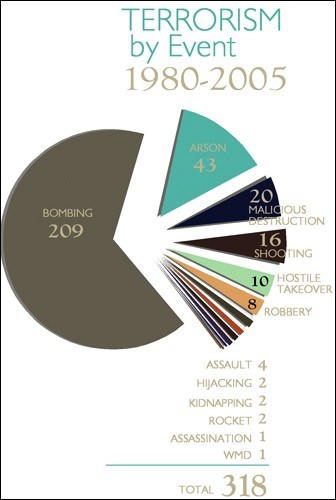
A study published by the FBI – could you get a better US-centric reference? – about the acts  of “terror” on US soil from 1980 till 2005 revealed approximately 318 terrorist attacks that varied in magnitude which break down in the following way:

Terrorism by event USA 1980-2005

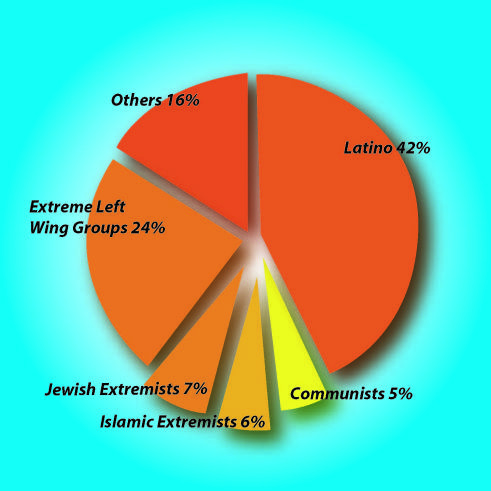
Luckily enough, the numbers and data in that study have been turned into a pie-chart (here) that categorizes all the terrorist attacks by religion/ethnicity/background:

Terrorism Islam USASure, many things happened since 2005. But not all of those things were from Muslims. The above percentages may have fluctuated slightly but they’re still representative. For instance, Jewish extremism has over a period of 25 years committed more acts of terror in the United States than Muslims had. Now isn’t that interesting? Did any American know about this or is it hail-Israel and bomb-the-Muslims all the way?

To back this up even further, CNN published a study about the threat of Muslim-American terrorism. The study was done by Duke University and the University of Chapel Hill and found that the supposed danger of the radicalizing of Muslim-Americans post 9/11 has been severely exaggerated. The level is “small compared to other violent crime in America, but not insignificant.”

Violence Begets Violence:

The more societies across the world shut out, categorize and work against people just because they wear a headscarf or pray in a different way, the more these people will find refuge in doctrines that may not represent their true beliefs. The actively-fueled verbal, moral or even social violence only serves to increase the physical violence of those on the other side of the equation. There could be a linear relation there. Sure, the aforementioned premise is an over-simplification but talking about Saudi or Qatari policies of exporting radical Islam coupled with American policies in the region which help fuel this export will take forever.

Is there a growing trend of radicalizing in Islam? I only need to look at samples across my country to say the answer is yes. But fighting this growing radicalization doesn’t happen by clumping those who haven’t fallen prey to erroneous indoctrination with those who have anti-American, anti-West or anti-non-Islam agendas.

The whole point is: political correctness is perhaps something that we need in a time when it’s very easy to judge and lump people in a batch of stereotypes just because we think we know everything there is to know about them, especially when said-political correctness isn’t really coming from a higher moral ground as much as it’s emanating from actual reality.

Empathy isn’t a one-way street. Those terrorist Muslims are the ones dying in the tens and hundreds daily across the world today and it’s not only because they’re fighting among each other.

So next time someone wants to “kill all the Muslims,” know this: not all Muslims are terrorists and it’s a certainty that not all the terrorists are Muslims – not even half of them.

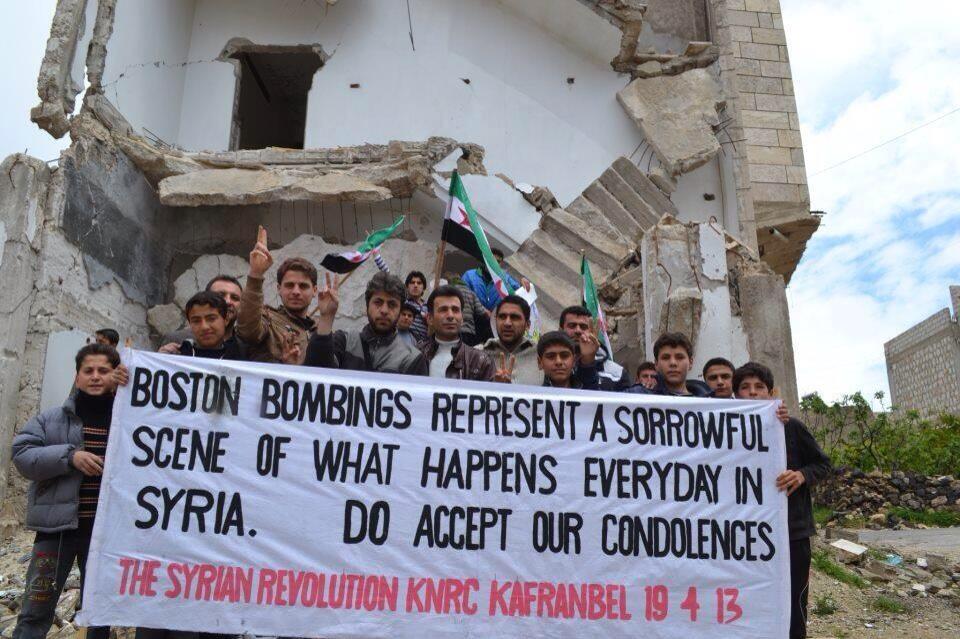
PS: A note from all those big bad Muslims to the people of Boston:

Boston Bombings Syria

Why #ThankBassil Backfired

Yesterday night, Nicolas Sehanoui decided to take his twitter presence and use it in support of another minister in his now-defunct cabinet. The minister he decided to support was Gebran Bassil, one of the FPM’s more polarizing figures. Mr. Sehanoui figured that tweeting some of Bassil’s “achievements” in the ministry of energy and water with the hashtag #ThankBassil would get people talking.

Well, people got talking alright. But it wasn’t good at all. Instead of the hashtag turning into something positive to light Gebran Bassil’s future electoral days, no pun, it became a space for people across the twitter spectrum to express their true sentiment regarding the minister. Saying those sentiments weren’t nice would be an understatement: people are still making fun of that hashtag today, almost 24 hours later.

Many FPM supporters cannot fathom how people can’t get past their prejudice agains this man and look at his achievements. But the reasons for that are actually quite simple. Let me try to list them:

1) Gebran Bassil is simply unlikeable. This is common knowledge among Batrounis, even those in the FPM circle. Many of the level-headed FPMers I’ve spoken to admit that any other “choice” for a battle-candidate in the region would get more votes. Why’s that? Because Gebran Bassil isn’t held in the best regards among those in the FPM, despite what they try to show, and he is not liked enough to get the votes of those who are politically “independent” in the region. Case in point? He lost twice. Another case in point? Even in Michel Aoun’s Christian hayday, he barely managed to get a majority in the caza. Nicolas Sehanoui, for instance, shares Gebran Bassil’s views. But he is likeable enough to get me to maybe consider voting for him. I don’t vote in Achrafieh so there’s that.

2) What is the source of said-achievements? It’s easy to categorize everyone on Twitter as a blind supporter of political parties here and there. Many actually are. But you know what’s also interesting about Twitter? It’s a space for many Lebanese who are fed up to express that sentiment. I am one of those people. I have no problem acknowledging when someone has done a good job. What I have a hard time doing, however, is to believe rhetoric that comes from political sources that have an agenda behind each word they blurt out: every number, every syllable, every point.

3) Have you seen some of those “achievements?” One example that comes to mind is the oil achievement. Am I supposed to be grateful and eternally thankful to Gebran Bassil that Lebanon has oil, something which many of us have known for years and years now? For reference, digging sites were set up in my Batrouni hometown in the 1970s for that matter. Or how about all those dams whose projects have been around since 1960? Are all the achievements non-sensical? Perhaps not. But I don’t trust any Lebanese politician enough to give them blind thumps up.

4) Why should I be thankful to anyone again? I’ve said it before in this article (link) but I don’t want to ever be thankful to any politician whatsoever for doing what they are theoretically required to do, regardless of how well they do their job. If I see tangible improvement in a certain area, which I’m not seeing with Bassil so far, I point it out. If them doing their job is absolutely horrendous, Gaby Layoun comes to mind, then I’ll point it out as well. It is our duty as aware Lebanese people not to get carried away with political hype, especially if it comes pre-electorally, and be critical of what we hear and what politicians do. But never, ever, be eternally grateful for something someone should be doing regardless of what his or her predecessors did. Meaning: when I start practicing medicine, please don’t be eternally grateful for me curing you when you are paying me to do it.

5) Does it even make sense for politicians of the same political party to start thanking each other for their accomplishments on social media? What’s next, have Gaby Layoun thank Minister Sehanoui next week and have minister Bassil thank Layoun the week after that? How is ministerial twitter love-fest remotely acceptable?

6) If you’re from Batroun, you’d know that Gebran Bassil is being paraded around these days almost everywhere. Thank you Gebran Bassil posters are literally everywhere across my region (pictures). Why’s that? Because the man is going around the country, to every single place his ministry has started a project, to make sure the project gets affixed to his name forever. Why is he doing that in the first place? Because he knows he won’t be going back to the ministry next time and he doesn’t want his “achievements” to be affixed to anyone else’s name. Two questions can be asked here: Did he take “accomplishments” from previous ministers? And isn’t #thankbassil another extension of the media frenzy?

7) Last but not least, if you’re from Batroun as well, you’d remember a little book that was also distributed across the region in 2009 ahead of the parliamentary elections to list Gebran Bassil’s achievements. Sounds familiar, right? Well, that little book was not only trashed, it was torn apart by criticism because it was so bloated and full of achievements that were not simply true. That little book was one of the reasons Gebran Bassil lost the elections in 2009. If you’re not from Batroun, now you know.

I met Gebran Bassil a while back at my hometown’s local church hall as he paid his respect to a deceased relative. He is very good friends with my aunt who was his classmates all through school days. He was more receptive to me than I was to him. He even joked that I wasn’t “apparently with them.” I laughed as he tapped me on the shoulder to tell me it’s okay.

For the record, I don’t think he’s a bad man. On the contrary, he seemed quite friendly and I wouldn’t mind having a chit-chat with him sometimes away from all the townspeople who couldn’t wait to touch his holy suit. We might end up at each other’s throat but that’s fine.

However, I do think he is a grating politician. Is he corrupt? Perhaps he is. I can tell you about the old houses being traded around Batroun or  the aquifer water well permits being handed out to people as easy as saying A. But he is definitely not the worst and most corrupt of politicians to roam this country. Batroun has better examples to give to that. Kolestone, anyone?

It all boils down to what Twitter user @MWNader said yesterday: You can buy ministries but you cannot buy chemistry.

Refer to Fouad Sanioura for further details.

Batroun & Keserwan Fighting Over Gebran Bassil

Let’s call it the war of pre-electoral billboards like you’ve never seen before: two regions, many kilometers apart, fighting over the same man with fiery reformative, empowering, pride-filled slogans.

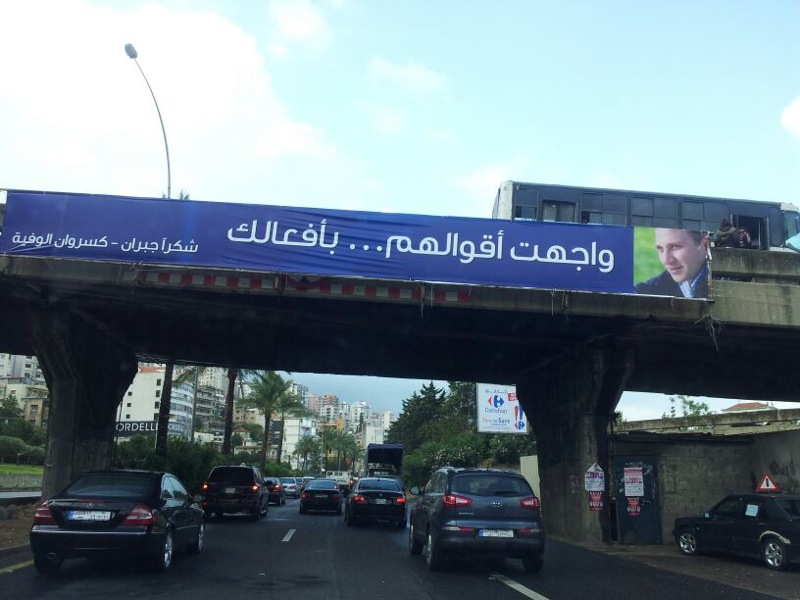
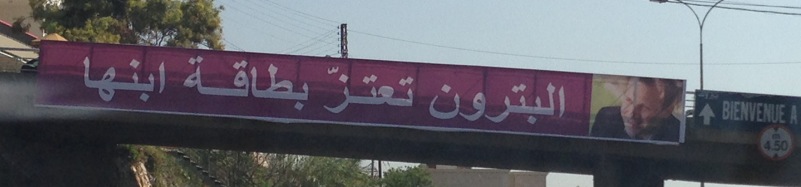
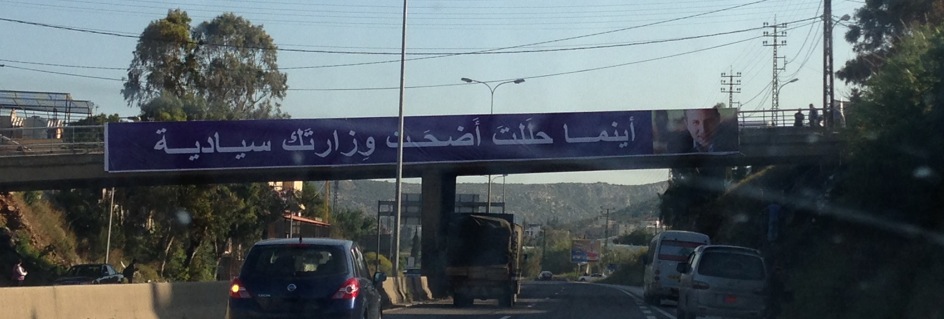
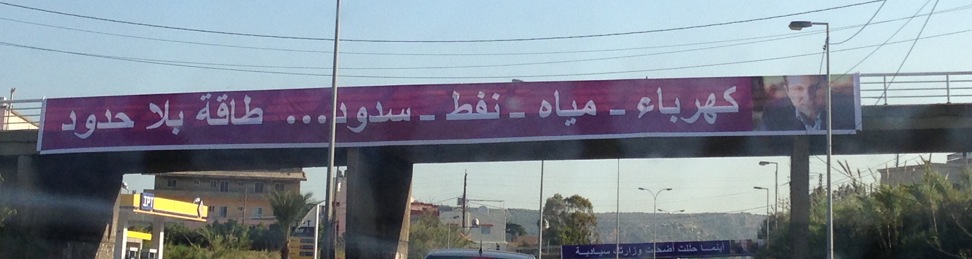
As I was driving back home to Batroun last Saturday, I was surprised to see a Keserwani-centric propaganda for Gebran Bassil all over the bridges stretching across the highway.

Gebran Bassil Batroun Keserwan - 1

Thank you Ismail Sakalaki for the picture

The question couldn’t not ask itself in my head: Is Gebran Bassil running in Keserwan this time around?

It made electoral sense for him to do so seeing as his chances in our home district are next to nil, something even people from his entourage agree on.

But something didn’t add up. Why would I have to answer several polls over the past few months about elections in Batroun in which he was presented as the main candidate for the March 8 side of Lebanon’s political spectrum? Aren’t those polls run by political groups who want to test out how the wind in a certain region is blowing?
And why would Gebran Bassil be doing electoral visits across Batroun to many households and villages over the past few months if he doesn’t intend to run there?

The Keserwani posters seem to have a deeper rumor around them. Let’s call it schmoozing galore. According to this article (link), the posters are the attempt of a Keserwani MP to kiss up to the FPM’s leader in order not to kick him off his prospective list in the region. And you thought our politicians couldn’t be that desperate?

Batroun, however, wouldn’t accept this Keserwani schmoozing, regardless of who did it or why it was being done in the first place. So à la “bring it, b*tch,” we started our own gebranophile campaign across our highway.

Batroun is proud of its son’s energy:

Batroun Gebran Bassil Keserwan - 6

Whenever you land, your ministries become essential:

Gebran Bassil Batroun Keserwan - 3

Electricity, oil, water, dams… energy without limit:

Gebran Bassil Batroun Keserwan - 2

We’ve lived and seen the dams in Batroun:

Gebran Bassil Batroun Keserwan -

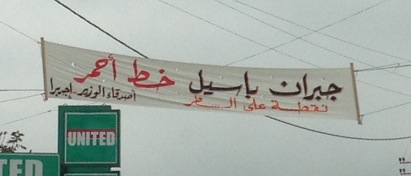
Gebran Bassil is a red line. Point à la ligne:

Gebran Bassil Batroun Keserwan - 5

If only billboards translated to ministerial actions or governmental projects, we’d be one first-world country by now. If political marketing blitz translated into votes, Gebran Bassil would have been in parliament now.

But as it goes in this country, the supplies of any kiss-up material, especially leading up to elections, begin to run dangerously low due to the huge demand. Who’s willing to bet that a counter campaign will be run to discredit any possible accomplishments advocated by this campaign? You know it will only be a matter of time.

So where will Gebran Bassil run? I guess the answer is quite simple: who cares about Batroun when Keserwan, the self-proclaimed heart of Lebanon’s Maronitestan, is vying for you?

As for me, I’m enjoying the billboard cat-fight. Sorry Keserwan, I’m going to side with my home-turf on this. I’m biased like that. Batroun FTW.

Gebran, why don’t you stay?

Let’s Talk About Al Ebra2 El Mousta7il (الإبراء المستحيل)

“Have you read Al Ebra2 el Mousta7il?” One of my FPM relatives asked me a few days ago, a smile spreading across her face like a three year old on Christmas Eve.
“Nope. Have you?” I replied.
“Not yet. But man, I can’t believe how anyone would fathom being with Hariri after it!”
“Yeah, yeah, yeah. I’ll read it when part 2 is released.”

Part 2 is currently in the works as a reply to part 1.

FPMers are having a field day with a recently released book from their MPs, mainly Ibrahim Kenaan which revealed “for the first time ever” some secrets about the Hariri era in Lebanese politics. You can buy the book for $8 at any bookstore. It has more tables in it than a Certified Public Accountant would like to handle and its purpose is more than clear: serve as pre-electoral political propaganda, as is their right.

They have begun to use the term “ebra2ihom al mousta7il” to categorize the Future Movement on their Facebook pages and political websites.

My premise isn’t about the book’s content. It’s about the point behind the book. Who among us does not know that the Hariri era of politics was riddled with corruption? Well, if you don’t now you do. And if you don’t think it did, then your conviction borders on the delusional.

Let’s pretend for a moment that Hariri was the only person running the show from the 1990 to 2005, his government not having any other participant, and ask the following: don’t FPM ministers have their own “ebra2 l mousta7il” from 2005 onwards?

A Western company is suing Gebran Bassil for the way he handled one of the many bids that pass under his ministry. Isn’t that corruption?
The following link portrays severe transgressions of Minister Bassil and Layoun (minister of culture) in Batroun, which MTV is currently investigating, whereby the ministry of culture takes over old Lebanese houses for a very cheap amount of money, gets Gebran to renovate them and sell them for massive amounts. Or how about the diesel scandal that took place last year?

We can also talk about minister Layoun’s disgusting practices in the minister of culture, from allowing the demolishing of the Roman hippodrome to the Phoenician port to many of Beirut’s old houses, including Amin Maalouf’s. How about we look at Layoun’s wealth before and after him taking on the mantle of the ministry?

The aforementioned transgressions are based on a few minutes of research here and there that I, a blogger who doesn’t register on our politicians’ radar, was able to pull off.

FPMers will dismiss this previous link immediately based on its source, as will those who are against the FPM will dismiss their book because their source is very political.

Al Ebra2 Al Mousta7il is not a book for the Lebanese masses because you can’t offer one side of the corruption story in Lebanese politics and expect people who differ from you politically to take you seriously. I will not read Al Ebra2 Al Mousta7il because, despite keeping an open mind (most of the time) to different scenarios in the country, I know for a fact that the other side which the book doesn’t portray, obviously, committed transgressions that may or may not be as severe as the side the book does, in fact, portray. But that’s not the point.

The point is that every single political party in this country has, upon reaching power committed corrupt acts. The point is that blaming the entire country’s financial and economic problems, through a book such as Al Ebra2 Al Mousta7il on one single politician and his party, however corrupt that politician was, is illogical and non-sensical.

Al Ebra2 Al Mousta7il is a book that will get those who support the FPM to support the party even further without even reading the book. Let’s be honest, most FPMers won’t read it and will count on their politicians telling them what the book contains. Those who are against the FPM will dismiss it as nonsense. And come election time, no one will really remember it.

And the merry goes round.

Hariri was corrupt, sure. But Hariri was not the only one who’s corrupt. People with glass houses should not throw stones. Everyone has their own ebra2 al mousta7il.