When Some Arabs View Christian Victims As Nothing But “Kuffar:” Thoughts With The Victims of The Egyptian Coptic Church Attacks

Yes, the majority of victims of wars in the Middle East are Muslims. That is not a matter of debate. But the people who have been dealt the worst hand in the ongoing conflicts in this God-forsaken region are minorities who have been systematically targeted in heinous ways, just because they happen to be different.

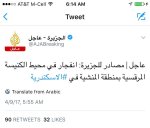
The latest is a disgusting attack on the Coptic Church in Egypt, on a day where they were celebrating. Palm Sunday was turned black, with two attacks, targeting two Churches hundreds of kilometers apart. The victim tallies are sky-rocketing and are already North of 30. Injured are north of 100, with numbers rising the more details emerge.

This is not the first time the Coptic Church is targeted, and it won’t be the last. The last time such an attack happened was less than 5 months ago, in December where 30 people died. The Copts of Egypt aren’t the only minority in these parts of the world to be systematically targeted as well. Between the Kurds, Muslims who don’t fit into the mold, and Christians of the some areas in the Levant, the stories keep unfolding, each more horrible than the one before it.

Today’s attack on the Churches in Tanta and Alexandria are horrible. Those were people with their children, having spent weeks buying new clothes, picking out the nicest candles, excited to be approaching the end of Lent, and full of humility at entering the week preceding Easter. Some of those people had their last celebration today.

The Copts in Egypt are not in a war-zone. They don’t live in a country ravaged by a dictator whose favorite pastime is using chemical weapons on his people. Their only fault is being a minority in a country they were historically integral to, as is the case with all the other minorities in the Middle Easts who have been forcibly turned into strangers in their own homes.

What can I say – or what can anyone say – to the mother who just lost her son? To the father who lost his daughter just as he was gushing over how adorable she looked right there, standing on that Church pew, as he tried to keep her quiet while the priest went on with his sermon? There’s nothing to say.

I am fortunate enough, as a Lebanese Christian, not to have to go through any of the hardships in 2017 that other minorities, which I would be considered to be elsewhere, in the region have to go through. I live in a country of minorities that are trying (their best?) to coexist together and have learned (or are learning), through all kinds of difficult ways, that one cannot exist without the other.

But that is not the case for governments of other countries in the Middle East. What can you expect from governments whose solution to the whole mess is to start a Twitter hashtag (in Egypt’s case, it’s #United_On_PalmSunday), but forget about the policies in which those same governments keep stomping on their own people to prevent them from assuming their natural place in society.

What can you expect from governments who have made sure that religious entities that help perpetuate the notion that anyone who is not Muslim in the Middle East is a disgrace, a kafer, whose blood is halal? It’s not the fault of Muslims, many of whom are as victims of their condition as those minorities. All this blood rests on the hands of kings, presidents, sheikhs and sometimes even priests who thrive under the perpetuation of the notion of kuffar, and the notion of victimhood.

What use is your sympathy when people get massacred this way when in all the days leading up to their killing, you’ve been teaching in books that considered them second class citizens, you’ve been advocating for laws that see them being slowly robbed of their own country, and you’ve been making sure that they’re to be considered as pests in their own home?

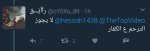
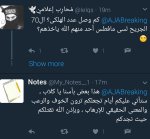
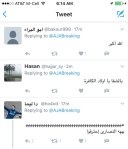
Just look at this sample of responses that news of the attacks in Egypt garnered:

There’s more when these came from. The sample is not comprehensive.

As long as some Arab Muslims look at Christians (and other minorities) in their own countries as abominations, as kuffar, then their countries will never amount to anything decent.

As long as some Muslim “scholars” and sheikhs keep perpetuating the hateful notion that Muslims are the only entities worth of life in their countries, as they shut away all attempts at modernity, some people of their religion will use their holy words to kill others they deem as lessers.

If you’re crying when I’m targeted but go about an hour later to consider me as less a person than you, then you are not even close to being part of a solution. We are not lessers. We are not second class citizens.

It says a lot about the coward pieces of shit who did this to kill tens of people on Palm Sunday. It shows that such cancerous entities are incompatible with any form of the world that we want.

Such abominations refuse diversity, refuse coexistence, refuse anything that doesn’t conform with their code of death. The only thing they deserve is to burn in the deepest pits of hell.

May the souls of the victims Rest In Peace. It’s about time we stand with the oppressed and claim them as people whose lives are worth celebrating when they’re abundant, not in the moment of their demise.

Lebanese Civil Society Triumphs: Naqabati Beats All Political Parties Combined At Syndicate of Engineers Elections

Make sure you download this blog’s iOS app to stay up to date! (Link). 

Tonight, we celebrate. It may not be the national victory we hope to see come parliamentary elections (if they allow us to vote) but every little step towards dismantling the hegemony of political parties over everything surrounding our daily life counts.

That step, today, is the resounding triumph of Lebanon’s civil society movement in the Beirut Syndicate of Engineers Elections, in a list they called Naqabati, represented by Engineer Jad Tabet, over a list headed by Paul Najm, who’s backed by all political parties in power.

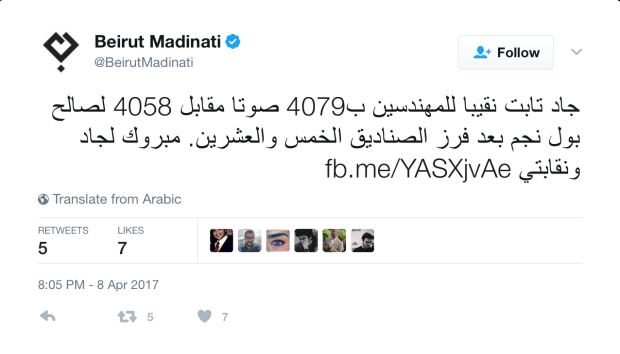
After a grueling electoral day, and a rather quick vote count aided by the use of electronic vote tabulations, Jad Tabet narrowly beat Paul Najm by about 21 votes:


This is a resounding victory. To have civil movement be this victorious over all political parties combined shows that if we’re united, we can achieve the results we hope to aspire at levels we had previously not dreamed of.

Naqabati’s campaign has been exemplary in how syndicates should be running in the country. They’ve been inviting press and engineers to attend their events in which they announced very clear platforms, geared towards giving a chance towards young engineers at making a dent in a field where hierarchy, as is the case in the remainder of Lebanese jobs, is key.

Jad Tabet wanted to help the youth. He wanted to restore his profession’s dignity and rights away from the uselessness of political parties. Today, he succeeded.

This is not a victory only for engineers. This is a victory for all of us to look up to. Yes, we can. Jad Tabet and Beirut’s engineers, thank you for showing us that.

Here’s hoping we can take this victory and turn it into parliament seats in the vote that matters most. We are the change that this country deserves, and we are about to bring it.

Mabrouk Jad Tabet. Mabrouk Naqabati.

Beirut Will Have Super Fast Internet On April 9th, 11th and 13th; Other Regions Starting April 15th

Make sure you download this blog’s iOS app to stay up to date! (Link). 

Let me start by saying this: Imad Kreidieh is the example of a Lebanese official that we need more of in every form of governance. Not only has he put his predecessor to shame in the 8 weeks he’s been heading Ogero, but he has also done so to every single Lebanese politician with how he has been clear, thorough and keen on making sure transparency is key in everything he does.

As such, Mr. Kreidieh held a Facebook live Q&A which you can watch in its entirety here:


In the parts that are relevant to us as consumers without all kinds of tech backgrounds, the highlights are as follows:

  • New plans with faster speeds and bigger quotas as well as reduced pricing should be available in the next 2-3 weeks pending a decree from the Ministry of Telecommunications.
  • Internet will not be as fast as it can be until infrastructure is changed, notably that of exchange sites (or centrals). The project regarding this will have its tender on April 19th with implementation following soon after. Drastic improvements should start being available in the Fall of 2017.
  • Unlimited internet might come back to Ogero users.
  • New ministry decree will slash the one month wait period between switching ISPs (Switching from Ogero to someone else or vice versa).

As for things that we will get to experience sooner rather than a later, Mr. Kreidieh announced opening up all of the possible internet speed in Beirut on three separate days, which will be April 9th (this Sunday), April 11th (next Tuesday) and April 13th (next Thursday).

Each day will see a different part of the Greater Beirut area receive as fast internet as possible, depending on how much your line can handle.

The regions are divided as such:

  • On April 9th: Badaro – Mazra3a – Elissar – Mrayjeh – Jdeideh -Hazmieh – Ras Beirut – Riyad el Solh.
  • On April 11th: Furn el Chebbek, Bir Hassan, Hadath, Amrousiye, Adlieh, Hamra, Choueifat, Nahr.
  • On April 13th: Dawra, Sin El Fil, Chiyah, Achrafieh, Mina el Hosn, Ras el Nab3, Dekwaneh.

Of course, since Lebanon isn’t only Beirut as one of the people asking Kreidieh said, other regions in the country will have on Sunday starting April 15th to benefit from the same event whereby internet speed will be uncapped with each user getting as fast a service as possible depending on how far they are from the exchange.

Faster speeds will be available from 8AM till 8PM and feedback is requested either on Twitter at @ikreidieh, or by emailing ogero on thepeople@ogero.gov.lb or at Ogero’s Facebook account, which you can access here.

April Fools’ Lebanon Style: We Were Promised Better Internet, We Got No Internet Instead

Make sure you download this blog’s iOS app to stay up to date! (Link). 

If you’ve ever wondered how a whole country can be without continuous internet for hours on end, including any form of mobile internet on our smartphones, look no further than the glorious Switzerland of the Middle East, the Democratic Republic of Lebanon, circa April 2017.

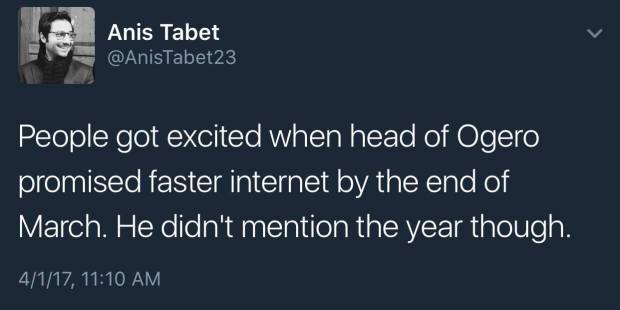
Leading up to this stupendous first day of April were promises of better internet by the end of March. Some people had already noticed their modems syncing at speeds that were, previously, only a far-fetched dream in the country.

As it stands, they’re no longer a dream on April 1st, but probably an immense fantasy more grand than Harry Potter.

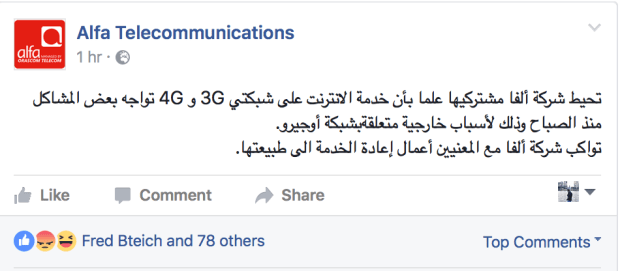
Even as they were adamant to deny the existence of any problem, as they usually do, even our mobile carriers had to admit that this whole business of you frantically trying to refresh anything on your phone to try and see what is up with your connectivity is not on you.

My bitching didn’t even help fix things and I wasn’t alone in my problems:

It turns out that Ogero, the supplier of all internet in the country, was doing some heavy testing which resulted in the entire country being taken off the grid, as per the tweets of Imad Kreidieh, head of Ogero:

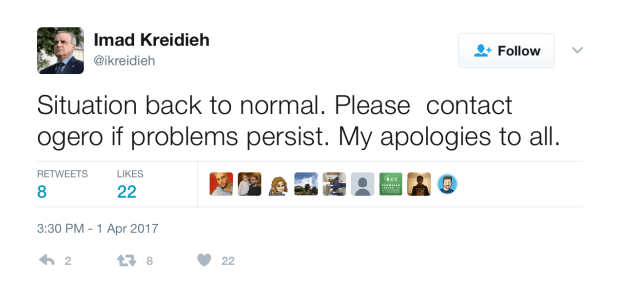
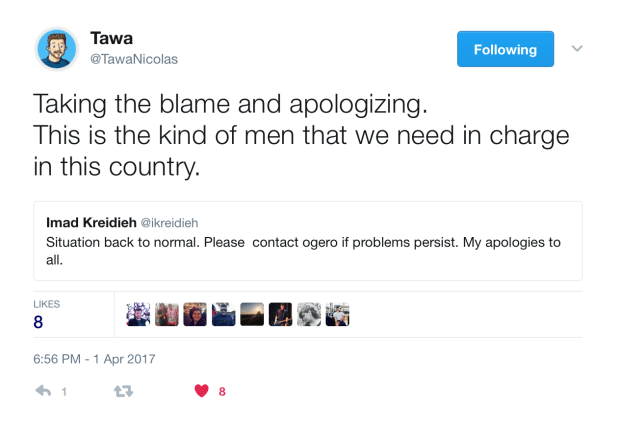
Truth be told, Imad Kreidieh has been doing a tremendous job as the head of Ogero so far. If there’s anything good to come out of this, it’s how he has handled it: he didn’t blame others for the problems of the institution he’s running, he was clear about what was being done, and later on he tweeted the following:

I’m very genuinely taken aback by how professional Mr. Kreidieh is. Is he really a Lebanese person in a position of power? Maybe this is the actual April Fools’ prank being played on us? Tawa Nicolas, the creator of this blog’s iOS app, WHICH YOU CAN DOWNLOAD HERE, said it best:

It’s not all bad though. I mean, think about all those MBs you’ve saved everyone! Here’s hoping that on April 1st, 2018 we would actually have a country whose internet speed is not apparently:

Tomorrowland Is Coming To Lebanon On July 29th

Make sure you download this blog’s iOS app to stay up to date! (Link). 


Tomorrowland is one of the biggest electronic music festivals in the world. Held yearly in Belgium, it’s attended by hundreds of thousands of enthusiasts. This year’s festival is taking place from July 21st till the 30th.

However, on July 29th, Lebanon was chosen as one of only 8 countries around the world to be “United” with Tomorrowland in a live broadcast of the festivities from Belgium in an event that start at 7PM and end around 4AM, in Byblos. It’s not yet clear whether this is in the official capacities of the Byblos Festival.

The line-up has not been announced yet, but based on some research I did on their website, guests can expect an event held in a setting inspired by Tomorrowland (a customized stage, decoration and special effects) combined with a massive well-curated line-up of local & international artists (at least 1 international artist).

The special effects in question are synchronised with the show in Belgium adding value to the global connection.

The announcement took place in the following video:

This event, unless Byblos – or some other festival – bring out the big guns by bringing in a top-notch international act, should be the highlight of the summer’s festival circle in Lebanon. It’s a great image for the country, especially given how tremendous the platform of Tomorrowland is, and it’s a great opportunity for those who can’t travel to Belgium to enjoy the festival itself.

To make sure you get tickets, pre-register at this link.