Shopping Bags at Lebanon’s American Eagle

This is the shopping bag one of my Facebook friends came back with after dropping by for a little shopping at American Eagle. Yes, this is in Lebanon.

While I’m not the most panicky about Israel-related things in Lebanon, I do find this very odd. How were these shopping bags even allowed to be printed, imported and used? Didn’t the workers there notice something odd, like their country’s sworn mortal enemy plastered all over them?

Of course, some people will take this as a sign of American imperialism making love to zionism in the heart of the levant. But American Eagle needs to get their stuff together and get new shopping bags because this, even for people who don’t breathe BDS, is unacceptable.

There Are No More Lebanese Prisoners in Syrian Jails

For years, some Lebanese politicians have been bombarding us with the same phrase: we have gotten word from Bashar el Assad, and his father before him, that there are no more Lebanese prisoners in Syrian jails.

Some of those politicians were squarely in Bashar’s camp. Others had defected “recently” and left behind them all their non-existent dignity. But one thing these politicians have in common is that they got fed the lies of Bashar and threw them up on families seeking closure to a tragic chapter of their lives that never seemed to find its way to conclusion.

An estimated 600 Lebanese were kidnapped and thrown in Syrian jail – dead or alive, we had no way of knowing. 600 with families behind them still clinging to every bit of hope they could get of their loved ones returning alive. Boutros Khawad, Elias al Habr, Ali Abdallah… the list goes on and on.

There are no prisoners left, they said. You need to get over it, they said. You need to forget them, they said.

But how can you ask of families to forget their fathers and brothers? Well, that’s exactly what some Lebanese politicians, in their quest to kiss up to the Syrian regime, have been doing for years.

For years, these families had to withstand their sons getting turned into traitors. They had to withstand hearing their fathers bad-mouthed, turned into filth. And they couldn’t do anything about it. With each passing day, they persevered – even as their struggle was ridiculed. Even as they set up protests that were never heard.

Those families did not block roads to bring back their children. They didn’t ask citizens to wreck havoc to a nation. They suffered silently and hoped their calls would some day be answered.

With each passing day, these families lost hope too.

And then there was Yaacoub Shamoun. There was hope for those families again. And all those lies those Lebanese politicians have been spoon-feeding their followers came crumbling down around them.

There are still prisoners left, it seems.

I’m not sure if hope is the best thing for the families of those prisoners. But if there’s any time to feel ever so slightly optimistic that they could see their loved ones again, it is now. And if I could choose one good thing to come out of the Assad regime falling, it would be for these families to get closure.

It’s been a long time coming.

Dear Lebanese Restaurant Owners “Affected” By The Smoking Ban

For years, you have been making money off my lungs.

For years, you have been forcing me to indirectly gulp down clouds of smoke with whatever I had ordered to eat at your premises.

For years, you made clear efforts at increasing your revenue by introducing various elements of smoking (shisha for instance) that doesn’t even work with most of your menus.

For years, your incessant need to make money in droves has driven your customers in droves to oncologists all over the country.

For years, we’ve put up with your crap. For years, we’ve taken it because we were those whom the law didn’t serve. For years, we suffered and you made money.

But this is unacceptable no more.

I invite you to check this study (click here) which clearly shows a benefit for non-smokers from smoking bans. You obviously don’t care about that because if you did, you wouldn’t have let the situation at your premises stay the way it has been for such a long time.

But that’s not the point. The point is that you want some places to be exempted from the law because it will have an economical effect on them. Clubs, with a smoking ban, would see their business decline apparently.

Would a smoker who likes clubbing suddenly decide not to go clubbing just because he is forbidden from smoking there? No. He would do as any other smoker would: take a mini-break from the dancing and drinking and go smoke a cigarette outside. With the other smokers. Away from my nose and lungs.

Would said smoker be furious at first? Sure, just as any over-indulgent five year old would be once you’ve taken their favorite toy from them. But once they get used to it, they will get over it.

I guess you don’t want that. In Lebanon, a smoker is always right and a non-smoker is always wrong. Things shouldn’t be easy for those who don’t want to smoke. Things should be kept easy for those who want to do so.

But this is not acceptable anymore.

When I was in Paris a few days ago, I was waiting for a table to clear at one of the city’s restaurants when I saw two women walk outside. The hostess asked them: Are you leaving?

They answered: No, we’re just going outside to smoke. And I smiled because that was the first time I had seen that simple act in my life. And I started wondering why can’t we have that in Lebanon as well?

The answer is so evident it doesn’t even need to be illustrated.

It’s high time that Lebanese society – even when it comes to the littlest things such as smoking – stop cutting corners for those who choose to adopt that luxury. And it starts with restaurants.

I invite you to read this little article that I wrote a while back about smoking in Lebanon. It stems from my limited, albeit existent, knowledge in psychology and psychiatry. If your restaurants keep smoking cues available everywhere, then even the harshest of laws cannot reduce smoking rates.

Will the Lebanese smoking ban go into full effect? I seriously doubt – as is the case with any other law in this country. There will be some decent places that will abide by it. Smokers will slowly get used to their favorite places, if any, abiding by the law. But what I can’t stand is a bunch of millionaire restaurant owners worrying about their bottom line.

It’s not their place to worry about the health of their customers, obviously. But I’d rather see a few shisha places out of the few million we have in each neighborhood in Beirut go broke than to see more oncologists hit the jackpot. A little harsh? Perhaps. But drastic measures need to be taken in a country where smoking has become a human right, not a “privilege” as it should be.

The only thing I’d change in the law? Make a cigarette pack $10 and watch the smokers cry.

Dear Fu*ked Up Arab Countries

This is going to be short and straight to the point.

Some Arab countries, notably those who happen to float on oil, have decided to throw expulsion threats at the Lebanese living there if anything happens to their nationals in Lebanon.

It started with Qatar and now Kuwait seems to be following suit. Some Khalijis were even using a hashtag on Twitter recently to get the Lebanese out of their island. They make us feel so loved. “Let the Lebanese out of our countries – they abuse our riches and don’t give anything back in return” was some of what was said.

As if they can manage to run a country to begin with. But that’s another issue altogether.

These countries seem to forget that when their lovely nationals were busy terrorizing it up over at Nahr el Bared, killing our people and army, we didn’t throw threats at them. Sure, you could say we don’t have that leverage. But I’m fairly certain that even if the Lebanese state had the means to buy a national football team, build climatized football stadium and have an income average of more than $100,000, we wouldn’t be as narrow minded, stupid and downright xenophobic as to throw such threats around.

A French national was also kidnapped recently in Lebanon. You don’t see the French state crying like a 5 year old girl over it. On the contrary, they keep their calm together and work towards a diplomatic solution. Simply put, they don’t turn into a PMSing mess.

Why’s that? Because they know that one person doesn’t sum up the whole nation. I’m not sure you’re familiar with that concept though. I’m not also sure you’re familiar with the economic repercussions of the threats you’re throwing around. You think the Lebanese people will suffer for getting expelled out of your country? Perhaps for a short while. But they will manage to find jobs elsewhere – they always do. On the other hand, when your companies become short on workers, will your overly-indulgent nationals accept to work extra hours?

I hardly think so.

Will this be read and reach its respective audience? Obviously not. But sometimes, one has to vent and let it out against those silly countries that some Lebanese want us to love. A place that doesn’t welcome me when the going gets tough is not a place I’d want to be – not one bit.

Conclusion of the recent days: Those Arab countries can only flex their muscles against the countries that they deem lesser than them. When it comes to biceps flexing for the “greater” causes, you see them cower away like the irrelevance that they truly are. I salute you for your riches.

PS: Oil doesn’t last forever.

Lebanon’s Twisted Perception of Beauty

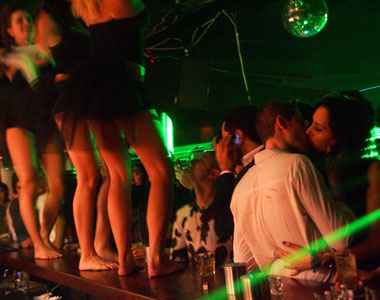
When a journalist wrote an article in the Huffington Post about Lebanon’s babes and botox in its capital, many Lebanese stood against the article in uproar.

This is not us. These are not our women. This is not our city.

Do they have a point? Sure they do. After all, not all our women boast plastic faces as they strut their heels and behinds on the tables of Beirut’s rooftops. But what people seem to fail to realize is that the side of Lebanon portrayed by the Huffington Post is the one we want to get across to the world.

Check out this video from 2011. I have written about it before (check it here).

I disagree with the content of the video. I dislike the categorization of Lebanese joie de vivre as something only related to partying the night away. But when the only face even your ministry of tourism is giving of your country is that of rooftops, nightclubs and night life, what could you expect from a journalist who’s coming to your country to see the supposed highlights your country has to offer?

When you tell someone to come visit specific places in a country and they judge a country based on the places you recommended, you can’t but blame yourself for that.

Even I am guilty of that. Whenever a French person decides to inform me he thinks my country is full of Islamists where women are forced to wear the veil in order to go out of their homes, I go on and on about our nightlife, among other things. And I’m not even a fan of nightlife to begin with.

What David Constable has noticed is a phenomenon that runs deeper than should be acceptable in Lebanese society. Have you ever seen a woman your grandmother’s age with her face so plasticized that she looks downright disgusting? I have seen way too many of those, the last one of them as I boarded my flight to France. Have you seen girls your age who decide the moment they finish high school to start injecting their lips and cheeks? Well, I know some girls like that.

And the list goes on.

No, I’m not saying everyone does it. I’m not saying all our women are plastic. I’m not saying all our women can be summed up with boobs and botox. What I’m saying is that we have a lot of them and what is “odd” is usually the thing that sticks out the most. Simplest example? We don’t notice the calm days we get throughout the year but when all hell breaks loose for a few days or weeks, we judge the entire year accordingly. And we get judged as an “unsafe” country by everyone else according to those days as well.

It’s the same premise when it comes to boobs, babes, botox and Beirut.

A friend of mine, whom I met abroad, has a Lebanese mother and a non-Lebanese father. She has a typical European face: blond, a little nose and green eyes. When she visited her mother’s homeland a while back, she got interrogated by random people on the streets who wanted to know the surgeon who fixed her nose – because no one can have a nose like that – and the place where she got her contact lenses – because no one can have eyes that green.

We have many people who want those little inconspicuous noses that don’t require them to choose a specific side every time them want to change their Facebook profile picture. We have many people who want bigger breasts and asses. We have many people who want to have chest implants to go off all macho. We have many people who want to change their faces, look younger and have bigger lips in the process.

Are those “many” people the entirety of the Lebanese population? No. Are those “many” also present in other societies? Perhaps. But if you look closely, you will find many even among your close friends who have at least had something done – the fact that we can get loans as well to do so isn’t helping. On the other hand, in a one month stay in Europe, I have failed to see as many botoxed babes here or women who dress up for a wedding every day before going to work.

Many in our societies in Lebanon like to show off. Be it through their phones, cars, clothes or even through plastic surgery. And those are the people we like to show the world because they are the ones who help us change the stereotypes others have of us. But with the baggage of the bling-bling crowds comes something else entirely, which is another stereotype: we are a country of fake people.

Are we fake? Absolutely not. Beirut has much more to offer than just that. Lebanon has way more to offer than rooftops and night clubs. But that idea won’t change anytime soon. Especially when the only thing we want people to see in Lebanon when they come here is Gemmayze, Skybar, Downtown and Zaitunay Bay. Demand of  our ministry of tourism to change tactics and to change the way it promotes the country  and then we get to be in uproar over an article turning our entire society plastic.