Lebanon’s Litani River Turns White

First we had the Beirut River turning red.

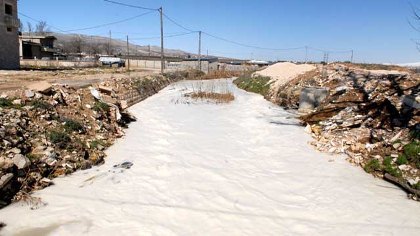
Now it’s the Litani’s time to turn white. It seems Lebanese rivers are drawing Lebanon’s flag. We still need one to turn green and it’s a go. I wonder, what substances can we pour into our water to achieve that color?

While the incident with the Litani did not affect the whole river, the cause has been said to be either the flow of calcified water into the river or some nearby factory throwing in its waste.

Either way, it’s highly likely that we’ll never know what caused this. One thing is certain – Lebanon now has another reason, apart from our snowy mountains, for its name.

Lebanon: A State of Identityphobia

Over the course of this past weekend, I thought I was living – at least for a fleeting moment – in Ireland. The weather was sunny, albeit chilly. It was very green outside, ironically fitting for the occasion to be celebrated, and everyone was excited about St. Patrick’s Day. But then I realized that, contrary to the input I was getting from my senses, I was in fact thousands of kilometers away from Ireland, in a Middle Eastern country called Lebanon.

But this drift in my sensory perception had happened once before. Back in November, many of the Lebanese I knew were excited about Thanksgiving. What do they know about Thanksgiving? Not much, obviously. It was featured in some Hollywood movie and that was sufficient to make it important enough to be imported into their celebratory calendar. “Come join us for our Thanksgiving dinner! We sure got a lot to be thankful for.” The pilgrims and the natives of Lebanon would be very proud, I bet.

If God forbid you asked someone about their plans for Drunk Thursday, you get ridiculed. “You still celebrate that day! Man, it’s so passé!” Or if you ask someone about their plans for “A7ad el Marfa3” [Mardi Gras applies], the same answer follows. The Lebanese “version” of Thanksgiving and St. Patrick’s day has become beneath us, apparently.

Of the many things I do not understand about Lebanese society perhaps the following is the most puzzling. Why is it that we disregard the customs and traditions of our own culture and are so vehemently adopting the traditions of others?

I heard there’s a tomato festival in Spain that happens every year. Why does Madrid get to have all the fun? Beirut could use some non-clubbing entertainment as well!

There’s also this awesome Samba festival in Rio. Why not bring it here? Lebanese women can definitely shake their hips.

It seems that our fascination with Lebanon being the crossroads of many cultures has reached the next level. Instead of embracing the fact that years of our country being a fusion of cultures has led to one that is inherently our own, we’ve started to go on a collection frenzy of anything “hip” that we may find in other cultures and importing it. We’ve got a reputation to keep, after all. What good is a Lebanese “identity” without many non-Lebanese toppings added to it?

We, as a country, suffer from a case of identityphobia. We are so afraid of who we are that we search for anything that could fleetingly satisfy our need for firmness. And then our feet lose ground again before we find something else to cling to. We’re so afraid of our identity that we can rationalize the destruction of ancient monuments that have created who we are as Lebanese.

We are so afraid of our own identity that we also feel the need to become part of a grander scheme: are you Arab or non-Arab? No I’m Phoenician. No I’m Roman. No I’m Canaanite. No, I’m everything but simply Lebanese.

Today is St. Patrick’s Day. Who knows what celebration from which country will become in soon.

There’s nothing wrong with going out for drinks on a Saturday. There’s nothing wrong with having dinner with your family on a Thursday.

What’s wrong is going for drinks on a Saturday because it is St. Patrick’s day. What’s wrong is having dinner with your family on a Thursday because it’s Thanksgiving day.

What’s wrong is us being Ireland one day, the US another, then France, followed by Italy, maybe even Egypt sometimes. Perhaps the sign welcoming tourists to Lebanon outside Beirut’s airport shouldn’t read: Welcome to Lebanon. Maybe the appropriate description should have been: Welcome to the Fragmented Colors of Lebanon – we can offer you anything you want because we have no clue who we are.

Or this can be simply considered a melodramatic rant and St. Patrick’s Day celebrations took place because the clover was mistaken for a cedar. It happens you know.

MTV Lebanon Produces Music Video for Women Rights with Participation of MP Sethrida Geagea

20120318-125915.jpg

MTV has recently unveiled their latest contribution to the current legislative efforts for a law to protect women from all forms of abuse, notably marital rape, soon after International Women’s Day.
To help them advocate for such a cause, they’ve enlisted the help of the female MP who has probably worked the most for such a law to see the light: Sethrida Geagea.

Geagea’s role in the music video is perhaps minimal but it’s a reflection of her commitment to the cause at hand, which brings me back to a point I had mentioned previously: the only way for the women of Lebanon to have true influence is to assert political power, which can only be achieved by voting in more women to parliament, who need to be as energetic and feisty about their rights as MP Geagea is and not a corresponding puppet to the political block they’re part of.

The Lebanese Help: New TV Hosts Ali Mahfouz – The Man Who Beat Up The Ethiopian Maid

The “Lil Nashr” TV show, hosted by Tony Khalife, had Ali Mahfouz as one of its main guests for its Saturday March 17th episode. Mafhouz is the man that beat up the Ethiopian maid in front of her embassy. The maid has since committed suicide.

Using the platform of the TV show, Mafhouz tried to come off as an affectionate man who deeply cared for the girl and was trying to sort out her affairs. He even went further than that and said he would never beat her up and that moment outside the embassy was unlike him.

The rest of this post will be assuming that Mr. Mafhouz was, indeed, acting outside of his character – although I have to say that modern psychiatry and psychology would assert that this violent behavior is, in fact, within his character, whether he wants to admit it or not.

Now, Mr. Mafhouz goes even further and argues that the maid, whose name is Alem Dechasa, was mentally ill and an unstable presence for him and the people she knew. He even cites a coroner’s report that she was having auditory hallucinations while still alive to “prove his point.”

The end result of the episode, which I was able to touch from both my parents, is that many individuals have lost their compassion to the maid and are now seeing her as an insane person, which clears Mr. Mahfouz. He is not in the wrong anymore.

Let’s get a few things straight.

1) A coroner’s job is to examine a dead body for a cause of death, among other factors. There is no way that a coroner (or medical examiner) can tell if the deceased person they’re examining was having psychotic episodes while they were still alive. It is beyond their scope. It is impossible to tell if a dead person was mentally ill via an autopsy and more importantly, there’s no way a coroner would have the authority to write a report containing such information.

2) I am very dismissive when it comes to Lebanese media for many reasons. But I never expected a TV show to host a man like Ali Mahfouz without advocating the victim’s side. This is not how proper journalism works, especially if it’s a TV station that supposedly respects itself. For the entire duration of the show, the arguments of the Ali Mahfouz camp were so front loaded that any attempt to speak on behalf of Alem Dechasa were rendered meaningless. This leads me to point 3.

3) The purpose of the episode, which I’m sure Tony Khalife is very proud of, was not to showcase the Alem Dechasa abuse in an objective manner. It was simply to help clear Ali Mahfouz’s reputation and to convert him from the man who led an innocent woman to her death to a man who was simply escaping the ramblings of a lunatic. Judging by the reactions I got from my parents, which I’m sure echo many other households that decided to tune in, their goal was achieved. New TV must be very happy with themselves.

It is a sad day when a victim’s reputation is tarnished just so an influential Lebanese man can escape the consequences of his actions. A few days from now, the whole affair will be forgotten. It has already started. Those who had thought Alem Dechassa was innocent are now believing the contrary. The rationalization of the Lebanese ego that a Lebanese can never behave this way is starting to work full throttle. The government will soon follow suit, especially as the wheels of Mr. Mahfouz’s “wasta” start spinning.

Alem Dechassa was killed three times. Once when her body was violated in front of her embassy and dragged into Ali Mahfouz’s car. The second time was when she got so desperate and took her own life. The third time was with the Lel Nashr episode that portrayed her as insane. The end result is simple: the victim becomes the abuser and the abuser becomes the victim. Well done New TV. Well done.

Save Beirut’s Heritage: The Roman Hippodrome To Be Demolished

Discovered in 1988, the Roman Hippodrome in Beirut is situated in Wadi Abou Jmil, next to the newly renovated Jewish Synagogue in Downtown Beirut. This monument, dating back for thousands of years, now risks to be destroyed.

The hippodrome is considered, along with the Roman Road and Baths, as one of the most important remaining relics of the Byzantine and Roman era. It spreads over a total area of 3500 m2.

Requests for construction projects in the hippodrome’s location have been ongoing since the monument’s discovery  but were constantly refused by former ministers of culture of which we name Tarek Metri, Tamam Salam and Salim Warde. In fact, Tamam Salam had even issued a decree banning any work on the hippodrome’s site, effectively protecting it by law. Salim Warde did not contest the decree. Current minister of culture Gabriel Layoun authorized constructions to commence.

When it comes to ancient sites in cities that have lots of them, such as Beirut, the current adopted approach towards these sites is called a “mitigation approach” which requires that the incorporation of the monuments in modern plans does not affect those monuments in any way whatsoever. The current approval by minister Layoun does not demand such an approach to be adopted. The monument will have one of its main walls dismantled and taken out of location. Why? to build a fancy new high-rise instead. Minister Layoun sees nothing wrong with this. In fact, displacing ruins is never done unless due to some extreme circumstances. I highly believe whatever Solidere has in store for the land is considered an “extreme circumstance.”

The Roman Hippodrome in downtown Beirut is considered as one of the best preserved not only in Lebanon, but in the world. It is also the fifth to be discovered in the Middle East. In fact, a report (Arabic) by the General Director of Ruins in Lebanon, Frederick Al Husseini, spoke about the importance of the monument as one that has been talked about in various ancient books. It has also been correlated with Beirut’s infamous ancient Law School. He speaks about the various structures that are still preserved and only needing some restoration to be fully exposed. He called the monument as a highly important site for Lebanon and the world and is one of Beirut’s main facilities from the Byzantine and Roman eras, suggesting to work on preserving and making this site one of Beirut’s important cultural and touristic locations. His report dates back from 2008.

MP Michel Aoun, the head of the party of which Gabriel Layoun is part, defended his minsiter’s position by saying that: “there are a lot of discrepancies between Solidere and us. Therefore, a minister from our party cannot be subjected to Solidere. Minister Layoun found a way, which is adopted internationally, to incorporate ancient sites with newer ones… So I hope that media outlets do not discuss this issue in a way that would raise suspicion.”

With all due respect to Mr. Aoun and his minister but endangering Beirut’s culture to strip away even more of the identity that makes it Beirut is not something that should concern him or Solidere. What’s happening is a cultural crime to the entirety of the Lebanese population, one where the interests of meaningless politicians becomes irrelevant. Besides, for a party that has been anti-Solidere for years, I find it highly hypocritical that they are allowing Solidere to dismantle the Roman Hippodrome.

The conclusion is: never has a hippodrome been dismantled and displaced in any parts of the world. Beirut’s hippodrome will effectively become part of the parking of the high-rise to be built in its place. No mitigation approach will be adopted here. It is only but a diversion until people forget and plans go well underway in secrecy. But the time for us to be silent about this blatant persecution of our history cannot continue.

If there’s anything that we can do is let the issue propagate as much as we can. There shouldn’t be a Lebanese person in the 10452 kmthat remains clueless about any endangered monument for that matter. Sadly enough, this goes beyond the hippodrome. We have become so accustomed to the reality of it that we’ve become very submissive: the ancient Phoenician port is well behind us, there are constructions around the ancient Phoenician port of Tyre and the city itself risks of being removed off UNESCO’s list for Cultural Heritage Sites.

The land on which ancient monuments are built doesn’t belong to Solidere, to the Ministry of Culture or to any other contractor – no matter how much they’ve paid to buy it. It belongs to the Lebanese people in their entirety. When you realize that of the 200 sites uncovered at Solidere, those that have remained intact can be counted with the fingers of one hand, the reality becomes haunting. It’s about time we rise to our rights. Beirut’s hippodrome will not be destroyed.