Patriarch Raï Equates Terrorists With Atheists & Non-Religious

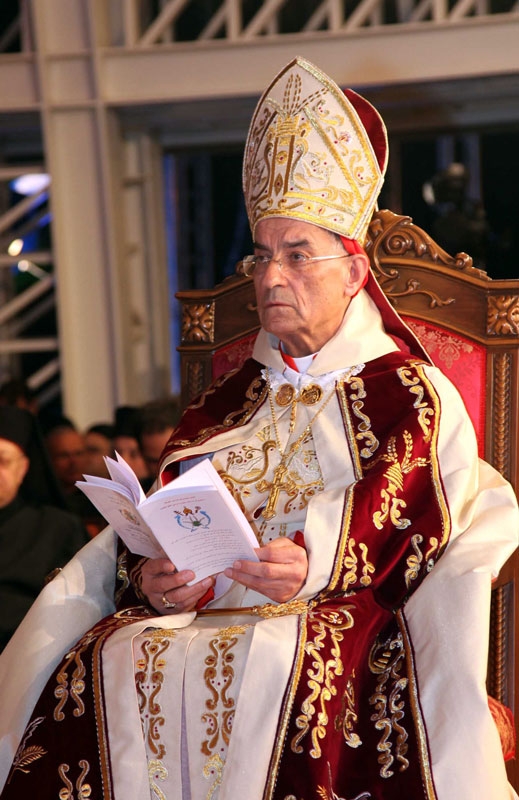
Patriarch Bechara Rai

It’s yet another Sunday in Lebanon and another opportunity for the Maronite Patriarch to offer his words of wisdom, in his weekly sermon, to the ears that would listen. It’s also yet another Sunday in a Lebanon of presidential void, security chaos and with more people listening in to the likes of Raï for possible hints at what to expect in the next few weeks when it comes to political development, the patriarch new quite well the stakes of his sermon. Here’s an excerpt, translated by yours truly, of Raï’s sermon today:

“In this occasion, we cannot forget that the Lebanese family is made up of two components: Christian and Muslim, and it has become a model for today’s societies, eastern and western, threatened by two extreme and opposite movements: religious regimes that aim to eliminate those that are different and to enforce their own faith and teachings onto others, and secular atheist systems which exclude God from society, legislating what they please without any regards of the natural laws of God. We are seeing signs of both these movements in Lebanon…. we demand the government and concerned ministries to issue decrees that stop such practices as is stated in article 9 of the constitution: freedom of belief is absolute.”

Color me confused but I was under the impression that it wasn’t non-religious people that took over Iraq recently, killed people just because they prayed differently. I was also under the impression that it wasn’t the acts of those non-religious people that led to many terrorist attacks, a few years ago, whose repercussions we still live today. Spreading across the Middle East today, and now in Lebanon, is a clear attempt to equate lack of religiosity with the terrorists threatening the fabrics of our society.

I have always been under the assumption as well that the root of Lebanese problems is our twisted understanding of religion. We have always been taught to fear that who is different: Muslims, Christians, Jews and now atheists – who are becoming a more vocal part of society, albeit still squashed by the thunderous voices of religious men whose influence spreads much deeper than to be challenged anytime soon. Secularism wasn’t what built our country, it wasn’t what ignited both our civil wars, it wasn’t what perpetuated the status quo from 1990 till 2005 and it’s not what’s bringing about the Lebanon of 2014.

Today, Lebanon is without a president, without a decent legislating body, without a decently functioning government, without security and without a functioning labor force. Who’s the cause for the mayhem and anarchy that Lebanon is living today? I’ll go on a limb and say, not those very horrifying nonbelievers, but our deeply sectarian system that empowers what Raï is championing. “If it’s not broken, don’t fix it” is the saying. But this is deeply, irrevocably broken.

Religious men of Lebanon like to spread fear. It is what puts food on their table at the end of the day. Patriarch Raï is no exception. By lumping ISIS, Al Qaeda or whatever terrorist group fits the bill with non-believers in one basket, he is doing just that: be afraid of those killing you… and be afraid of those that can challenge your well-rooted beliefs that have been enforced in you for such a long time by your families, by your schools, by your communities and by the likes of Mr. Rai.

What’s threatening the fabrics of Lebanese society isn’t lack of belief. It’s the blind attachment to belief and taking those beliefs to a point where they become maimed, mutilated and unrecognizably wrong. What’s threatening the fabrics of Lebanese society today is people, like Raï, still making people fear the premise of a secular system where people are treated based on their merits, not sect, where their worth is contingent upon who they are as people not on which region or religion they were born in, where equality is assured to everyone and isn’t relative to the inner rules of the sect your parents happened to belong to.

What’s threatening the fabrics of Lebanese societies aren’t some of Lebanon’s citizens becoming more liberal, supporting laws that their parents or parish priests wouldn’t approve of, it’s the fact that the absolute majority of Lebanese don’t challenge their parents’ beliefs or what they’ve been taught at school for so many years or what they’re being told by the head of their sect during a Sunday sermon.

Article 9 of the Lebanese constitution asserts freedom of belief, as Raï pointed out. Freedom of belief also extends to the freedom of not believing in any god and in having a country protect your right of not believing. Raï is afraid of the influence the increasing number of Christian nonbelievers has on his power. Perhaps he shouldn’t as it’ll be a long time before his influence budges. But I’ll let him know this: once upon a time, Mr Raï, I was one of those people that belonged to the flock that calls you their shepherd. I’m so glad I’m not part of that Maronite herd anymore that is susceptible to every word you say. I’m one of those you don’t have power over anymore, and it’s been extremely liberating.

What’s Happening At Zara Lebanon?

Update: AZADEA were kind enough to explain the process of their pricing. Sales and promotions are monitored by the Lebanese Ministry of Economy. If such a mistake were to be found at their premises, the customer is to get the lower price guaranteed. You can also always consult their costumer service in case you encounter such an aberration.

A friend recently sent two pictures my way of people they know shopping at one of Zara’s shops in Beirut and discovering that they were possibly victims of fraud by a chain that many believed wouldn’t resort to such techniques for profit.

Every year, come sales time, retailers slash prices off many of their items in attempts to lure customers into buying. We all fall for it – what’s better than paying a whole lot less for something that, a few days ago, cost a whole lot more?

Except it seems to be possible that some retailers have reverted to a technique that many of us had only heard of before but haven’t seen: increasing the pre-sales price on an item and then applying the sales discount on that, to maximize profitability on the item to be sold.

I don’t know how long this practice has been going on in their premises nor do I know if other retailers in Lebanon also adopt this fraudulent technique to rip us off of our hard-earned money. What it seems to be, however, is that even shopping in Lebanon isn’t the simple straightforward matter that it should be.

Perhaps it’s a typing mistake, perhaps it’s not. But even international brands may not above bending the law when they set ship over here. Today even our markets are in anarchy. With no control, no safeguards, no monitoring and no regulations, who protects the average Lebanese customer from falling to such practices?

Getting Assaulted By A Taxi Driver in Beirut

It was Sunday June 15th, a few hours before starting my final year of medicine, as I headed to the graduation dinner of colleagues at my university. I took the unfortunate decision to go to the location by a “service,” or the cheap fare for taxis in Beirut. The place was within walkable distance on any given day but I was borderline suited up and it was June in Beirut.

The taxi picked up a 25 year old guy who wanted to go to “Hotel Dieu” and drove onwards. He dropped me off next to Banque Byblos on Achrafieh’s main road, facing Sofil, and I gave him 20,000.

That was mistake #1.

The moment he saw the bill, he started barraging me about how I hadn’t told him that I had such a huge bill with me. I looked at him and replied: “it’s just 20,000. What would you have done if I had a bigger bill?”

He didn’t like my reply. Perhaps I should have just ignored, but I have a very low threshold as an individual for unnecessary rudeness. A few minutes later as he held up traffic, under a street camera belonging to the bank or the nearby Dutch embassy, he threw all 1000LL bills at me, so I got out of the car and closed the door behind me with an extra flair. I turned my back and crossed the street.

That was mistake #2.

A moment later, I started hearing shouting from behind me. “I will fuck your mother, you cunt!” I turned around and saw that the taxi driver was addressing me. I turned around and walked onwards. “You cunt, you cunt. Your mother is a whore.” I turned around and immediately gave him the finger. His voice kept rising and the insults kept coming. I gave him a second finger and walked onwards.

That was mistake #3.

I walked down the Sofil road, on my way to the location of the graduation dinner, when I heard the shouting get closer. The guy he was supposed to take with him to Hotel Dieu still in the car, the taxi driver drove his car towards me. A moment later, he was out of his car with a bat and before I knew it he slammed me on the side. It was one of those fight or flight moments we get taught about in biology. I decided to fight. So I started beating him as he hit me with the bat he had.

A minute or so later, I break free as the valet parking personnel of nearby “Le Maillon” come close. The taxi driver then runs to his car and drives away as he sees people getting closer. I hadn’t gotten his license plate number. The guy with him was texting throughout; he hadn’t moved a muscle.

My (brief) medical training allowed me to quickly assess my injuries. I felt blood gushing down my neck and lip. I also felt a bruise over my forehead and shoulder. I hadn’t lost consciousness, nor did I feel dizzy or vomit. I assumed my injuries were minimal so I marched on the dinner.

I was disheveled and obviously shocked. I had never thought such a thing would happen to me. My friends were all smiling when they saw me. Their smiles turned into shock when they saw my bloody neck. They went with me to the bathroom to help me clean up.

The graduating physicians assessed my head wound and decided it was superficial and didn’t need stitches. I let my body’s coagulation system run its course and headed back to the dinner. I decided not to ruin the night for the friends who wanted me there, and I tried my best not to.

A couple of hours later, I couldn’t take it anymore so I headed out to my hospital’s ER room. I entered without going through the personnel at the entrance. I saw familiar residents. They knew me. They immediately asked what was wrong so I explained to them that I needed a medical report of what had happened to me to present it to the police. The ER physician asked me to go open a file, the way any other patient would do. I told him I didn’t have money on me – he couldn’t care less. There was no preferential treatment for their own student there. I paid whatever fee they asked, running out of money in the process, and waited in my own triage cubicle.

I quickly told the resident examining me that there was nothing wrong. I just needed my wound cleaned so I can get on my way. The whole thing took about an hour. I was out of the ER and broke my 1AM. My friend was going to take me to the police to file an official complaint.

The best part of the night was yet upon me.

I arrived to the police station a few minutes later. What do you need, the policeman guarding the door asked. I told him the purpose of my visit and he directed me to the 5th floor. To reach said floor, he pointed me towards an elevator for everyone minus “officers.” The elevator wasn’t working.

I reached the 5th floor and explained what had happened to the personnel there. Their initial reaction was not to ask whether I was okay or not, it was to make sure they understood the precise location of where the assault had happened. The reason? “The location falls outside of the jurisdiction of this floor. Please go to the 1st floor so they can assist you.”

Make sure you go down the elevator to the ground floor, they said, it doesn’t stop at the first. I did as they said.

On the first floor, the personnel there brought up fancy Google Earth. They had underestimated my ability to read Beirut from satellite, telling me I wouldn’t understand what I saw. I pointed them to where the assault had happened. Guess what? It wasn’t their jurisdiction either. I was pointed to another floor.

I went up. It wouldn’t end there. “Did the assault happen on the sidewalk or on the asphalt?” They asked. “Does it matter?” I replied. Of course it did. Their jurisdiction only extended to the asphalt of the road going up from Mar Mkhayel towards Achrafieh’s main street. The assault on me had happened on the way down to Mar Mkhayel… on the sidewalk. So what what I supposed to do?

“You look okay,” they said, “and we’re obviously not going to do anything now. So why don’t you come back tomorrow at 9AM?”

I didn’t return.

Perhaps I had different expectations of how my first police encounter and how my first calling upon the law would work.

Perhaps I was too foolish to believe that those policemen wouldn’t waste an entire hour of my time at 1:30AM in the morning sending me between their office’s floors in their vain attempts to throw their work off on each other.

Perhaps I was too stupid to believe I would actually get the law working for me, in an area with about 100 cameras per squared meter, by simply asking for my right without resorting to my non-existent connections to help push my cause forward.

My friends told me I should have gone the second day and wasted my time because no one will give me my right if I don’t fight for it, but I have to ask: is it acceptable that, after getting assaulted with a bat at a supposedly safe street in your capital, you need to also figuratively fight with those whose job is to supposedly fight for you, wasting your energy and effort at something they told you wouldn’t lead to much anyway?

I guess I’m lucky he didn’t have a gun.

As I was walking down the stairs to exit the police station, I saw those anniversary posters for our internal security forces. “Our job is to serve and protect you,” they said. I just laughed at the irony as I headed back to the car that drove me back home.

Oops, Sorry For “Accidentally” Destroying Your Mar Mkhayel Home

While everyone jumped from one pub to the next in Mar Mkhayel yesterday to catch the first game of the FIFA World Cup, there was a woman there standing in disbelief in the midst of her living room, looking over the streets filled with traffic. She was not looking out of a window.

The Facebook group advocating to Save Beirut’s Heritage (link) is trying to propagate the story of a woman who could have died because of the greed of contractors in Beirut who know there’s no law to hunt them, no regulations to constrict them and no one to tell them they did nothing wrong.

Right next to that woman’s house is a 1920s building which as of yesterday does not exist anymore. In the process of demolishing that building, her own apartment’s walls were destroyed in the process. If that woman had been there while those skilled workers were doing their “job” she would have been seriously injured, if not killed. The wall that was demolished is that of her living room. Her apartment is in a building that’s over 100 years old. The contractor has offered the woman to buy her another apartment instead, but what good would that do when it could have almost cost that woman her life?

Let’s not be gullible and assume it’s an innocent mistake. I don’t know the woman’s name. I don’t know who the contractor is. What I do know, however, is that the practice of damaging houses “accidentally” in order to force their tenants to evict has been going on for a long time in Beirut as the city’s manic rush to exemplify its concrete maze status is pushed full gear.

This isn’t about the value of an old house in Mar Mkhayel, although that’s another topic worth discussing in itself especially that the area is facing yet another round of demolition soon with the Fouad Boutros Highway tearing it apart. This is about the length that Beirut’s real estate mafia would go to in order to get that new “it” high-rise they’re craving for so much. This is about how little the lives and well-being of people mean in the grand picture of millions of dollars in investment being put to remodel the city and make it more chaotic, irregular and without a character than it already is.

A few blogs have already spoken about the issue (here and here), but I believe this is something vital to highlight so here I am trying to propagate it further. Beirut’s Municipality should care less about fencing Rawche at this point and care more about the well-being of the people in the city, the people who are dying because of their total disregard to the illegality taking place here. Lebanon’s ministry of interior should care less about people not having an easy path to World Cup watching and care more about making sure such a thing never happens again.

Yesterday, this woman returned to a damaged home. Some other day, many of us – living in old Beiruti apartments in areas bustling with construction – could suddenly face a reality without home.

These are a few pictures from Save Beirut Heritage:


The Fault In Our Stars (2014) – Movie Review

fault-our-stars-movie-poster

There’s a multitude of ways that movie adaptations of books can go. They can span from an absolute abomination that gets fans of the novel rallied up against the atrocity they see on screen or it can be a very faithful representation that preserves the subject matter in the best of ways. The Fault of Stars is the latter.

Hazel Grace could be your every day 16 year old girl. Her time is filled with reality TV series, while obsessing and re-reading her favorite novel. Except she walks around with nasal cannula connected to a tank of oxygen that she carries around wherever she goes. Hazel Grace has terminal thyroid cancer with lung metastasis. The cancer is held at bay with a wonder drug in clinical trials – but it’s just that: barely held there, capable of getting her fragile body to collapse at any given moment.

At the request of her mother, Hazel goes to Cancer Support meetings carried out at the litteral heart of Jesus. She hates them. You see, Hazel Grace is not your average fictive cancer patient who relishes in the idea of telling her cancer story over and over again, while identifying with those who share her disease. No, she seeks normality in any way she could find. A Cancer Support meeting, however, is where she stumbles on Augustus Waters, an 18 year old boy with a limp. Augustus had been free of osteosarcoma, a form of bone cancer, for 14 months now. Full of positivity and always upbeat to Hazel’s constant demure, Augustus sets out on changing her entire perspective on life… even about the significance of a cigarette between one’s teeth.

As I said yesterday, it’s easy to dismiss The Fault In Our Stars as a tale for hormonal teenage girls. But this movie is anything but. It’s gut-wrenching, exceedingly tough to watch at times for an average viewer who has never been exposed to the atrocities of cancer that are represented in the most real of ways on screen. Sure, there are some inescapable cliches here and there, but the people I watched the movie with – not hormonal teenage girls, for the record – all found the movie exceedingly tough to watch. It’s not the kind of tough that makes you feel run over by a truck once the credits roll; It’s the kind of tough that – for a moment – gives you a perspective over how lucky you are to be sitting in that cinema chair, not with a nasal cannula as your main way of breathing.

The Fault In Our Stars is bolstered by a pair of great lead performances that elevate it to what it is. Shailene Woodley, on a cinematic roll with “The Spectacular Now” and “Divergent,” is an absolute wonder to watch on screen. Not many young actresses can pull off the role of Hazel Grace the way that she does. The nuances with which she infuses her character are A-rate. The camera lingers just a little longer for a lot of moments on Hazel Grace’s face – those moments help you encompass the scope of the emotion span that Woodley’s character is going through. They also help you make sense of how it is to be those characters, living those lives.

On the other side of the cinematic lead is Ansel Elgort, whose first major role came in the atrocity of a movie called “Carrie” and who also shared screen time as Woodley’s on-screen brother in “Divergent,” is a reveal. While most of us knew Woodley had the cinematic chops to carry on the role with an Academy Award nomination under her belt already for her role in “The Descendants,” I – for one – never thought Elgort would pull off Augustus Waters as well as he did. He spans the entire shades of his character throughout the movie effortlessly, from positivity to fragility, from strength to weakness. He balances Woodley’s act in the best of ways.

The movie wouldn’t be as it is without the decent screenplay that it has. Those who are wary the movie might have ruined the book need not be afraid as John Green had a lot to do with the screenplay at hand. Another entity that could easily be overlooked for The Fault In Our Stars is the stunning soundtrack it bolsters. I personally can’t get enough of some of the songs there – so make sure you give it a listen.

At the end of the day, The Fault In Our Stars is a movie about human fortitude. It’s a rare thing to have such a theme embodied on screen and this movie does a great job at it. Is it for all tastes? Probably not. But it’s also not as easy to dismiss as many would like to. The Fault In Our Stars the kind of movies that stem power from them being truthful, realistic and – ultimately – human. Go watch it. Okay?

8.5/10