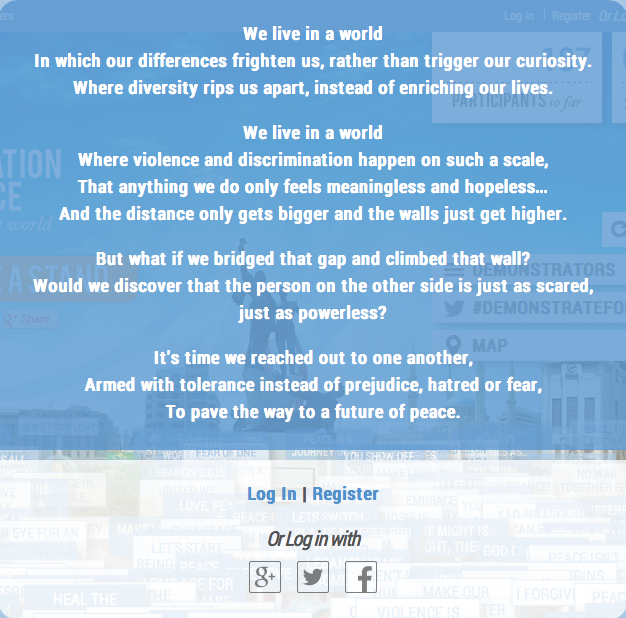
Demonstrate For Peace, Live from Beirut, Online

Demonstrate for Peace Beirut

The next age of protests is upon us. A new initiative has made its way online today, called Demonstrate for Peace, which calls on an online gathering on September 21st in order to protest for peace. It will be the first of its kind. It is orchestrated by the United Nations.

You can join the movement by following this link. This demonstration, despite the website listing Martyr’s Square, will not take place in any physical locations in Lebanon but is simply Lebanon playing its part in International Peace Day.

I have to ask: what effect could such a rally truly have? Is an online protest as efficient as a real life one that requires people to go down to Martyr’s Square and ask for peace using their voices, not their keyboards? Or does the UN know that such protests may not be as effective or as enticing to people?

I’m not really sure what a protest such as Demonstrate For Peace could do, especially that real life protests – complete with bloody faces – in this country have failed to do much as a general rule of thumb. But I guess there’s no harm in logging in with any social account and expressing the simple and extremely important need to live in peace, especially in a country like ours. I assume we’ve all come to appreciate the beauty in the quietness of these past few days, which have been oddly calmer than their predecessors.

Demonstrate for Peace Beirut 2


Let’s hope that those who actually dictate peace log in as well?

Nadim Gemayel, Yalli Khallaf… Meit

I grew up hearing about Bachir el Gemayel – the man of hope for many people – a hope in a country they wish they had. Many of the people I know still look upon his memory and get an undeniable feel of nostalgia on the days when they really believed in the potential of the place they call their land.

I never got the hype. I always thought it’s better to live in the “now” than in the memories of days long past that will not nor can they ever return. For many though, the hope of Bachir lived on with his son Nadim. Today, however, I have to tell those same people who look upon Nadim Gemayel and say “Yalli khallaf ma meit,” hoping he’ll be the man his father was, that on the contrary, yalli khallaf mesh bass meit… Meit w sar trab kamen.

I’m not sure if it’s Nadim turning a show of force from his bodyguards as a personal attack against his sanctity. I’m not sure if it’s Lebanon’s security forces dragging the activists with whom the altercations happened to investigation today, arresting many of them in the process. I’m not sure if it’s the absolute naivety with which he handled the event at hand and expected to get away with it with his reputation unscathed. I’m not sure if it’s his apparent need to be in some form of spotlight… And what better spotlight than a presumed “assassination” attempt by the people opposing the unjust extension of our parliament’s mandate. But Nadim Gemayel has fulfilled what I always thought he would do.

This is the son of a man who supposedly called for democracy and safety.
This is the son of a man who called for the rights of his people, for them not to live in terror, for them not to fear those who think are “higher” than them, for them not to be constantly fearful and paranoid. Yes, yalli khallaf meit.

This man who belongs to our age group, who should understand the struggles of the youth, who has lived his fair share of struggles against long-standing regimes and who was victim of such practices isn’t only doing them onto the people who look up to him but actively trying to turn them into his own brand of Hollywood fiction. But here’s a news flash to Nadim Gemayel: this isn’t a Stanley Kubrick movie.

If Nadim Gemayel were the politician he thinks he is, he wouldn’t have just called away his bodyguards but fired them as well. If he were the politician he thinks he is, he would have resigned from parliament and been there chanting with those same activists for his and their rights as Lebanese citizens, for elections that would keep democracy in this country alive and for parliament members who don’t need to hire henchmen in order to feel safe – who only need a sovereign state empty of militias in order to move around the country and have unannounced dinners here and there.

Nadim Gemayel will get elected again, there’s no denying this. Whoever say otherwise are deluding themselves. This event will only put a fixable dent in the armor of the son of Bachir el Gemayel as he basks in the glow of his father’s memory, not daring to move away from it. What Nadim el Gemayel doesn’t know is that he is killing his father’s legacy with his practices. What he doesn’t know is that his father would have wanted him to build his own legacy that is very very different from the man Nadim Gemayel has become today.

Yalli khallaf meit. It takes more than just chromosomes and a similar face to fit into the legacy of the man that made you. And there’s no person more disappointed today than the man who made Nadim.


Saving The Jesuite Garden… because It’s Christian

20130620-100833.jpg

I always thought everyone knew that Beirut had a green space problem. The city has 3 parks that are open to the public. You can count the trees on the entire city’s sidewalks. There is no concept of urban planning. And there’s certainly no functional public transport system, which is one of the main flaws with the city structure.

Yet there are people who think all is fine with the city environmentally. Don’t be shocked, yes they exist.

The fight to save the Jesuite Garden, which culminated in a protest held at the garden in question slightly less than a week ago didn’t take much to go down sectarian lines. The representative of the Beirut municipality that showed up at the protest had one line of interrogation to throw at those who didn’t want the garden removed: what’s your name? Where are you from? Who’s politically backing you?

Because, you know, God forbid a fight to save a park is exactly just that: a fight to save a green space.

Interestingly, for many – the fight wasn’t to save a green space. Many protestors against the park’s removal don’t even care that this is one of the few areas of green space in Beirut. They care that there are ancient Christian ruins there… And that might be exactly what is needed to save the park.

It’s one thing to tear down a tree. It’s even one thing to tear down a Phoenician port, a Roman hippodrome or any other old structure. But once religion comes into play, all projects are off. Do not even attempt. It happened with the Beirut Downtown site recently and it might happen again here.

The bottom line when the religion card is played in such cases often turns out to be positive. It might be even smart to cash in that card whenever possible. But is it healthy to coerce a municipality to save a park just because they don’t dare to awaken a sleeping monster not because they, as a municipality, should become aware of the problems such a destruction would cause?

The municipality will end up not learning anything for future practices later on or even possibly thinking about some plans to really tackle the issues that necessitated the park’s destruction.

Till when will the focus of individuals in this country be religion-centric, ignoring other facets of society that affect their lives as well and which are worth speaking up for?

I don’t want the Jesuite Garden gone not because it has a derivative of Jesus in its name and on its grounds. But what do I know, I guess. Talking about a temporary fix for parking and destruction of green spaces sure pales in comparison to Jesus.

The Destruction of Achrafieh’s Jesuite Garden

While walking around Rome with a friend yesterday, he said the following: “you know, it’s a beautiful city but I wish it had more trees like Paris.”
I replied: “We’re ones to talk. The only trees I’ve seen in Beirut are in the Jesuite Garden next to my apartment in Achrafieh.”

I guess I jinxed it.

A highway tearing Achrafieh in two, removing countless parking spaces and destroying greenery that is otherwise rare in Beirut was not an enough project for Beirut’s municipality.
They now want to destroy the Jesuite Garden in question, which I wrote about before, in order to build … *drumroll* … a parking space (link).

The municipality is trying to sugar-coat the deal by saying they will replant trees above the parking, which will be underground. But how is that acceptable when the park has been around for decades and has ruins in it that date back to ancient times as well?

Is there a parking problem in Achrafieh? Sure. Is the solution for that problem killing off one of the few rare green spaces in Beirut? Hell no. I have absolutely no idea who’s the urban planning expert working at that so-called municipality but how inept is he at his job?
But what can we expect, really, when experts from Ile-De-France try to convince the municipality that its practices are unacceptable and still they go through them?

It’ll be one sad day when this park where I broke my arm and where my grandpa used to take me to play becomes a mass of concrete rubbish. But isn’t that what Beirut really is?

The Conclusion of Dahye’s Missiles: Tripoli Is Not a Lebanese City

2 missiles fell in Beirut today, targeting Hezbollah’s stronghold Dahyeh. Nobody knows why the missiles were fired.
They could be to serve as further proof for the need to extend parliament’s mandate. They could be to show that Hezbollah’s involvement in Syria is not inhumane but very needed.
They could have a multitude of reasons. But I don’t really care.

Minutes after Dahyeh was hit with the two missiles, the level of panic rose to enormous levels. Lebanese media was all over it with live coverage from the sites of the missile launch, conspiracy theories along the lines of المؤامرة على سوريا were being thrown around, to name a few.

Our minister of interior Marwan Charbel was the first Lebanese official to visit the site in question. More will soon follow because can you imagine them not visiting an area that was just targeted with two missiles?

Guess again.

Over the past week, the capital of North Lebanon was hit with thousands of missiles and mortars, 1200 of which fell in one single night.

How many official visits happened to the city? Zero.

How extensive was the media coverage for the battles? Let me quote a friend of mine who has been following the news very closely: “I was honestly convinced the electoral law was the most important thing taking place today.”

Did you know that snipers are still shooting aplenty across the city?

Even the politicians of Tripoli were quicker to condemn the missiles of Beirut than the missiles of their own city.

Ladies and gentlemen, we have reached the realization we’ve all been pondering over for a long time now. It may be within the confines of our beloved and much-spoke about 10452km2 but the Northern city of Tripoli might not be effectively part of this country at all. And we never had such temporally close examples to back that claim up.

We complain about some media’s hypocrisy in the way they talk of the region’s conflicts. And yet we do it, and we keep doing it. The missiles that hit Tripoli are not as important. The latest toll of 31 dead which fell in the recent battles is not important. The reasons why Tripoli is being victim for repeated battles are never spoken about. The citizens of the city who live in terror for days and nights are never really cared about. They are as irrelevant as the city they call home.

What is this Lebanon you speak to me about? Hold on while I push the snooze button on Dahye’s missiles and the 3 injured Syrians who are on their way to rehabilitation.