Beirut Goes To Storybrooke

20130320-092042.jpg

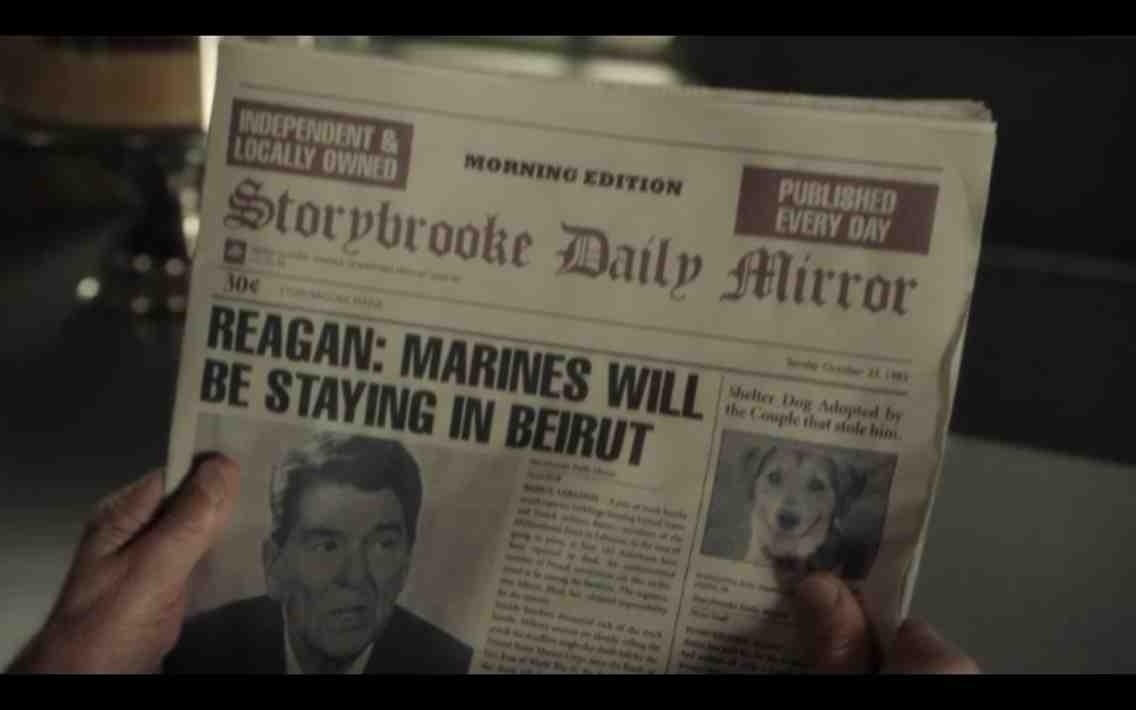
While watching the newest episode of American TV Show “Once Upon a Time,” which flashbacks to the earlier days of Storybrooke, one of the characters was reading a newspaper in which former US-president Reagan is declaring something regarding the Marines in Beirut.

For those who don’t know, Once Upon a Time is a very creative and interesting show by the creators of LOST, which is one of my favorite TV shows of all time (despite the lackluster finale). It’s about every single fairytale character you could think of and how their stories intertwine as they are taken out of their world and into ours where they live in the town of Storybrooke, without any recollection of their previous lives.

Of course, the plot has definitely thickened and gone much darker since the show’s early days but it’s always interesting how they manage to weave together stories you never thought would have any relation to each other: Snow White and Hook, Little Red Riding Hood and Snow White, Jack (the one with of the beans) with Hook, Rumplestilskin and everyone else, etc….

It also offers a whole new “perspective” to the stories we grew up reading – can you imagine for a second that Snow White may have been the reason her stepmother went bad?

If you’re not watching Once Upon a Time, I highly recommend you start doing so – not because of their irrelevant mention of Beirut which lasts less than 1 second but because the show’s premise is very different from everything else out there.

The Death of the Lebanese Dekkéné

Rue Aabrine Beirut Lebanon

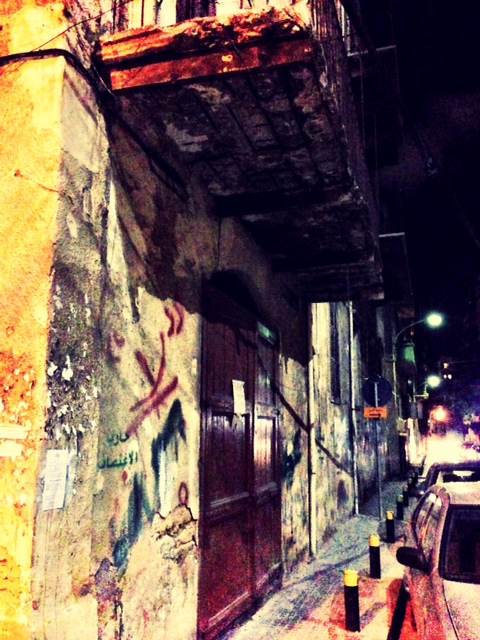
Aabrine Street was, until recently, one of the last remaining Achrafieh streets that still contained a flair of an old Lebanese life that you wouldn’t believe still existed in Beirut, especially Achrafieh: one where a family lived in the same building which had a dekkéné that they ran. Their house harbored them for decades – all through the civil war.

Their house’s entrance is very inconspicuous. The cats roaming around the place hid in the space of those traditional windows. The family took care of them. I went to their place a few times: high ceilings, old chandeliers and armchairs… what you’d expect to find in old Lebanese houses in the village was there. Except this was the heart of Beirut.

Their house was also the witness to the Civil War story I wrote on this blog in 2011. You can read it in its three parts here.

Their home is no longer theirs as some investors took over the entire stretch of buildings on their block, all of which are old buildings. But this isn’t Amin Maalouf’s house for it to cause a ruckus.

Beirut Aabrine Street Old Bldg Beirut Aabrine Street old building 2

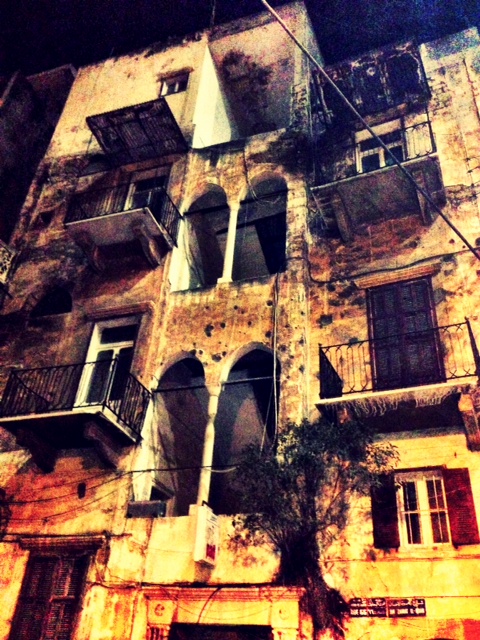
As I walked by the house yesterday, I was saddened to see all the dark, empty windows. What used to be lit apartments and the voices that emanated from inside is now nothing but emptiness awaiting for it to become non-existent.

The family that lived in that apartment lived off a small dekkéné at the other side of the building which stretches down the street by being connected to lesser maintained parts. This dekkéné allowed their father to send many of his children to the United States where they got naturalized shortly after the civil war ended. He ran the small place for 50 years. He played cards with my grandpa and other Aabrine men as customers came in and out – Tarnib Koubba in case you’re wondering. Backgammon tables were there as well.

Dekkane Beirut Aabrine Street Lebanon

Today, the door of Sassine’s dekkéné holds a paper which he signed to announce that he had relocated. Another small office a few meters away, in that same building, announced the same thing. This dekkéné, which by the looks of it could fit anywhere but in Achrafieh, is gone for good. It still stands. But not for long.

The building that contained the dekkéné and all the nearby buildings connected to it will soon be demolished to allow another colorless high rise in their place. The history of the place will be gone for good. The place where my grandpa played cards with his friends, where small children would run to get their mother something she urgently needed for the tabkha she was cooking will be gone and with it another chapter in the life of a city that will soon not recognize itself anymore.

This isn’t about the worth of the dekkéné or its efficiency – it’s about what the dekkéné signifies: how easily we tear down what is old to bring in what is newer but never better.

This is the other side of the building in question, less maintained than the section where the family lived:

Aabrine Street Old Building

Beirut Rue Aabrine old bldg

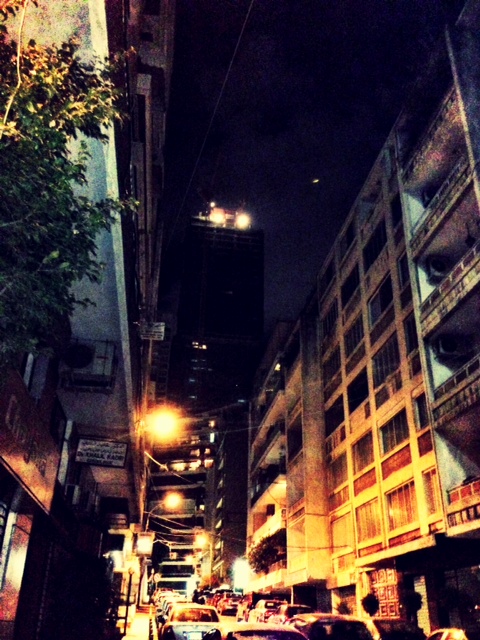
And this is what the dekkéné and its building will be replaced with. Beautiful.

beirut achrafieh high rise

Lebanon’s Mall Centralization

With the news that ABC is opening another mall in Beirut, set for a 2017 opening, it dawned on me: bureaucracy isn’t the only thing that’s centralized in Lebanon. Malls have their own centralization as well: I will call it Mall Centralization: Al Markaziye Al Malliyé.

Prior to ABC’s grand Verdun-related unveiling, CinemaCity had announced that they will be bringing their cinema experience to Beirut Souks, a souk-mall hybrid that we are all familiar with.
With that, let’s look at the total tally of malls and cinemas in Beirut and immediately around it:
– LeMall in Dbayyeh
– ABC Dbayyeh, less than 200 meters from LeMall
– CityMall, a few kilometers from ABC Dbayyeh
– ABC Achrafieh, a few kilometers from CityMall
– LeMall, Sin el Fil, a few kilometers from ABC Achrafieh
– Beirut Souks, a few kilometers from ABC Achrafieh
– ABC Verdun, a few kilometers from both Beirut Souks and ABC Achrafieh.

All of the above malls have (or will have) multiplex cinemas in them as well.

Which other Lebanese cities have malls other than Beirut? I can think of Saida and that’s mainly because it’s Mr. Hariri’s hometown. If you go North from Beirut, you will find no malls and no cinemas until Las Salinas in the North and City Complex in Tripoli, both cinemas only with the latter having a few stores here and there and both of which are nowhere near decent enough to show movies.

Tripoli is Lebanon’s second biggest city and hasn’t had any major construction projects that found their way to completion even during the periods when the city didn’t experience the clashes that take place today.

And let’s assume Tripoli is a big no-no for political reasons, despite that being downright despicable, what’s wrong in having similar development in Batroun or Jbeil? You know, something to serve those who don’t want to drive an hour in order to watch a movie to buy a shirt.

So while places like Beirut Souks ruin the idea of an old fashioned Souk and while places like ABC Achrafieh overcrowd neighborhoods that are already beyond crowded with cars and traffic, someone saw it fit to add another mall in an empty space in Beirut. Because the city absolutely needed one.

I won’t go into how malls affect negatively smaller retailers that create bustling streets and bring life to some aspects of urban life in Beirut. A metropolitan place like Beirut should have malls and such projects, there’s no denying that.

But the question is the following: What’s Lebanon’s Mall Centralization limit?

I say it’s until every single empty space in Beirut runs out.

Other places in the country don’t (and won’t have) have similar developmental projects hat would bring jobs and some economic life to arguably an entire region.

Flipping the coin of Lebanon’s mall centralization, and in broader terms the centralization of capital, economy and development, is rise in poverty and consequently extremism. But there’s no point in caring – Beirut is getting a new mall soon. The other twenty right next to it were not enough.

Details On The Guns N’ Roses Concert in Lebanon

Guns N' Roses concert Lebanon Beirut

You all know that one of the world’s best rock groups is coming to Lebanon. Well, I’ve got some extra details for the concerts that you might be interested in.

  • Location: Forum de Beyrouth
  • Date: March 30th,
  • Ticket prices: General Admission: 55$ or 82,500 LBP, zone A and B (Green): 100$ or 150,000 LBP, zone A (Blue): 120$ or 180,000 LBP, golden Circle: 150$ or 225,000 LBP, zone A and B (Pink): 200$ or 300,000 LB, lounge Access: 200$ or 300,000 LBP.
  • Ticket sale: Begins February 25th (tomorrow) from Virgin Ticketing Box Office
  • Bande’s lineup: Axl Rose, Dizzy Reed, Chris Pitman, Frank Ferrer, Richard Fortus, Tommy Stinson, Ron Thal, DJ Ashba.
  • Doors open: 6 pm.

A presale for those of you who are very interested is currently available through this website (click). You can call 70488170 or e-mail them on Info@Presella.com.

You can now buy the tickets from Virgin by clicking on this link.

This is the link for the Facebook event.

Thank you Frodo’s blog (link) for the info.

Ossit Sawani (Blind Intersections) [2013] – Movie Review

ossit-sawani-blind-intersections movie poster

Never since Nadine Labaki’s first movie Caramel have we had a decent Lebanese movie that doesn’t dwell on the Lebanese Civil War and Lebanon’s religious diversity. Some moviemakers tried to branch out and portray other aspects of society but their handling of the issue was either too shallow, too pretentious or downright silly. Until this came along.

Ossit Sawani – its English title being Blind Intersection – is not a movie about religion or the civil war. Thank God for that. It is the cross examination of the lives of three main people in Beirut as they go about key moments of their lives. Nour is an engineering student who is about to graduate when she loses both her parents in a car accident. She is left to take care of her elderly grandma with no financial means to do so. Karim is a young schoolboy who is the victim of maternal abuse and repeated child molestation as his body is sold for the next door grocer. India is a well-off western-mentality woman trying to conceive while attempting to give back to her community by teaching needy students at one of Lebanon’s government-run schools.

The movie is the story of how the lives of these characters intersect without them realizing – how the actions of one affect the other and shape their lives indefinitely. It is not a plot device that you haven’t seen before but it is the first time it’s used in a Lebanese movie. The scenes are jumbled and do not fall in chronological order. In a way, each character’s story has its own timeframe and you need to situate yourself accordingly in order to understand what’s happening.

Some of the scenes were a little dragged out or unnecessary. Other scenes felt out of the place but once you get into the mindset of what the movie is trying to say, it flows rather smoothly despite a few hiccups after an admittedly strong opening sequence with Nour going to the hospital where she finds out both her parents had passed away.

In a way, Ossit Sawani may not feel like a Lebanese movie at all because of what we have come to associate Lebanese movies with. But it is one. The city is Beirut. The dialect is Lebanese (I still don’t get why they feel like they need to give us English subtitles). The people are relatable. From a child trying to block out the sound of his mother having sex in the next room to shower sex scenes to subtle portrayal of the act of child molestation, Ossit Sawani is quite daring for what we have come to assume Lebanese movies are limited for. The extent that this movie goes to with regards to sex is proof enough that other movies such as Beirut Hotel were not banned because of nudity but because of their underlying political message.

Ossit Sawani is enjoyable enough for it to be worth the admission price but it eventually falls off very flat as the stories never seem to find a way to be resolved, open-endedness being another plot device employed. While that worked in Nadine Labaki’s Caramel as you felt the story arcs had sufficient material to feel substantial enough, the three stories in Ossit Sawani never feel complete or resolved, leaving you feeling let down as the credits start rolling.

Is it the Lebanese movie to bring the masses to the cinema? I doubt. At the end of the day, it attempts to be a gut-wrenching portrayal of modern Lebanese society woes but comes short. It tries to infuse a little humor here and there with some characters but the story is too grim to have that work as well. Ossit Sawani could have been much more than it turned out to be. However, it is a good sign that some Lebanese filmmakers have decided to branch out from the mold and actually do a decent job at it. Give Ossit Sawani a chance – you might be positively surprised.

3/5