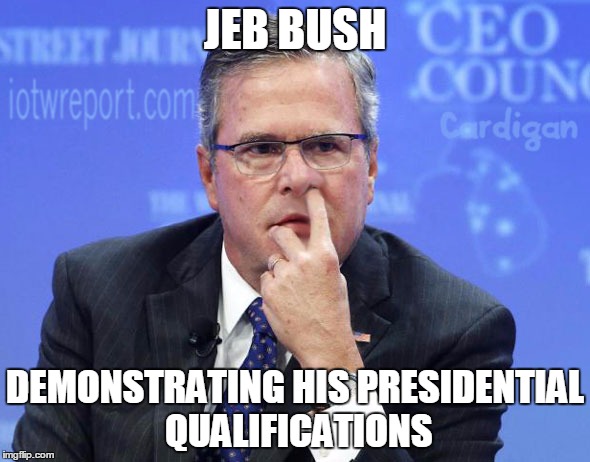
US Presidential Nominee Jeb Bush on Lebanon: “If You’re A Christian, You’ll Be Beheaded”

Jeb Bush

The joy of Republican primaries unfolds as their latest took place yesterday, right on their safe haven Fox, in yet another scene of Donald Trump and, to a lesser extent, his friends making fools out of themselves for everyone except their base, much to the shock of the entire world and the dismay of the intellect of a few billion people around the World. Yet again, what’s new.

Their discussions veered from building walls to stop Mexicans from entering the United States, to throwing a few million immigrants out of the country and back where they came from, along with a few pinches of homo and xenophobia before going on about how comprehensive healthcare and equality are the satanic manifestations of the coming of the anti-Christ.

Sure, such topics are interesting to discuss in times when you’re just bored out of your mind with Lebanon’s stagnant politics that you feel like talking about something that’s stimulating to a certain extent. Did you know politics can be more than just the whole “to be or not to be” mantra? For years, I had no idea.

Except yesterday, while trying to score a few points in a growingly depressing campaign, Jeb Bush – the brother of infamous previous American president George W. Bush – decided to score a few points on our behalf by flexing his muscles and pretending that he, out of all people, cared for those Christians of the East, notably Lebanese Christians, who are getting beheaded in their own country. And no, he is not smart enough to mean that in the sense of Christians not having a president and thus having their figurative political head absent.

The exchange went as follows:

Trump was going on about how Putin “going in and we can go in and everybody should go in,” presumably to Syria, Fox cut to Bush on the split screen, shaking his head, waiting to tell people how Trump was wrong. Brace yourselves for his big moment.

“Donald is wrong on this,” Bush said. “He is absolutely wrong on this. We are not going to be the world’s policeman, but we sure as heck better be the world’s leader. There’s a huge difference.”

Hurray! Big words. World’s leader and not its policeman, whatever it means, serves as a helluva good sentence for future America, don’t you think?

The audience applauded. Could Jeb Bush use this moment to turn the tides?

Of course not. He then used the next few moments to talk about Syria being a board game akin to monopoly, unless you count the few hundred thousand people dying in the process, before moving on to his magnum opus as it pertains to us: “If you’re a Christian, increasingly, in Lebanon…you’re going to be beheaded.”

Ladies and gentlemen, Lebanese Christians have something more to fear than red Starbucks cups. Someone is out there to behead us, if only I knew who. Care to enlighten me Mr. Bush?

This post won’t be about how Jeb Bush is wrong. Any person with a sane mind who is willing to go beyond what is being told on a biased, xenophobic and Islamophobic TV station will probably know that Christians are not – contrary to popular opinion – currently walking around Lebanon, like Nearly Headless Nick, with their heads propped on their shoulders.

Any person with an inkling on foreign affairs would know that Lebanon is such a big fat religious cliché it’s become not only nauseating to tell, but a huge hurdle to overcome when it comes to making things in governance work. But that’s another topic for another day. The biggest threat to Christians in Lebanon today, Mr. Bush, is probably the fact that there’s no way to get their garbage picked up.

The truly horrifying aspect of Mr. Bush’s statement is not only in its ignorance, but in its repercussions. It shows how this man, who really, really wants to be president just like his brother and father, knows next to nothing about a very important facet of ruling a country that wants to become/remain? the world’s leader as he so eloquently said. If Jeb Bush thinks Lebanese Christians are dropping dead on their country’s street, what has he left to the people of the Middle East whose suffering actually extends beyond not being able to party at SkyBar this summer or pretending that their political rights are being eaten away while they discuss the best way to buy a $700 Balmain dress (whatever that is) at H&M.

Dear Mr. Bush, my parents are not afraid of being beheaded. They’re afraid of how the long-standing repercussions of the instability your country helped incur on their region will affect their children’s stability, their job prospects, their ability to make ends meet and to live life and have it abundantly. And yes, that’s a Bible verse paraphrased in case you didn’t know.

Dear Mr. Bush, my parents are not the only ones afraid in this country. Everyone is in danger. We’re all victims of a government that has no idea how to govern. We’re all victims of your own country’s blind policies that only sees the region as “Israel and Others.” We’re all victims, Muslims and Christians of being constantly lumped as those beheading and those beheaded by those who have no idea how it is to live in a country teetering at the age of chaos.

Dear Mr. Bush, sometimes the best thing to do is to stay quiet. I suggest you do this sometimes and find other ways to beat Donald Trump than to let people think I’m writing this from beyond the grave.

Dear MTV Lebanon, Lebanese ARE Racist

There’s plenty that MTV could have covered in their news: A failed 25th attempt at electing a president, more debate and analysis over the Roumieh torture videos, SaudiLeaks cables, etc… The same applies to any Lebanese TV station, clearly.

Instead of covering what actually matters, however, MTV decides to be offended by a Ramadan series aired on its rival LBC. Why? Because, and I quote MTV, “it’s showing Lebanese in a wrong light by portraying them as racist towards Syrians.”

I’ve watched the video over and over again. I honestly have no idea what that TV station is smoking or what that reporter is drinking or what country Naccache is located in because it sure doesn’t feel like the country I’m in.

This is the report currently making rounds, and which will make your blood boil for its sheer narrow-mindedness, lala landness and utter ridiculousness:

I don’t know about MTV, but let me talk about the Lebanon I come from.

1) A few months ago, my hometown decided to enforce a curfew on Syrians. Because that wasn’t enough, some men decided they wanted to form night guard duties, weapons and all, against those Syrians. It wasn’t even a hidden thing. It was a Ebrine normality. In between their “guard” duties, some of those men physically assaulted many Syrians simply because they existed outside of their rooms beyond their forced curfew. A pregnant Syrian woman had to take permission to go out of her house to the hospital to give birth. And the examples are ever-flowing. You can read this article for more info (link).

2) A couple of years ago, Annahar decided to go around Beirut and ask a few Lebanese what they thought of the Syrian refugee presence in their countries. The result was the following video:

I’m particularly interested how someone saying, and I quote, “there are so many Syrians here we might as well call it Syria,” qualifies as tolerance. Or how “I’m afraid of walking on the streets now because there are more Syrians than Lebanese” is a sign of progressiveness. I digress. Let’s proceed.

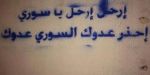
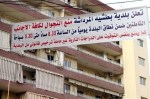
3) Since MTV was beyond pissed about how that TV show portrayed Achrafieh, let’s see what was all around Achrafieh just a year ago. Luckily, the internet is a beautiful thing, so pictures are aplenty and here are pictures to you:

Again, I’m trying to see how such signs, years after the withdrawal of Syrian troops and a clear manifestation of Christian xenophobia in a heavily Christian region are an indication of how tolerant and open minded we are as Lebanese.

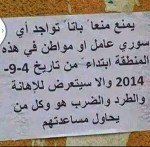
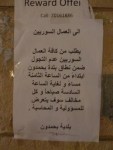
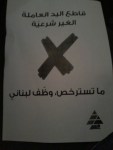
4) With the influx of Syrians into the country, many municipalities, like mine, decided to start curfews for Syrians. Many took this a step further as well. Some places had political parties also come up with posters for the purpose of doubling down on the increasing Syrian presence in Lebanon:

The posters translate into the following: “No Syrian is allowed in this area starting this date or they’ll be insulted, beaten along with whoever’s helping them.” Another one says: “Boycott illegal labor. Hire Lebanese.”

Nothing was done about this back then. Few were the voices that called these as they were, racist and degrading. But we went about our days normally. Have a TV series give the narrative to a Syrian FICTIVE character? Oh Lord no, our Lebanese oversensitive pride won’t have that.

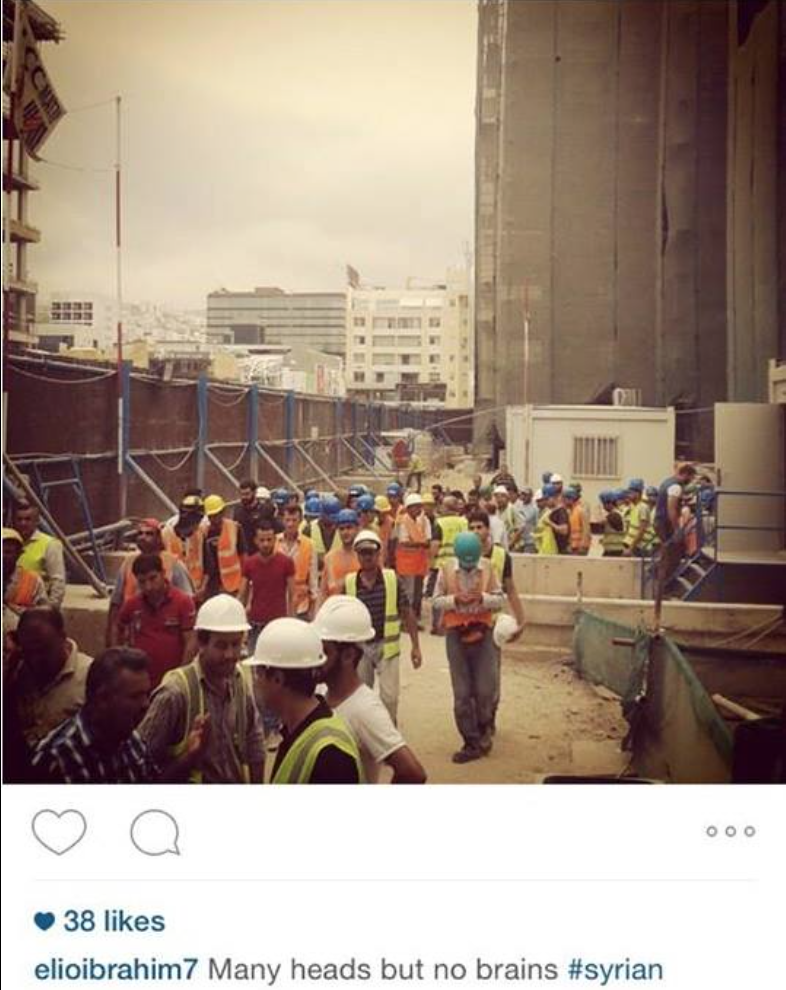
5) It’s been only two days that the following picture made the rounds on social media. An AUB student took a picture of Syrians and captioned it, on Instagram with filters and all: “Many heads, but no brains. #Syrians.” The outrage at that student was entirely political. I’m willing to bet most of those outraged at him were so simply because his political background serves as fuel to their own political hatred, more so than for them being caring about Syrians per se. But still, it clearly shows that such mentalities exist today and are aplenty.

Syrians Racism Lebanon

6) Now that we’ve established that MTV lives in a separate realm of existence (let them talk to Stephen Hawking, he’d be interested), let’s go over a quick survey of the many things we’ve all heard about Syrians and Syria, among people that we all know: Oh look, a Syrian. Oh, there are too many Syrians, be careful. The best thing to come out of Syria is “el festo2 el 7alabi.” And let’s not start with all the homsi jokes, which is when we are taught to be racist towards Syrians the moment we become aware.

But dear MTV, many Lebanese are not racist towards Syrians only. They’re also racist to those of nationalities they deem lesser.

Don’t you remember the guy who wouldn’t shake hands with people who are black?

Don’t you remember that Mothers’ Day ad about special offers on maids?

Don’t you remember the countless MEA reports about racism aboard their airlines? 

Don’t you remember the many maids that lost their lives to abusive employers and have no laws to protect them?

Don’t you remember that picture of the purse getting a seat while the maid remains standing as her family has lunch? 

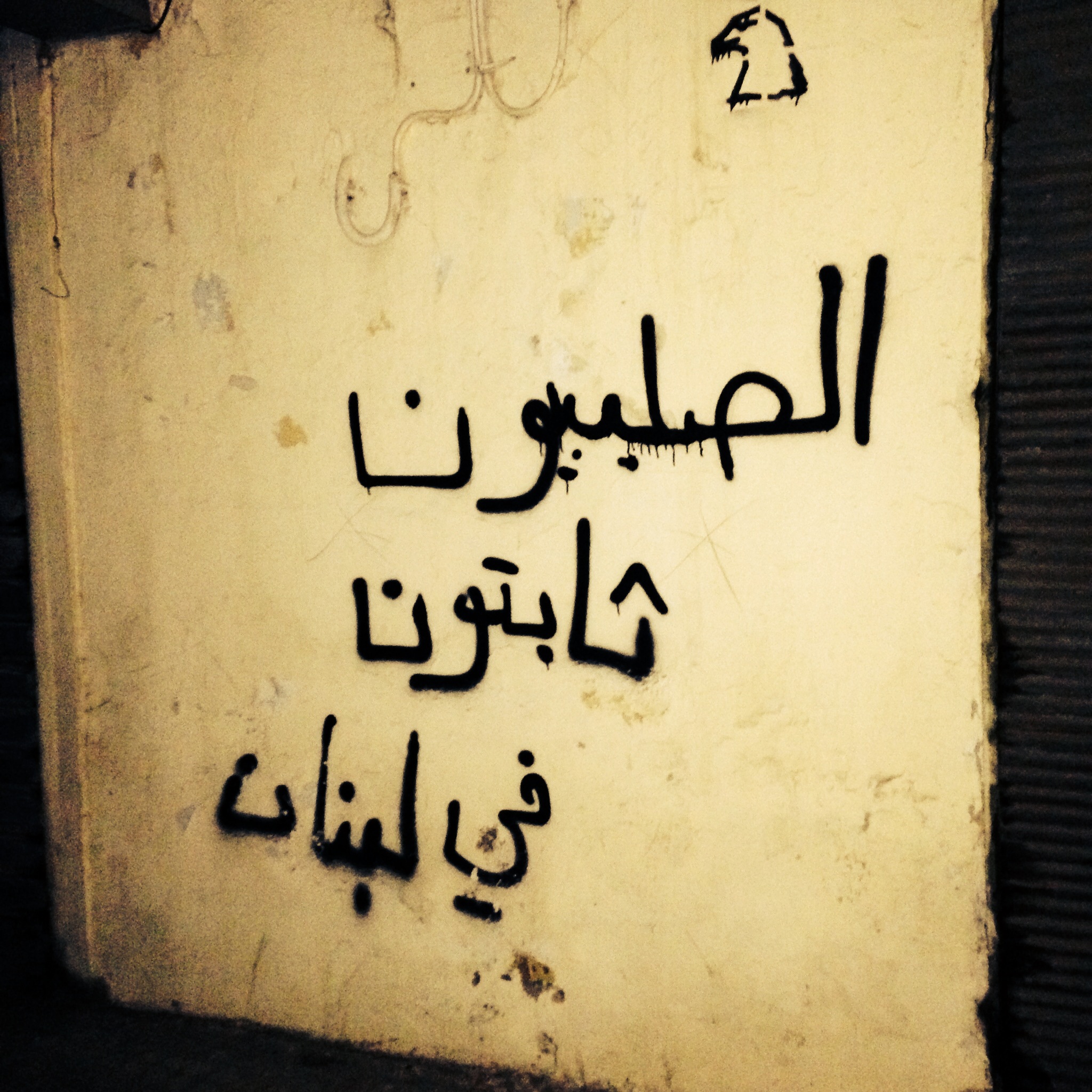
We’re not only racist towards other nationalities. We’re also racist to each other. If you walk around MTV’s beloved Achrafieh, you are bound to find plenty of “Ra7 Tdall Jrasna Tde2” graffiti plastered around red crosses. Those newly coated with paint to keep their memory as fresh as their color. Who do you think they’re targeted to? Let’s just say it’s not someone who worships the Cross. For reference, I also have this to look at every morning:


People in Keserwan have endless stories about them chastising “el gharib.” The people of Tripoli are ridiculed by many because of the situation in their city. I have friends from Tripoli who changed their city on their CV because they know it decreases their chances to get hired. But please, tell me more about how we are not racist.

This isn’t to say that every single Lebanese is racist. There are many movements across the country to combat such mentalities. There are many people who are as far from racism as MTV is from being an objective and decent news outlet. The inherent problem isn’t only racism, it’s us pretending that there isn’t such a problem to begin with, it’s outlets like MTV – with substantial power and reach – engorging the ever-growing Lebanese ego, tapping it on the back, and telling it that there’s nothing wrong with you.

Fixing the problem starts with acknowledging it, not being offended by its existence. This is just shameful.

Christians Are Disappearing From Lebanon

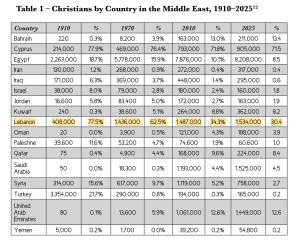
The infamous Lebanese Christian civil war slogan goes: “نحن هنا وهنا سنبقى.” If you google those words that translate to “we are here and this is where we’re staying,” you get plenty of Lebanese-centric references that can, even over 24 years after the theoretical end of the Civil War, get those same Christians riled up. As it stands, however, Harvard did some studies on behalf of the region, and the whole “نحن هنا وهنا سنبقى” slogan is not entirely correct.

Religion Demographics specialists Todd Johnson and Gina Zurlo have recently published a study (link) in the Harvard Journal of Middle Eastern Politics and Policies that examines the situation of Christians in the Middle East in general and in some of its countries in specific.

In general, they noted that the overall Christian population of the Middle East stood at 13.6% in 1910. That 13.6% decreased to a measly 4.2% in 2010. The projections for 2025 put the population at only 3.6%.

They attribute the shift to multiple reasons, including emigration due to wars, instability, the rise of Islamic extremism, etc…. But Lebanon is a focal point of the study due to the different nature of the country compared to the region, especially that they find the drop in the Christian population of Lebanon to be substantial. 

These are their findings:


In 1910, prior to the founding of the state of Greater Lebanon (catch up on your history book), Christians constituted about 77.5% of the population of what was the Mutasarrifate of Mount Lebanon. Before the Lebanese civil war, the portion of Lebanese Christians relative to the general population was approximated to 62.5%. 

Following the end of the civil war and in estimated numbers for 2010, Christians constituted 34% of the Lebanese population. This percentage is expected to drop even further come 2025 to about 30%. 

The reason for the decrease is explained as follows:

  1. The Lebanese civil war and the emigration of Christians to Western countries,
  2. Lower birth rate in the Lebanese Christian population due to their generally higher economic status,
  3. Increasingly decreasing role and influence at a national level.

It’s eye-opening to see in numbers what we know in theory.

Decreasing percentages don’t mean that Christians are going to be wiped off from the country quite yet. The decrease has less to do with the propaganda of ISIS’ threat to existence through fear instilled by fear-mongering politicians, but more to do with how things are in the country as things stand today in 2015.

The purpose of this post is not to elicit sectarian talk. This isn’t about Christians as a religious establishment as much as a demographical agglomeration. The role of Christians in the building of Lebanon is historically established, so losing them is a disaster to the country. Their role in the advancement of the country cannot be denied: all the country’s major universities and schools were formed by missionaries; even our hospitals emanated from Christian religious establishment.

Changing demographics is a natural process in any country’s lifespan. Populations age, their characteristics change, their constitution gets altered over the years. So the solution isn’t to panic about the changes, but to see what they mean.

The Lebanese problem isn’t only that its Christians are becoming less and less of its population, but that those same Christians cannot 1) agree on a future for the country and 2) see that their future lies in stopping to look at themselves as Christians but as Lebanese first and foremost who have a country they need to build, especially given that Lebanon is probably the only country in the region where they can be safe and hope for a country. God, country, family – not in that order.

What Lebanon in general and its Christians in particular need at this point is to finally realize that the only hope, regardless of how demographical percentages change, is the establishment of a secular state in Lebanon where people are not defined by the religion they are born into, but as citizens with rights and duties that are not adjusted to their prayer building.

Certainly, the notion is beyond delusional at this point as it requires a massive leap of forward thinking from the entire Lebanese population. But if Lebanese Christians can’t see the danger of clinging to the status quo where the status quo is as moving as quicksand, then they have more things to worry about than decreasing percentages over a bunch of decades.

Less slogans, more plans. Less chants to civil-war-leaders, more criticism and accountability. Less religious marriages, more civil marriages. Less this faculty’s dean has to be Christian, more this faculty’s dean has to be competent. Less let’s massively panic about Khaled el Daher, more let’s ignore and try to take the higher road.

The “نحن هنا وهنا سنبقى” slogan is easy to say, but it’s tough to implement with no president, political deadlock, rising poverty, no prospect for jobs, and the urge to get visas stamped on your passport the moment you receive your college degree. I guess it all doesn’t matter in the face of fiery existential chants. If only, though, the numbers lied. Build a country in which you’d want to stay, not just shout about staying.

Once Upon a Time in Maaloula

It was December 2010, slightly after Christmas, that I went to Maaloula as part of a two day stay in pre-war Syria.

The village was nestled up the mountains some 30 minutes away from Damascus. I had no idea what to expect there, other than some difference from the  souks and mosques that their country’s capital had to offer. I should have known that Maaloula would be drastically different – the driver had been talking a language I wasn’t understanding all the way. It was Aramaic.

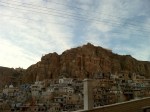
Once upon a time, the Maaloula I visited was a calm village, part of a calmer and oppressed country. The people there seemed poor. They also seemed especially devout, asking us to take off our shoes as we visited Christian shrines for saints that Christians in Lebanon worshipped. The town’s houses were tightly packed together, haphazardly built, in a way that climbed up the mountain that overlooked the village. A statue of the Virgin Mary could be seen atop those mountains. I’m sure they figured she’d be protecting their homes.

I walked around the hills next to the village, patches of snow from a storm a few days prior still visible. The townspeople looked at us warily: just another batch of tourists who are coming and going, expecting some funky eccentricities. A few children were busy playing football on the tarmac across the street. They asked us to play but we didn’t have the luxury of living where they did. So we kept looking around.

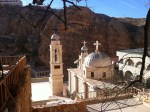
The monastery we visited, Deir Mar Takla, where the relics of a renowned Saint reportedly lay, was not very different from several ones I had seen in Lebanon. But I guess it’s always more interesting just because it represents a minority, something different in the vast sea of sameness you had come to associate with the Syria I was visiting back then. I never thought that desolate town, huddled in those cold Syrian mountains, would become the focal point of Lebanese politics almost three years later.

I never gave Maaloula a second thought until today when I was told that the Syrian civil war had reached it and I was told that I should care about the lives of its people, just because they are Christians, more than the lives of all the Syrian civilians who have died since whatever’s taking place in Syria started back in 2011. There are varying levels to the value of a human life.

Maaloula became the centerpiece of a long-used argument revolving around the core foundation of Christian victimhood, because the presence of Christians in this region cannot be guaranteed but by dictators and oppressors. Let’s always choose the lesser evil.

I was also invited to #ActForMaaloula today, an admirable effort and all. But I have to wonder: aren’t Muslim villages worthy of me acting for them? Who am I supposed to act for in Maaloula exactly fully knowing that 90% of its people have apparently left their town? Am I supposed to act for the Churches that have not been touched according to all news services? Am I supposed to act just for the sake of acting so I can tell the entire world that I care about the likes of those who happened to be born into my religion just because they worship Jesus and don’t fast Ramadan?

Christians in this region are and apparently will always be dhimmis, precisely because of this rhetoric, whether they like it or not. They’re dhimmis because they’re always forced to ask for protection. They’re dhimmis because they’re always treated differently than the countries of which they are part. They’re dhimmis because they relish in the rhetoric that they are different, that their lives are more precious, that one needs to act for their sake but not the sake of others just because they have carried a Cross.

Being against the regime next door doesn’t mean we sympathize with the Islamists. It doesn’t mean some Lebanese politicians, who remember the never-ending Christian victimhood argument listed above whenever they’re bored, get to patronize us about not doing enough for our “Christian brethren.” I refuse to be blinded to the fact that this talk about extremists and Islamists and Nusra and Al Qaeda did not exist in 2011. I refuse to be forced to forget that the talk about a ruthless regime, which can send the cold, penis-less corpse of a thirteen year old to his mother’s doorstep, has existed since the 1980s. I refuse to be forced to fall to that ridiculous notion that Christians are special and must be protected because Israel considers them competition.

I used to think the fear for Christians in the region is overrated. I don’t think that way anymore. But I also think that the entire way the issue is being dealt with will only lead to further decimation of those Christians and further increase of the fear they are forced to live in. You want to protect the Christians of Syria because you love them so? You fight for a political solution that involves stopping the regime that has killed hundreds of thousands of its people and with it those Islamists we all fear whose existence stems from that precise regime.

One more thing before I bring you full circle.

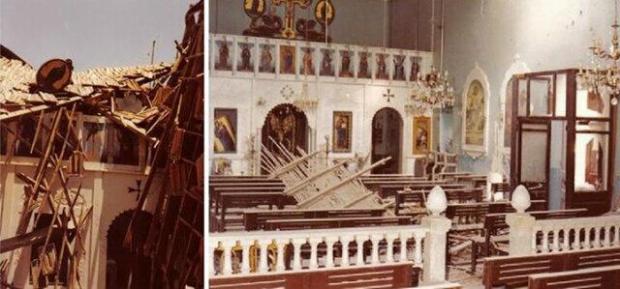
The Syrian regime protects Christians, sure. The rebels are creatures who want to behead Christians and only do that, sure. The following is not in Maaloula.

Lebanon, courtesy of the Syrian army.

Lebanon, courtesy of the Syrian army.

Whose protection am I supposed to ask for now?

Neither Aoun Nor Geagea Is Defending Lebanese Christian “Rights”

Preamble:
The following is what the LF, FPM, Kataeb and Marada agreed upon in Bkerke:

“The parties convening have decided not to run based on the 1960 law and consider the law at hand as one that consecrates the injustice towards Christians. The parties convening have also agreed on the need to take a firm stance against the 1960 law in fear of having this law forced as a reality when the nomination window is open. It is also important to affirm that this law is rejected and is non-viable as a reference to run for elections.”

The electoral reality today:
As the nomination window for the 1960s law closes, the ministry of interior has tabulated 706 nominees, which contain more than 20 candidates for each of parties that agreed upon the above preamble. Talk about “not running” and taking a stance against the “unjust” law at hand.

Let’s talk electoral laws:

This isn’t the only part as to why these politicians are doing a terribly bad job but it’s the most current and as such deserves being dissected in grosso modo to draw a frame for the discussion.

Michel Aoun started out against the Orthodox Law and supportive of the law proposed by the government (13 districts with proportional representation). He later on switched stances to support the Orthodox Law because other Christian parties jumped on the bandwagon (the LF were the first to support this law publicly), effectively becoming the law’s main defender despite him fully knowing that the law will never, ever see the light of the day. If by some miracle the Christian consensus around it were to make it to parliament, the law wouldn’t pass the president. And if the president ended up signing it, the constitutional council might have probably found it unconstitutional. Aoun knew this and knew it well. He also knew that the only reason he was getting support from Hezbollah over the law was because Hezbollah didn’t lose any Shiite seats with it and would use it to boost him among Christians, not because they are deeply concerned for the rights of Christians. He also knew that the support Nabih Berri gave the law was lukewarm at best. That’s why he kept his options open and gave us another electoral option: one proportional representation district. All other laws were rejected, as was obvious by his party’s practices and as is their right.

Samir Geagea started out with the neatly-cut 50 district laws which makes sure his party gets a majority in parliament. When that law received no outside support, he switched to the Orthodox Law and became a prime defender of that law… until he hit the roadblack set forth by his allies regarding the law and for a while it seemed he was taking on the Future movement and Jumblat by marching on with the Orthodox Law. At one point, Geagea’s breathing space came in the form of a Bkerke agreement to put the Orthodox Law on hold and to find a law that brings more consensus. So he effectively killed off the Orthodox Law and started running a campaign against it, only to be “surprised” by an anti-Geagea campaign from FPM supporters and a bishop who obviously went beyond his jurisdiction. Shouldn’t they stick to masses and baptism?

The problem with Christians and the electoral law is two-fold.

  1. In the most optimistic of scenarios, we are 40% of the voting population which has to vote for 50% of parliament.
  2. Lebanese Christians are the only sectarian component of Lebanese society which have a true form of “democracy” whereby despite their numbers, the 50-50 division between Aoun and Geagea renders them meaningless.

Parliamentarian representation has two components as well. Let’s call them a horizontal and a vertical factor. The horizontal factor is an MP’s sect and the vertical factor is his region. The Orthodox law tackles one but not the other. The question, therefore, asks itself: How is Aoun defending “my” electoral rights when he supports a law he knows will not pass and when the other law he supports is one that basically makes “my” vote irrelevant (not that I personally care), effectively not allowing me to make the decisive choice in ANY of the Christian MPs?

And how is Geagea defending “my” electoral rights when his support of electoral laws is almost always apparently contingent upon what his allies believe is best, despite his best attempts not to make it look that way? And how is it defending “my” rights to be a staunch supporter of a law one day and have your media work staunchly on portraying it the “best” for “Christian rights,” effectively convincing most Christians of this, only to trash it when the wind blows differently?

How are both Geagea and Aoun defending “my” rights when they both refused a Kataeb proposal of personal electoral districts which effectively fixes the two-fold problem I have presented earlier? How are they defending “my” rights when the probable reason of their refusal is because personal districts limits their parties’ influence? How are they defending “my” rights when they don’t really care for “my” parliamentarian representation as much as their parliamentarian share?

I Liked Geagea:

I would be lying if I said my mind doesn’t lean one way in the Aoun-Geagea dichotomy. There’s nothing wrong in supporting any of these two men. In fact, I personally believe that between 2005 and 2010, Samir Geagea had a near parcours-sans-faute in Lebanese politics. His discourse was Lebanon-centric. He was moving his party away from the common misconception (at least back then) that it was a Christian party by the Christians for the Christians. They even actively worked to kill off the Lebanese Forces typical symbol of that cut cross. But not today.

Nowadays, the discussion of both men is as Christian-centric as it gets. The more Christian-centric one of them gets, the more Christian-centric the other goes. And I may be a minority in thinking this but I really don’t believe “my rights” are best served in the rhetoric being spewed by both men and their supporters all over the place and even some priests and bishops.

“My” rights are also not served, in my opinion, when the rhetoric being employed is one that is only leading to increase the divide in the country and not work towards trying to fix things. When Aoun completely ignores the fact that his ally Hezbollah is fighting in support of the Syrian army in Al Qusayr, how is that defending “my rights?” How is it defending “my” rights when a politician such as Aoun is completely silent, effectively supporting, the practices of Hezbollah in defending an army and a regime whose main purpose was to destroy my rights as a Christian in Lebanon for years and years? How is it defending “my” rights when the only arguments used on the matter are ones revolving around Jabhet el Nusra and the rise of Sunni extremism while completely ignoring the equally dangerous Shiite extremism and political brainwashing at hand?

On the other hand, how is it “right-defending” for Geagea to completely ignore the rise of the Ahmad el Assir phenomenon or at least not actively work towards decreasing it? What about is his silence regarding the Future Movement’s involvement in fueling the Syrian crisis with his support of the rebels? What about his silence on the Lebanese Sunni extremists who are entering the fights in Syria in support of one of the sides, effectively becoming the same version of Aoun on the other side of Sunni-Shia divide?

Both Aoun and Geagea are taking parts in the Sunni-Shia problem that Lebanon is facing today and their parts are not healthy, not even in the least. Instead of making Christians a form of link between those two components of Lebanese society, our politicians are working on getting those components further apart with their near-blind support of whatever they do and whatever they commit to. It’s not in our best interest as Christians to take either position from the Sunni-Shia struggle at hand. It’s not in our best interest to take the sides we’re taking. It’s also not in our best interest to stand on the sidelines and cheer. The best way to fight for “our” rights is to take the right stance at the right time. At the current time, that stance is the following: get the parties involved not to drag the Syrian war into Lebanese territory, which will lead to more degradation of Christian rights.

A Lack of Vision?

With Aoun coming out against the extension of parliament’s mandate (at least until now) and Geagea possibly announcing his stance in a few hours, I have to wonder: are our politicians truly out of imagination or resources to succumb to the status quo this way? And how is it defending “my” rights when, in one way or another, they both don’t take the fight the long way home and contribute to transforming this country from a growing democracy to a growing dictatorship? That’s the only way really to categorize our parliament extending its mandate for itself.

Is there any guarantee that, in case parliament extends its mandate for two years, our politicians will actually reach a new electoral law? No.

Is there any guarantee that, in case parliament extends its mandate for two years, the security situation will become better enough to hold elections? No.

Why not, for instance, ratify the 1960 law in the following way: divide Akkar in two districts, bring the Maronite seat of Tripoli to Batroun, move a few seats from Beirut 3 to Beirut 1, move a few seats from West Bekaa (where 20% of the population is Christian and gets 4 seats out of 6) and put them somewhere else?

Why not run elections based on that ratified 1960 law, upon which Christians might be able to choose around 50 of their representatives, with an agreement to have parliament work day in and day out in order to reach an electoral law after which it dissolves and we hold new elections? It even has the same guarantees as the extension scenario.

The democratic process in this country has to be upheld. Any talks about modifying it because (insert any form of non-viable argument) does nothing to defend “my” rights as a Lebanese first and foremost.

People Like Us:

I believe or at least I hope that this sentiment is shared by many Lebanese Christians today. It baffles me how Lebanese politicians somehow believe they talk on behalf of every single Lebanese when there are people like us who don’t agree with almost any of their practices nowadays.

I, for one, believe no one represents me today and I kindly request them all to back off “my rights.”