The July 2006 Lebanon/Israel War: My Story

This is a guest post by my good friend Hala Hassan.

Hear it from those who were there.

A neighboring country at war, you sympathize.

Innocent civilians torn into pieces under the wreckage of their houses, you shed a couple of tears.

Frightened children and sick elderly begging for international intervention, you pray deaf ears listen somehow.

But what if you were that citizen in that country, held up in your house, scared like you’ve never been, reciting every single prayer that ever crossed your mind for those bombshells to stop and those warplanes hovering in the sky to go away…

Yes, it’s been 5 years since “July war”, “the 33 days war”, “the 6th Lebanese/Israeli war” or whatever they want to call it. But for that traumatized girl, it still feels like yesterday…

To survive a war is one supposedly satisfying ending. Not to have lost a family member is considered a blessing. But for a 17 year old, survival was not enough to overcome such an altering experience: A slamming door, a blowing wind, even fireworks… any sound still triggers her fearful memories and is capable of causing her a panic attack.

She still remembers each day and date in the intricate details of their events. She still remembers that Wednesday July 12th when her father called asking her not to be alarmed if she hears distant explosions. She remembers how he came back that afternoon ‘whistling’ trying to make her and her sisters feel like everything was just fine. She remembers how she had to share a bed with her older sister that night, freezing at instances and suffocating at others out of fear.  The warplanes had started violating her sky that day. They wouldn’t leave till late August.

She still remembers the following two days she spent in the supposedly “safest room” of the house – back then “safe” meant having a double ceiling, no glass windows and least furniture – and how she kept on squeezing her mom’s hand relentlessly all night like a 2 year old.

She still remembers the voice that emanated from the radio, her only way of communication with the world, asking her and other Southern residents to leave their villages. Or else. That radio also conveyed news about those innocent civilians, who got betrayed by their naïve expectations, upon leaving their houses thinking that a white flag would save them from being savagely murdered.

She still remembers that shelter in her grandparents’ house: a tight narrow tunnel lacking light and at some points oxygen in which she sought mistaken safety with other family members and neighbors. She still remembers the smell of those sweaty fearful souls and the cries of those frightened hungry kids.

She still remembers July 19th when her peaceful village was attacked by deadly showers of cluster bombs, those internationally banned bombs that kept on dropping like rain for hours during which she felt the epitome of fear, leaving behind a dead woman and many serious injuries. She still remembers that awful silence following the disaster, a silence which was not broken until a few of hours later by the siren of an ambulance that waited a long time to be given permission to come for rescue.

She still remembers July 21st when a vehicle of the Lebanese army was bombarded in her village leaving behind severely burnt soldiers, even though the army was left outside the equation back then.

She still remembers her 8-year-old sister hugging her physician father as he was leaving them to help in rescue efforts, begging him not to leave as everyone watched the scene and wept.

That day was her last in her beloved village because the citizens whose cars “survived” the attacks decided to leave. Food, water and medication had become scarce. And most importantly it had become obvious to them that they were targeted to be killed.

That day she saw her father covering their car with a big white piece of fabric. She saw frightened people struggling for seats in the leaving cars, which got stuffed with traumatized flesh and blood seeking refuge…. The last face she saw was that of her grandfather at the house gate. He refused to leave because for him life does not exist beyond that gate.

She still remembers that cursed journey to the Bekaa, every moment she spent looking through her window praying for that Apache not to show up in the sky and turn her and her family into pieces. She still remembers those endless days she spent crying and thinking of the life she left behind, wondering if she’ll ever be back.

Who said time makes people forget their previous fears and overcome past sufferings? Well, here is something that girl has come to learn: child or elderly, woman or man, illiterate or educated, everyone who survived that war has suffered and still is. They are all hidden victims that no one ever bothered to soothe their psychological needs and problems.

That 17 year old is turning 22 soon. She is a graduate of the American University of Beirut and planning a medical degree, which makes her someone who supposedly has been provided with the best education and environment to overcome whatever distress she has been through. And yet that girl is still held up in that summer. As a friend of hers always suggests, therapy might be the best solution for her condition. Therapy might put an end to the nightmares. It might alleviate the effects of the past pain… but the scar will always remain, carved with blood and tears in her memory.

They say what doesn’t kill you makes you stronger. For that girl, this saying has become a belief. 4 days after the battles stopped, there she was, back in her village along with most of those who left, challenging all the difficulties and threats. Everyone had one common goal: rebuild the destruction, heal the wounds and restore life in their beloved South. After all, it’s Lebanese determination that was being tested. Who is better at acing such a test than those who have endured vicious wars throughout the years, one after the other? History will probably keep on telling their stories of glory and courage until the end of days.

Lebanon Bans Iranian Movie “Green Days”

I honestly do not get Lebanon these days – or maybe I do and don’t want to admit that our newly formed government is as uptight and horrible as we thought it would be, but the Iranian movie “Green Days” has been banned from being screened in the country.

What is the movie about? The 2009 Iranian protests against Ahmadinejad.

The movie “Green Days” was directed by Hana Makhmalbaf, aged 22, daughter of Mohsen Makhamalbaf, who is close to Iranian opposition leader Mir Hossein Mousavi, whose followers led the 2009 protests. A General Security personnel in Lebanon said the ban was fulfilled after a request from the Iranian minister in Lebanon.

Since when does a request by an ambassador actually get fulfilled in Lebanon? Especially if it’s something as silly as them asking to ban a movie that details the regime they represent in a hideous light? It’s nice to see Iran’s main allies in Lebanon looking after their love’s interests over here. After all, why should Lebanese be allowed to watch a movie that details Iranian protests? I think that’s something Khamenei banned, no? Therefore, we should not be allowed to watch it! What an abomination that would be to our souls and to the good of the glorious nation of Iran!

But wait! Isn’t Lebanon a mutlicultural country where the say of one group or sect shouldn’t apply to the rest of the people? You’d think Mr. Orange, carefully looking out for the “best interests of Christians”, would stand up against such an atrocity. You’d think the “best interest of Christians” would be them exposed to all the different cultures the world has to offer. Guess now we know who’s truly ruling the country, regardless of how many ministers they have in our awesome new government.

I don’t know about you but I shall be downloading this movie (along with subtitles) and making a few copies to distribute just to spite the ambassador and the holy Lebanese resistance whose only job these days, by the looks of it, is to ban movies. How does that work against Israel again?

The Nakba

Gebran Khalil Gebran wrote in “The Prophet”:

Your children are not your children.
They are the sons and daughters of Life’s longing for itself.
They come through you but not from you,
And though they are with you yet they belong not to you.

Imagine this quote being applied to something more concrete than a human soul… imagine this quote being applied to your land.

Your land is not your land. It does not belong to you.

There is nothing harder than having no home – only a transient house, or even a tent, where you sleep the night, worrying what the following day brings.

Some people have been worrying about that issue precisely – where to sleep – for more than sixty years. I am not appealing to any political reason, only humanitarian common sense. There’s a people who has had their land swept away from beneath their feet on the premise that this land does not belong to them, whose homes got ripped to shreds because they were built on a land that was not “theirs” and who are in limbo just because they were the victims of wrong place, wrong time circumstances.

The Palestinian people, and I do not mean its political figures (because those are as rubbish as garbage goes), are a collection of human beings whose lives have been torn apart by years of them being in the middle of a conflict they chose not to be part of.

I shall not go into the history of how they lost their land. After all, the history is well known (Balfour promise, etc…). But the sad thing is how this people is portrayed today: a collection of terrorists voting terrorists to fight those who are good, aka, Israelis.

Sure, the Palestinians have had their share of mistakes. They sought out a country where a country was already built and they have constantly failed to get themselves represented in the best possible way. Arafat? Abbas? Seriously?

But there’s more to the conflict than what ABC, CBS and Fox share with their viewers. There are people who are the victims of massacres against them on daily basis, whose children are used as bullet pillows and whose souls are being hammered with missiles. I firmly believe the holocaust has happened. Whether the number of Jews who died is ten million or one million, it doesn’t mean they were not ruthlessly exterminated at one point. But you’d think going through that ordeal would deter you from wanting to inflict it on another people. Not true, obviously.

I do not advocate equaling the holocaust with what’s happening in Palestine today. But I feel the human life has become of so little value in some areas of the world, it’s sickening.

However, the Arab Nakba (which translates as catastrophe) does not stop with Palestine. Arab countries are infested with dictators who kill their people ruthlessly without caring and who limit freedom, in spite of protests demanding for their basic right to speak.

The Arab Spring, which is also the name analysts have called the Tunisian and Egyptian revolutions, is slowly turned into another Nakba. Why? Sectarian clashes in Egypt against the Coptic population, just for them wanting to remain Christian in their country. Copts face daily discrimination, having to ask state permission to build churches and must indicate their religious affiliation on their ID cards.  Their schools were nationalized by the government in the 1950’s and over the last several decades they have witnessed terrible massacres. This past weekend witnessed two churches being burned and several dead. And yet, people in the Arab world have turned a blind eye on them and their suffering mean while constantly bemoaning about discrimination against Arabs. Not to mention what has happened to Assyrians and Chaldeans in Iraq, half of whom have fled for their own safety. And no it was not American troops who drove them out.

Add to that rioting in Tunisia that is knowing no end. The Libyan revolution dying a painful and agonizing death amidst an international silence that knows no limit. A Syrian revolution attempt that is the victim of people simply not caring anymore and a Yemeni revolution that’s the victim of them being so geographically distant that they have become also distant from attention.

It doesn’t help as well that the population in the Gulf suddenly got preoccupied with watching Star Academy and counting their oil millions again.

Yes, the Arab Nakba doesn’t stop with Palestine, although they are the bigger victims in it. It’s the story of a whole region of the world that allows itself to be degraded with time by incompetent rulers, indulgent people and hypocrisy without limit. The next time you protest against Israel ask yourself. Do I believe in equality in my own home? Have I treated one of my own citizens differently based on ethnicity or sect? Are people in my own state suffering because they are religiously or ethnically different? Next time you march or protest ask yourself these questions.

And quoting Gebran Khalil Gebran again,

Pity the nation that raises not its voice
save when it walks in a funeral,
boasts not except among its ruins,
and will rebel not save when its neck is laid
between the sword and the block.
Pity the nation whose statesman is a fox,
whose philosopher is a juggler,
and whose art is the art of patching and mimicking.
[…]
Pity the nation divided into into fragments,
each fragment deeming itself a nation.
PS: Thanks to Paul Gadalla for his input in this post.

They Should Not Be Forgotten

Lebanese Detainees in Syria

Amidst the political brouhaha taking place across the Middle East today, I’m afraid we are beginning to forget about a very importance puzzle piece in the face of the Lebanese political situation today.

What has brought this to my attention again were the protests that erupted in Syria on March 15th and the hope that rekindled in me that Syrians would find it in them to take these protests the long way and come out triumphant, toppling down the system that has made their lives – and ours – a living hell.

In Syria today is a group of Lebanese people who, the least you can say about them, have been killed without them dying. How so? Hundreds of Lebanese have been taken as political prisoners to Syria, never to be seen or heard from them again. Sure, the most logical conclusion you can draw is they were killed… but what if they’re not?

These Lebanese prisoners have been slowly turned into second degree political prisoners. Why? because Syria, after all, is not our “mortal enemy” like Israel and therefore, Lebanese prisoners in Syria are not as worthy of attention as their counterparts in Israel. And so the length that some parties go to in order to liberate the prisoners they have in Israeli prisons, they simply do not make for these prisoners, even though they might be the only parties in the country who have the means to currently do so.

Lebanese detainees in Syrian prisons are treated like less than human beings. One of the few who got out alive is a school teacher from Tripoli who told about her torture through a process called the “tire” (Douleib). They basically put her inside a tire and hit her with electric cords, not caring where the cords slammed her. Her eye was hit and it erupted like an egg in a frying pan. They did not care. They kept on hitting her.

Contrast that with Samir Kuntar, who, according to many, has committed one of the worst crimes in Israeli history. He came out of Israeli prison as part of an exchange safe and sound. He even married an Arab Israeli in prison and she received monthly payments because he was a prisoner. And while in prison he also pursued a university degree. When Kuntar was “liberated”, he received a hero’s welcome by the party that sought out his release. When the teacher I mentioned earlier was released, she went into oblivion. And in my mind, that is seriously wrong.

So today, I plead to the humanitarian side of those who still have it. It looks like the political party who has the means to help doesn’t care at all. Therefore, I hope with all my heart that something comes out of the Syrian protests that would lead to some closure for the families of the Lebanese detainees and hopefully a new page in the story of the Lebanon-Syria relationship where we are seen as equals and not a province that wasn’t.

Dear Hezbollah, I Am Not Israeli

While going back to my hometown today, I was surprised to see counter ads to the ones spread by the March 14 forces.

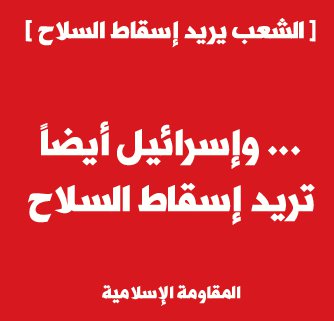
This is a picture I found online of one of those ads:

For those who can’t read Arabic, this reads as:

[The people want our arms surrendered]

And Israel wants our arms surrendered as well

The Islamic Resistance

The apparent meaning of this is quite clear: They want to make people notice that Lebanon’s mortal enemy *gasp* is supportive of the agenda that the protest on Sunday is adopting.

But if you think a little deeper about it, this is Hezbollah’s way of inferring that Israel might be behind this movement.

I hate to break Hezbollah’s bubble again, but Lebanese people wanting its arms to be surrendered sometimes goes beyond Israel’s existent wishes. Sure, Hezbollah being weaponless is inside Israel’s wishing scope, but the Lebanese people have gotten fed up with Hezbollah flaunting its arms left and right. This is a case of: If you got it, DO NOT flaunt it.

In addition to that, Hezbollah is also launching a counter-campaign on Facebook titled: “Mbala”, which is Lebanese for “Yes”. Yes for what? Let us see.

According to Hezbollah, we’re supposed to go down to the streets to support it and say yes to its arms because these arms have:

– returned our pride and glory,

– have liberated our land,

– have protected our families and us.

I would have gladly given those three points to them without even thinking twice about it had the date been March 11th 2001, a few months after South Lebanon was liberated from Israeli forces. However, 10 years later, where do we stand from this?

– Because of Hezbollah’s arms, I had to stay home for two weeks in 2008 because they decided to go into a near-civil strife rampage in Beirut, just because they felt like it.

– Because of Hezbollah, my family’s vote in the last parliamentary elections, against it and its allies, has basically been equated with junk. Why’s that? Because they decided on one Tuesday to send out its personnel, dressed out in black to the streets of Beirut, reminding everyone of the aforementioned point, basically telling everyone that we can do whatever we want whenever we want and there’s nothing you can do about it.

– Because of Hezbollah, our economic boom that started in late 2005 got reversed into a severe economic breakdown when Hezbollah iniated the 2006 war against Israel. Yes, Hezbollah was the main cause of that war and hiding from this fact will not change it.

So how did you, dear Hezbollah, protect me and my family since 2001? Against a war that you initiated? It was your obligation after all. Did you return my pride when you paraded around my university campus with your allies killing people left and right just because those people you killed decided to oppose you? And what land did you liberate since 2001? And do you honestly think you could have even liberated South Lebanon if Israel hadn’t been pushed into implementing U.N. Resolution 425?

As far as I’m concerned, all of this boils down to you and your arms becoming more or less useless. It’s the harsh truth, but it needs to be said. And you want people to come down on March 20th to support you? Is this your way of retaliating to those whose only reason of going down to the streets in 2 days is you attempting to suppress their voices?

Yes, we are going on March 13th. And if I hadn’t been 100% convinced, I am more than convinced now. Why’s that? Because the amount of hypocrisy in this country has become unsupportable and Hezbollah wears the hypocritical mantle with the best possible fashion.

They equate you with being a traitor or an Israeli-supporter whenever they feel threatened. And they’re a bunch of tyrants as much as Israel is. So to them we say, we are not Israelis. We are pure Lebanese, whose minds are only for Lebanon.

So on March 13th, let us all go down as a testimony of our belief that Lebanon will never prosper under a mandate of unlawful arms is unacceptable. Martyr’s Square will be our testimony on Sunday

March 14 - Ad