BBC Pop Up’s Report On Tripoli Is Shallow, Garbage, Full Of Generalizations, Horrible, and Horrifyingly Silly

I’m sick of Western journalist coming into the country with their preconceptions in place and then going out of their way to find the right people for them to make sure they propagate those exact beliefs back onto their core audience.

I haven’t been discussing BBC Pop Up’s reports much, mostly because I’ve found them to be just another regurgitation of a lot of previous reporting on the issues they’re tackling. But then the crew of BBC Pop Up decided to visit the capital of North Lebanon, Tripoli, against all advice – or so they’d make you believe after all the Beirutis they know told them it was dangerous and unvisitable.

But our brave, courageous crew decided to risk their lives – hilarious – and visit Tripoli. They probably didn’t know that the most dangerous thing that could happen to them in the city is an overdose on sugar and an increased risk of diabetes at Hallab, but you wouldn’t have known that based on that 16 minute report.

Instead, what you got was an “in-depth” – which is also basically the same vomit that we’ve been exposed to as Lebanese from the extremists that still plague the neighborhoods of Bab el Tebbaneh and Jabal Mohsen. The cause of the fighting was never discussed – because labeling as sectarian and having it remain at that is enough. The gut-wrenching poverty in those neighborhoods wasn’t even tackled, even when a man from Jabal Mohsen said – and I quote: “When I don’t have any money and then someone gives me $3000-4000, and asks me to fight. This is how they attract people.”

You’d think that statement, coupled with a previous one about how Ali – the man in question – was being paid 50,000LL to throw a grenade during the fighting between Bab el Tebbaneh and Jabal Mohsen, which has been over for about 3 years now, would prompt them to change direction of their reporting and delve deeper into the root of the city’s fighting.

Spoiler alert: it did not.

Not even when Ali agreed with the Sunni protestors who were the centerpiece of the report, with a protest calling on the government to free the jailed Islamists, a recurrent but ultimately fringe topic in the Lebanese political spectrum but one which made it onto a 16 minute report about an entire city, labeling it Islamist anyway, did the nature of the report change.

Even when Ali mentioned that a lot of those jailed people had nothing to do with the fighting and those who did were being manipulated by leaders higher up the echelons who are still free today, the report still did not veer from the goal it had set for itself the moment that random Beiruti told the British crew that Tripoli was unsafe: we are here to show that this place is different from Beirut, and that it is dangerous and that people here are extremists.

Extremism? Nice. Going to the poor areas of a city and labeling it all based on them? Amazing.

Delving into the cause of that “extremism” and poverty? Meh, who has time for that.

The magnum opus comes when they interview one man who’s asked about Shariah Law, before he says that everyone in the city wants that, somehow making his statement a valid proposition in the eye of the reporter. His rhetoric was not challenged, neither on the spot nor in a voice over that shows that not to be in the case in the other side of Tripoli, the majority, that BBC Pop Up did not try to cover because it doesn’t fit into what they’re trying to advance in the documentary.

The twist though is that that wasn’t what the man said, according to eye-witnesses who were there at that moment. What he said was: as a Muslim, I agree with the Shariah but this can never be applied in Lebanon where we have such diversity. This didn’t fit with what BBC wanted to portray so they cut his words and edited them the way they wanted.

The only saving grace is the brief mention of March, and the tremendous work that the organization is doing in Tripoli, with it bringing together both sides of the conflict and trying to change their perspective on how it is to live together. March has brought young people from both sides into a play that has toured Lebanon. They’ve also built a coffee shop that’s run by the people of the area, and they’ve renovated and fixed up the fighting-ravaged markets of the area into “Bab El Dahab,” without the help of any local politician, some of whom tried to take credit for the initiative.

For BBC Pop Up, Tripoli is Syria Street and the two factions that live on either side of it. The city of over half a million people is represented, in their eyes, by the tens of thousands who live in stinking poverty in those two neighborhoods, effectively making it okay for them to title a piece that would be broadcast to the world: Tripoli: Extremist City?

The title is horrible. The report is shallow as hell. The reporting is horrifyingly silly. The generalizations are ridiculous. The overall result is garbage. You’d think that an organization with their resources would actually have the decency to delve deeper into the conflict, but no luck. Instead, what we got was the same kind of report that Lebanese media used to do back when the fighting was still ongoing: no substance, no style, barely scraping the surface. Except this time the report is international, and not on a narrow Lebanese level for the parents of those who live in Beirut to forbid their children from going up North because “it’s dangerous.”

The fact of the matter is Tripoli is not dangerous. Not even those parts that the BBC reporter visited are dangerous: they’re just people who’ve been dealt a very bad hand at life trying to make the best of what was given to them and who are trying to find a new normal after their war. But that’s too mundane to be reported on I guess.

The fact of the matter is that beyond the narrow Syria Street is a city that’s trying to reclaim its position on the Lebanese level: with festivals, events trying to bring in people from other parts of the country, attempts at revamping its image, among other things. Of course, that’s not cool enough to be reported on because who needs another city trying to paint itself cosmopolitan in Lebanon when you can have a new Qandahar instead?

Lebanese Ministry of Culture Is Transferring The Roman Columns That Were Thrown Away To A Safe Location


Around 2 days after I wrote a very widely circulated post about the matter, which referenced a L’Orient Le Jour article on the issue, Lebanon’s Ministry of Culture decided to take notice of the 500 or so Roman Columns entrusted to its care, and it has begun transferring them to warehouses for safe keeping.

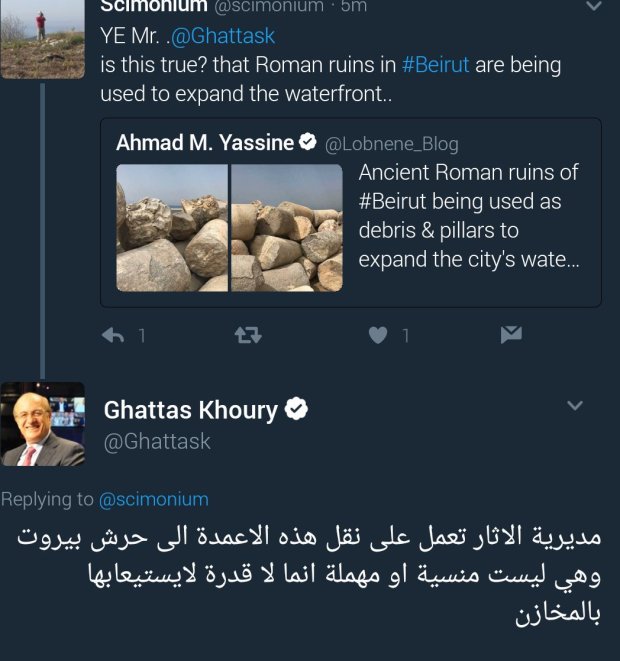
The actions of the Ministry of Culture were brought to my attention by SkyNews Arabia reporter Larissa Aoun who tweeted the above referenced picture from the site where the Roman Columns were thrown away when their warehouse was dismantled earlier this year.

Minister of Culture Ghattas Khoury, on the other hand, is not happy that the issue got this much attention, especially with MP and head of Kataeb Samy Gemayel discussed the issue in a Facebook live video, which you can view here:

In a statement from the site where the Ministry of Culture was doing its job, Minister Khoury issued the following statement:

The statement’s essence translates to: “we’re here to assert that the columns here are under the care of the Ministry of Culture. I had said on Twitter that we were monitoring the columns and would transfer them to Horsh Beirut soon.”

Of course, the definition of “soon” in Lebanese politics and governance would’ve been months if not longer, hadn’t the issue gained the traction that it did, forcing the Ministry to save face by acting on the issue as promptly as it did, and transferring the columns – especially those with inscriptions and other decorations – for safe keeping.

As I mentioned previously, the columns were supposed to be transported to different locations across Beirut to make Jbeil-esque entrances or streets in the city, but such plans were changed for reasons that have not been detailed.

The columns, according to Minister Ghattas Khoury, are now set to be transferred to Horsh Beirut, which is the last green space available in Beirut – if they keep it of course. What will happen to them in Horsh Beirut is probably uncertain as sections of it are going to be transformed to a hospital, because that’s exactly what Beirut needs: less green spaces, more buildings.

It’s a shame that our history and heritage needs viral blog posts for our system to governance to act on protecting it. It’s not just about these columns. It’s also about the many ancient houses around Beirut, the many sites uncovered at various construction plots around the city, among others. How many more times are we supposed to cry out for such landmarks and historical sites to be studied and preserved when it should be a reflex for concerned ministries to do so?

It doesn’t make sense that in a country with as much history, a lot of it is wiped to ease the way for businessmen, without Lebanese people even becoming aware of it in the first place, and to have that history’s last frontier be social media, not authorities who should be the main defender of the heritage of the country they’re serving.

Until the next archeological crisis, I hope these columns beautify Beirut. We all know it needs it.

500 Roman Columns In Beirut Have Been Thrown Away By The Sea Next To Biel, Because Who Needs History Anyway

Make sure you download this blog’s iOS app to stay up to date! (Link). 

The saga of the sure and constant destruction of any historical remnants of Beirut continue. The city, which is constantly listed among the world’s oldest continuously inhabited locales, is having progressively less things to show for its history as the Lebanese government and everyone involved in governance seems not to care the least about that particular aspect of the city, treating it with as much carelessness as you could imagine… and then some.

Picture this: if you go near Biel, in the recently built Beirut Waterfront area, you will stumble on an archeological discovery that most countries around the world can’t even boast about having: between 400 to 500 roman columns are found there, thrown away by the sea, waiting for kingdom come to do its job.

Of course, it’s not a discovery per se. Rather, those columns are there because the place that’s been storing them for the past 20 years was recently demolished to make way for new construction in the area. I wonder what string of logic led them to believe that the best mode of action towards those columns was just to throw them away near the sea and wait?

First reported a few days ago by L’Orient Le Jour, these columns were obtained during the many archeological digs that took place around Beirut between 1993 and 1997, soon after the end of the Lebanese civil war. The plan for the columns in questions, all of which were well-preserved, was to be dispersed around the city in various historical public spaces, similar to the one you’d see entering Jbeil.

Except that did not happen: the columns were never properly sorted, they were never categorized according which site they were extracted from in order to plant them in their natural location, and here they are today lying by the sea.

The person overseeing those columns was Hans Curvers, the archeologist appointed by Solidere. Needless to say, we all know the story of Solidere with any archeological finding in the Downtown Beirut area: complete media blackout, banning anyone and everything from approaching the site where those ruins were found and then – suddenly – those ruins vanishing or getting destroyed beyond recognition.

The General Directory of Antiquities in Lebanon (DGA) admitted that there were some shortcomings in the way the columns have been dealt with, which is an understatement given the fact they’re lying by a polluted sea because their warehouse was demolished without a backup plan.

The Ministry of Culture, through its head Mr. Ghattas Khoury (whose track record is of taking out the protections of cultural houses around the city), noted that the columns were “not forgotten” but awaiting transfer to Horsh Beirut, and that they were lying there because they didn’t have warehouses to store them. How is that even an excuse?

Why weren’t those columns transferred to Horsh Beirut months ago when the park opened instead of waiting until media notices the fact they’ve been thrown away? Why weren’t transient alternative warehouses built for these columns until such transfer could be accomplished? Are the ministry of culture and the DGA so incompetent that they don’t know (or probably don’t care) about the damage that such columns might be exposed to in such conditions?

The fact of the matter is, Beirut – one of the world’s most archeologically rich places – is becoming progressively poorer in anything that represents its history and heritage by the day. From old houses and breweries and buildings, to ruins and roman columns, nothing is safe. But I guess it all doesn’t matter as long as some shady international publication decides that it should be placed on a “best of” list which makes everything a-okay.

Looking For The Lebanons In USA, And The Stories They Hold: Fadi BouKaram’s Homesick Journey Across America

Make sure you download this blog’s iOS app to stay up to date! (Link). 

Less than 7 months ago, Lebanese photographer Fadi BouKaram decided to embark on the journey of visiting the cities and towns across the United States of America whose name was that of his home country, Lebanon.

The origin of those town’s name is the fact that Lebanon was mentioned in the bible over 70 times. He announced his journey in his blogpost: Welcome to Lebanon, USA. That post was published a few days after Fadi had visited his first Lebanon, in the Northwestern state Oregon. He has since finished his journey, which led to a beautiful Foreign Policy feature that you can read here.

In total, the United States has over 50 Lebanons, many of which are no longer active towns or communities. Of those 50, 28 are still active locations today where many Americans from all sides of the spectrum call home. Fadi visited them all, and photographed 24, in this order:

1. Lebanon, Oregon; Oct. 19, 2016

2. Lebanon Township, North Dakota; Oct. 30, 2016.

3. Lebanon, South Dakota; Nov. 1, 2016

4. Lebanon, Nebraska; Nov. 6, 2016

5. Lebanon, Kansas; Nov. 9, 2016

6. Lebanon, Wisconsin (Dodge County); Nov. 14, 2016

7. Lebanon, Wisconsin (Waupaca County); Nov. 17, 2016

8. Lebanon Township, Michigan; Nov. 20, 2016

9. Lebanon, Maine; Nov. 26, 2016

10. Lebanon, New Hampshire; Nov. 29, 2016

11. New Lebanon, New York; Dec. 6, 2016

12. Mount Lebanon, New York; Dec. 8, 2016

13. Lebanon, Connecticut; Dec. 12, 2016

14. Lebanon, New Jersey; Dec. 21, 2016

15. Lebanon, Pennsylvania; Dec. 24, 2016 

16. Lebanon, Kentucky; Jan. 1, 2017

17. Lebanon Junction, Kentucky; Jan. 4, 2017

18. Lebanon, Tennessee; Jan. 6, 2017

19. Lebanon, Virginia Jan. 14, 2017; 

20. Lebanon, Ohio; Jan. 25, 2017

21. Lebanon, Indiana; Jan. 30, 2017

22. Lebanon, Illinois; Feb. 3, 2017

23. Lebanon, Missouri; Feb. 6, 2017

24. Lebanon, Oklahoma; Feb. 8, 2017

His quest, as per his blog and the Foreign Policy feature, was to find a taste of home in the country where he was setting roots, especially that it was prompted by a Google Maps search for Lebanon in one of his homesick moments, which led him to discover the existence of those Lebanons when the search results pointed to them, instead of his home country.

So for months, Fadi Boukaram drove across the U.S. He had his rental RV stolen in Albuquerque, New Mexico but was lucky enough that the police was able to recover it without causing hiccups on his journey. As someone who’s considered from the “coastal elite,” or typical democrat demographics, he surprised many of his friends by undertaking this journey. Many of his fellow Americans had never been to the States he was visiting, and many were afraid that his ethnicity would cause him trouble.

The only time he got into trouble for being from Lebanon was at a bar in Nebraska where a man approached him, asked him where he’s from, then interrogated him about he’d feel if he came to his town like that. That man was promptly kicked out of the bar, with every single person there apologizing to BouKaram for what he just went through.

The bartender also paid for Boukaram’s drink. I’ve always spoken fondly of American hospitality and kindness, especially once you penetrate political barriers, and this is the biggest testament of that. She also left him a post-it note on his car: “There’s a lot of hatred in this world, and I’m sorry for that.… I hope you meet more good souls than bad on your journey. Safe travels, Alissa.”

Part of his Lebanon, USA journey was also to find 7 Cedar Trees that former president Camille Chamoun had given mayors of 7 Lebanons in the USA who were invited to visit Lebanon a long time ago. Only one of those trees survived, and it’s currently growing in Lebanon, Ohio.

The America that is present in a lot of those Lebanons, according to Karam, is an America that is forgotten often and is skipped over in a lot of what gets discussed. The term is flyover nation. Coming from a bustling San Francisco, he found a land that was a long way removed from the way of life or economical advances that he was used to.

Instead, he was faced with foreclosure signs, for sale signs, and signs of economic despair. This changed his perspective to these towns and their people. Politics in the context of where they come from and what they know becomes entirely different when you’re exposed to their conditions.

I would love to do the trip that Fadi Boukaram did one day. I’ve had the chance to pass through Lebanon, NJ and Lebanon, PA on a couple of drives I had in the Northeast during my two latest visits in the U.S. and there’s always a sense of pride, mixed with joy once you see those signs announcing those towns coming up in a few miles. More importantly, I hope to one day get the chance to have such a life-altering experience that exposes me to so many different people, and helps me change my perspective, just like Fadi.

Welcome to Lebanon, USA.

Here are some pictures taken by Fadi. You can check out more on his Instagram page and Blog, as well as in the previously linked Foreign Policy Feature.

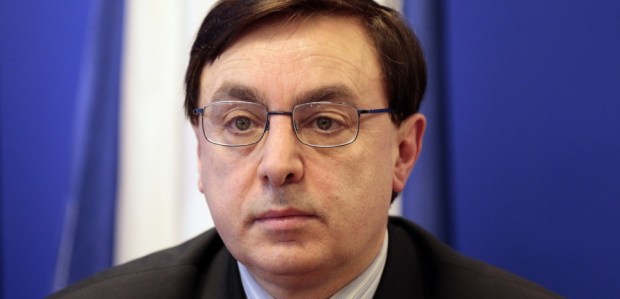
Lebanese Jean-François Jalkh Is Now The Head Of Le Pen’s Far-Right French Party “Front National”

Make sure you download this blog’s iOS app to stay up to date! (Link). 

AFP PHOTO / JACQUES DEMARTHON.

Mabrouk Lebnen! We keep exporting the best of the best, don’t we?

After her expected ascension to the second round of the French presidential elections, Marine Le Pen resigned her position as president of the party she inherited from the father, in order to airbrush herself as a candidate who’s open to everyone and is devoid of political attire.

I guess it’s a bit hard to try and label yourself as an outsider when you’ve inherited an entire party from your father. That’s like Taymour Jumblat or Sami Gemayel in Lebanon going like: “oh, we’re new to this game. We are not politicians,” while both of them take up the mantel of a party founded by their grandparents.

But I digress.

In her attempt to gain as many votes as possible in the second round, Marine Le Pen is trying to further distance herself from the party that led to her rise, which is why Lebanese-French Jean-François Jalkh has been appointed interim chairperson, until – I would guess – Le Pen learns of the result of the second round and, in the case she’s not elected, resumes her position.

In summary, this is the Lebanese-French man who is now the head of the far-right populist French party whose rhetoric is fueled by anti-semitisim, racism and hate:

Jean-Francois Jalkh is a 59 year old French man of Lebanese origins who was born in 1957 at Tournan-en-Brie, in the Ile-De-France region. He has been a member of the party since 1974, and wasn’t even 18 years old when he enlisted.

Within 7 years of his enrollment, Jean-Francois Jalkh rose up the ranks of the Front National until he became a member of the party’s central committee, with further promotions to other more important committees later on. He became a deputy of his region in 2005.

Jalkh was a candidate for the 2012 French parliamentary elections but did not qualify to the second round with him ranking third behind the Republican and the Socialist candidates (much like his party’s head Marine Le Pen in the 2012 elections as well). However, that did not deter him from further rising up the echelons of the Front National: a few months after he failed to win a parliamentary seat, he became the vice president of the Front National and was tasked to run all electoral purposes.

His most important position came about two years later when in the European Parliament elections of 2014, Jalkh was voted as a European Parliament Member with his list getting about 30% of the votes in his region.

His career has not been devoid of scandals. Did you expect otherwise?

While he’s not a French household figure, he was involved in a financial scandal investigation about the election funding of Le Pen’s party, in which investigators were suspicious of fraudulent activity involving public money going into the party’s campaigns.

Jalkh was also appointed by Jean-Marie Le Pen, Marine’s father, as his advisor while the latter was a member of the European Parliament, even though Jalkh had already been a secretary of the Front National. This led to Le Pen being forced to pay back 300,000 euros in retribution.

In November 2016, his parliamentary immunity was revoked after an anti-discrimination group filed a suit against Jalkh for allowing publications by the Front National which call for access to public social registries, something which was proposed by his party for municipal elections in their program.

Another scandal involving Jalkh was his borderline Holocaust-denying attitude with him questioning the use of certain types of gas in the mass extermination that were conducted. Not at all surprising given his history’s party, be it with his founder or with Marine Le Pen’s recent attempts at absolving the French-Vichi government of its Nazi-fuled past.

I can’t comment on whether this man is an appropriate lead of the Front National or not. For starters, he sure goes hand in hand in what the party represents, but then again what the party represents is in complete contradiction of any decent values as well as with the foundation of the French Republic.

I sure hope, however, that French-Lebanese, 60% of whom voted for the Republican Francois Fillon in the first round, and are on the fence regarding their choice for the second round do not see this as a sign that the Front National will be nicer to French of Lebanese origins than everyone else.

Marine Le Pen will take away your dual nationality. She will stop your family and friends from being able to easily visit. She will create an environment in which you are a second-rate French citizen by virtue of you not being a pureblood, and she has used your country as a prop during her visit for as big of a publicity stunt as she could muster with her veil and with the characterization of Lebanese Christians as oppressed and persecuted.

Make the right choice. That choice is not on the far side of right.