Save Beirut’s Heritage: The Roman Hippodrome To Be Demolished

Discovered in 1988, the Roman Hippodrome in Beirut is situated in Wadi Abou Jmil, next to the newly renovated Jewish Synagogue in Downtown Beirut. This monument, dating back for thousands of years, now risks to be destroyed.

The hippodrome is considered, along with the Roman Road and Baths, as one of the most important remaining relics of the Byzantine and Roman era. It spreads over a total area of 3500 m2.

Requests for construction projects in the hippodrome’s location have been ongoing since the monument’s discovery  but were constantly refused by former ministers of culture of which we name Tarek Metri, Tamam Salam and Salim Warde. In fact, Tamam Salam had even issued a decree banning any work on the hippodrome’s site, effectively protecting it by law. Salim Warde did not contest the decree. Current minister of culture Gabriel Layoun authorized constructions to commence.

When it comes to ancient sites in cities that have lots of them, such as Beirut, the current adopted approach towards these sites is called a “mitigation approach” which requires that the incorporation of the monuments in modern plans does not affect those monuments in any way whatsoever. The current approval by minister Layoun does not demand such an approach to be adopted. The monument will have one of its main walls dismantled and taken out of location. Why? to build a fancy new high-rise instead. Minister Layoun sees nothing wrong with this. In fact, displacing ruins is never done unless due to some extreme circumstances. I highly believe whatever Solidere has in store for the land is considered an “extreme circumstance.”

The Roman Hippodrome in downtown Beirut is considered as one of the best preserved not only in Lebanon, but in the world. It is also the fifth to be discovered in the Middle East. In fact, a report (Arabic) by the General Director of Ruins in Lebanon, Frederick Al Husseini, spoke about the importance of the monument as one that has been talked about in various ancient books. It has also been correlated with Beirut’s infamous ancient Law School. He speaks about the various structures that are still preserved and only needing some restoration to be fully exposed. He called the monument as a highly important site for Lebanon and the world and is one of Beirut’s main facilities from the Byzantine and Roman eras, suggesting to work on preserving and making this site one of Beirut’s important cultural and touristic locations. His report dates back from 2008.

MP Michel Aoun, the head of the party of which Gabriel Layoun is part, defended his minsiter’s position by saying that: “there are a lot of discrepancies between Solidere and us. Therefore, a minister from our party cannot be subjected to Solidere. Minister Layoun found a way, which is adopted internationally, to incorporate ancient sites with newer ones… So I hope that media outlets do not discuss this issue in a way that would raise suspicion.”

With all due respect to Mr. Aoun and his minister but endangering Beirut’s culture to strip away even more of the identity that makes it Beirut is not something that should concern him or Solidere. What’s happening is a cultural crime to the entirety of the Lebanese population, one where the interests of meaningless politicians becomes irrelevant. Besides, for a party that has been anti-Solidere for years, I find it highly hypocritical that they are allowing Solidere to dismantle the Roman Hippodrome.

The conclusion is: never has a hippodrome been dismantled and displaced in any parts of the world. Beirut’s hippodrome will effectively become part of the parking of the high-rise to be built in its place. No mitigation approach will be adopted here. It is only but a diversion until people forget and plans go well underway in secrecy. But the time for us to be silent about this blatant persecution of our history cannot continue.

If there’s anything that we can do is let the issue propagate as much as we can. There shouldn’t be a Lebanese person in the 10452 kmthat remains clueless about any endangered monument for that matter. Sadly enough, this goes beyond the hippodrome. We have become so accustomed to the reality of it that we’ve become very submissive: the ancient Phoenician port is well behind us, there are constructions around the ancient Phoenician port of Tyre and the city itself risks of being removed off UNESCO’s list for Cultural Heritage Sites.

The land on which ancient monuments are built doesn’t belong to Solidere, to the Ministry of Culture or to any other contractor – no matter how much they’ve paid to buy it. It belongs to the Lebanese people in their entirety. When you realize that of the 200 sites uncovered at Solidere, those that have remained intact can be counted with the fingers of one hand, the reality becomes haunting. It’s about time we rise to our rights. Beirut’s hippodrome will not be destroyed.


Lebanese Authorities Do Not Allow Madonna Concert

According to Al Nahar, Lebanese authorities refused to grant Imad Qanso, a regular fixture for concerts and events in Lebanon, permisssion to have a Madonna concert in Lebanon.

The cause for their refusal was, according to them, Madonna’s statements that the biggest portion of her concert’s revenue goes to the Israeli department of defense.

I’m not a fan but I know people who are actually traveling to watch her perform in UAE and Turkey and who were asking how come she didn’t make a pitstop for a gig in Lebanon.

Either way, I hardly think religious active groups and the BDS would have let the concert be had Madonna been allowed. And while I’m more inclined to see the point of view of the refusal in this case, I still disagree with it. She may be pro-Israeli but she shouldn’t be forbidden from singing here.

Lebanon’s Chicken Hit With Deadly Virus

I actually come from a family who owns chicken farms both from my paternal and maternal sides. I grew up around family members highly involved with the little creatures, although I tend to stay away from anything I am not obliged to do with their regards.

Every month or so, my family has to bring in over 125,000 chicken to our farms and get them to grow to full size before they’re taken out and turned into food. Recently, there has been panic about a virus that has been blowing in from the Northern parts of the country, killing thousands of poultry in its path. My uncle likes to call it: the plague of the chicken.

I don’t mean to get anyone to freak out, not with all the rotten meat and cheese frenzy, but I have yet to see any major news outlet talk about the matter so I figured I would.

Only yesterday, one of the farms next to my uncle’s in our hometown, had ten thousand chicken die because of the virus. My uncle was lucky enough to have his current flock removed before the virus hit. My maternal uncle, however, may not be as lucky. Extra measures are currently being taken to ensure his 100,000 birds do not suffer dramatic losses as a result of the virus. Despite those measures, over 8000 have died overnight yesterday.

The “silver-lining” is that with this virus killing the chicken, the odds of it getting transmitted to people by consuming chicken are next to nothing.

However, it will lead to drastic shortages in chicken meat in the Lebanese market. In two short days, the price according to which my uncle’s chicken were sold jumped more half a dollar from $1.90 a kilo to $2.5 and it’s been increasing since then. Add this to another factor eating away at the wage increase.

With all the rotten meat, rotten cheese and now dead chicken, perhaps observing lent was actually a good idea this year? ‘Tis a good time to be a “devout” Christian apparently – or vegan.

The Lebanese Help: The Abused Ethiopian Woman Commits Suicide

Ali Mahfouz. Know the name. That is the name of a man who drove a woman to her death.

After publicly beating her up, right at the doors of her embassy, Mahfouz dragged his Ethiopian maid into his car and out of sight. The government had noticed the event and is now working to bring the man to court. But what good is it for that woman and her family back in her home country?

Mr. Mahfouz and his family created such an unstable work environment for the Ethiopian maid, whose name we still don’t know, that she drank detergent in an attempt to kill herself. That attempt was thwarted, leading to him beating up her in front of the embassy and somehow, in an interview conducted with LBC, he put the blame on the maid, denying he had even beaten her up. As if videos actually lie.

This Ethiopian maid’s death will, unfortunately, go in vain simply because there are a lot of people in Lebanon who share the same mentality as Ali Mahfouz, who see these Ethiopian (and other nationalities) maids as their “slaves,” who see nothing wrong in abusing them, be it by overworking them, beating them up, verbally abusing them, banning them from contacting their families…. Many simply don’t see them as human being. They don’t see them as people who, like us, have their own story in life, who have a voice and who need people to hear that voice.

Do you want to help me make the voices of maids heard? Then get aboard The Lebanese Help. If we manage to stop one family from being this abusive to their maid, then we can deem the plan a success.

Change starts with a whisper.


LIRA: The Lebanese Internet Regulatory Act – What You Need To Know

The news about an internet regulatory act, targeting Lebanese bloggers mainly, surfaced a few months ago and then died down. No one had taken the whole affair seriously. After all, in the country of freedom of the Middle East, such a thing could never be viable – or so we thought.

Efforts by minister Walid Daouk to pass the law have exponentially increased recently, including him bypassing parliament and taking the law immediately to his cabinet, an obvious breach of hierarchy, but what could you expect from a minister in a cabinet that has done next to nothing in the year it has been ruling except create hurdles for itself, protest on itself, quit within itself and preach about “shortcomings” of previous governments?

Al-Nahar has published the law in its current form. Blogger Joseph Choufani has translated it to English as well, for those of you who cannot read Arabic.

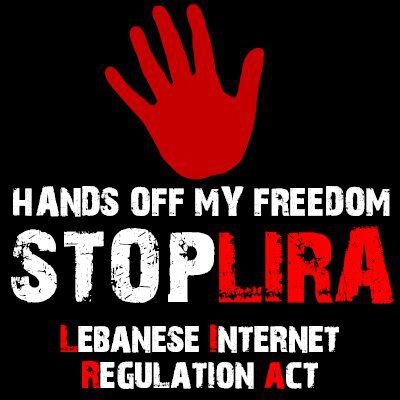
The law has been dubbed LIRA – the Lebanese Internet Regulatory Act, an interesting name if you ask me. It is the Lebanese version of SOPA and PIPA, which took the internet by storm back in Janurary.

What does the average Lebanese user need to know about LIRA?

Simply put, for a blogger like me, I’ll have to register my blog with the ministry of Information. For me to be able to run this blog, I shouldn’t have committed any crimes or misdemeanors. So if your judicial record is not “clean,” you cannot express yourself online (or even in voting but that’s a different matter) – so your voice is quenched. I also cannot run more than one blog at a time. So you’re stuck with “A Separate State of Mind” by yours truly.

For people using electronic media, the same rules regarding journalism will apply to you. Never mind the fact that most of us use electronic media as a carefree medium to express ourselves, the minister expects us now to behave on our blogs, online accounts and any other social network we are present on as if we are journalists in some fancy Lebanese newspaper – with punishments applicable.

On top of that, the law is actually very vague. It states that every Lebanese website needs to go through the proposed regulations. But what’s the definition of a “Lebanese” website? Is it one hosted in Lebanon? Is it one whose domain has been purchased by a Lebanese?

In simple and concise terms, your whole online presence will have to go through in a way that is approved and clear to the Ministry of Information, conforming with the rules it has set for you.

As BeirutSpring points out, the motivation behind such a law is not to “protect” Lebanese internet users but rather to have a 21st century big brother presence over them, punishing those who stray away from the pack set forth by the law at hand. In a time when neighboring countries are moving towards more freedom (regardless of what you think of the process taking them there), Lebanon, the country which has the most freedom out of the bunch, is taking steps backwards.

This is not only detrimental to us as individuals, it is also detrimental to us a society at a time where online presence has become a make it or break it deal for businesses, people and everything in between. If Lebanon’s online presence, however dismal that may be with our horrible internet, is threatened by regulations on top of our pitiful bandwidth, then we might as well kiss our position in the 21st century bye bye.

Minister Daouk must heard Somalia’s information darkness is very nice all year round. If you care to join him, be my guest. If you don’t, Lebanon’s online community has decided to fight the bill using the medium the act is trying to regulate. The hashtag #StopLIRA will be used on Twitter. Sharing articles with your friends (such as this one) to raise awareness about the issue is a must. Get going, everyone.