A State of Lebanese Twitter

Lebanon + Twitter

A friend of mine decided to start using Twitter recently. She followed enough people to get a taste of it and stayed on the sidelines, observing our timelines as they got busier and busier with tweets flooding their minutes and seconds, some original while others basically deja-vu.

A week later, the conclusion about the Lebanese Twitter scene that she came up with, by following the people that most of us follow and read, is the following: this is one hell of a hostile environment.

I tried to change her mind. But I wasn’t convinced it wasn’t the situation either. The past few days have not only revealed a hostile environment, they revealed an utterly disgusting infestation that I can’t begin to describe.

People on Twitter are panicking over 140 characters. Let me rephrase that: People are getting hormonal on 140 fucking characters. Do you have any idea how stupid that is? Do you have any notion how utterly ridiculous you sound when you post screenshots of your private messages with the people you want to ridicule just because you have “dirt” on them? Do you know how disgusting you come off when you screenshot your private conversations to use them as material to bully people?

Do you know how moronic it is to make fun of others because they asked for retweets fully knowing that you had also asked for retweets at a certain point? The difference is the people you asked retweets from are actually decent enough creatures not to spread your laundry for everyone to see.

The courtesy doesn’t seem to go both ways.

Some Lebanese on Twitter feel proud lately about them ridiculing teenagers, getting them feel insecure – basically bullying the bejeezus out of them. They are proud to have started Twitter wars. The Twitter community isn’t much different from its offline counterpart. And what for?

Because of a stolen tweet? Because those people are not original? Because they delete tweets? Because they tricked their way into followers? Because you think they’re dicks?

News flash: bullying, which is what many of you are doing, is not original.

The Lebanese Twitter community is witnessing a growing infestation of bullies. They are people who take pleasure in bashing others for the fun of it. As one twitter user put it on Sunday, they must check their dicks after each bullying tweet to see if it got longer. There must be an association there somehow, I’m willing to bet. And they can somehow fathom coming up with excuses to their bullying. They’re proud of it. They don’t hide it. “Nfokho” is what you get when you point it out.

Bullying cannot ever be justified, let alone when it’s about a reason as silly, as retarded, as stupid as one tweet.

You’re annoyed by someone “stealing” your oh-so-original tweets? Make it known. You’re annoyed by someone’s tweets or by the fact that they delete their tweets? That unfollow button is bigger than Jennifer Lopez’s ass. You’re annoyed by someone who’s annoying you? Block them. You don’t want to get anything from them anymore effectively making their presence non-existent? Turn off retweets. Mute them as handles, mute them as keyword, mute them as hashtag. Mute the hell out of them and just cross that bridge.

But wait. Some of you are STILL stalking those that you block. Masochism much? Are you so fixated on bringing people down that you can’t seem to move the fuck on?

I’d post some of the tweets inundating my timeline but I don’t want to give the many attention-seeking people behind them the attention they crave.

Here’s some perspective for those concerned, especially those who see a tweet getting stolen as the next coming of doomsday. I go to the hospital every day at 7:30AM. I deal with dying patients and children all day. I see grief and horror and people dealing with it on daily basis. We had to tell our patient’s mother yesterday that her bundle of joy will not live to see the tender age of 5. Then I come back home and check Twitter only to find some people acting like prepubescent teenagers with surging hormones who panic over the most meaningless of things, who treat Twitter like some holy shrine, who don’t view a tweet as just a tweet: 140 miserable characters to communicate an idea. Not to get you popular. Not to get you famous. Not to turn you into a major star, its only purpose being for you to have fun, to make friends, to let off some steam.

Isn’t that why those “major” Twitter accounts whose asses many are all hell-bent on kissing simply couldn’t care less about people stealing their tweets, about people calling them unoriginal and about many flooding them with sheer negativity and bullying and dimwittedness?

The Lebanese state of Twitter recently has sucked the fun out of what used to be a decent place for people to have decent exchanges. I met my best friend on it so I would know. People worry more about the number of retweets their tweet would get than about the things they should be worrying about. They worry about the copyright status of a joke that has been milked all the way from Mercury to Saturn. They get up in a fit about the most meaningless, worthless of things.

News flash 2.0: that internet explorer New Year joke has existed ever since Internet explorer became a source of jokes. Just an FYI for the wise asses who think their nostrils drool originality.

The only thing some people have turned Twitter into is a typical old fashioned catfight between two matriarchs in some Lebanese town who are arguing about whose progeny is first in his class. It’s downright childish, despicable and horrifying. And there are still people who look at the people on Twitter as the sign of a better future. Screw that future if this is a sample of the ride we’re in.

Here’s to those awesome people who don’t get a surge of testosterone behind the shroud of an online handle.

The First Lebanese Born Without a Sect

IMG_7246

I’m sure you all remember Khouloud and Nidal Sukkariyeh, the first Lebanese couple to get a civil marriage without going to Cyprus and forcing our government to recognize it as legitimate, using a loophole that existed in our constitution back from the days of the French mandate.

We all knew as well that they were awaiting their first born when the news of their marriage spread like wildfire among the Lebanese populace. We wondered what would happen to that child, bureaucratically and whatnot. Well, we now have our answer.

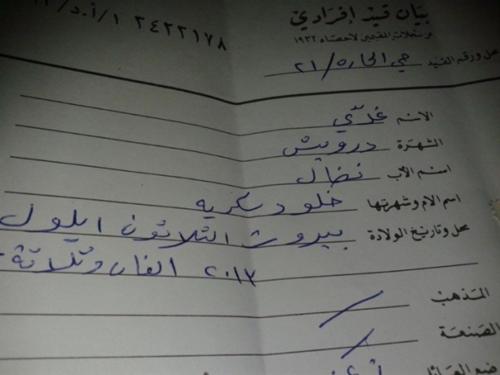
Ghadi, Khouloud and Nidal’s firstborn, is – I believe – the first Lebanese citizen to be born without a sect plastered across his papers. The Lebanese mold has been broken once again.

This is obviously great news. It’s another firm step in getting our country to become more aware of citizens like Khouloud, Nidal and their son who don’t want to be governed by regulations that are detrimental to their well-being as citizens and which are custom-made to the community they just happened to be born in.

It’s a firm step in getting people who have lived all their lives believing there’s no alternative to realize that yes, something could be done about the situation we’re in. And it’s also a firm step in, maybe, changing the perception of those who view all of this as one big load of unacceptable actions.

But I have to wonder: is 2013 Lebanon the best place for a child like Ghadi to be born into regarding his sect-less identity? Our country is divided among sects. Job interviews need you to be honest about your religious affiliations. You can’t get into certain places if you don’t have a wasta that is contingent upon your political affiliation and your sect. The entire country is built in a way that allows those and only those who exist within the grand mold of a “sectual” identity – even if only on paper – to truly have a shot at making it.

I hope the current status quo isn’t bad news to Ghadi because it would be a shame for a child that just made the history books to go down memory lane unremembered. Allah y3ayysho.

Lebanese Restaurants: What Will Your Price Limit Be?

I decided to go out with a few friends tonight for dinner. Pretty mundane stuff, right? Well, with med schools and all such dinners have become quite rare so I tend to jump on them whenever I can.

We went to a place we were all familiar with: nothing too fancy, supposedly, and prices that were acceptable, supposedly.
We were given the menus. I looked at my go-to item and it seems since I visited that place last back in September, prices had taken a hike.

That same hike also happened last year across many of the country’s restaurants. And then the year before that. And the year before that. And we can go on for several years more but the sentence would become too wordy and tedious.

As we made our way back home, my friends and I wondered: when will Lebanese restaurants realize that it’s unacceptable to have these yearly price hikes that come in like clockwork when there are very few reasons (read none at all) to warrant them?

Lebanese restaurants don’t exist in vacuum. They exist in a country where salaries have not increased since last year and where the economic situation has become very tough for many people who used to frequent such places.

Have they seen their business take a dip over the past year? I doubt. And I doubt they’ll be affected this year as well. But we’re fast reaching the point where burger joints will stamp the word gourmet next to their names and cater only to select clientele because, you know, Lebanese love their exclusivity.

I’m not saying restaurants shouldn’t open a charity-esque business or not work for profit because that defeats the purpose of their existence.  I’m just saying there comes a time when the price of a French fries platter that doesn’t contain that much fries almost hitting $5 is way too much.

Tripoli And “El Khetta L Amniyé”

I’m not the kind of people to get deterred from going to Tripoli by the sporadic fights that erupt there or the occasional bomb that finds itself to explosion. It’s not that I have a death wish – it’s that 1) the fights are often not close to the places I frequent, 2) the people I visit there are like family and 3) I  love the food.

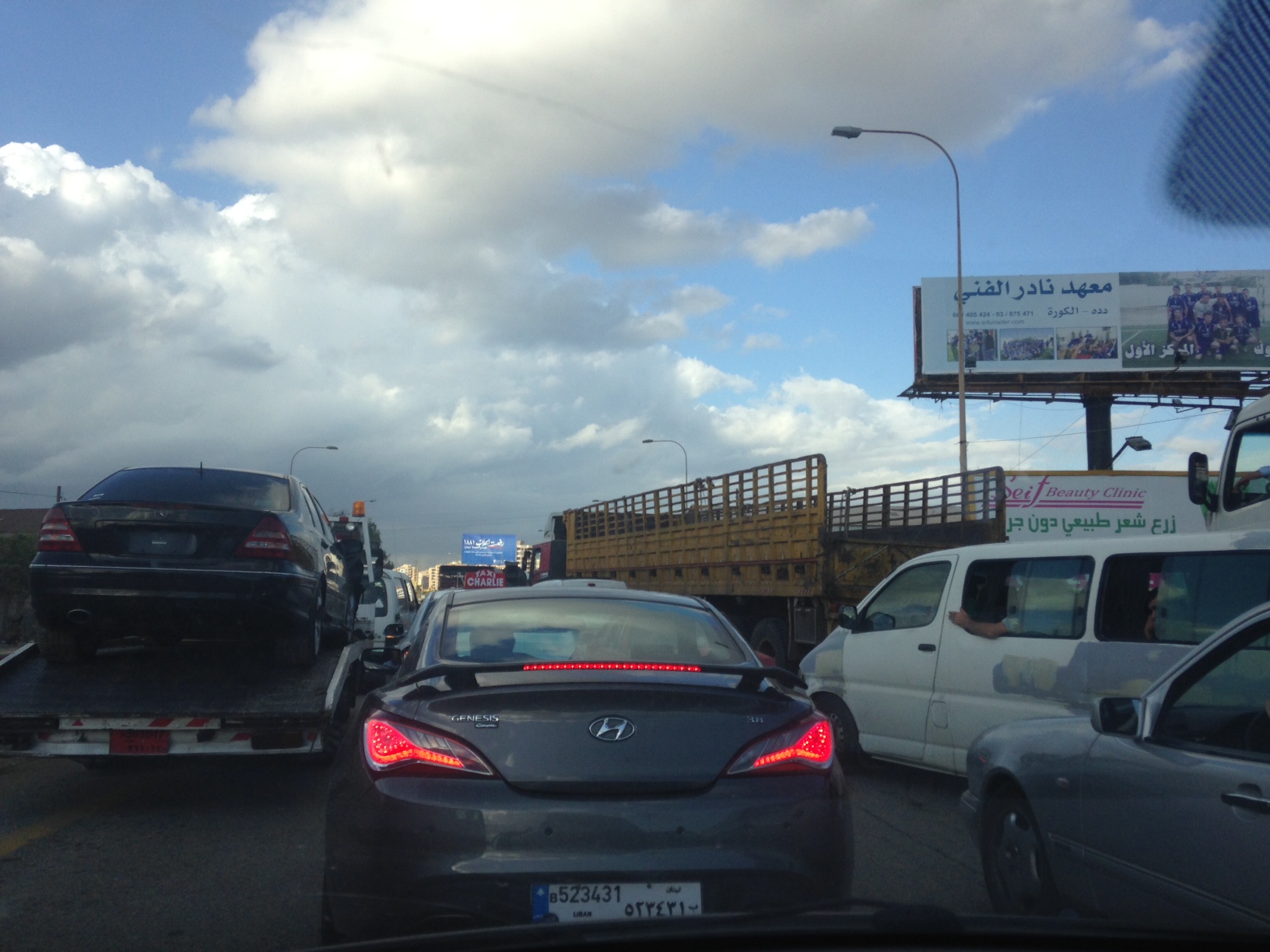
Around late September, I was driving to Tripoli, rolling fast on the highway, when I was shocked to find traffic. Those of you who have been there know it’s near impossible to have a congested highway. But it was. And it took me almost 30 minutes to cross those few kilometers into the city.

Why did that traffic exist? Because a “khetta amniye” (security plan) was put forth. I’m not following the news so I had no idea. I grabbed a picture then of the cars piling up above each other and figured I’d write a blog post about it: security vs efficiency – we just couldn’t have both. Should we accept to compromise over the other?

But I let it pass.

photo-14

Today, all entrances to the city are blocked by checkpoints that screen every car as well as rude officers that don’t even try to make it The army is also present across the city and it’s all part of said “khetta amniye.”

The catch? These past few days have witnessed a resurgence of the fights in Tripoli. And the fights are heavy – heavier than in the last round the city witnessed. Of course, no media will talk about these things because, you know, must keep perfect image about Lebanon (as many of the comments on this suggest we should). But the question is no longer of security vs efficiency in Tripoli. We’re getting neither.

My friends from Tripoli call their city jokingly the Qandahar of the North. We laugh about it because there’s nothing else to do but make fun of  the situation that has befallen their city. But the question to ask: if a security plan as stringent as the one imposed on Tripoli now can’t keep the city safe then what can?

What’s the point of making the lives of its people a military mess if said military can’t keep the city safe when the going gets tough? There’s no point I guess.

My friends in Tripoli, your city is not tragic in itself. It’s a manifestation of the utter failure of the Lebanese state. It’s sad that you have turned out to be the scapegoats of a government and a country that can’t keep its citizens safe even if it tried. The story of Tripoli and said “khetta amniye” is one sitcom waiting to happen. Just make sure to never tell that officer monitoring those many checkpoints “bonsoir” and you’ll be saved.

Disgusting Lebanese People: The “Help” Doesn’t Get a Chair… The Purse Does

Disclaimer: This post was published originally on Sunday October 20th. I then took it down as per Dyala’s request because she got word that the family had actually asked the maid to sit and she refused.

My friend Dyala Badran was having lunch at a Beiruti restaurant today when she spotted something that made her twist in anger.

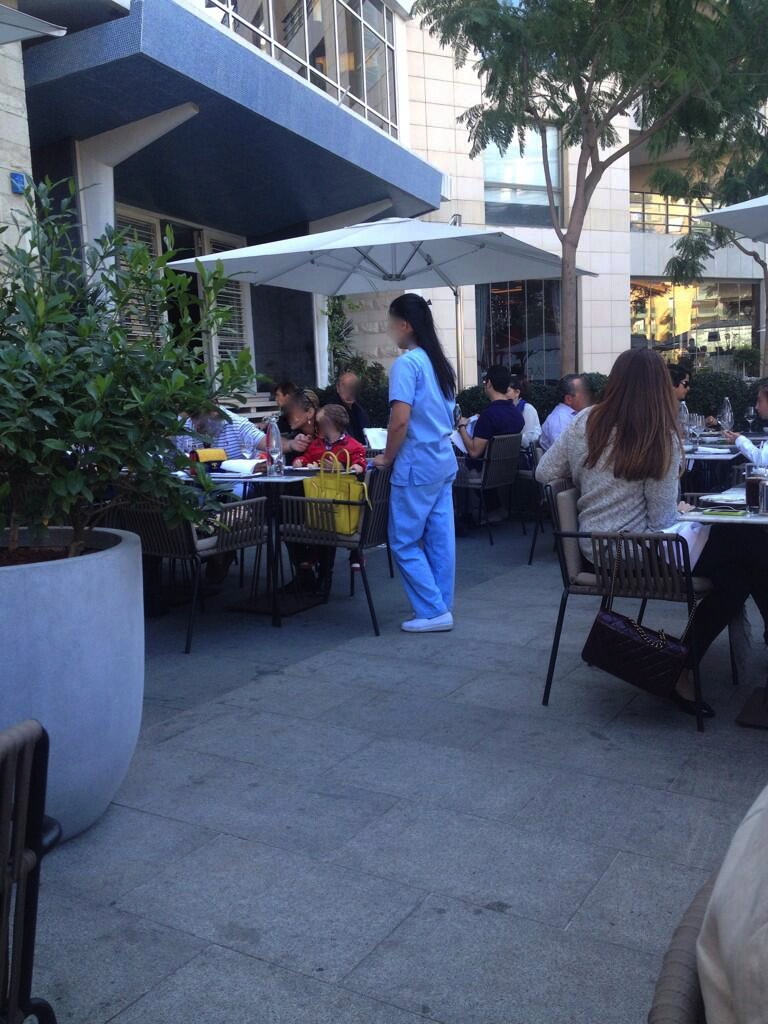
A Lebanese family was sitting across the place from her having their Sunday lunch. They were all seated happily, enjoying their food. The father was cuddling his newborn who was sitting on his mother’s lap. And there was their maid, standing there, clutching the chair that was empty… save for the bag of the madame.

And Dyala documented that moment in picture.

Let’s talk about two scenarios.

Scenario #1: 

The maid wasn’t actually told to sit as Dyala was told, in which case I wonder what is it about the madame’s brain that got her to think that poor human being, who probably spends more time with that woman’s children, looking on their table had no right for a chair. Oh, nevermind. How could a Lebanese share a table with the Help? It’s so beneath us, duh!

The maid actually sat at one point to nurse the baby. Then she was told to stand up again after finishing.

The madame probably thinks she’s doing her maid a great service by taking her out with them for Sunday lunch. Who’s willing to bet she will brag about her open-mindedness in that regard to her friends in a few days? Who’s willing to bet she may have also forgotten to feed her lunch? Who’s also willing to bet she’s even prouder of that uniform she got her because “their clothes are just too filthy?”

Scenario #2:

The family asked the maid to sit and she refused. People took this as a sign that the family is good, that people treat maids well but they don’t want to benefit from our goodness as Lebanese.

Has anyone wondered though: why did that person refuse to sit? Why does she refuse to take a chair? What has led this person to believe that sitting, as an equal to the family on that table, is an abomination? What has gotten that poor woman to believe that she shouldn’t take the seat that the bag ought to have?

Conclusion:

Regardless of whether scenario #1 or #2 played out in that restaurant yesterday, a pattern emerges of a disgusting Lebanese mentality that manifests in a behavior that believes sharing the table with that person is a disgrace, a lowering standards. That woman didn’t sit because this country is brimming with disgusting individuals who don’t think she deserves an empty chair.

Dyala has written her own blog post on the matter in which she has declared “shame on [her]” for taking down the picture. I regret hiding this blogpost yesterday as well.

We “import” these people in a form of modern day slavery. We work them like there’s no tomorrow on a salary that is not only laughable but a disgrace. They don’t have rights and even if they had, we make sure they don’t have access to any of those rights’ forms. They cannot seek protection. They suffer from our abuse day in day out. Our media ridicules them or goes on manhunts against their existence because the Lebanese is always right.

But that doesn’t matter, I guess, because Beirut is THE place to visit.