Arabic is Dying in Lebanon

We’ve all tossed around the idea of the Arabic language meeting a slow but sure demise in Lebanon. It was only very recently that a friend and I figured we should strive to lessen mixing languages during our day to day discussions. This has proven to be especially difficult seeing as our day to day discussions stem from elements in our lives where Arabic is as dead as dead goes.

As an example at the top of my head, there are next to no Arabic words that I’m aware of with which I can describe what goes on at the hospital. So I simply revert to the language that makes such descriptions easier. It’s a simple matter of convenience.

However, there are now tangible numbers as to the state of the Arabic language today. Out of more than 61,000 brevet students, only 33.7% managed to get the required 30/60 to pass their Arabic exam, one that has been easy by all standards:

I’m guessing such news comes as no surprise to anyone. I also don’t see this pattern reversing anytime soon, no matter how much the Arabic curriculum is changed or the exams made easier as the LBC reporter suggests.

For starters, the bulk of your education, be it at school or at the university level, doesn’t happen through the mother tongue, not that I’m complaining. The last thing I want to do, honestly, is to study Maths and science in Arabic. However, when you are priming a student for years and years not to use his mother tongue in almost all the dealings of his everyday life, isn’t it expected for him to slowly move away from that language?
This lack of Arabic use in education reflects clearly on the extent with which Lebanese use Arabic outside of their education as compared to neighboring countries. For instance, many of my Syrian friends find chatting, texting or doing anything of the sort in Arabic completely normal because of the extent that language is used in their education. Is that the case for us? Obviously not.

Upon leaving high school and going to college, the Arabic you get exposed to is directly correlated it with how much Arabic you are willing to take. For most, that is the one required course in order to graduate – an easy course at best, with many struggling to make it through as I’ve witnessed personally. If you’re not majoring in Arabic literature and have no interest in languages in general, there’s next to no use for you to pursue this language further. Couple this with the fact that your exposure to its components becomes non-existent and the populace suffering a decline in their Arabic proficiency becomes certain.

Back in our days, we were not overwhelmed by a lack of Arabic as the newer generation is today. We didn’t go home to countless Internet pages and smartphones that beeped to no end. How much of our laptops and devices are Arabic-equipped?
How many Internet pages that we actually use are written in Arabic? How many of the Arabic pages that are present do we normally use? Outside of the news ones, I can think of none. Horoscopes, maybe?

Moreover, the entire online presence of the Lebanese population, the youth particularly, is one which doesn’t rely on the Arabic language. We use arabizi out of convenience. We revert to English and French because even arabizi has some aspect on which we fail to agree and its use becomes tedious for those who are not that used to it. Who of us regularly tweets using Arabic? It comes as a surprise for many if some of us actually do that. Who of us has set their Facebook account to Arabic? How many of us even feel it’s easier to blog in Arabic even though it should give us a wider base? My MacBook Pro, for one, doesn’t have an Arabic keyboard.

There are a multitude of jokes about Achrafieh women who are proud of their children not knowing a word of Arabic. The reality though is that in a world as changing as this and with a people as malleable to circumstances as the Lebanese people, the Arabic language simply doesn’t seem to find a place of use except as being the language we were born hearing and speaking. Is that enough? Perhaps not.

The Geitawi Pedophile “Monster”

It is widely believed that incidents of child molestation are not really present in Lebanon. The reality, though, is that most of them go hidden for years. It might be because as a society, we forcefully turn a blind eye to such elements that may be very flagrant in front of us.

The last time child molestation made headlines was with an instructor at renowned private school. The issue has now made headlines again with a 28 year old man who has been doing so for 14 years in Geitawi, a part of Achrafieh.

There is a sense of tragedy in thinking of the lives of all the children this man has maimed and ruined. The innocence he has taken from them will have a lasting, albeit repairable, effect on their lives.
And it’s precisely that: these children can easily be helped.
The man in question has triggered countless red flags along the 14 years he spent doing his deed. And yet, no one ever thought of intervening apparently.

1) The man in question was discharged from the military back in 2007 for violent sexual conduct. That would make him 22 year old at the time. Didn’t it cross anyone’s mind to refer him to some psychological help? Doesn’t our army have anyone to council them for any PTSD, which has probably become recurrent lately?

2) The man in question was also reported to be the victim of sexual abuse himself when he was a child. I highly doubt this is new information. It never crossed anyone’s mind that such a childhood trauma would have an ever lasting impact on a person’s being?

3) The man has also been “active” for 14 years. That would make him 14 at the time things had started. I find it extremely hard to assume that there was absolutely nothing that ticked off anyone to any odd behavior he might have had back then.

There is an equally tragic aspect of this story, however, in the cluelessness and utter unprofessionalism with which Lebanese media is reporting on the issue. Of course, “monster” brings much more attention than trying to actually address the issue. Instead, we are met with attention-grabbing headlines and empty content: from baseless psychoanalytical theories to give some science cred to a journalist’s piece down to publishing pictures of the man, along with his name.

I’m not justifying what the man did as anything remotely acceptable. It’s not. It’s sick and revolting.

But what’s also not acceptable is for such incidences not to serve as a way to educate parents on signs that something wrong might be happening with their children in order to intervene before it’s too late.
Instead, we are met with gossip-like handling of the issues simply because it is believed this is what people want.

Pedophilia falls under a subset of sexual disorders called paraphilia which are related to culturally unacceptable sexual activities which cause the individual severe distress. This may not apply to this Achrafieh “monster” if his actions didn’t cause him distress. But I’m also tempted to believe that the “monster” he is today is the byproduct of his experiences as a child, which nobody even cared about. And I’m also willing to bet that many of us would have felt sorry for that child at some point in his life before the lack of help turned him into the “monster” grabbing headlines he is today.

Breaking News: I Almost Died

Well, not quite.

I was in Tripoli when Saad Hariri’s long-awaited Ramadan speech was taking place. I couldn’t care less about what he had to say so I just sat with my friends on a porch, enjoying an afternoon August breeze.

“He’s ten minutes in and we haven’t heard bullets yet,” Ismail said jokingly. And, as if on queue, the bullets started getting fired up the air.

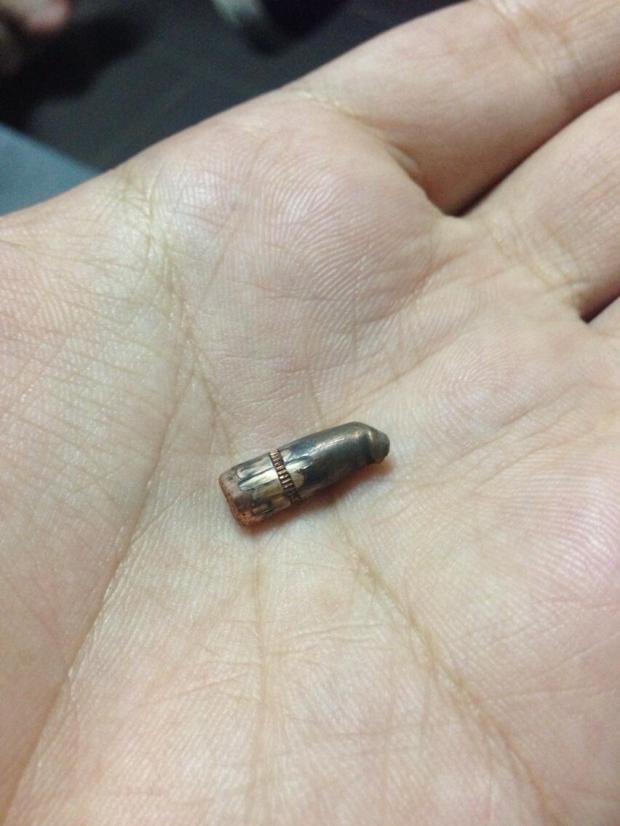
So as we discussed some inescapable politics through the distant shots, we heard something ricochet off the wall and land immediately next to us. We were four people. This surprisingly heavy bullet could have hit anyone:

Bullet tripoli lebanon

I’m not the kind to immediately freak out so we simply retreated inside as they cursed the morons shooting on the streets in celebration. The shooting soon ended as the speech died down.

Then I wondered: what if this actually hit one of us?

Any kind of injury because of this bullet would necessitate hospital attention.  What if we can’t afford the hospital? What if there’s no hospital around? What if the supposed injury was life-threatening? Why is my well-being contingent upon the odds of ricochets?

Till when should we be satisfied that this is simply a “what if” scenario?

The worst part of it is that we have all become so used to this, even those of us who don’t come from a city that has become far too acquainted with such incidents, that the logical thing to do was to simply change rooms and wait it out because we knew there was nothing else we could do and that no entity whose job was to prevent such things from happening would actually do its job.

However, I’m not full of negativity. I can see the silver lining in all of this: they were firing bullets not rockets.

The U.S. Visa Cancellation of Lebanese Citizens

It’s a joyful moment for many when they get that American embassy employee to smile at them and tell them their visa request has been finally approved. I wouldn’t know since I’ve never had that happen to me.

For many, it is believed the struggle to get into the United States is almost done – what can go wrong now that you’ve got the paper work? Nothing, right?

Wrong.

For 3000 Lebanese, visiting the United States has become an impossibility for reasons no one knows. The people whose visas got cancelled belong to different Lebanese sects and religions: Christian, Muslim, Sunni, Shiites. They belong to different societal strata: businessmen and regular joes.

The U.S. Embassy in Lebanon has denied such numbers  (link), asserting that it is within the authority of the American State Department to cancel visas if information came to light after their issuance that would make the person in question inadmissible in the United States. But isn’t it also the right of Lebanese citizens, whoever they are, to know what those information are?

The most prominent example of canceled visas is the Hallab family in Tripoli, which has affected all four owners of  Hallab. For those who don’t know, the Hallab family owns and runs Asr el Helo (The Palace of Sweets). Some were forbidden from going for their medical checkups while others were told, upon leaving the United States on their way to Lebanon, that this would be their last visit. Even calls for Lebanese officials who, until very recently, used to be fully acting prime ministers to help with this issue proved to be completely useless.

Furthermore, it has been brought to my attention that Hallab, the sweets shop, is currently cautious about exporting its goods to the United States. The family is currently in a legal debacle in order to try and see how the visa cancellations affect the export.

But is there even any logical why the Hallab family’s visas are canceled? I can think of none. They do not harbor nor support terrorism and Islamist movements. They do not fund radicals who might find their way to American soil.  And yet here we are.

Another businessman whose visa got cancelled is Khaled Rifai who owns the Tripoli branches of GS, Springfield, Polaris and Bossini  as well as an insurance company. Khaled Rifai and the three Hallab brothers, who are a mere fraction out of many that includes Lebanese students, were not given any reason as to why their visas got cancelled. Better yet, their cancellation got almost no media coverage in Lebanon to begin with. I guess the media blackout over Tripoli extends to such incidents as well.

Who do we blame for this? I guess we can blame the politicians who have willingly turned the country into a playing field for everyone who wishes to start a game of tug of war. We can blame our useless passport, the most expensive and least efficient in the whole world. We can blame the current situation. We can blame whoever we want, point our fist at Awkar and pretend being outraged will get us somewhere.

But the truth is there’s absolutely nothing we can do but remain under the mercy of such embassies, vying for the next visa to take the bunch who doesn’t live in their version of Lebanese lala land out of here. I guess it comes with the territory of being where we are, what we are and who we are.

There’s nothing we can do but take it.

Video of Lebanese Woman Committing Suicide

The video below is disturbing. Watch it with caution.

Video link if taken down: here.


The video looks real. And according to the following news item (link), the woman in question, Amina Ismail, did throw herself off the balcony of her apartment at the 8th floor of a Beiruti building. She has been buried in her hometown, Tyr.

I wonder what got into her husband’s head to start filming though. It must be completely natural to bring up a camera when your wife straddles herself off a balcony in order to jump to her death. Or could he have sniffed out signs that his wife might do such a thing and figured a video is the best way to prove his innocence in court?

Either way, this tragedy, regardless of whether the video turns out to be true or not, is further proof that we are in dire need for two very important things:

  1. De-tabooing the idea of mental health across the country,
  2. Making psychiatry more accessible for everyone.

I don’t know what the conditions that led to this woman jumping are. But her death, if the video isn’t fake, could have been prevented if the idea of seeking help hadn’t been, in this country, worse than the idea of death itself.

May she rest in peace.

Update: according to an email from a reader who allegedly knows the couple, the man was filming their newly bought apartment when the incident happened.