It is a sad moment when you find out that even though you belong in your country, you simply don’t fit there. This past week had this revelation thrust upon me. I belong in Lebanon. But I do not fit.
It started with me blogging about the Batroun cocaine scandal and my parents getting inundated with phone calls for me to pull the article offline. Some of those calls had been from a high-ranking priest. Others had threatened to pull their political strings. My parents got so worried about my well-being that they couldn’t sleep that night. I had to abide. It seems that there’s a limit to what you are allowed to say even when it comes to littlest things such as writing a harmless, nameless post about an issue that’s affecting my generation. But it doesn’t stop with drugs.
Everywhere I look, I am faced with the reality of people so untouchable that the mere idea of mentioning them would make me lose sleep. I am not a coward. But it’s just the way things are. In fact, I think I am automatically limited in Lebanon to the confines of what is allowed to me simply because my father is not one of those untouchables, he doesn’t know one of them and he’s not a millionaire who can buy his way into becoming one.
As I sat pondering over this in my Achrafieh apartment, I was melting in the July heat. There was no electricity. I wasn’t put off by the fact that the three hour cycle I had gotten used to by now was being messed up. It would only be a matter of minutes. But when those minutes turned to hours and those hours started doubling, I knew something was wrong. It just couldn’t be.
The situation persisted for a day. And two. And then three. So much so that after the only 50 minutes of electricity I had gotten on one of those days, I met up with some friends for a walk around Beirut. As we wandered through Gemmayzé and then Downtown, I felt happy to see so many people happy. Perhaps alcohol-induced ignorance is really bliss.
But as we got to Downtown, a Lebanese-looking girl came up to me and said with a khaliji accent that I later realized was fake: “I want you to fuck me.” My first reflex, after the few seconds it took me to understand whatever she had said, was to reply with my Lebanese accent. She immediately lost interest. It seemed that this girl and her friend had been hunting down foreigners and khalijis in Downtown Beirut, using an improvised accent to hook them. If you’re Lebanese then odds are your coffers are empty and they wouldn’t be interested in you.
As I walked through Downtown and some very annoying people came flooding over me with their pleading for me to sit in one of their restaurants, I looked at the menus they were offering. And behold: the main dish every day for the entirety of summer is…. KABSE! Our national dish is no longer tabboule or fattoush, but Saudi Kabse. Even l’entrecote de Paris in Downtown Beirut had hookahs being offered. Would you like some apple-flavored nicotine with your French steak, sir?
Scattered around the area were ancient ruins as well, some of which had been demolished already in favor of the newer structures. Others stood defiant among restaurants, churches and mosques. I remembered the Phoenician port that was demolished and how some people thought that decision was wise. What use would the port be for tourists? Would the Khalijis like to visit the port?
Because the entirety of the country now rests upon what the khalijis may or may not like. So we give them what we expect would bring them pleasure and say screw everything that is Lebanese.
Our identity crisis didn’t stop there. Our need to please foreigners with what we think they would like doesn’t stop at the mere elements of food or ancient monuments. Our walk took us to Saifi village, a very beautiful place in Downtown Beirut. One of the shops there was selling khaliji clothes and nothing more. Because, you know, there’s nothing better-looking than for me, as a Lebanese, to wander around in one of those white robes with that thing strapped around my head.
So I left the security zone known as Downtown Beirut and went back home. And there was no electricity still. I showered with whatever water I had left using a fluorescent light that I had left charging with whatever grid-coverage my house had gotten throughout the day. And then when the lights flickered, I decided to watch the news. Somehow, a very creepy looking bearded man riding a horse (or a donkey) and making fiery statements in Saida had made national news. That man was sheikh Ahmad el Assir, an extreme Muslim cleric who has apparently decided to restore Sunni pride and honor by blocking roads and making speeches, despite the former being clearly against Islamic shari’a.
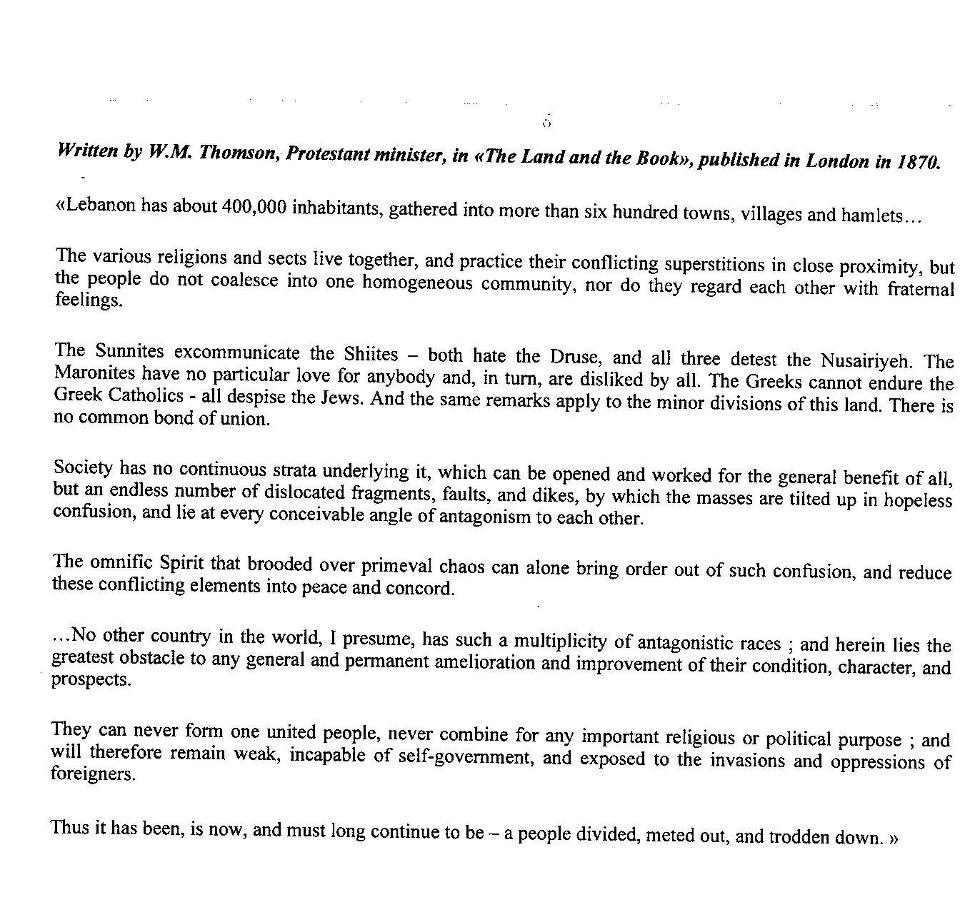
Ahmad el Assir was followed by another bipolar segment about the Maronite Patriach and another statement of his that contradicted something he had said a day or two before. Then came on his Holiness Hassan Nasrallah (because using any other prefix would get you shot) to bestow upon us his eternal wisdom. As I listened to these three men talk, each of them representing one of the country’s three main sects, I realized exactly how deep their influence runs. When Nasrallah speaks, the Shiites rise. When Ahmad el Assir shouts, the Sunnis boil and when Beshara el Raï does anything worth mentioning, the Maronites go into a frenzy.
It’s the way things are. It’s the way things have always been and will always be.
It is then that I decided to check the situation of my visa application at the French embassy for my trip during the month of August. The same notification popped up. “Wait 10 business days on average for the application to be processed.” Fine. So I decided to see if there was a possibility for the visa to be done before the 10 business days. They did say “on average.” My google searches led me to a page that listed which countries were required to have a 10 day wait for their schengen application to be processed. Lebanon is one of them, obviously. What are the other countries that Lebanon was grouped with? Let me name a few: Niger, Afghanistan, Pakistan, Congo, Rwanda, etc…. The total is 39 countries. How many of us thought we were better than those countries? I’m sure most of us did. Not for the folks in the Eurozone. The rest of the world either doesn’t need one or can have it issued in less than a day.
I don’t really care about needing a visa, although ideally I would prefer not to. But it seems my passport is so low-grade that even my visa has to go through countless bureaucratic steps. My mind then wandered to my family in the US, how they are all US citizens, with the exception of my father, and how for the simple fact that they hold that navy-blue American passport, they have much more opportunities – the simplest of which is when it comes to traveling. But I shrugged the idea off.
The following day, my friends were trying to come up with plans that involved going to the beach in Sour (Tyr). I had my reservations on the matter. For the past few months, the only thing I had heard of Sour was about restaurants serving alcohol getting bombed and liquor shops getting forcibly closed. I had started to wonder if that part of the Lebanese South was slowly getting turned into New-Tehran. And even though I had never been past Saida, my interest in visiting Tyr had gotten very minimal. My friends told me my worry was unfounded. But when the minimal concept of people being free to drink whatever they want is lost upon some individuals, what would they think of me?
“You don’t really need to drink beer on the beach in Sour.” But the question is: what if I want to?
Amid all of this, the citizens of Jal el Dib were busy throwing a tantrum. Their bridge had been demolished because it was a safety hazard and their commute time had increased by a few minutes. Totally unacceptable. What way of protest did they decide was the most suitable? Block the highway in both directions. That would teach the Lebanese something, sure. And they, of course, got what they wanted: $20 million from our tax money for them to have a bridge (or a tunnel) whose construction will create way more traffic for everyone in the year or two (or even more) it will take to finish. It’s not like this form of protest is illegal but our security forces are too cowardly to crack down upon them and open the highway. It’s apparently not my right to go to class or work but it’s their right to stop me.
And we’re also not allowed to talk about the army, the ISF or any form of people who are “protecting” the country because they are doing all of us a service. It seems that the concept of a person doing his or her job has escaped people in the country. People have forgotten that they’re paying the army, the ISF. But I digress.
“Thank you minister Sehanoui for fixing the internet!”
It’s his freaking job to fix the internet. I shouldn’t thank him for it. It’s his duty to fix whatever went wrong because he is in charge of it.
“Thank you minister Bassil for providing the $1.2 million needed for the water project in Ebrine.” That was a banner at the entrance of my hometown.
No, I don’t want to thank Bassil for using money that I had paid to fund a project that has been in the works for a few decades.
No, I don’t want to be eternally grateful to ministers and MPs who are spinning doing their job into a 2013 elections campaign.
So as I sat in one of my med school’s tutoring classes, as a practicing physician told me how I’d be lucky to get paid $400 in Lebanon after 7 years of medical school, I looked around me and saw one of my colleagues who thinks Ahmad el Assir is the best thing to come to Lebanon in a long time and then another who thinks Muslims should be eradicated from the country because they are the root of all evil and a third one who believes that Hassan Nasrallah is the undeclared return of Imam el Mehdi.
And I realized that these three people represent their societies, their families. Their convictions run way deeper than what they’ve declared. And as the realization that I do not really fit among my friends dawned on me, I remembered that girl from downtown, my electricity situation at home, my crappy cellular coverage, my lack of water availability at home, the deafening traffic, the people who can move mountains, figuratively, with a flick of their finger; the people who can block roads and not face any resistance; the people who honk until your ears bleed because you stopped at a red light; the people who cannot stand to grab their kleenex for a few minutes so they throw it outside their cars without caring; the people who couldn’t give a rat’s ass about our national heritage… And the list goes on and on.
I realized I have pitiful job prospects in a country of no national pride, no national unity, no electricity, no water, no internet, no security and – for the first time – no hope whatsoever.
Can we nag? Sure. Would that lead anywhere? No. Can we talk about it? Sure. Would that get us anywhere? No. Can we do something about it? Perhaps. Would that change things? No.
We’re in a ditch that we cannot escape, change or alter. And they wonder why we look West in envy. What 2012 has shown over and over again is that the situation is hopeless. We thought we had learned from May 7th, 2008. And then many mini-May 7th took place in the space of a few weeks. We thought we had learned not to get swept by enticing political rhetoric. It only takes a leader a sentence to get his followers on or off the streets.
I know I had said before not to take Lebanon lightly. But I believe that we get the country that we think we deserve. The sad reality is that the collective of the Lebanese population thinks they deserve shit. And shit is what they’re getting.




 A Separate State of Mind | A Blog by Elie Fares