Lebanese Tales You Don’t Hear Everyday

She was blowing the candles off her 35th birthday’s cake. This would definitely be her year. She had a man by her side she was marrying in a few days. She had a loving family. Her wedding preps were going smoothly. And yet, there was this one thing gnawing at her head: how was she going to tell him that he wouldn’t be the first, that the skin on which all dignity lay was not really there, that there were several men before him, that she had even had one ectopic pregnancy which she obviously aborted?

She had gone to her gynecologist a month prior. She asked for advice. She wasn’t worried like other women would be at that point. She knew that medicine can do wonders in that regards those days but she didn’t want anything major. So he stitched her up.

What if I didn’t bleed? She asked. Her doctor told her then that only around 35% of women bled on first intercourse, that the myth with which she was troubling herself was unfounded. But she wouldn’t take those odds. Who knew how those Eastern men thought, she told her doctor. Would any of those men she had slept with in years past marry someone like her?

He recommended she’d get a tube of her own blood with her and hide it. So on their first night of marital bliss, she faked being in pain as her husband thought he was giving his wife a new experience. Faking it all the way to the bathroom, she spilled the blood in the tube on a white towel and returned with it to her husband, clutching her abdomen as she faked the insufferable pain all the way the bed.

She was relieved. He was happy. And she told this to her doctor giddily.

– – – – – – – – – – – – – – – – – – – – – – – – – – – – – – – – – – – – – – – – – – – – – – – – – – – – – – – – – – – –

He was rounding on his patients as he normally does every morning, making sure their night had gone smoothly. After a weekend, Monday morning rounds are more complicated because they require you to catch up with two days of work which you hadn’t attended.

So there she was, a girl his age, suffering from a complication that happens in 1% of assisted reproduction therapy cases. She sat in her bed, obviously worried. But why would she be worried, he wondered. There was nothing about her condition that was troubling if it’s under the control similar to hers.

Mom, can you leave the room for a bit? She asked just as she saw him making his way inside. Her mom obliged. She gave him the bag of medicaments she was on: hormones here, hormones there. He went through them quite fast, still wondering why someone his age, who wasn’t married, would be on a therapy designed to eventually get women pregnant.

But she didn’t want to get pregnant. She was getting her body prepped for something far less motherly – She was preparing her ovules for sale.

It was against the law, sure. The hospital she was in had no clue and would never do such a thing, certainly. But no one was allowed to know.

I’ve got myself covered, she said when he asked her how she intends to carry on with her plan. Just don’t tell my mom.

– – – – – – – – – – – – – – – – – – – – – – – – – – – – – – – – – – – – – – – – – – – – – – – – – – – – – – – – – – – –

What You May Not Have Known About Abortion & Some Medical Ethical Issues in Lebanon

You’d think class discussing ethics in medical school are the most boring. The truth, however, is that those classes are the only ones capable of engaging the entire class. The sloths wake up because of a rising tone with their classmates. The conservatives rise because the liberals in class are infringing on their beliefs. The liberals get infuriated at everyone else because they just don’t get it. And the physicians giving the lecture sit back and watch.

Pop corn material? You bet.

Because I am receiving my medical training in Lebanon, we have to also deal with certain aspects of Lebanese law pertaining to these issues and to say our laws are bipolar, nonsensical and surprising is an understatement.

  • Abortion:

We all know abortion is illegal in Lebanon. There’s no pro-life, pro-choice debate. Women have no choice when it comes to this. However, did you also know abortion is illegal even when it comes to congenital abnormalities? In other words, it is illegal for a physician to abort a baby in Lebanon if the baby has, for example, Down’s Syndrome or any other defect which would render his life extremely difficult. The only situation in which abortion can be performed in Lebanon legally is when the pregnancy is endangering the mother’s life – and even that comes with its own baggage of morality clauses.

In fact, any physician who performs abortions that are not indicated – even if they are for what many perceive as common sense causes – can be targeted by the law especially if he rubs a prosecutor the wrong way. Some physicians refuse to do abortions fearing legal issues while others refuse to do so for religious issues. In fact, a physician who is training me said to my face: “I wouldn’t even abort my own sister if the baby was a product of rape.” I was outraged but this is how it goes.

Certain major hospitals in the country do not even do amniocentesis, which is a component in prenatal care and diagnosis to detect certain abnormalities. Their argument? We’re not aborting anyway so what’s the point of the mother knowing if the child has Down’s Syndrome or not? Besides, amniocentesis carries a theoretical 1/250 chance of causing a miscarriage – who needs that risk?

A relevant abortion real life story we were told is when a radiologist missed the absent right arm of her fetus, a condition called phocomelia. She later found out of the condition at a gynecologist’s visit and decided to abort. She then wanted to sue the radiologist for missing the condition but was eventually talked out of it because having the case reach a court of law would get both the mother and physician in jail.

  • Gamete donation:

I daresay Lebanon doesn’t need more fertility. If anything, we need to have population control. But some people just need those little bundles of joy in their lives. Some want to because they feel a need to be parents. Others want to because society looks down upon the women who don’t give their husbands children. Many couples resort to In Vitro Fertilization or other methods of Assisted Reproductive Technology. Insurance companies pay for such practices without knowing so because hospitals cover it up in their charts.

For some couples, however, gamete donation is required for them to have children. Yes, the child wouldn’t be theirs biologically but that’s not all that matters now, right?

Here comes the interesting part, Lebanon-style: There’s absolutely nothing – no religious decree, law – allows sperm donation. It doesn’t matter what the man’s fertility status is. It doesn’t matter if the woman is as fertile as they come. Oocyte donation, however, is an entirely different story that is governed by each person’s sect. Meaning: whether or not a person is allowed to donate or receive donated oocyte is correlated with that person’s sectarian personal status. Move over civil marriage, I guess.

Don’t worry though, the sects agree on this. The Christian, Druze and Sunni sects prohibit this. Shiites are the ones who have gone off the rails – but not all of them. Lebanese Shiites fall under two main branches. There are those who follow Mohammad Hussein Fadalallah in their practices while others follow Iran’s Khamenei. Those who follow the latter are not allowed to donate or receive oocytes while those who follow the former can do so as per a fatwa which he issued shortly before his death. The condition? The oocytes have to donated by someone by the man’s other wives.

  • Embryo Research:

Not a lot of research is being done in Lebanon. This is especially lower when it comes to embryo research – the number is zero. However, who would have thought that the law can actually be interpreted in a way that permits such research?

In fact, the Lebanese law pertaining to this issue stipulates that the embryo is a product of conception and can be manipulated as long as both parents agree. Other products of conception include the placenta. This effectively renders the embryo prone for research. So in a way, we are ahead Western countries in this regard.

Why hasn’t this law gained traction? Mainly because no institutions actually allow such forms of research to happen in their premises. Most of the country’s main hospitals are religious institutes at their base. The law has also passed unnoticed by the radar of sects because they’re all busy elsewhere and we still don’t know if it’s been put into effect. Interestingly though, at least some MP members (Kassem Hachem, I believe) tackled the issue at hand. Meanwhile, women are still waiting on their own domestic violence law.

  • Conclusion:

We were asked the following question about frozen embryos: if you freeze an embryo for 5 years and then implant it, is the fetus one day or 5 years old?

All hell would have broken loose if we hadn’t been a small group in the discussion. I guess it doesn’t really matter where we legally stand from such issues. What is clear, at least to me, is that we are lightyears away from having a decent discussion about them. But I still find them fascinating.

Medicine in Lebanon: The VVVVIP Patients

The following are bits and pieces of things several of my medical student colleagues and I, at many Lebanese hospitals across the country, have lived over the past few weeks. 

“What do you mean I have to deliver in third class? I DON’T DELIVER IN THIRD CLASS.”

Beautiful thing to wake up to in the morning, right? Well, such things are not fiction – they are every day reality in Lebanese hospitals. The woman in question was very very pregnant to say the least. She was also very very angry. Why? Because two emergency C-sections had taken up the first class beds she was promised to welcome her bundle of sunshine into the world.

“We couldn’t help it,” the nurse pleaded. “Those two women just came here in labor!” The nurse was almost begging as I stood there watching.

“I don’t give a shit.” The woman shrieked. “I want first class – I am not a person who can deliver a baby in third class. Take them to third class, they already delivered.”

A few phone calls later, that woman got her way. I guess some vaginas are more precious than others. Literally.

The separate classes in the Lebanese social hierarchy also reflect in its hospitals. There’s really very few things that hospitals can do. They accommodate what they can given how messed up and archaic our health sector financing is. What is bad, however, is the sense with which some people view medicine in this country: it’s not a human right that should be guaranteed to everyone. It’s a privilege, a luxury that only they should be entitled to.

“My ovaries hurt.” I was staring at the face of a supposed emergency condition who had just presented to the emergency room. I could see sunscreen all over her body. She was definitely tanning a few minutes earlier.

“How are your ovaries hurting you exactly?” I had no idea how ovaries could actually hurt a person, not to mention how a person would know where their ovaries actually are. When had the pain started? Well, the pain had happened 6 months ago and had died since but she wanted to know why that pain happened then… now. Bref, there was absolutely nothing urgent with her. But she knew enough people and had enough resources to take away physicians from places where they could be needed and keep them busy for a couple of hours in order to make sure her ovaries are perfect.

And then there are those patients who are so important they book two first class rooms because, you know, what if they got visitors? Can you imagine hosting them in one first class room? They are the patients who are so revered their treating physicians would drag themselves out of bed at times they shouldn’t be at the hospital just to do an exam that I, as a medical student, should be doing – just because it’s that particular patient. Those are the patients who are even treated differently in operating rooms just because they can enforce such levels of fear: “be careful with her… she’s important.” They are the patients on whom we don’t learn simply because they would get “too annoyed” to have that many students in their room. So no one enter please.” That vagina glows of gold, I was told.

Those are the super duper very very important patients that come to Lebanese hospitals: patients whose medical cases are nothing more than mundane, simple and even boring… patients who can turn those cases into a matter of national security. And there’s nothing you can do but smile and the most professional individual that you can be be while you secretly hate on the system that hammers hospitals and medical education alike.

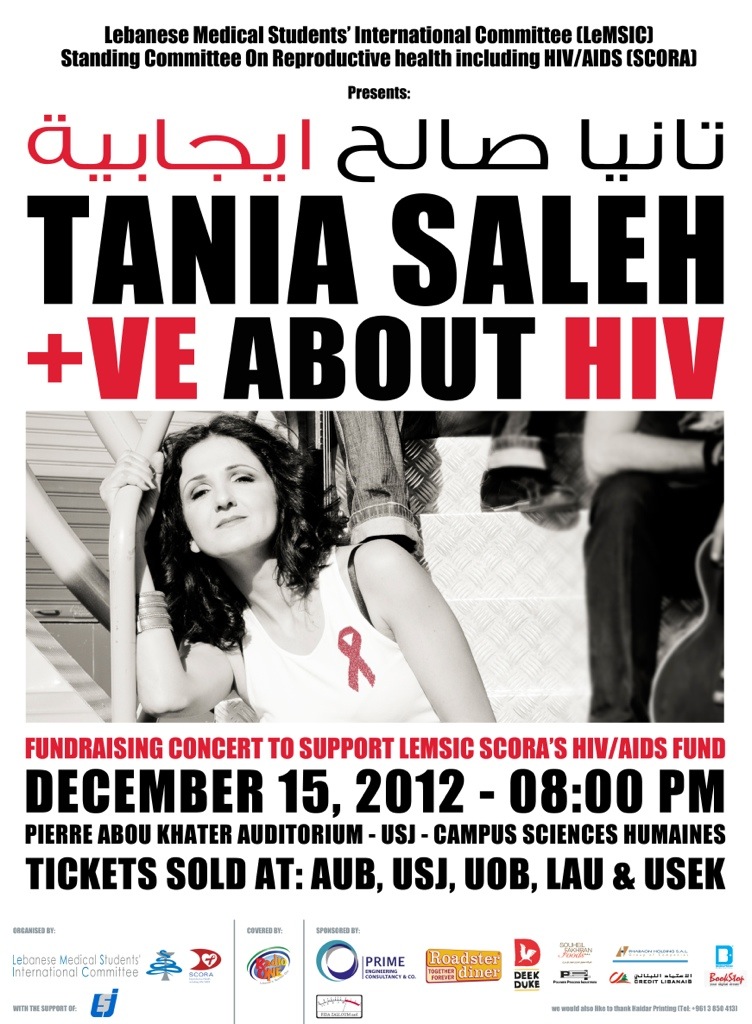
Tania Saleh Fundraiser Concert for World AIDS Day

20121130-125733.jpg

The Lebanese Medical Students International Committee – LeMSIC in short – will be holding a fundraiser concert by Tania Saleh on December 15th, as part of its World AIDS Day awareness campaign.

The concert’s revenue will go to the HIV/AIDS fund of one of LeMSIC’s committees that’s involved in reproductive health which will then help HIV positive Lebanese patients get CD4 counts, which is not covered by the ministry of health or by Lebanese insurance companies.

A CD4 count determines the stage of the disease. The lower it is, the worse a person’s status is. It’s a mark of how far HIV has gone in destroying a person’s immunity and it is one of the criteria used to determine whether a patient has reached a state of AIDS or not, which would in turn affect the patient’s treatment options. The test itself is not cheap at all and many patients cannot afford one on their own.

Tickets prices are as follows: $20 if you are a medical student who’s a member of LeMSIC. $25 if you’re a non-member medical student and $35 for non-medical students.

And in case you’re worried, the concert will not comprise any medical lectures.

The Facebook link for the event in case you’re interested: click here.

Memorial Hermann, a Houston Hospital, Live-Tweeting Brain Surgery

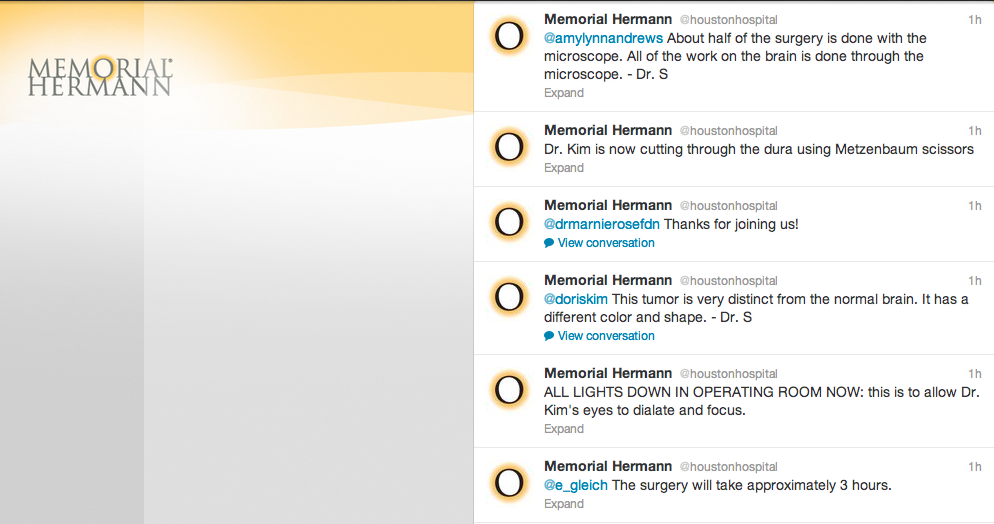
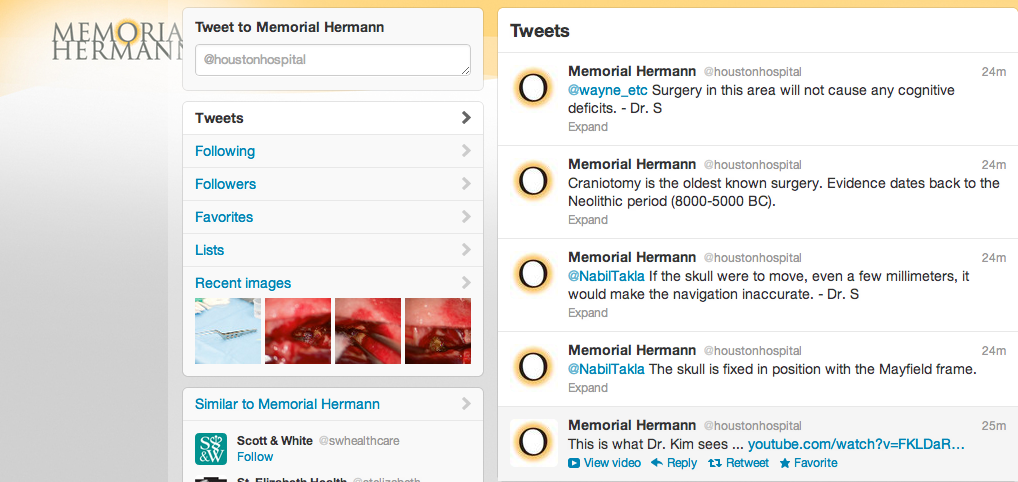
The day has come where Twitter is used effectively as a learning tool in medecine. Memorial Hermann, an institution based in Houston, Texas is currently broadcasting updates and answering questions during a brain surgery that’s going underway right now. You can check out their Twitter account here.

As a sample of what they’ve been talking, I took the following screenshots:

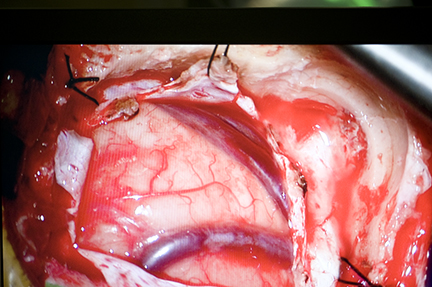
They’ve also tweeted a few pictures live from the operating room, as well as a brief video of the brain while they operated on it.

I think this is great. While I am familiar with some of the terms they’re throwing around, I think this a great educational opportunity for medical students, current MDs, and knowledge enthusiasts. I hope they do this again some other time as well because it sure is interesting.