Why Rima Karaki Shutting Up The Islamist Hani Al Siba’i Is Super Important To Middle Eastern Women Rights

The video of Rima Karaki shutting up Hani Al-Siba’i couldn’t come at a more appropriate time for the region. Its rise in popularity happens to take place one day before International Women’s Day.

He is an Egyptian Islamist who is now residing in London after fleeing Egypt where he faces charges for the support of Islamists. He is BFF’s with Al Zarqawi and thinks Bin Laden is to be respected. He’s a pile or hypocrisy: someone who wants to implement the sharia’h… but lives in London. He’s a defense lawyer… but can’t handle an argument.

Out of all people that interviewed him over the times, Lebanese TV presenter Rima Karaki drew the thickest line. She wore a veil out of respect to his presence (even if through satellite from London), and he ended up demanding she shut up for trying to direct the conversation in a manner suitable for her TV show.

She did the opposite and cut him off right there on air, stopping him from spewing even more hate and disrespect to her and, indirectly, to Middle Eastern and Arab women everywhere.

Hani Al Siba’i is a representation of the sheikhs roaming our lands who think everyone should abide by the rules they have in mind, who think they have the right to shut up a woman just because she dared speak up and who have the audacity to not only request it, but shout it on platforms that always give them a megaphone.

In those 2 minutes, Rima Karaki did something that many women in the region are too afraid to do: stand up to a bully who happens to be protected by religious establishments and fear that allow him to thrive.
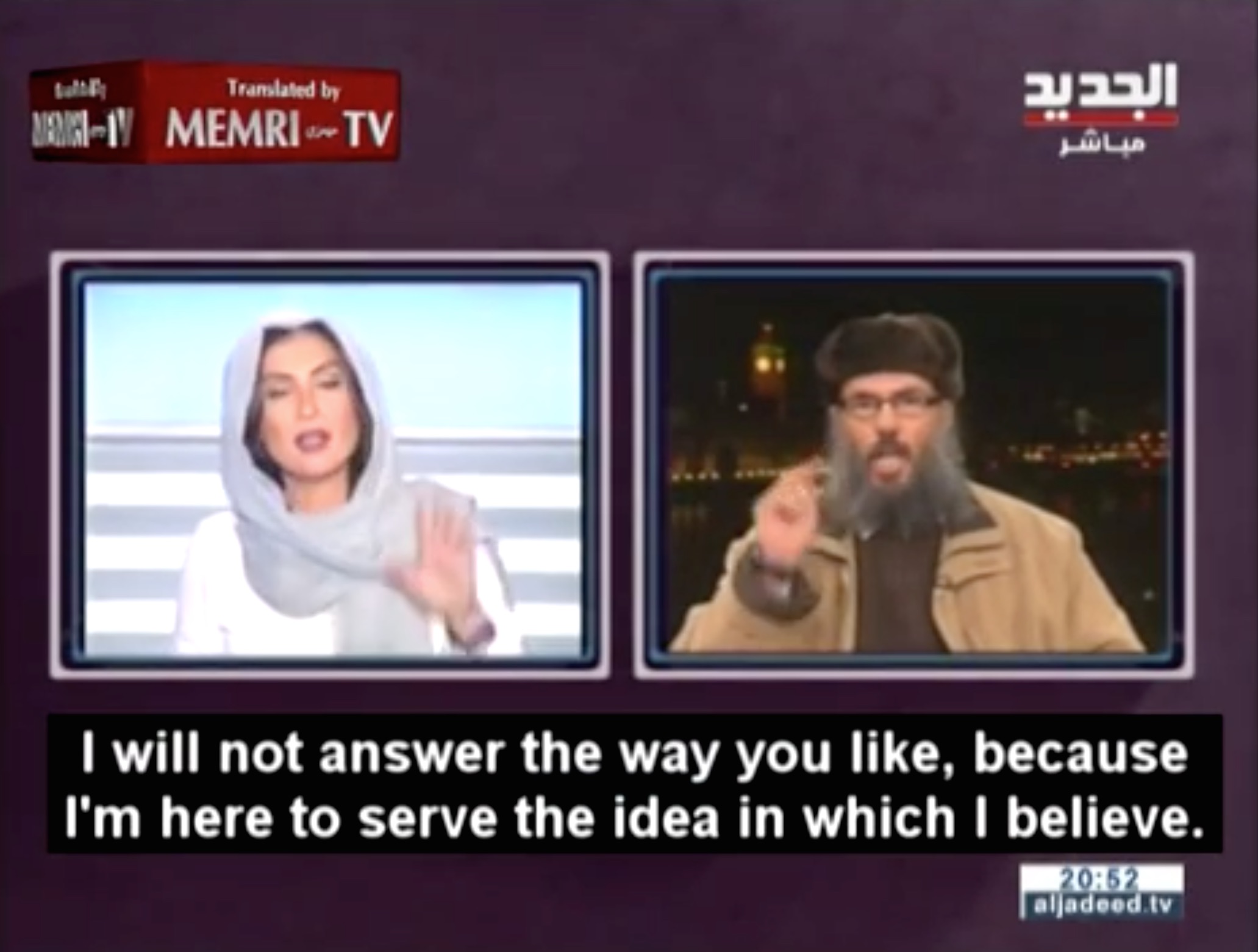
Rima Karaki - 1

When Al Siba’i tried to intimidate her, she stood her ground and still tried to take the harness of the interview away from his monologue.

Rima Karaki - 2

Instead, she told Al Siba’i something that probably no other woman he ever encountered has ever told him: she would be the one taking the decision.
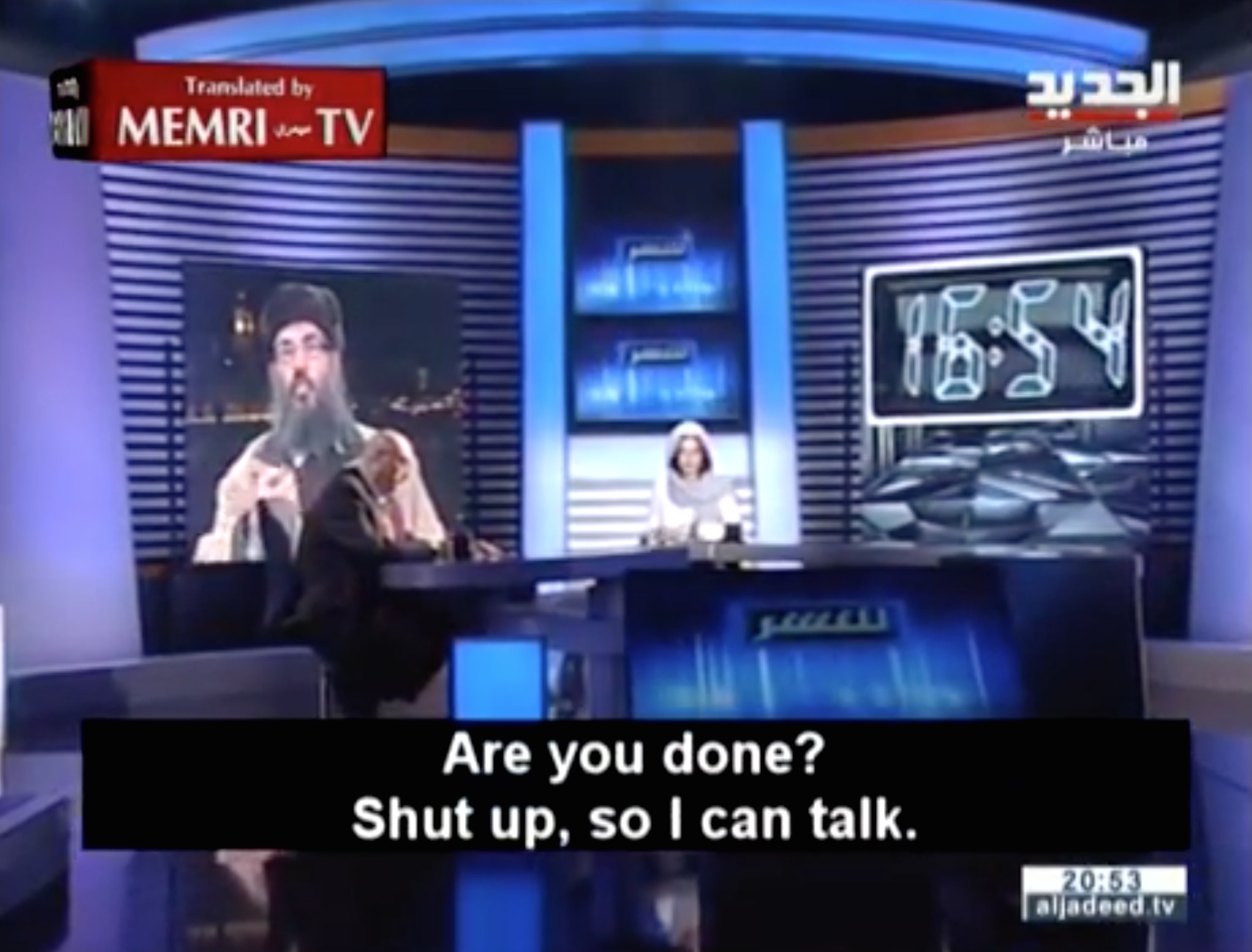
Rima Karaki - 3

So because this was all too weird and foreign to him, Al Siba’i reverted to what he knows best and told Rima to shut up.

Rima Karaki - 6

So while trying to be respectful, Rima Karaki answered back. I’m sure he wasn’t used to getting that thrown in his face… ever.
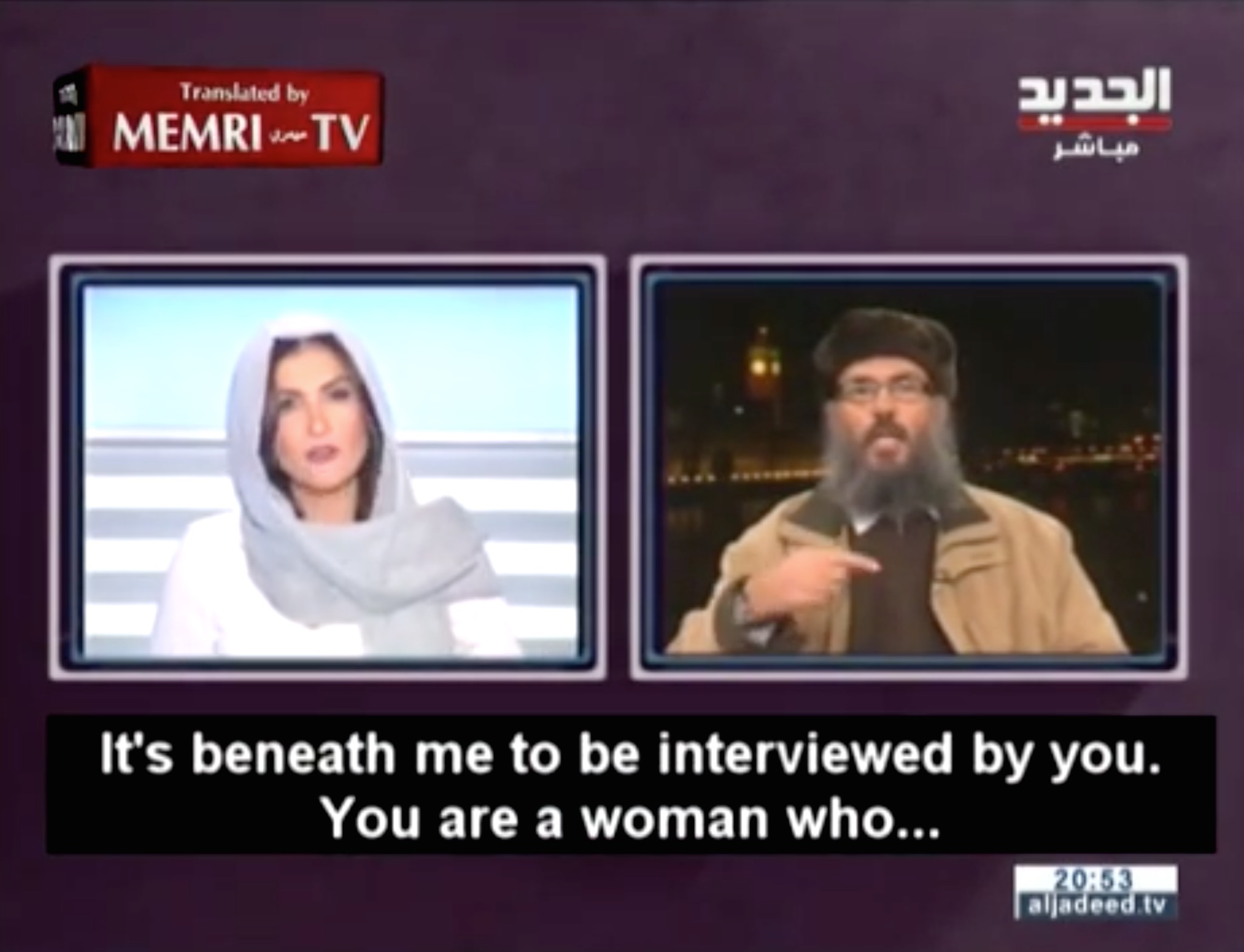
Rima Karaki - 5

So naturally, he reverted to full blown sexism and disrespect to bring Rima down. She didn’t budge. She cut his mic off and then his feed.

In those 2 minutes, Rima Karaki did what every single person, let alone women, should do to people like Al Siba’i: cut them off. I couldn’t not find myself rooting for her. There’s nothing sweeter and more beautiful seeing a woman standing up to someone like him in that manner, someone who hates women and contributes every single day to their detriment.

If I were her, I would have thrown away the veil too, just as the Egyptian anchor did a couple of years ago (link).

Ironically, in those 2 minutes NewTV produced the best TV in their history. This is the full video:

http://www.youtube.com/watch?v=bOlpK6Yj5a4

On March 8th, 2015 this is the view across the Middle East and Arab world:

  • Women in Lebanon are not allowed to pass on their citizenship to their children. They are not protected by a decent law against domestic abuse.
  • Women in Saudi Arabia are not allowed to have authority over their own self; their male relatives do. They cannot go anywhere without male chaperones. They are not allowed to run for any government body that is allowed to legislate. They are not allowed to drive. They aren’t allowed to go out without wearing appropriate religious attire.
  • Women in Jordan are still the victims of rampant domestic violence and honor killings.
  • Women in the U.A.E. can face jail time if they are ever caught engaging in pre-marital sex, or drinking.
  • Women in Egypt are still the victims of female circumcision, a barbaric practice whose sole purpose is to decrease their sexual drive.
  • Women in Kuwait and Qatar cannot pass their citizenships to their children. They’ve also only recently, and very limitedly, started to try and become more engaged in the political life of their country.
  • Women in Iraq are being forced, in some parts of the country, to wear head scarves and traditional abayas to cover up. Their political presence only stems from the quota required to be filled by women according to law there.

We live in the region with the world’s highest gender gap.
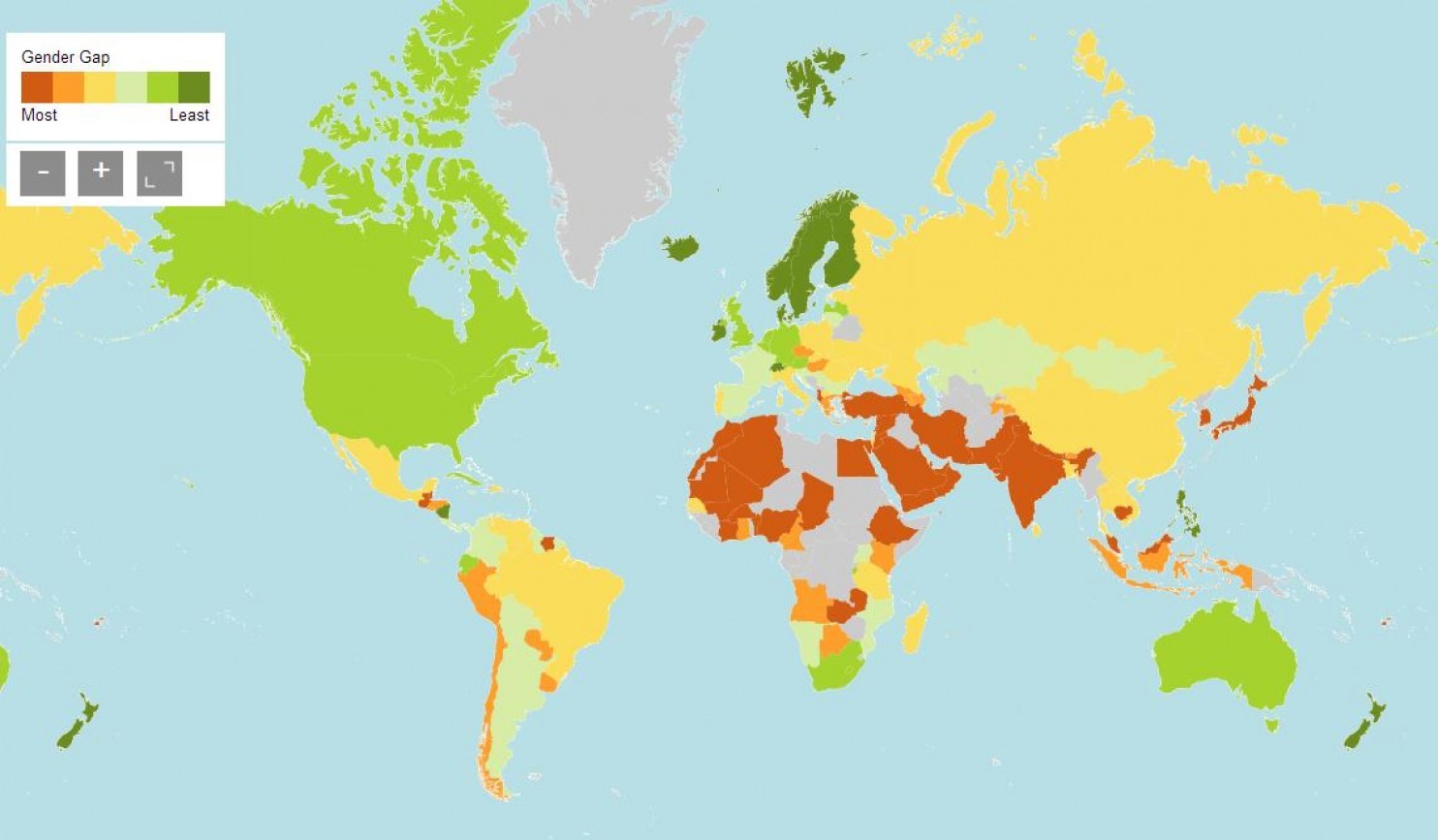
Gender Gap World

And what is common between all those countries is that the value of women is always contingent upon the integrity of their hymen, their worth relative to the purity of their bodies, their purpose in life is to breed and procreate, but rarely produce, and never, ever, stand up to religious authority without facing repercussions.

Until today.

If there’s anything to empower Arab and Middle Eastern women this year around, it’s this. It’s standing up to those who contribute to those women not having rights, who bring them down every time they try to stand up to themselves, who think that “woman” is an insult, who think women should shut up when a man is speaking and who are given a religious cloak to make all their poison holy.


Lady Gaga’s ARTPOP Gets Censored for the Middle East

Like her or hate her, there’s basically no escaping her especially if you tune in for 10 minutes of local radio. Lady Gaga is gearing up to release her upcoming album which she has titled: ARTPOP. A few weeks ago, she revealed the album’s title to be the following:

ARTPOP

Pretty weird, right? It’s not like you’d expect anything less from her at this point though. However, Middle Eastern countries are getting a different and censored version of this same cover, which was just released and is the following:

BYP0Iz0CQAAE123.jpg-large

They’ve increased the dimension of that ball in front of her, whatever it might mean, to cover her breasts. They’ve also colored her legs black in order to give the impression that she’s covered up.

And yes, Lebanon is one of those countries as is evident by the Lebanese iTunes Store.

I really don’t get this. Did local authorities tell her label they would refuse to sell the album under its previous cover? Or did the label do this out of courtesy? If so, did they really think people wouldn’t simply switch the censored and covered-up cover for the other one in case the decided to purchase the album?

I may not like Lady Gaga and her music but I absolutely hate censorship especially when it’s this absurd and non-sensical. What’s next? Cover her up with a burqa and retitle the album to something regionally-appropriate in order not to irk some people? After all, who knows how they’ll take the “art” in Artpop?

Last time I checked, regardless of whether I agree or not with her methods, she was someone championing for personal liberties and whatnot. Our countries have squashed that right out of the bat – and the album is yet to be released. Perhaps they’ll then censor the track listing as well which contains songs called Sex Dreams and Swine because, as you know, sex and swine are both haram.

I guess the bright side is that this wasn’t banned, not that it would make any difference given that’s available online aplenty.

Lebanon’s Porn Habits

Popsci has recently published, off of a website called PornMD, an aggregation of every country’s porn habits based on the search items users who are located in that country use while accessing some porn websites.

Some interesting observations that the aforementioned website noticed are the following:

  1. Finland has Oedipus complex,
  2. Iran likes to search for gay porn,
  3. Ukraine has a thing for gay raincoats.

Some observations regarding the Middle East that I noticed are the following:

  1. Syria is into some form of incest. Their top search is aunt.
  2. Israelis are into Arabs.
  3. Palestinians love their families even in porn.
  4. Gulf countries have no data involved. Could be all the blocks.

Naturally, I figured I’d look at Lebanon’s part of the info-graphic. It’s sad to say we are not very creative, although slightly nauseating (shit orgy? Really?), in our porn browsing habits:

Lebanon Porn Habits

You can access the entire infographic, which contains no pornographic material, here.

Could Patriarch Raï Become The Next Pope?

The conclave of Cardinals in charge of electing the new pope to replace Benedict XVI is currently underway at the Sistine chapel in the Vatican. You’re out of luck if you are a Roman tourist at this time of year – you can blame Benedict’s old age for that.

As it is with papal elections, there is no clear frontrunner as of this point. The myth goes that the cardinals leave their choice to the holy spirit through copious amounts of prayers and holiness. That is if you believe the holy spirit is a combination of politics, geographic, demographics and whatnot.

Eventually, any Pope nowadays is chosen based on one premise only: strengthening the position of the Catholic Church around the world. The late pope John Paul II led one of the biggest developments the Catholic Church had seen when it comes to the Youth, especially in popularity. Benedict’s undeclared job was to contain this surge that John Paul caused in a more Christian, usable, framework.

Today, the Catholic church is stuck at the edge of a steep cliff with the following predicaments:

  1. Decreasing worshippers across the world,
  2. Rise in Christian persecution in certain parts of the world,
  3. Sex-related scandals that plague Catholic priests more often than none,
  4. Corruption scandals that always seem to find a foothold,
  5. The issues of abortion, same-sex marriage and other thorny issues.

Seeing as the Catholic church is firm in its position regarding abortion, same-sex marriages (despite some recent breakthroughs in that regard), stem cell research and the like, I believe point #5 is not even an option in the voters’ mindset. Corruption and sex-related scandals are issues that Cardinals feel should be best kept in-house, not influencing the decision of choosing a Pope who will lead a Church not only based on those two criteria. The stances of the Catholic church regarding the many sex abuse cases that were revealed is a testament to that – if anything, it reminds me of typical elderly Lebanese women whose job in life is to cover up any wrongdoing in their family and showcase it to the world in positive light. Cardinals are similar to those elderly women in that regard.

The most important framework for Cardinals voting today is the following: help Christians around the world stay Christians and lessen the numbers of Christians who are deciding not to be so anymore. There’s little that a Pope can do when it comes to decreasing worshippers – after all, how do you convince people who lack faith that they should have it? It’s impossible. But what the papal conclave of Cardinals can affect is the persecution of Christian minorities across the world, notably in the Middle East.

Pope Benedict’s XVI’s visit to Lebanon back in September – his last major visit to any country before his resignation – was not out of the blue. Him demanding Patriarch Raï to go to Syria and hold mass there, which sparked an insane reaction, was also not out of the blue. Small steps they may be, sure, but for the faithful who still cling to their belief despite the hardships, a patriarch or a Pope acknowledging their strife is some very important business.

The question, therefore, asks itself: Could Patriarch Raï be the dark horse to be elected as the upcoming Pope?

Many Lebanese have already set Facebook pages to that effect, out of enthusiasm mostly, as if a liking a Facebook page to demand our patriarch be instated as Pope is actually beneficial or worth it. But that’s how things are with us – we always take things to Facebook.

However, I have thought about it lately and come to conclude that Mr. Raï could have a decent, albeit slight chance, at becoming the world’s next Pope for the following reasons:

  1. If the main focus is to target the persecution of Christians in the world, what better option than the head of the Christian majority in the location where Christians are targeted the most? The Middle East.
  2. Former pope Benedict’s XVI’s visit to Lebanon was, in part, to sign the Post-Synodal Apostolic Exhortation (text) in which the Vatican goes on and on about the crucial importance of the Church in the Middle East.
  3. A Pope from the Middle East would set the wheels for true Muslim-Christian dialogue, which is what this deeply religious and troubled region needs and the Vatican knows this.
  4. Patriarch Raï is age appropriate to be pope. He is only 73. He also speaks several languages fluently, as is required of Lebanese bishops.
  5. Patriarch Raï does not come from a country where priest sex scandals are aplenty and being relatively unknown to the vote has a rather “cleaner” slate than his counterparts. He was also elected as an assistant to the interim Pope over the past week.

The reasons may not be supremely compelling to have someone become Pope, sure. But they’re still viable enough to put Mr. Raï on the papal map. I’m not even sure if Mr. Raï can be a good pope but he might become one.  And frankly, him getting elected sort of scares me.

The Rise of the Middle East’s Atheists

September 2012, Middle East:

A low-budget movie titled “The Innocence of Muslims” makes its way to the media of the region. The movie insults the prophet Mohammad and doesn’t pretend to do so innocently. The mayhem it caused became infamous, notably for the American embassy storming in Libya which made its way to the US presidential elections. Protests across the region turned bloody. Innocent people lost their lives because of cheap ten minute footage. And the image that some Muslims have been giving to Islam over the years was reinforced once again.

October 2012, Pakistan:

Malala Yousafzai, a fourteen year old girl, was shot in the head by Taliban individuals who feared her message. Malala’s message was not that of an uprising against the men who worked endlessly to make her life and the life of countless other girls like her a living hell. She was calling upon girls her age to seek an education, which most of us take for granted: the kind where we sit behind a desk and listen all day to teachers telling us things we believe we’ll never need. Her message did not sit well with the Taliban whose mission had been, in part, to eradicate education in the parts of the world where they are of influence. They had destroyed countless schools and forbade women from attending schools in their attempt to restore the days of 600AD.

October 2012, Facebook:

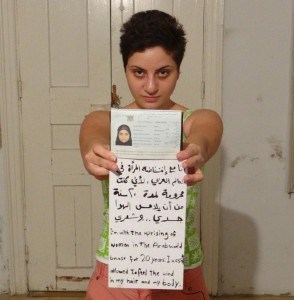
A Syrian woman named Dana Bakdounes posted a picture of herself on Facebook without the veil as part of a movement for the rights of women in the Middle East. (Check the picture here). The message Dana wrote, as part of her picture, said “I am with the uprising of women in the Arab world because for 20 years I was not allowed to feel the wind on my body… and on my hair.” The message rubbed some people the wrong way and a bunch of extremists took it upon them to silence Bakdounes, even on Facebook. So they mass reported her picture as offensive, prompting Facebook to remove it.

October 2012, Egypt:

In a post revolution Egypt where Islamists have been gaining power, two Copt boys, aged nine and ten, were arrested for defiling the Quran. Another Copt teacher was arrested after some students accused her of speaking badly of prophet Muhammad in class while another Copt is facing charges for material deemed offensive which he posted on his Facebook account. A veiled Muslim teacher also cut the hair of two girls in class who refused to wear the veil. She later explained that she had been “challenged.”

The Rise of Atheism:

The rise in religious extremism in the Middle East is touching all of its religions. Be it Christians who are worried about their fate and revert to their Bible in belief that it will somehow be their salvation. Or Jews whose reputation has become intermingled with zionism and borderline inseparable in the mind of many. However, I decided to only discuss Islam because the broader picture of the Middle East, in which there’s a tangible rise in Islamist Influence, is a canvas of Islam – as it is the region’s first and foremost leading religion, demographically.

The rise in extremism is attributed to many geopolitical reasons. It is also associated with a serious lack of understanding of religion from all involved, most notably the men of the robe who are doing more harm to their religions with their backward mentality than anyone else.

The Middle East has probably one of the world’s highest rates of religious people. And it’s simply because we were born this way. We are not allowed to choose what we want to be religiously. I was born into a Christian Maronite family. Therefore, I am a Christian Maronite. If fate had it differently and my parents were from another part of Lebanon, I may have been a follower of a different religion. And this applies to everyone. As we grow up, we are taught our religion and nothing else. Come Sunday morning, it was better for me to attend Mass. For others, they had better pray five times a day, fast during Ramadan and never eat pork or drink alcohol. During my early days at AUB, I was surprised to find that some Muslim people – obviously a minority – had absolutely no idea when Christmas was celebrated. On the other hand, I thought Achoura was a happy celebration. We rarely challenge our religious beliefs because we don’t feel the need to. Those beliefs enable us to blend in our societies and not get ostracized – at least in that regards. They enable us to connect to other people with whom we are able to identify not due to their mentality or thoughts but because of their religious beliefs. At a certain level, deep down, it’s always easier for a “Christian” to make “Christian” friends than to become friends with a “Muslim.” The reverse is also true.

Our narrow religious upbringing also limits us to the other religions present around us, especially in the region’s few relatively mixed countries. Egypt’s Muslims know very little about the Copts who were founders of their country. Lebanon’s Muslims know very little about its Christians. The opposite is also true. This lack of understanding, combined with an increased rooting in unchallenged belief, places the seed of conflict, which has been manifesting way too many times across the region.

However, religion is but one side of the coin. For with the rise of the Islamists on one side, I believe that the region’s atheist numbers are increasing dramatically, albeit most of them are probably closeted, and they are fueled by the exact same events that are getting people to become more religious, coupled with an increase of education across the board. What people turning increasingly religious see as a threat to their belief, others do not see it as such. What some increasingly religious people do to defend their beliefs, others see as a violation of freedom. What some increasingly religious people feel related to, others want to detach from it. The religious behavior that makes some religious people proud causes others to be the opposite. The picture that some extremists deem offensive, others see as a manifestation of free thought. The children seen as defiling Islam by some, others see as children being children. The girl infecting the minds of other girls with poison, which some (obviously very, very few) believe, others see as a complete violation of every single human sanctity.

One part decides to cling further to what they know because of such events. Others decide to look at alternative, which might fit better with how they see the world, away from a notion of faith that has become alien to them. After all, all they’re seeing of faith is repeated incidences of things they do not remotely agree with, despite that being as remote from what religions call for.

Religious people will call it a lack of understanding and narrow-mindedness for someone to turn atheist. They will never be convinced how someone who was born and raised on certain teachings can ditch them entirely and move towards thoughts that they find revolting. What they don’t get is that the same rhetoric they use applies in similar fashion to atheists who are moving away from teachings that they find revolting and forced upon them throughout their years.

Of course, this does not apply to all religious people as some practice their religion in silence, without letting everyone know when they’re praying and when they’re offended. But this silent majority is not the one that gives an impression. Out of a crowd of millions, the person who changes perceptions is that whose voice is heard the most. And in a time of religious insecurity, in a region of political insecurity, the voices heard the most are those of people that rub a whole lot of other people the wrong way.

Regardless of where you stand regarding the two sides of the religion-atheism coin, the image being painted is the following: religion is the bread of the poor. Atheism is the butter of the “educated.” However, the only one thing that I believe is of absolute necessity is that the Middle East needs more atheists.