The Voice is Coming To The Middle East: The Voice Arabia

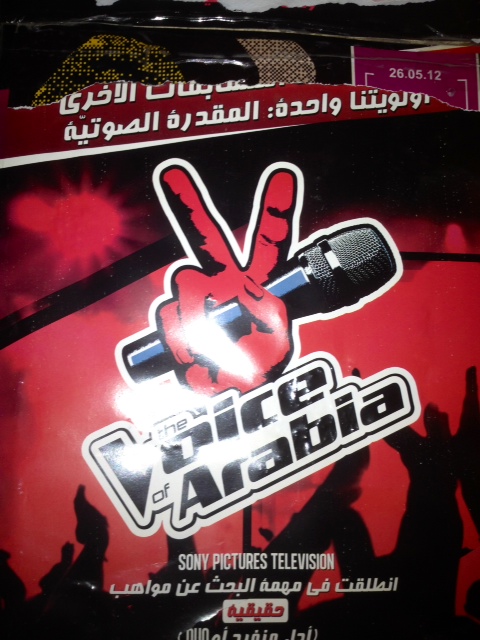
I spotted the following poster while walking in Gemmayzé yesterday.

Yes! Another talent show imported to the region for insatiable crazed fans.

The Voice, originally a Dutch TV show, was taken up by the US and then many other countries followed suite. Now it’s the Middle East’s turn.

Because between Star Academy, Arab Idol, Arabs Got Talent and many other talent shows that I haven’t heard of, we still have a shortage.

The concept of the TV show from what I gathered is the following: it starts with blind auditions whereby candidates sing to judges who have their backs turned to them. If only one of the judges likes a candidate, he would choose for this candidate to be on his or her team. So each judge builds a team and then the teams go head to head against each other while people vote, obviously.

I have mentioned The Voice on my blog before when I spoke about a Lebanese contestant on the French version of the show. He ended up losing around the quarter finals.

Will you be watching this? Because I surely don’t have time for it.

Censorship in Lebanon: Not Exemplary in the Middle East?

The Samir Kassir Foundation recently shared this study that they conducted regarding various forms of censorship in the region. It’s an  interesting read. You can get the PDF here.

What’s interesting to note about the study is that cases of censorship in Lebanon are not among the region’s best. But fear not, it’s not the state that’s actually doing all the censorship.

In Lebanon, two phenomena raised concerns among defenders of liberty. First, the physical assaults on journalists by non-state actors, whether members of political parties, demonstrators, or a new category of activists commonly called “the inhabitants” (Al-Ahali) of some delicate regions. All sides of the Lebanese political spectrum were responsible for such acts.

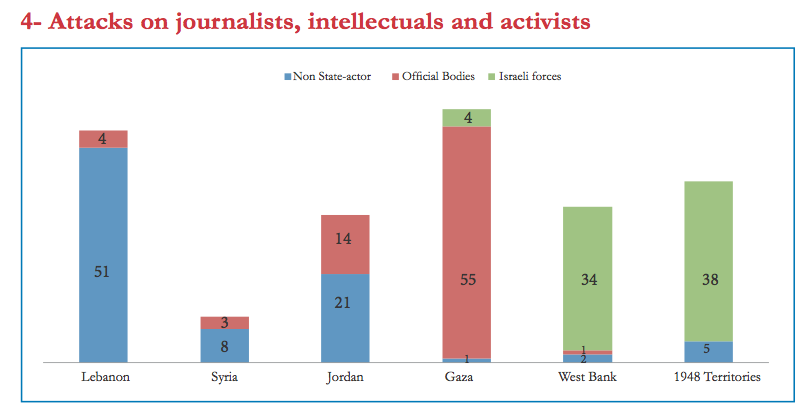
In fact, in the facts & figures part of the study, a graph showing attacks on journalists in each country of the study had the following results:
The low number in Syria is not to be interpreted positively, as the study conductors noted. The attacks, when they’ve taken place, were brutal, as others graphs of the study show: Syria has the highest rate of violence against intellectuals and journalists.

What’s interesting about the results, however, is that 51 out of 55 attacks on journalists in Lebanon weren’t carried out by State authorities, but by non-state entities. Examples given are: Hariri supporters attacking journalists on the “Sunni Day of Anger” when Hariri’s government was toppled, as well as Hezbollah forces attacking journalists investigating their transgressions in Lassa and other villages in South Lebanon.

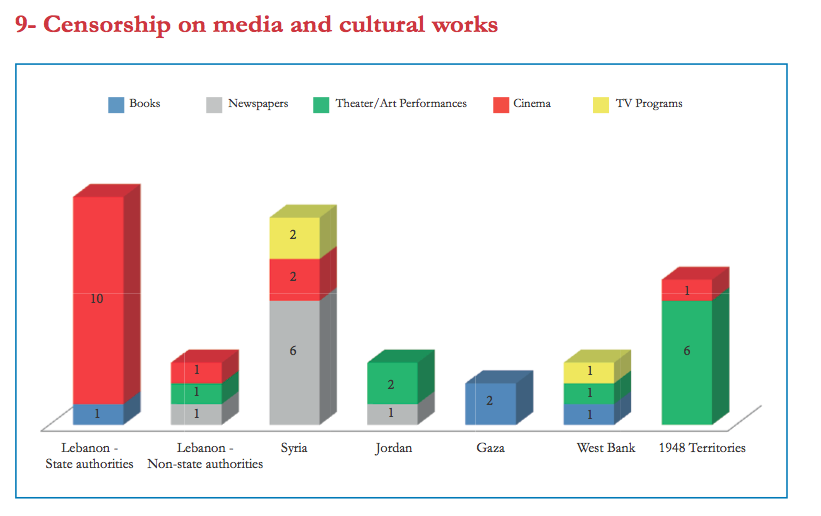
Another interesting fact to note is that the sector most affected by censorship in Lebanon was cinema with more than 10 movies being banned from being screened in Lebanon. Officials justified the decisions as a necessary precaution to preserve Lebanon’s relation with Syria and Iran and our civil peace. I think they were referring to the abysmal Beirut Hotel in one of those points.
For the non-state bans in Lebanon, one is regarding the LMFAO concert ban which happened due to some groups protesting the band’s anti-Christian feel in their song’s video. MEA has banned the newspaper Al Akhbar from being distributed on its flights. And last but not least, the infamous incident to hide Steven Spielberg’s name off the “Tintin” movie poster.

All in all, while Syria takes the cake when it comes to fighting liberties, the situation in Lebanon is not exactly peachy according to this study. Honestly, I didn’t think we had this bad compared to neighboring countries, which leads me to my conclusion.

What I think is a grave flaw in the conduction of this study is that such events in neighboring countries do not make headline news as they do over here, making our numbers seem inflated compared to them. Most of the transgressions that happen in them might be hidden or kept under the radar, making the situation seem much better than it is.

Either way, I’d take the results of this study with a grain of salt. While it is always an interesting read, I don’t think it’s correct nor is it a representative comparison between the countries of the region. Perhaps a look at the numbers of countries known for championing freedom is a clearer comparison. At least you’d know that being skeptical regarding their numbers is unfounded.

Sh*t Middle Eastern People Say…

There are two YouTube videos I recently stumbled on that parody people from the Middle East and they’re actually quite funny, so definitely check them out.

The one parodying girls:

“Free free Palestine!”

The one parodying guys:

“Bro, I want her to smell me in Palestine, bro!”


Lebanon in the 1960’s – The Golden Age

Almost all our parents tell us about the days when Lebanon was the golden country of the region. They tell us about the days when Beirut was called the Paris of the Middle East. They tell us about “Sahet Al Burj” (now Martyr’s Square in Downtown) and how lively it was.

We also heard stories about the train that used to run in Lebanon. I, for one, have a family member that worked as a train conductor back in the days.

But for all they are, these tales remain as they are – stories – of a long lost past that we try to make out pictures for in our mind.

How about a real-life video of Lebanon in the 1960’s? Well, there’s just the thing. And it’s a few minutes long, done by Harold Baim for the BBC. Bank Audi’s ad about the importance of the “lira” apparently took a scene straight out of this.

I, for one, had a sad smile as I watched this. It made me proud to know that my country was simply this awesome at one time. It also makes me really sad that it’ll be very difficult for us to get this back.

Women wore bikinis to the beach and didn’t care to be filmed. Jounieh’s bay actually has green spaces. Beirut’s skyline isn’t full of useless ugly high-rises. Perhaps the only place in the video that still looks pretty much the same is the gorgeous Lebanese North – mostly because it is one of the country’s most underdeveloped areas.

But who or what are we to blame? our go-to-for-blame sectarian political system? Absolutely not. We only have ourselves to blame: letting foreign armies into our land to govern us, not having any futuristic approach regarding civil planning, selling land to whoever and however, demolishing Beirut and turning into an identity-less concrete mess – even building inside cemeteries.

We may not be able to turn the clock. But at least you can stop the hurt before it runs deeper than it does today. Maybe it’s time to lessen the endless political bickering and focus on laws that help us preserve whatever identity we have left.

Former culture minister Salim Warde had a great initiative regarding this, one that got shoved into the depth of some bureaucratic drawer as his government toppled. This legislation is something we terribly need right now.

“Without roots and heritage there is no future,” Warde said. Perhaps by having tangible proof of ours, we can work towards saving our future.

Nancy Afiouny: My Meow – Lebanon’s Lady Gaga/Britney Spears/Other Pop Trash Wannabe

It seems the concept of beauty queen wannabes, models, actresses, etc… wanting to become singers is still selling to some overly wealthy producer like hotcakes.

How about having a former beauty queen contestent, an actress and a model all together in one package? I’m sure the producer who paid for Nancy Afiouny’s foray into the singing world must have thought he hit a gold mine. And what’s more, this actress/beauty queen/model was willing to take it off in her music video in a region where the word conservative would be considered a gross understatement for its sociological description.

In all honesty, I have no problem in watching a video like this, as long as the music behind the video is actually decent enough. Who would mind something like this actually. Don’t start the whole feminist “women stereotyping, sexual image using, etc…” talk. If the women don’t want it, it doesn’t happen. But with horrible pronunciation, obvious Lady Gaga antiques and an atrocious song to top it all off, Nancy Afiouny is just horrid.

I’m not criticizing the overly suggestive music video. In fact, I think this uptight region needs more liberal arts to let it loose a little. After all, the Salafis and the Ikhwans are scoring major wins in Egypt’s recent elections. The Islamists have already won in Tunisia and Morocco. God knows they need to let loose a bit.

But when it comes to Lady Gaga, her music videos have always had – whether you like the song or not – something to back them up musically. Her music videos and music are definitely over the board but they work for her. Lady Gaga however doesn’t work as a costume for Nancy Afiouny – not even Britney Spears or any other pop star/trash for that matter.

Perhaps miss Afiouny is giving the world a gift for St. Barbra’s day this weekend. That kitty costume would sure get lots of horny Islamist men to go meow before they start shouting: “BLASPHEMY.”

As for my ears, they’re still bleeding. The stray cat outside is still meowing in pain.

Proceed at your own risk: