Nadine Labaki’s Where Do We Go Now (W Halla2 La Wein) No Longer In Running For Oscars: Not on Foreign-Language Shortlist

The shortlist for Best Foreign-Language movie at the Academy Awards has just been announced and Lebanon’s Where Do We Go Now is not on it.

Therefore, we are no longer in the race for an Oscar nomination.

The nine shortlisted movies, out of which five will be selected for nomination, are:

Belgium, “Bullhead,

Canada, “Monsieur Lazhar,” 

Denmark, “Superclásico,” 

Germany, “Pina,” 

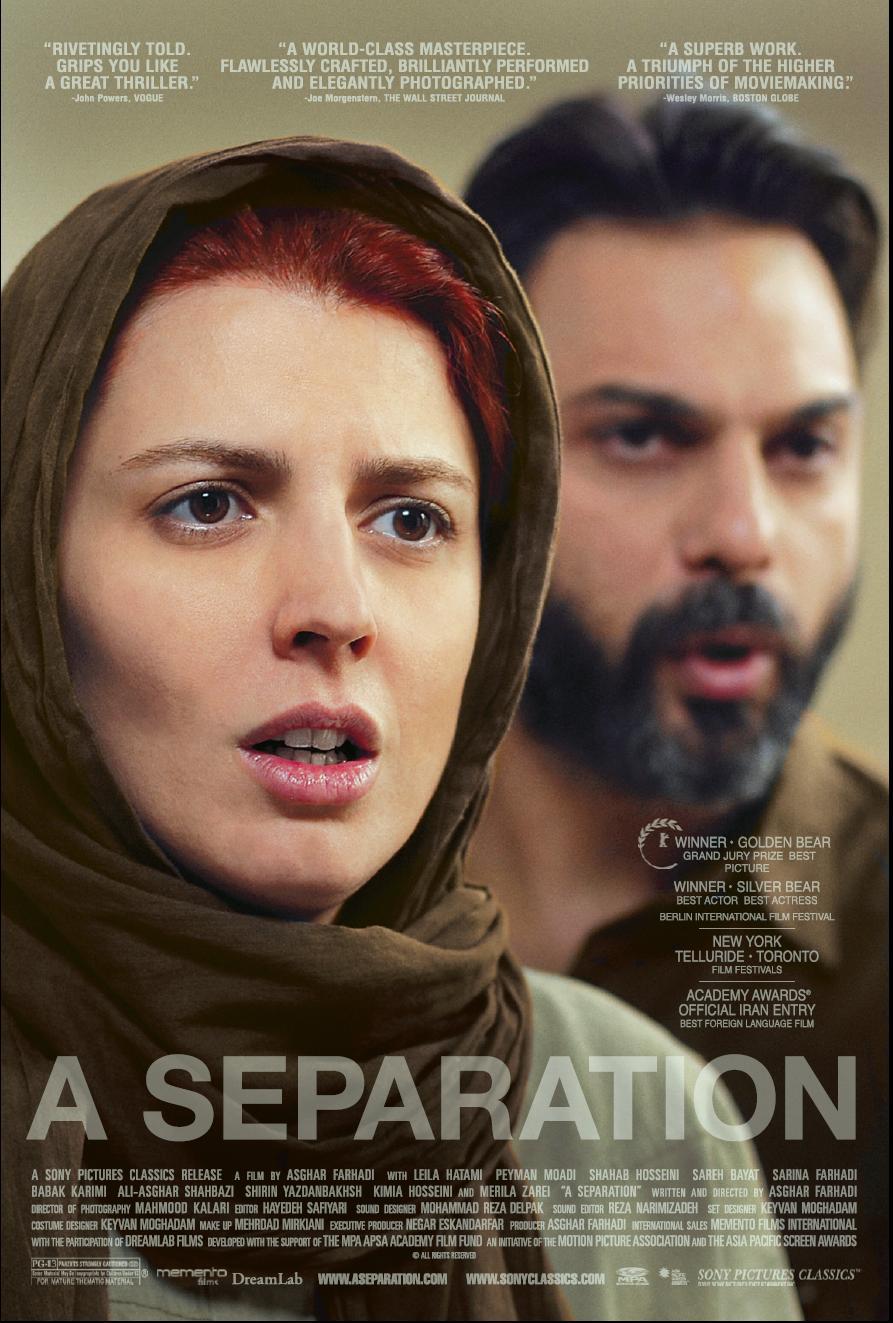
Iran, “A Separation,” 

Israel, “Footnote,” 

Morocco, “Omar Killed Me,” 

Poland, “In Darkness,” 

Taiwan, “Warriors of the Rainbow: Seediq Bale.” 


That’s it, fellow Lebanese, I guess we were too foolishly optimistic about our chances. I guess having a movie from Iran, Israel and Lebanon in a shortlist was too much for the region. Till next time, I guess (which means till Nadine Labaki’s third movie). You’d think winning the same prize that the King’s Speech and Slumdog Millionaire won, at one of the world’s top festivals, would be enough to pull an Oscar nomination for a movie. But I guess politics is more important.


A Separation – Movie Review

Iranian filmmaker Asghar Farhadi’s new movie, A Separation, opens with an Iranian couple in court. Simin (Leila Hatami) is asking for a divorce from her husband Nader (Peyman Moaadi) because he refuses to travel with her to a European country now that their visa paperwork is in order. The visa has 40 days left to expire and Simin wants to leave now. “Has this man beaten you or cheated on you?” the judge asks her. She replies negatively. He simply refuses to leave. Why can’t Nader leave? Because e can’t abandon his father who has Alzheimer’s. “Your father doesn’t even know you,” Simin tells Nader. “But I know him,” he replies. Simin and Nader also have a daughter, Termeh (Sarina Farhadi – the filmmaker’s daughter). Being eleven years old, Termeh can choose the parent she wants to stay with after the divorce and both want to bring her to their side.

As he goes back home, Nader is faced with the realization that he cannot tend to his father all day long due to his work obligations. So he hires Razieh, a very religious woman, to look after his dad while he’s at work. But taking care of Nader’s father will prove much more difficult than Razieh had anticipated especially with her strict religious rules. One day, Nader comes back home and finds the house empty and his father almost dying on the floor next to his bed. Razieh is nowhere to be found. Money is also missing from the drawer in his house – the exact equivalent of a day’s work for Razieh. When she comes back, he accuses her of theft and pushes her out of his house. She stumbles on the stairs. And soon, Nader finds himself in court being accused of causing the miscarriage of Razieh’s nineteen week old fetus.

Peyman Moaadi, as Nader, delivers a great performance as the morally torn father between his own family and his obligation to his own father. You can see him making the decision of choosing to take care of his dad every single day of his life with every action he does, every word he speaks. One scene in particular is so masterfully acted out by Moaadi that it will play on your heartstring. Soon after he pushes Razieh out of his house, Nader breaks down as he cleans his father in the bathroom – the father that doesn’t even know who his son is.

Leila Hatami’s role is much more limited than Moaadi. She gets much less screen-time and her character isn’t as like-able as his. She comes off as the woman who wants her husband to let go of his parents even though on one particular scene, Nader’s father holds her hand and calls her name as if telling her that no one can really take of him the way she did.

A Separation is not a movie strictly about a divorce. In fact, the divorce aspect of the movie – the separation of a couple – takes very little time to unravel compared to the other plot elements offered in the movie. The problem that arises with Nazieh’s miscarriage is most of what the movie is about – how Nader deals with it in a way to protect himself and his daughter and how Nazieh, the mother of a little girl, is trying to deal with it in her way to protect her little girl and her unemployed husband.

A Separation’s forte, however, is simply its brilliance realism. There’s not one scene in the movie that is impossible to have been acted out in real life. It also transcends stereotypes of an Islamic society and offers a cinematic experience that can be relatable to anyone who watches. It’s not simply the manifestation of male dominance in the court of law in an Islamic country. It’s the legal, political, dramatic and intriguing family dissolving that the movie is about.

A Separation is multi-layered. It’s not bland. It runs deep. It showcases its characters in a way that reveals their secrets, their vulnerabilities. It does not shy away from ripping bandages dry. It doesn’t flinch from showing the hurt. It also smartly maneuvered around obvious Iranian censorship and managed to become Iran’s official submission to the Oscars this year. It is, at the end of the day, a moral dilemma revolving around family. It takes on gender, class, social, family issues and spins them into a fabric that a sort of critical view of Iranian society. The actors and actresses in the movie stand out. The screenplay is very sharp and the directing exquisite.

And now to the part that would interest any Lebanese movie enthusiast. Is A Separation better than Where Do We Go Now? I’m sad to inform you, dear Iranians, that the answer is no. No, I’m not being biased. While watching A Separation, your emotions are roused. You feel compassion to the characters and the story is interesting enough to keep you grounded. But it doesn’t offer the emotional roller coaster that is presented by Nadine Labaki’s Where Do We Go Now. You don’t find yourself laughing and then crying. You don’t find a smile on your face while watching A Separation as tears trickle down your cheek. A Separation is more tense. But Where Do We Go Now is more universal, more heartfelt, more approachable and more genuine.

For those who are still shocked, yes… I have watched an Iranian movie. Yes, it was also spoken in Farsi.

8.5/10

Nadine Labaki’s Where Do We Go Now, W Halla2 La Wein, Nominated For Critics Choice Award

The nominations for the Critics Choice Awards, seen by many as one of the Oscar indicators, were revealed today and our little movie that could, also known as Where Do We Go Now (read my review), has been nominated in the Foreign Movie category.

The Critics Choice Awards pride themselves on having a greater predictability of the Oscars turn out than most other Award shows, including the Golden Globes. So this is a great sign for Nadine Labaki’s movie that it might get an Oscar nomination. Getting a win, though, is a far different story.

However, the people who vote for the Foreign Movie category at the Oscars are the same type of people who attend the Toronto Film Festival where Where Do We Go Now was voted as best film. I wouldn’t get my hopes way up just yet but I would start getting slightly optimistic that Lebanese cinema, thanks to Nadine Labaki, is slowly but surely getting there.

Back to the Critics Choice Awards, the competitors of Where Do We Go Now are:

In Darkness (Poland)
Le Havre (Finland)
A Separation (Iran)
The Skin I Live In (Spain)

I’d say out of all of these movies, A Separation is Where Do We Go Now‘s main competitor.

I am saddened by the no Deathly Hallows love though. Hopefully that will turn around when the Golden Globes nominations are announced on Thursday.

One thing is clear though, things are looking very good for Nadine Labaki.

Johnnie Walker Lebanon – Keep Walking With Nadine Labaki

If you’re also tired of the Johnnie Walker “Architect” ad that has been airing on our TV sets for the past year, you’d be happy to know they have found a new person to represent the brand in their “Keep Walking Lebanon” ads. And that person is Nadine Labaki.

Fresh off her ingenious movie Where Do We Go Now (read my review), Labaki is at the top of the world. Her movie is Lebanon’s official submission to the Oscars, it has won the People’s Choice Award at the Toronto International Film Festival, has done really well at Cannes, won more awards at other festivals such as Doha, Dubai, Stockholm, etc…. And now she’s the new face of Johnnie Walker in Lebanon, a brand always known for inspirational ads, coming after people like Elie Saab and Bernard Khoury.

One has to ask with all the accolades Labaki is getting lately: where does she go now?

Visit the Keep Walking Lebanon website here. And check out the ad:

Nadine Labaki’s New Movie: Where Do We Go Now (W Halla2 Lawein) – Review

Lebanese cinematic talent has not been given much room to grow. In a country where art is the least concern, cinema has found it especially hard to take off. However, a stream of Lebanese movies has been finding its way to our theaters. Some like Nadine Labaki’s previous movie, Caramel, were a huge hit with viewers. Others were not as lucky.

But the fact remains that the Lebanese audience is hungry for movies that describe its society, its problems, its worries and woes.

And then comes Nadine Labaki’s new movie: Where Do We Go Now, with its Lebanese title: W Halla2 La wein (also in French: Et Maintenant, On Va Ou?)

The premise of the movie is quite simple – and for many Lebanese, worry-inducing for fear of overuse of cliches. The overall basis of the plot is the coexistence of Lebanese Muslims and Christians in one community, sometimes peacefully and other times not. Many, like yours truly, felt the issue was overdone. Maybe not in cinema but in everyday life. Most of us are sick of being bombarded with commentary about the struggles that face our very diverse community. But this is not the case in Where Do We Go Now.

An unnamed village during the later part of the 20th century has its only connection with the outside world in the form of a very rudimentary bridge, around which landmines had been planted and never removed. Even TV reception is very poor to the village and the movie begins with a few youngsters searching for a broadcast signal to set up a TV night for the town-folks. This village is also a religiously divided community where the Church and the Mosque are only a house apart. And more often than not, the people live together happily.

But as it is, and despite barely having any access to news from the outside world, the men of this village start to confront each other in violent ways. Little things that would pass unnoticed cause them to explode, signaling the anger they’ve been bottling in. And it is then that the few women of the village start to devise plots to keep the men busy, entertained and get their minds off being violent. These plans will vary from fake miracles to putting hashish in cakes. But these women will go to every measure possible and break every limit imposed on them by society to keep their town together. And it is for these women, representing a vast majority of our Lebanese mothers, that this movie is so aptly dedicated.

Nadine Labaki, director of the movie and starring as Amal, is astonishing as always. You, really, cannot see her eyes on screen and not be mesmerized. She’s simply entrancing, even when she doesn’t speak. Then how about when she delivers a tour de force performance as one of those women, who happens to be in love with a man from the town’s other religion. But to be perfectly honest, the accolades one ought to give Labaki are not for her acting but for her directing. Never have I imagined a Lebanese movie can turn out this good and she makes it seem effortless. Her camera shots, her focus on details, her keen eye… all of this combine to give you a cinematic experience that will entrance you.

This movie, like Caramel, features mostly unknown faces and all of them deliver as well. It is hard to believe – and yet in retrospect so evident – that such acting can come out of common people that we all meet on the street. Where Do We Go Now is a movie of such epic proportions that these “unknown” actors and actresses (mostly actresses) deliver performances that are so subtly nuanced, so exquisitely flavored and so astonishingly well-done that they would put the best actresses and actors of Hollywood to shame. Yes, I have said it.

The score of the movie is chilling and haunting and wonderfully executed by Nadine’s husband Khaled Mouzanar. The movie also features a few highly intelligent songs, written by Tania Saleh.

And let’s talk about the script. What an ingenious way to tackle the subject at hand. Not only did Nadine Labaki not fall to any cliche known to us as a Lebanese community, but she managed to introduce them in a subtle comical way that would make us laugh at ourselves for uttering or doing them in the first place. The script is so strong it will turn you bipolar. Yes, lithium is advised to be taken at the door while going in. Why? Never have I laughed so hysterically one moment and just wanted to cry the other. And then after being utterly devastated, it brings you back to laughter. The movie plays with you like a ping pong ball. And you cannot but love every moment of it.

I was talking to my friend Elia the day before we went to watch Where Do We Go Now, which happened to be the day it won the People’s Choice Award at the Toronto Film Festival, and she said: “Elie, I’m very cautiously optimistic about this. I’m not letting my expectations overreach because I don’t want to be disappointed.” Well, I’m pretty sure Elia agrees with me on this: Where Do We Go Now brings out things in you that you didn’t even know you had. It brings out the best in you, as a Lebanese, sitting in that cinema chair for ninety minutes. And you need the best of the best to do that. Nadine Labaki, you deserve more than the few minutes of applause the people in the movie theater gave you. You deserve a full blown standing ovation. You have done the impossible. Again. Lebanese cinema has no excuse but to overreach for excellence now. And this movie deserves an Oscar win. Cheers to our mothers.