Lebanon Is Not Egypt

The title is stating the obvious. Sadly, it’s not that apparent.

It was 2011. The Egyptians took it to the streets. They removed Mubarak. A sense of pride swept around the Middle East. The “Arab Spring” they called it. Freedom this way comes. Everyone wanted to be Egyptian. Everyone was proud of Egypt.

But none so more than Lebanese.

We felt more involved in what was happening in Egypt than whatever was happening back home. Fun fact: January 2011 was our own mini coup happened. Many Lebanese wished they could become Egyptian – patriotic opioids sure run across borders.

A few months later, as the events in Syria raged and the promise of an “Arab Spring” started quickly running down wintery lanes, Egypt disappointed as well. The Lebanese sentiment quickly turned to “Morsi” et au revoir. We had gotten over it.

It is now 2013. The Egyptians took it to the streets again. They were protesting the Egyptian “winter” they had voted their country into. And Lebanon was involved anew. Nothing was wrong here at the time again. Fun fact 2.0: The army was fighting Al Assir only a few days ago and Hezbollah is still fighting in Syria. Morsi was uprooted very fast, with the help of the Egyptian army. And fireworks erupt in Lebanon in celebration. The same sentiments of people who wish to be Egyptian rose to the surface. Egypt, the beacon of democracy. Egypt, the torch of hope. Egypt, making us proud. Bigadd kan el manzar mofre7 awi awi. 

Then, naturally, you get those many, many people who want whatever happened in Egypt to happen here. If they did it, why can’t we?

Well, here’s why.

Egypt is 100 times Lebanon’s size. It has 20 times its population. That population in question is divided in the following way: 90% is Muslim and 10% is Christian. Official positions in Egypt are not divided according to sectarian lines. The president, for instance, doesn’t need to be Muslim. He just happens to be every time by power of probability and mentalities.

The recent events in Egypt were bolstered by a catalyst that sped up the process remarkably: the Egyptian army. Roadmap or whatnot, it is the presence of a strong army with centralized military power that helped the 30 million or so Egyptians who protested get to where we want. Which army will help us in Lebanon if we were to have similar coups? The Lebanese army with its 60,000 personnel many of whom have ammo-less weapons while militias roam the country freely, protected by their weapons and popular support?

Moreover, I don’t believe the issues in Egypt are as politicized as they are over here. Case in point? Let’s examine the following scenarios:

What do you want to protest about in Lebanon? Electricity? I’ve just made the issue political right there. Half of the Lebanese population won’t go to my protest, even if the demands are true, simply because they’ll see it as a protest against their poster child. Let’s say I want to protest against slow internet. That same 50% of the Lebanese population will turn a blind eye to my protest for those same reasons. Now let’s say I want to protest against people like Ahmad el Assir. I’ll be joined by that same 50% which boycotted my last 2 protests while the people that attended the first two will not. In case my protest doesn’t have some undertone supported by one of the main camps of the country, good luck finding ten people to attend it – regardless of what the activists that pop up right before elections every four years say. And God forbid I try to protest against militias and arms that exist outside the jurisdiction of the Lebanese state, which brings me to my next point.

There are no issues in this country upon which enough Lebanese agree in order to cause change. Hezbollah’s weapons? Half of the country hates them. The other half adores them. The weapons stay. It’s that simple. The regime? the governing half doesn’t want it changed because the people it likes are in power. The other half wants it changed just because the people it likes are not. What alternative regime do we want? I’m willing to bet I can’t find a sizable portion of this country that can agree on a format. You only need to go back to the electoral law discussions and how very, very few Lebanese branched out from the rhetoric being spewed by their political party of choice (especially Christian parties) when it comes to the electoral law they see best. Party say, person do.

Egypt not being as divided on sectarian lines as Lebanon means the sectarian sentiment that is overflowing here doesn’t exist as much there. Sure, many Egyptian Muslims hate the Copts (and vice versa) but the same exists in droves over here while we pretend otherwise. The sectarian sentiment overload doesn’t only cloud people’s judgement regarding so many things in the country, it also limits whatever actions they would be willing to do to what’s best for their sect. Sect say, person do. Case in point: the amount of non-religious Christians who wanted the Orthodox law, of non-religious Sunnis who believe their sect is being threatened and of non-religious Shia who’d be the first to take weapons if you approach Hezbollah.

Moreover, many of those same people who want Lebanon to become Egypt would, in case elections happened next week, vote for the same people all over again. I’m not saying they shouldn’t vote for whoever they want to vote for. It’s their vote, their choice, they can do whatever they want with it. But it is downright hypocritical to preach for change and not act out on it when the going gets tough just because some people cannot fathom not voting for the people they’ve liked for years.

What I thought people learned back in 2011 is that the models of the countries in which revolutions happened cannot be applied here: you cannot extrapolate Egypt onto Lebanon. And yet people seem to want to do it anyway. The fact that Egypt and Lebanon are incompatible doesn’t mean one is better than the other. It simply means that if any change were to be done in this country, we need to find our own formula. As of now, we have none. Lebanon is not Egypt and I, for one, don’t want it to ever be.

Neither Aoun Nor Geagea Is Defending Lebanese Christian “Rights”

Preamble:
The following is what the LF, FPM, Kataeb and Marada agreed upon in Bkerke:

“The parties convening have decided not to run based on the 1960 law and consider the law at hand as one that consecrates the injustice towards Christians. The parties convening have also agreed on the need to take a firm stance against the 1960 law in fear of having this law forced as a reality when the nomination window is open. It is also important to affirm that this law is rejected and is non-viable as a reference to run for elections.”

The electoral reality today:
As the nomination window for the 1960s law closes, the ministry of interior has tabulated 706 nominees, which contain more than 20 candidates for each of parties that agreed upon the above preamble. Talk about “not running” and taking a stance against the “unjust” law at hand.

Let’s talk electoral laws:

This isn’t the only part as to why these politicians are doing a terribly bad job but it’s the most current and as such deserves being dissected in grosso modo to draw a frame for the discussion.

Michel Aoun started out against the Orthodox Law and supportive of the law proposed by the government (13 districts with proportional representation). He later on switched stances to support the Orthodox Law because other Christian parties jumped on the bandwagon (the LF were the first to support this law publicly), effectively becoming the law’s main defender despite him fully knowing that the law will never, ever see the light of the day. If by some miracle the Christian consensus around it were to make it to parliament, the law wouldn’t pass the president. And if the president ended up signing it, the constitutional council might have probably found it unconstitutional. Aoun knew this and knew it well. He also knew that the only reason he was getting support from Hezbollah over the law was because Hezbollah didn’t lose any Shiite seats with it and would use it to boost him among Christians, not because they are deeply concerned for the rights of Christians. He also knew that the support Nabih Berri gave the law was lukewarm at best. That’s why he kept his options open and gave us another electoral option: one proportional representation district. All other laws were rejected, as was obvious by his party’s practices and as is their right.

Samir Geagea started out with the neatly-cut 50 district laws which makes sure his party gets a majority in parliament. When that law received no outside support, he switched to the Orthodox Law and became a prime defender of that law… until he hit the roadblack set forth by his allies regarding the law and for a while it seemed he was taking on the Future movement and Jumblat by marching on with the Orthodox Law. At one point, Geagea’s breathing space came in the form of a Bkerke agreement to put the Orthodox Law on hold and to find a law that brings more consensus. So he effectively killed off the Orthodox Law and started running a campaign against it, only to be “surprised” by an anti-Geagea campaign from FPM supporters and a bishop who obviously went beyond his jurisdiction. Shouldn’t they stick to masses and baptism?

The problem with Christians and the electoral law is two-fold.

  1. In the most optimistic of scenarios, we are 40% of the voting population which has to vote for 50% of parliament.
  2. Lebanese Christians are the only sectarian component of Lebanese society which have a true form of “democracy” whereby despite their numbers, the 50-50 division between Aoun and Geagea renders them meaningless.

Parliamentarian representation has two components as well. Let’s call them a horizontal and a vertical factor. The horizontal factor is an MP’s sect and the vertical factor is his region. The Orthodox law tackles one but not the other. The question, therefore, asks itself: How is Aoun defending “my” electoral rights when he supports a law he knows will not pass and when the other law he supports is one that basically makes “my” vote irrelevant (not that I personally care), effectively not allowing me to make the decisive choice in ANY of the Christian MPs?

And how is Geagea defending “my” electoral rights when his support of electoral laws is almost always apparently contingent upon what his allies believe is best, despite his best attempts not to make it look that way? And how is it defending “my” rights to be a staunch supporter of a law one day and have your media work staunchly on portraying it the “best” for “Christian rights,” effectively convincing most Christians of this, only to trash it when the wind blows differently?

How are both Geagea and Aoun defending “my” rights when they both refused a Kataeb proposal of personal electoral districts which effectively fixes the two-fold problem I have presented earlier? How are they defending “my” rights when the probable reason of their refusal is because personal districts limits their parties’ influence? How are they defending “my” rights when they don’t really care for “my” parliamentarian representation as much as their parliamentarian share?

I Liked Geagea:

I would be lying if I said my mind doesn’t lean one way in the Aoun-Geagea dichotomy. There’s nothing wrong in supporting any of these two men. In fact, I personally believe that between 2005 and 2010, Samir Geagea had a near parcours-sans-faute in Lebanese politics. His discourse was Lebanon-centric. He was moving his party away from the common misconception (at least back then) that it was a Christian party by the Christians for the Christians. They even actively worked to kill off the Lebanese Forces typical symbol of that cut cross. But not today.

Nowadays, the discussion of both men is as Christian-centric as it gets. The more Christian-centric one of them gets, the more Christian-centric the other goes. And I may be a minority in thinking this but I really don’t believe “my rights” are best served in the rhetoric being spewed by both men and their supporters all over the place and even some priests and bishops.

“My” rights are also not served, in my opinion, when the rhetoric being employed is one that is only leading to increase the divide in the country and not work towards trying to fix things. When Aoun completely ignores the fact that his ally Hezbollah is fighting in support of the Syrian army in Al Qusayr, how is that defending “my rights?” How is it defending “my” rights when a politician such as Aoun is completely silent, effectively supporting, the practices of Hezbollah in defending an army and a regime whose main purpose was to destroy my rights as a Christian in Lebanon for years and years? How is it defending “my” rights when the only arguments used on the matter are ones revolving around Jabhet el Nusra and the rise of Sunni extremism while completely ignoring the equally dangerous Shiite extremism and political brainwashing at hand?

On the other hand, how is it “right-defending” for Geagea to completely ignore the rise of the Ahmad el Assir phenomenon or at least not actively work towards decreasing it? What about is his silence regarding the Future Movement’s involvement in fueling the Syrian crisis with his support of the rebels? What about his silence on the Lebanese Sunni extremists who are entering the fights in Syria in support of one of the sides, effectively becoming the same version of Aoun on the other side of Sunni-Shia divide?

Both Aoun and Geagea are taking parts in the Sunni-Shia problem that Lebanon is facing today and their parts are not healthy, not even in the least. Instead of making Christians a form of link between those two components of Lebanese society, our politicians are working on getting those components further apart with their near-blind support of whatever they do and whatever they commit to. It’s not in our best interest as Christians to take either position from the Sunni-Shia struggle at hand. It’s not in our best interest to take the sides we’re taking. It’s also not in our best interest to stand on the sidelines and cheer. The best way to fight for “our” rights is to take the right stance at the right time. At the current time, that stance is the following: get the parties involved not to drag the Syrian war into Lebanese territory, which will lead to more degradation of Christian rights.

A Lack of Vision?

With Aoun coming out against the extension of parliament’s mandate (at least until now) and Geagea possibly announcing his stance in a few hours, I have to wonder: are our politicians truly out of imagination or resources to succumb to the status quo this way? And how is it defending “my” rights when, in one way or another, they both don’t take the fight the long way home and contribute to transforming this country from a growing democracy to a growing dictatorship? That’s the only way really to categorize our parliament extending its mandate for itself.

Is there any guarantee that, in case parliament extends its mandate for two years, our politicians will actually reach a new electoral law? No.

Is there any guarantee that, in case parliament extends its mandate for two years, the security situation will become better enough to hold elections? No.

Why not, for instance, ratify the 1960 law in the following way: divide Akkar in two districts, bring the Maronite seat of Tripoli to Batroun, move a few seats from Beirut 3 to Beirut 1, move a few seats from West Bekaa (where 20% of the population is Christian and gets 4 seats out of 6) and put them somewhere else?

Why not run elections based on that ratified 1960 law, upon which Christians might be able to choose around 50 of their representatives, with an agreement to have parliament work day in and day out in order to reach an electoral law after which it dissolves and we hold new elections? It even has the same guarantees as the extension scenario.

The democratic process in this country has to be upheld. Any talks about modifying it because (insert any form of non-viable argument) does nothing to defend “my” rights as a Lebanese first and foremost.

People Like Us:

I believe or at least I hope that this sentiment is shared by many Lebanese Christians today. It baffles me how Lebanese politicians somehow believe they talk on behalf of every single Lebanese when there are people like us who don’t agree with almost any of their practices nowadays.

I, for one, believe no one represents me today and I kindly request them all to back off “my rights.”

Why The Lebanese Government Is Silent On Tripoli

Every once in a while, the city I once referred to as “3enna” by mistake becomes a place I force myself to go the extra mile to recognize.
The last time such heavy fights broke out in the city, we were all in outrage at how media couldn’t care less about the people dying and the innocent lives in danger. Today, the outrage over Tripoli’s worst night since the Civil War is gravitating towards a government that is as apathetic as apathy goes.

However, are we supposed to expect anything more from our government? Tripoli’s Ministers and MPs go on air to voice their disdain and condemnation over what’s going on. What’s actually happening, though, is that in the other side of the room is one of their henchmen waiting on a phone to issue further instructions to the fighters on both sides of the battles.

Najib Mikati feigns peace. But he probably has men fighting. Mohammad el Safadi feigns innocence. But he probably has men fighting too. Have you ever seen how Bab el Tebbane worships Kabbara? Why do you think that is? You don’t have to over think it really.

The solution for Tripoli isn’t political. If it were, all those politicians asking for calm and peace would have succeeded by now. The problem is that those same politicians want to perpetuate the status quo, because this status quo works and does wonders for them and their careers.
It keeps the city poor for them to do their “charity” work.It keeps the city relevant politically for them to make a “political” dent and remain in the country’s political spotlight.

Perhaps the solution for Tripoli is for a side of the battle to actually win. Perhaps the problem in this country is that we have never had a clear winner and a clear loser in anything, not elections, not the war and not even those sporadic battles in Tripoli which we’ve gotten used to.

Until then, my thoughts go to all the people spending their days and nights in absolute terror in the city I’ve come to love, a place that doesn’t deserve the hand it’s dealt.

The Cost of Running An Ad on Lebanese TV During A Lebanese Politician’s Interview

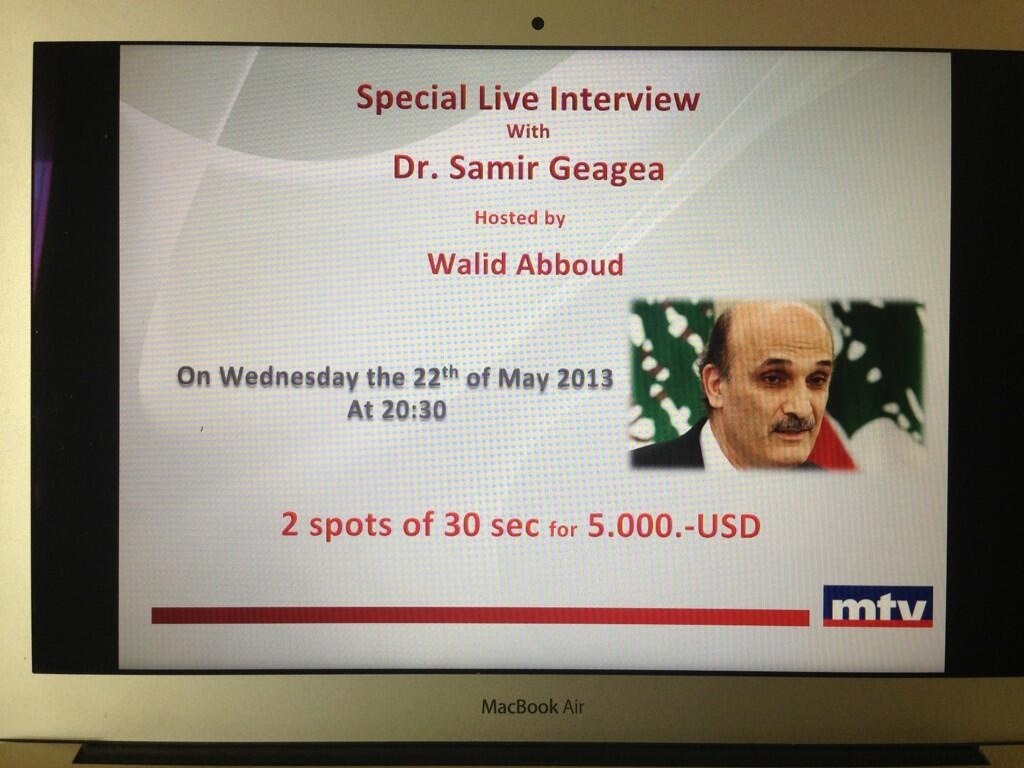
MTV hosted Michel Aoun on Walid Abboud’s show “Bi Mawdou3iya” yesterday and he discussed the current debacle in the country regarding the electoral law and whatnot.

So because we live in extremely sensitive times, Lebanon’s main political foe for Michel Aoun is, naturally, going to seek out airtime as well. Samir Geagea will be on “Bi Mawdou3iya” as well tomorrow, all to MTV’s delight.

This isn’t about what both politicians want to discuss (or not discuss). It’s not about their propositions and constant tug-of-war leading nowhere. In order to announce the episode, I stumbled on the picture that follows.
The most interesting part of the picture to me was the cost to run an ad on MTV during Samir Geagea’s show. Two 30 second ads can cost you up to $5000.

20130521-122129.jpg

Every single second of commercial break is probably sold by now. This is how much audience our politicians bring in. Too bad there’s absolutely no tangible and efficient measures that are brought with them and the income they bring to the TV stations they appear on.

What Lebanese Christians Are Not Entitled To

Entitlement. The word thrown around so loosely lately it’s become the go-to term in Lebanese politics, especially when it comes to Christians and their – forgive me, our – rights.

As such, I have decided to make a list of things Lebanese Christians think are entitled to but are not:

  • We are not entitled to vote for our half of parliament all by ourselves.
  • We are not entitled to have laws that govern us and only us.
  • We are not entitled to legislate in ways that only benefit us and pretend it’s for the common good of all.
  • We are not entitled to vote for an MP solely because he Crosses himself when he “prays.”
  • We are not entitled to play victims all the time, at every single turn.
  • We are not entitled to blame the Sunnis and only the Sunnis for our predicament in the country.
  • We are not entitled to pretend as if we live in a country alone because it’s the best way for us to sleep soundly at night
  • We are not entitled to bring Jesus into the petty fights of our politicians in order to prove a point that doesn’t even exist to begin with.
  • I’ve been disappointed by the Lebanese Forces for a very long time now. But if there was a time when I felt they made a “decent” decision, it was them deciding to go for a law that’s not as dim-witted as the Orthodox Law and which might come back to bite them because many Lebanese Christians feel their sense of entitlement has been breached.

    For those who actually think that some politicians are there to protect their “rights” with such electoral laws, humor me and answer the following question: How is moving back and forth between a law that supposedly gives our vote a maximum impact (Orthodox Law) and one that gives it the least impact (Lebanon as one proportional representation district), while saying they are the only two viable options, protecting our rights exactly? How is it ANY different from the political auctioning of our votes and to which many fall victim because of the fixed delusion that our rights are only equal to voting for our kin and our kin alone?

    You know what Lebanese Christians are entitled to? We are entitled to proper representation and proper legislation. But first and foremost, we are also entitled to proper politicians who actually think of their constituents as more than numbers to form a tsunami 2.0, who actually don’t count on the one-sidedness of so many people out there to cash in points here and there and who actually don’t think of our potential in the terms of where we pray only and who actually believe our rights are not summarized by the religion of who we vote for (link).

    Judas is rolling in his grave at using his name in vain these days.