The Lebanese Electoral Law No One’s Talking About

Orthodox law here, orthodox law there. It’s all about the Orthodox law and the myth of its improvement of “representation.”
In the very narrow sense of things, the Orthodox Law makes sense given what the country is all about. Those who suddenly woke up and panicked about the law being sectarian: where were you living exactly?
You may not like what that sense is and you may be absolutely in love with it. In broader terms, however, the Orthodox Law is a disaster – not because it “improves” Christian power as some claim it will, but because it doesn’t really tackle the foundation of the issue which necessitated such a law to be present in the first place.

The problem with Christian representation in its current form in parliament is the following: democracy.

Let’s examine 3 different scenarios.

Caza A: has 40,000 Shiite voter and 60,000 Christian voter. Christians usually vote 50-50 between both politics camps. Shiite voters vote with about 90% for one camp. Half of the Christian voters feel their voice has been stripped.

Caza B: has 40,000 Druze voter and 60,000 Christian voter. Christian votes get divided almost equally. Druze votes are beyond one-sided. The Druze voter has now chosen for the Christian voter.

Caza C: 40,000 Sunni voter and 60,000 Christian voter. Repeat same scenario as in A or B.

The above scenarios are in play in Lebanon today in several districts of which I note:
– Aley: has 50,000 Christian voter who, the propaganda, goes cannot choose their own MP because of the Druze majority.
– Jbeil: has 10,000 Shiite voter whose votes make the election result look very lopsided while it isn’t.
– Zahle: A sizable Sunni population was key in the victory of whoever won in that area.

Don’t worry, I am not defending the Orthodox Law’s premise. The above examples are to illustrate the following:
The “problem” in Lebanon today isn’t that Christians are too few demographically or that they are given a greater voice in parliament than they should have or that their only solution is for a separation from everyone else in choosing their representatives. It is that there is a true democratic condition among Christian communities which is beyond nonexistent in all of the other sects in the country – and any electoral law which doesn’t lead to the growth of an opposition to the key leaders of each of the landslide-sects is not a law which can actually be used for a sustainable development of Lebanese society. This is nowhere near guaranteed with a law such as the Orthodox Law or any of the laws currently discussed.

Another major shortcoming that politicians seem to ignore in order to communicate the rhetoric of “defending Christian rights” is the following: how is it logical and acceptable for a Maronite voter in Akkar to vote for a Maronite MP in the deep end of the South? How can they fathom it is a “right” for the Sunni in Saida to vote for the Sunni MP of Tripoli? How is it logical for the Shiite in Tyre to vote for the Shiite MP of Hermel?

But there is a law that takes in consideration both regions and proper representation. It is a law which is not even discussed around the round tables of our MPs as they fight over their prospective seats in parliament: individual districts (El daweyer l fardiye): voters can vote for one MP in a small district of a few thousand voters.

To illustrate this, let’s examine a real life example: my district, Batroun, which has only two MPs – one of the fewest per district in Lebanon.

If my entire district is considered as only one electoral circumscription, the results are pretty well known: the current MPs will be re-elected. The votes coming in from the Mountains overtake whatever votes are coming from the Coast. If any third party candidate wants to run, they have to communicate their message – or try to at least – to over 60,000 voter. And parties rule by having a sizable base spread across the district which can vote for whichever candidate their party endorses.
Now with individual electoral districts, my district is split in half corresponding to each of the MPs it gets. The lesser number of voters per district means higher effect for those whose votes bordered on the irrelevant in a bigger district: the 1000 Sunni vote of Rasenhash and the 500 Shiite vote in Rashkida become something that whoever wants to run needs to win in order to have a chance at winning. By lessening the number of potential voters, any third party candidate will also have a higher chance at communicating their message to the voters. Instead of having an Antoine Zahra-Gebran Bassil face off in the coast and a Boutros Harb-Whatever face off in the mountains, we could have a three-way race with a viable alternative candidate. Said candidate may not win but at least people would have another option to vote for and express their disappointment with the current political establishment.
By decreasing the overall number of voters per circumscription, the bulk-voting effect of political parties is also decreased.

This electoral model, when applied to bigger and more diverse districts, leads to a more substantial weight for minorities, less effect for political parties and a room for centrists to take office.

Individual electoral districts, however, will never see the light of the day for the following reasons:
– It decreases Hezbollah’s influence by cutting his bases into pieces.
– Can you imagine the seizure Jumblat will have if this law is proposed and he won’t be able to get every single Druze seat in the Lebanese Republic? The only law he accepts is the law everyone refuses. They call this in Lebanese slang: “7ajar el dema.”
– The Future Movement will also lose a few MPs because of a decreased effect of the voters which constitute his base and an increased power of those who don’t.

The individual districts electoral law means that the current political establishment receives a drastic makeover. Do any of our politicians want this? Absolutely not. They preach about change, reform, proper representation. But anything that doesn’t bring them back to power with absolute certainty isn’t something they can accept.

True representation isn’t, in my opinion, sects voting for themselves and themselves alone. If Maronites vote for Maronites alone, how can we expect to accept Sunnis and Shiites voting for the president? If Sunnis vote for Sunnis alone, then why should the Christians and Shiites vote for the prime minister? If Shiites vote for Shiites alone, why should Christians and Sunnis vote for the speaker of the house?

A Maronite MP isn’t an MP that represents Maronites only. He is an MP who represents the voters of the district he comes from in order to transcend that and become a representative of the entire country and as such, it is shameful that an MP of a given sect who has to represent everyone has no chance of getting the votes of the other part of the country which he/she should represent.

Our votes as Lebanese of different sects are not and should not be confined to the sects that we are born into. It is saddening that some people want to summarize us with whatever’s written in the sect box of our IDs and are beyond convinced with this.

I refuse to be just another Maronite number.

Lebanon’s 134 MPs

Because 128 MPs was a strange number. Because minorities need to be represented. Because a country of slightly south of 4 million must have a tiny voter to MP ratio. Because there’s no need for common sense. We now have 134 MPs.

And what a beautiful proposition that is. I read somewhere that Samy Gemayel is the mastermind behind such a proposal. He must be so proud of himself, I bet. And for good reasons too! I’m more than sure that Mr. Gemayel didn’t think of the brilliantly smart repercussions that his proposal has. So let me illustrate them for him:

  1. Less unemployment! 6 more people will now enter the parliament. That’s 6 more people with a job – or not, perhaps, since parliament does nothing over here except bicker like high school drama queens.
  2. More millionaires! Constant paychecks till the day they die? Sign them up! The queue is already stretching till Timbuktu.
  3. Minorities ❤ ❤
  4. Did I mention minorities?

What a shame though that the extra seats won’t have any for us Maronites. This is totally unacceptable. But I’m willing to let it slide seeing as for the first time in a long, long time our country’s politicians agreed on something. This is an unbelievable feat in itself seeing as they won’t agree on a way to vote for these extra people. They agreed to increase the numbers of their kind. How far-fetched. How honorable. How selfless, how holy, how riveting, how *insert sublime adjective of choice.* Instead of voting for 126 empty chairs, we are now voting for 134.

Because minorities that’s why. That’s the only reason why anyone would want to commit to this step. And if you speak against this, then you are targeting all those Lebanese minorities whose future is in jeopardy in the country of minorities.

You can go on and on and analyze this step that our governing bodies decided upon in a “serious” tone. You can tear the fact that this is maybe the only part of the “Orthodox Gathering” law which will actually pass. But when it comes to a country of unparalleled absurdity, the only way to address things is through silliness.

The American congress has 435 members for a country of more than 300 million. But Lebanon is a case of special needs. So because 128 geniuses were not enough, we now have 134.


Lebanon’s First Civil Marriage Approved

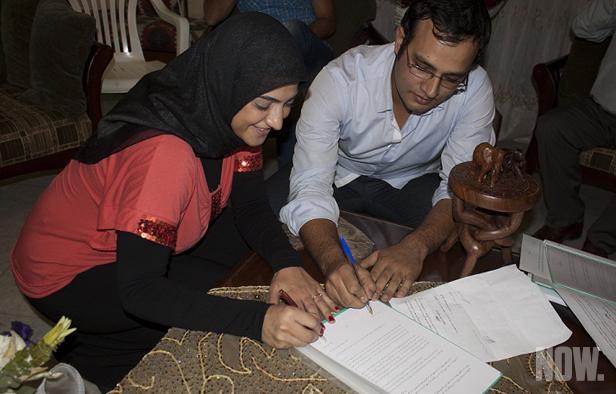
Civil Marriage lebanon - 2

“I will sign Khouloud and Nidale’s marriage,” Marwan Charbel – our minister of interior affairs – declared today, “even though I do not support civil marriage myself.”

I don’t get why it seems like not supporting civil marriage is actually a healthy mentality for politicians who are ruling our country.

Perhaps it is to please their growing political aspirations, after all the majority of Lebanese apparently do not support the issue with drastic differences across sects. A recent poll I read shows the following results: Druze and Christians support civil marriage with more than 60% while Shiites and Sunnis oppose it with more than 70%. The total comes down to almost 57% not supporting civil marriage.

Khouloud and Nidale’s marriage passed through a lot to get to where it is. There was a time where it appeared it won’t pass as minister of justice Shakib Qortbawi said he doesn’t believe the legal aspects of it work out. A committee that was assigned to look into the issue decided that the marriage was in fact legal and despite statements from minister of interior affairs that he wouldn’t sign, he apparently did.

So it is now official – Lebanon has now had its first civil marriage ever. But at what price?

Could Nidale and Khouloud’s marriage truly get more Lebanese who are enthusiastic about this to do what they did (link)? They stroke off their sects off all their legal documents, when through a lot of legalities in order to bypass the strict counter-regulations to what they were doing and eventually had to wait months and months until their issue was resolved.

Their marriage and the debate that ensued sparked reactions from religious and common folk that no one could have expected. From fatwas declaring apostasy on all Muslim politicians who approve of it to Christian priests convening for the main purpose of discussing it.


I’m willing to bet that if their issue hadn’t received media attention, it wouldn’t have ended up this favorably as well.

The questions to be asked are: will Nidale and Khouloud’s marriage be the first of many to be done in the same way? Or will the hardships they went through deter people from doing so when the alternative is much, much simpler? Will their marriage open up the flood gates or will it remain a singular event standing in a country that seems to be as close to legalizing civil marriage as it is to come up with a new electoral law especially when so many couples are nowhere near willing to strike off their sects just to get married while there is a much simpler alternative only 100km and $2000 away?

Congrats to Nidale and Khouloud. Hopefully their struggle to have their union recognized doesn’t die off as another cause du jour in a country where causes are faster to spring up than rabbits reproducing.

Insulting The Maronite Patriarch

I don’t believe Bechara al Raï’s visit to Syria was the devil incarnated as many seem to believe. He simply went there to hold Mass, believing his visit would actually get the Maronites of Syria to relax about their future. But it’s not all peachy. His visit is most probably not on his own accord. Odds are the Vatican had requested he visit Syria but I think Al Raï was more than itching to go down in history as the first Maronite Patriarch to visit Syria post Lebanon’s independence. The visit, in my opinion, is absolutely miscalculated and, if anything, showcases a seriously short foresight on his behalf as well – one that a person in his tenure should not have. Al Raï was simply too limited to see the repercussions of such a visit. The hidden meaning is far more serious than it being a simple religious visit.

The Syrian regime has, over more than 20 years, systematically persecuted the Maronites of Lebanon, be it politically or demographically or even socially. The Maronite Church stood against the regime countless times, effectively being the first catalyst that led to the regime’s army departing from Lebanon on April 26th, 2005. Bechara Al Raï’s stances have been far removed from the Maronite Church’s historical views towards the Assad regime. But how can a patriarch truly expect the first Maronite Patriarchal visit to Syria since 1943 be considered as a shallow affair of prayer seeing as it is visiting the country of a regime who did what it did to Lebanon’s Maronites? His visit was not to the regime, granted. But in a way, it is by extension. The Maronites of Syria sure deserve their patriarch to visit them – but not under current circumstances. The argument that Maronites all around the world deserve a patriarchal visit is something that the patriarch shouldn’t even touch to justify him going to Damascus. There are also Maronites in Israel. But that part is taboo.

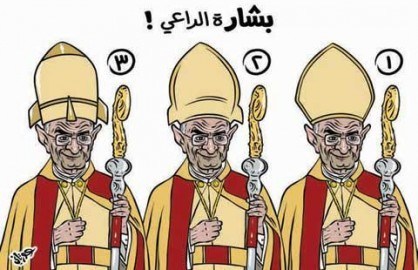
The Maronite Patriarch Bechara Al Raï’s visit has been, to say the least, extremely polarizing. Many were supportive of it as a step towards reaching out to the scared Maronites of Syria, few as they may be. Others were staunchly against it, characterizing the visit and its Mass as diabolical. Caricature drawings in Saudi newspapers were circulated:

Bechara el Rai Caricature Saudi newspaper Al Watan

The idea being discussed was the following: the Maronites will never do what the Sunnis did with the prophet caricatures or what the Shiites did when Hassan Nasrallah was portrayed on Basmat Watan. The argument goes that Maronites are “more civilized.”

Someone forgot to tune in during last week’s Maronite road barricades in support of the Lebanese army. So it’s not really beneath us as Maronites to block roads. After all, it is in these days.

The Caricature in Al Watan newspaper is definitely not acceptable but it’s not because it’s demeaning and offensive to Christianity. Al Watan newspaper did not, similarly to Danish newspapers, publish offensive pictures of holy Christian figures in order for the comparison between potential Maronite reactions, or lack thereof, and Muslim reactions to be valid.

Pretending as if this is the same caliber as the Muslim reactions to the prophet drawings, which in themselves were not acceptable, is quite frankly very silly. Patriarch Bechara el Raï is not Jesus. He is not a Holy person. He is a neo-politician-priest who did what many believe is a mistake. And it stops at that.

But it is not acceptable in any way whatsoever for a disgusting newspaper, Al Watan, which is published in a country like Saudi Arabia where freedom of speech does not exist, where they cannot – nor do they dare – criticize their own religious folk and their ruling class after which their country was named, where Christians are not allowed to practice their religion freely (even the Cross in the caricature was hidden), where women are kept on a leash, where liberties are suppressed and where human rights are unheard of to remotely have the right to criticize anyone in that way, let alone someone who does not affect their country in any way whatsoever.

I have to wonder, in what way does Al Raï’s visit to Syria bother Al Watan? It only shows exactly how silly that newspaper is – that they’d go after a religious figure who is probably unknown to the majority of Saudis just because he is one of the few religious figures in the region which they can attack. And it’s not because they hate Christians, as many seem to believe, which I would suppose might hold some truth. It’s because it gives them the illusion that they are free, that they can do this and face no repercussions. They thought wrong.

If this caricature had come out from a newspaper in a country known for its freedom of speech, such as Denmark – a place which dared to publish Mohammad caricatures – the discussion would have been totally different. If the pope receives such caricatures, then why not Raï? But Al Watan, with the demented theocratical country it operates in, publishing them is not and should not be tolerated. They only practice their freedom of speech when their bosses approve. When it doesn’t get on the nerves of its readers… when they address a population which lives far away in an issue that does not affect them in any way whatsoever.

They don’t dare to see that their own society has a multitude of issues that could be made into a caricature, starting with that sheikh who beat and abused his 6 year old daughter to death to the fact that women are now starting to learn how to drive after their gender has been voting for more than several decades in countries around the world. And that makes them cowards. It makes them not respectable as a publication or a newspaper or any form of media that wants to be read.

The best place for Al Watan is the trash bin.

Now let’s address our own Lebanese.

The Lebanese reactions towards the Saudi insult have not been much better although a Lebanese addressing the issue is definitely more acceptable than someone who comes from a country that doesn’t even know freedom of religion. The caricature, the visit and everything around it was milked politically like everything in the country nowadays. Anything that revolves in any way around defending Christians in this country serves as ammo for politicians from both sides to fire at each other, trying to create a firework display of Christian power to please the masses ahead of the parliamentary vote.

As the constant disk of those “bad Sunnis of Saudi Arabia attacking us poor Maronite minority in Lebanon” kept playing, some people were forgetting who was doing even worse than those Sunnis to the former patriarch Sfeir with insults that went from the belt down (“heida l batriark thayyaj” anyone?), to attacking his tenure, his position, his seat and his person. But that doesn’t count – because it’s only bad when a non-Maronite does it apparently.

You want to criticize the patriarch himself, as a person, fine by me. Feel free to criticize his political opinion, if any. Feel free to address his stance regarding social issues as much as you want. I think it’s healthy when religious figures are challenged in this country and no religious figure has probably been challenged as much as the Maronite patriarch, especially by his own people.

But there’s a minimum required respect for the seat the man occupies. The Patriarch is but a temporary filler for the head of the Maronite Church. Calling the patriarchy a patriarchy of disgrace is not acceptable. Calling the Mass that took place in Syria as diabolical is unacceptable. I am not saying religious figures – as men – are the ones that should never be criticized despite everything. I’m saying that the institutions that these figures represent have a minimum of respect that should be given to them, regardless of where you stand when it comes to the matters of faith or lack thereof.

When I read some Lebanese people calling the Maronite patriarchy a new prostitute for Al Assad, that to me – even as a non religious Maronite – is offensive because it not only attacks the patriarchy in its current form, it also attacks my forefathers of whom I cannot but be proud as they struggled through centuries of persecution against tyrants who were worse than Al Assad and I don’t mean this in the religious but in the historical sense.

Insulting the Maronite Patriarchy and patriarch is not exclusive to one sect or one political side. Everyone does it and pretends as if it’s not okay to do it. What many seem not to realize is that there’s a thin line between being critical and downright insulting, especially when it comes to such institutions, that we cross way too readily, most often on a whim. Criticizing the Maronite Church’s practices is definitely not and should never be a taboo. And I’ll be the first one to criticize some of the policies they might come up with, something which I have done many times before. However, a few questions need to be asked: did the patriarch’s visit to Syria really cause any harm among the Maronites here or there? No. Did it bruise our pride? Perhaps it did. But is that reason enough to insult the patriarchy, the patriarch and enable publications from countries that do not even know the basic concept of freedom to do the same? I hardly think so.

The Blinded Fools of Lebanon

Don’t you find some Lebanese reactions to things in this country overly odd?

I can somehow fathom some religious extremists taking it to the streets in order to protest the murder of their religious leaders even though I’m against it.
I can somehow fathom political militia groups blocking roads to get a boost in tactical power even though I’m definitely against it as well.

What I can’t fathom is how some people can be more than convinced that the best way to stand up for the Lebanese army is to block the road for everyone else and create a new mess for the army to clean up.

You try to tell them so. They say you’re not patriotic. I guess we can say now we’ve heard it all in this country.

Do you want to support the Lebanese army and have the urge to show it? How about you do so in productive ways like – say – enroll? But weren’t you the same people, like me, praying and crossing every single digit in your body so they cancel that mandatory army enrollment by the time you turn eighteen?

Those barricades blocking roads in support for our army are a mere pre-election political ploy and people eat them up. Politicians, notably Christian ones, can’t wait to come on TVs and point fingers and say: See those? Those are the people you shouldn’t trust. See us? You should vote for us all the time because with us the army is always protected.

The truth, though, couldn’t be farther away from that notion.

For instance, the people of my district, Batroun, decided that – similarly to the people of Sarba – they were going to block the highway yesterday in solidarity with the army and both its new martyrs Pierre Bechaalani and Ibrahim Zahraman.
I have to ask the people of my district one simple question: where was all this army love when one army man of our own, Samer Hanna, was gunned down and murdered like a dog, his killer never to see a jail cell?

Oh wait. What was Samer Hanna doing flying over parts of Lebanon?

Where was this fear for the army’s sake when people like Francois el Hajj, who defended the entire country during the clashes of Nahr el Bared uttering his infamous sentence: they either come out of that camp in body bags or in handcuffs. was blown up to little pieces?

Hold up again. What business was it for Francois el Hajj to snoop around?

Wasn’t the army threatened back then too? Is it truly us supporting our army when we are 1) hypocritical about it, 2) not knowing we are hypocritical about it and 3) not even knowing how to support the army?

Our army has been taught a few lessons over the past few years.

Chapter one: Samer Hanna – the South is off limits.
Chapter two: Francois el Hajj – the army is only allowed a very limited leeway.
Chapter three: The Sunni Mufti – parts of the North are off limits.
Chapter four: Pierre and Ibrahim – Arsal is another no-no.

Between chapters one, two, three and four, our politicians had differing opinions. Some of their supporters, who never see themselves as blinded because God forbid their politician of choice ever make a mistake, had differing opinions as well.

The army man who died in chapter one cannot compare to those who died in chapter four. And vice versa.

I’ve said it before and I’ll say it again: emotional upheaval towards the army in this country is an auction. Fools are those who actually fall for it – and fools are many. Because the blood of Samer Hanna doesn’t serve some people politically so it’s never – ever – mentioned.

But I will never forget that man and how some politicians who can’t wait to flaunt army love today were the first ones to dismiss his murder a few years ago.

And who’s the victim always in this? Our army. So you support him by blocking roads and feel good about it because your twisted imposed logic tells you so. Because protesting against those “extremists” by doing exactly what those “extremists” do is not extremism and terrorism at all.

The fact of the matter is “justice” in this country is only applied to those who are weak. So when our army barges into Arsal to capture those killers and justifiably so, I really hope someone out there remembers that there are other army killers out there and that there are army martyrs who are now forgotten, who didn’t have roads blocked for their sake and whose blood has gone cheaper than dirt.

Rest in peace Samer Hanna. Every day of hypocrisy, especially from the people of your region, is another nail in your coffin.